
Company formation documents are official legal records issued by Companies House that prove a business is registered in the UK. They include the Certificate of Incorporation, Memorandum of Association, Articles of Association, and Share Certificates required for compliance.
What Is a Certificate of Incorporation and Why Is It Required?
A Certificate of Incorporation is a legally binding document issued by Companies House that confirms the legal existence of a UK company. It displays the unique company registration number, official business name, registration date, and legal jurisdiction.
The Certificate of Incorporation acts as the legal birth certificate for a newly registered corporate entity. UK law requires every private limited company to possess this document before commencing commercial operations. Financial institutions require this official document to open business bank accounts, evaluate loan applications, and establish merchant processing facilities.
Corporate entities must present this certificate during contract execution, commercial property lease negotiations, and supplier onboarding processes. Government bodies, including HM Revenue and Customs (HMRC), utilize the legal details on this document to register companies for Pay As You Earn (PAYE), Corporation Tax, and Value Added Tax (VAT). Obtaining an official copy ensures that corporate leadership can validate legal status during statutory audits and third-party due diligence reviews.
What Is a Memorandum of Association in UK Business Setup?
A Memorandum of Association is a statutory legal statement signed by all founding shareholders or guarantors declaring their intent to form a company. It records the agreement of each initial subscriber to take at least one share in the corporate entity.
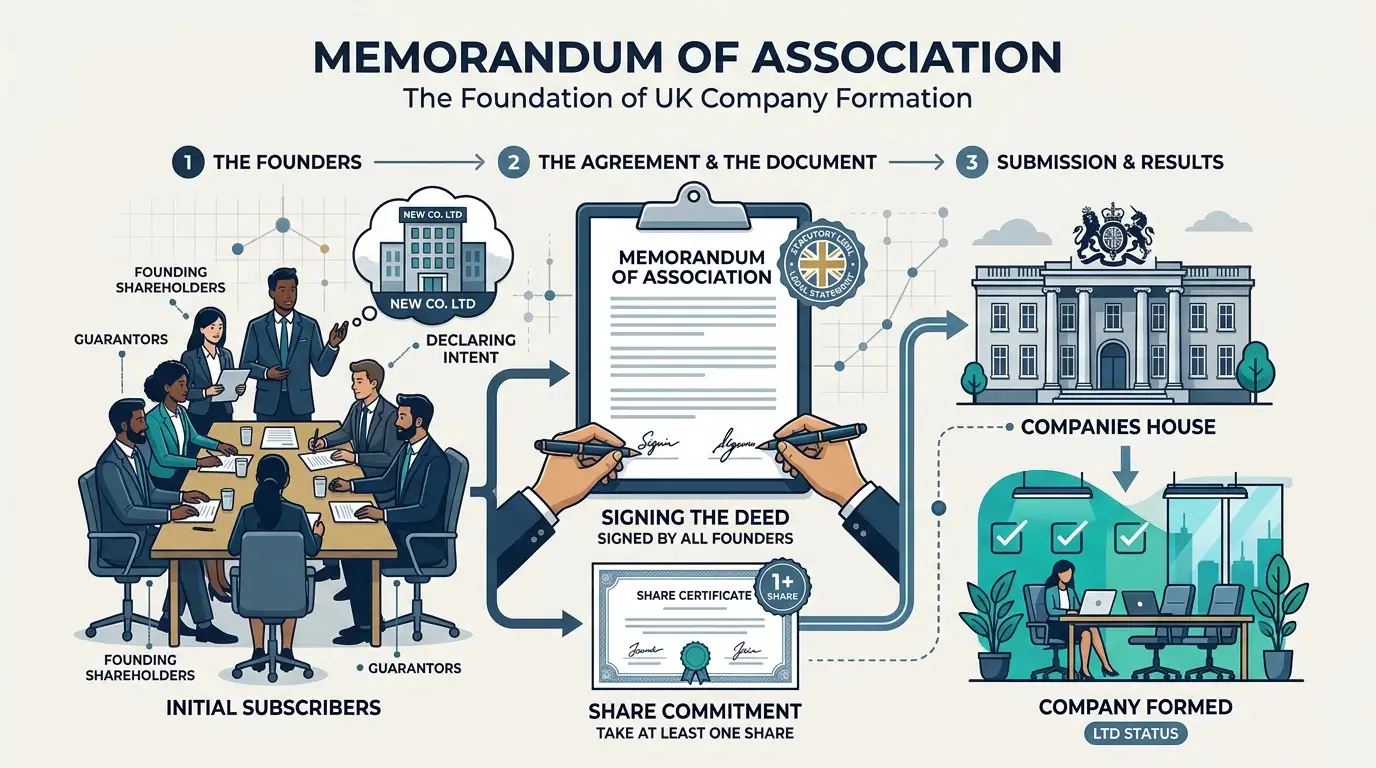
The Memorandum of Association serves as the historical record of the initial formation agreement between business founders under the Companies Act 2006. Once submitted to Companies House during the registration process, the document cannot be amended or altered during the lifespan of the company. It establishes the permanent foundational commitment of the original subscribers to create a legal entity.
This document contains key legal details, including subscriber names, digital or physical signatures, and confirmation of corporate intent. Regulatory bodies review this record to verify the identity of founding shareholders during legal disputes or corporate restructuring efforts. Financial auditors inspect the document to establish the original equity allocation established at the exact moment of incorporation.
What Are Articles of Association and How Do They Rule a Business?
Articles of Association are the written internal rules that govern the management, operational workflows, and administrative decision-making of a company. They define the legal duties, voting powers, share transfer mechanisms, and administrative responsibilities of appointed company directors.
The Articles of Association function as a binding legal contract between the company, its appointed directors, and its registered shareholders. Companies can adopt standard Model Articles provided by UK legislation or register custom articles tailored to specific operational requirements. This document sets clear operational boundaries regarding how board meetings operate, how dividend payments are declared, and how strategic decisions pass via shareholder resolutions.
Regulatory compliance requires companies to align every internal decision with the provisions set out in their registered articles. Courts and legal professionals evaluate these provisions during internal shareholder disputes, directorship conflicts, or external litigation scenarios. When corporate leadership decides to modify internal governance structures, the business must pass a special resolution and submit updated articles to Companies House within 15 days.
What Are Share Certificates and Who Issues Them?
Share Certificates are official legal documents issued by company directors to certify that a specific individual or entity legally owns a defined quantity of company shares. They detail shareholder names, share classes, nominal values, and total issued capital.
Share Certificates provide definitive evidence of equity ownership within a private limited company registered in the UK. Company directors issue these records immediately after incorporation or following subsequent share allotment, transfer, or structural reorganization events. Each individual certificate displays a unique reference number, the official company name, the registered business address, and the exact date of issue.
Prospective investors, commercial lenders, and acquisition partners scrutinize these ownership certificates during investment evaluations and corporate acquisitions. Shareholders must retain these documents securely to validate dividend entitlements, exercise voting rights at general meetings, and calculate capital gains tax liabilities upon share disposal. Corporate secretaries reference these certificates to maintain an accurate Register of Members in accordance with UK statutory compliance guidelines.
What Are Supplementary Company Documents and Why Do Businesses Need Them?
Supplementary company documents are official auxiliary certificates—such as Certificates of Good Standing, Certificates of Incumbency, and Apostilles—that provide additional corporate verification. Businesses require them to satisfy advanced international compliance, legal vetting, and banking due diligence standards.
While foundational incorporation records confirm basic legal registration, third-party institutions often request broader proof of operational legitimacy. International commercial partners, foreign banking institutions, and overseas government departments regularly request a verified supplementary company documents package to confirm that a company maintains active corporate status without facing liquidation proceedings. These supplementary records bridge the gap between basic statutory registration and complex cross-border compliance demands.
Legal teams utilize these additional verification documents when establishing overseas corporate branches, acquiring foreign commercial assets, or bidding for international public tenders. Financial institutions examine these papers to verify ultimate beneficial ownership (UBO) structures and combat international money laundering activities. Obtaining these auxiliary files prevents administrative delays during cross-border commercial transactions and high-value corporate negotiations.
How Do You Access and Secure Certified Formation Records?
Companies House provides access to digital formation records online, but legal and financial institutions usually require certified physical copies. Businesses can order certified physical documents directly from official registration agencies or request certified document packs for professional verification.
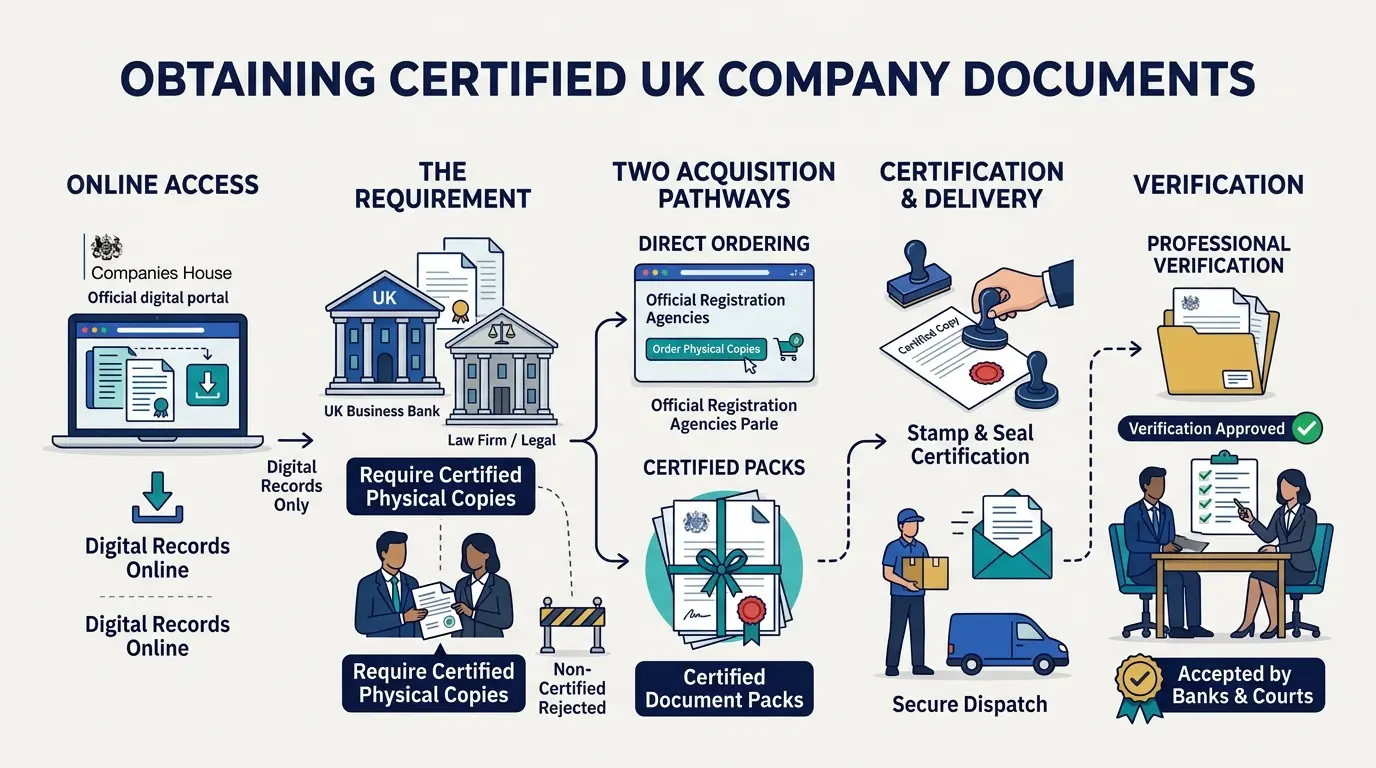
Modern corporate operations require rapid access to fully authenticated company paperwork to execute time-sensitive business deals. Electronic copies satisfy basic administrative requests, but corporate law firms, foreign registries, and overseas courts demand official physical certification. You can easily review the step-by-step process of how to get all formation documents certified in one bound pack to ensure every paper meets strict legal submission benchmarks.
A properly certified collection of corporate records includes official stamps, officer signatures, and formal legal verifications. Legal professionals examine certified records to ensure that corporate details match the primary entries held on the public register. Maintaining fully certified, bound physical documentation protects businesses against administrative rejections from risk-averse financial compliance departments.
Why Are Up-to-Date Formation Documents Essential for Compliance?
Up-to-date formation documents maintain a company’s legal standing, protect directors from statutory penalties, and prevent transactional rejections. Regular updates ensure that corporate filings align accurately with real-time operational structures registered at Companies House.
The legal framework governing UK corporations mandates strict adherence to transparency and statutory reporting obligations. Failure to maintain accurate corporate records can lead to administrative fines, corporate prosecution, or involuntary striking off from the official public register. Updating statutory filings following director appointments, registered office changes, or share transfers guarantees continuous legal protection for corporate leaders.
Financial institutions perform periodic anti-money laundering (AML) and know-your-customer (KYC) audits on existing business account holders. Outdated corporate paperwork triggers immediate compliance red flags, potentially freezing active business accounts and halting commercial payments. Maintaining fully accurate formation records simplifies annual confirmation statement filings, stream-lines tax submissions to HMRC, and builds long-term trust with commercial partners.
Commercial organizations looking to verify, update, or legally certify their official corporate filings can directly order certified company formation documents from Form My Company to ensure complete statutory compliance across all UK operations.
Company formation documents establish the legal foundation, ownership structure, and governance rules for every UK business entity. The Certificate of Incorporation, Memorandum of Association, Articles of Association, and Share Certificates serve distinct statutory functions required for banking, taxation, and legal operations. Maintaining accurate, verified, and certified copies of these vital records ensures seamless corporate compliance and operational transparency. Form My Company assists businesses in obtaining, verifying, and certifying essential corporate documentation to support ongoing growth and legal security.
Explore More Supplementary Company Documents Guide,
What Do Investors Look for in Your Articles of Association?
What Are the Share Transfer Rules in Articles of Association?
Frequently Asked Questions
What are supplementary company documents for a UK limited company?
Supplementary company documents are official legal certificates and corporate records—such as Certificates of Good Standing, Certificates of Incumbency, and formal company resolutions—that support a business’s primary incorporation filings. These records provide verified, up-to-date proof of operational legitimacy, management structures, and statutory compliance under UK law. Form My Company supplies these additional certificates to ensure businesses meet strict administrative and compliance standards.
Why do banks and lenders request supplementary company documents?
Financial institutions require supplementary company documents to complete enhanced Know Your Customer (KYC) checks and confirm ultimate beneficial ownership (UBO) structures. Official files like certified board minutes, updated share registers, and Certificates of Good Standing verify that the company is actively trading without facing insolvency proceedings. Form My Company assists business owners in obtaining professionally verified document packs to prevent onboarding rejections and processing delays.
How do I order supplementary company documents through Form My Company?
You can request certified files directly online through the Form My Company Supplementary Company Documents service page. Select the required official documents—such as duplicate certificates, bound registers, or customized board resolutions—and provide your corporate details for automated validation. Form My Company then retrieves, verifies, and dispatches legally compliant digital or physical records tailored to your company’s needs.
What is the difference between statutory formation documents and supplementary company documents?
Statutory formation documents—including the Certificate of Incorporation, Memorandum of Association, and Articles of Association—establish the initial legal identity and constitutional rules of a business. Supplementary company documents are secondary extracts and formal records produced throughout the corporate lifecycle to reflect ongoing structural updates, officer changes, and active standing. Form My Company provides both core filing support and supplementary documentation to ensure full regulatory compliance.
Are supplementary company documents legally required for international business operations?
Overseas registries, foreign financial bodies, and international vendors frequently mandate certified supplementary records alongside official Apostille stamps before authorizing cross-border activities. Documents such as a Certificate of Good Standing validate that a UK company is properly registered and fully compliant with national filing requirements. Utilizing the Supplementary Company Documents offering from Form My Company ensures every record meets international legal authentication criteria.