
UK certified copies of company records do not have a statutory expiration date, but third parties like UK banks, lenders, and foreign authorities typically require fresh certified copies issued within the past three to six months to satisfy strict AML and KYC compliance regulations.
Why Do Banks and Regulators Require Fresh Certified Company Records?
Financial institutions and regulatory authorities demand fresh certified company records to verify that a business remains active, financially solvent, and compliant with current UK corporate governance standards while preventing fraud during corporate transactions and mandatory identity verification checks.
Corporate records change frequently during standard business operations. UK banks, financial lenders, and regulatory authorities must verify current corporate standing before approving financial transactions, opening merchant accounts, or granting operational licences. Corporate officers update official filings regularly at Companies House. Old documents fail to reflect recent director resignations, share allocation changes, or registered office updates. Regulators enforce anti-money laundering (AML) and know-your-customer (KYC) frameworks. These legal frameworks mandate that institutions verify live data rather than historic records.
Financial institutions risk severe regulatory penalties when they rely on outdated corporate documentation. Compliance officers reject documentation that exceeds strict internal age thresholds. Most UK banks enforce a firm policy requiring certified copies issued within ninety days. Foreign authorities often accept documents certified within six months when legalised via apostille. Obtaining fresh copies guarantees that third-party legal departments receive up-to-date corporate information. This proactive documentation strategy prevents account freezes, delays in commercial financing, and rejected corporate applications.
How Often Should Your Business Renew Certified Company Documents?
Businesses should renew certified company documents every three to six months for routine commercial operations, or immediately following any official corporate changes, such as appointing new directors, altering share structures, or updating registered office addresses.
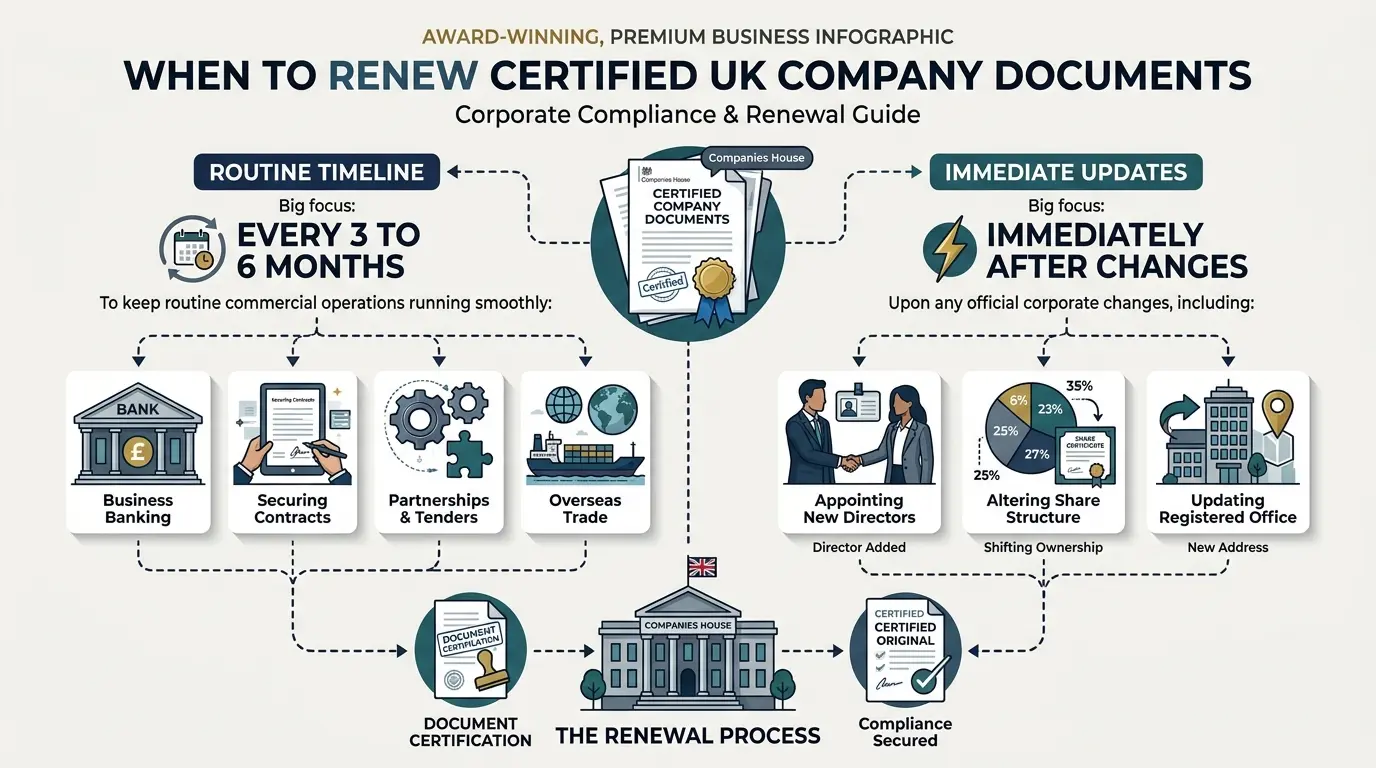
Commercial renewal schedules depend directly on your operational activities and regulatory environment. Routine commercial activities require periodic document updates to ensure uninterrupted legal standing. Maintaining a proactive renewal cycle prevents emergency delays during crucial corporate transactions.
Three primary triggers dictate your document renewal schedule:
Update documentation quarterly to satisfy ongoing bank compliance reviews
Certify new records immediately after submitting official filings to Companies House
Request fresh legalised copies six weeks before entering foreign jurisdiction contracts
When corporate structures remain stable, a bi-annual renewal cycle satisfies most standard commercial requirements. Holding recent certified copies enables fast responses to vendor due diligence requests. High-growth companies that alter share capital or board structures must renew records immediately after Companies House updates the public register. Submitting outdated records that contradict public filings creates immediate compliance red flags. Proactive management of your certified documentation protects operational momentum and maintains institutional trust.
What Factors Determine the Validity Period of Certified Company Records?
The specific requesting organization, the type of corporate document, and the jurisdiction where you present the records determine the operational validity period of certified UK company documentation.
No single UK statute establishes a universal expiration date for certified corporate filings. Instead, external institutional rules govern document acceptance periods. Understanding these external variables allows directors to order necessary records with precise timing.
Three main operational factors dictate document acceptance windows:
Requesting party requirements, with UK high-street banks enforcing strict ninety-day limits
Overseas legal regulations, with international authorities allowing up to six months
Specific document types, with legal standing certificates requiring more frequent updates than static incorporation certificates
Overseas governments and foreign courts often apply broader acceptance windows than domestic financial institutions. International registries frequently accept certified documents produced within six months, provided an apostille certificate accompanies them. Conversely, UK commercial lenders maintain rigid three-month cutoffs. The nature of the legal document also influences acceptance. A Certificate of Good Standing reflects real-time compliance status, making older versions obsolete quickly. Articles of Association remain valid longer if company bylaws remain unchanged. Aligning your ordering schedule with specific end-user requirements prevents unnecessary processing expenses.
How Does the Certification Process Work for UK Company Documents?
The document certification process involves extracting official corporate records directly from Companies House and having an authorised UK solicitor or notary public verify, sign, and date the copies to confirm their authenticity.
Official certification converts standard corporate record prints into legally binding documentation. The process begins by retrieving official documents directly from the UK Registrar of Companies. Third-party institutions reject self-printed filings that lack formal legal validation signatures.
Three sequential steps complete the document certification workflow:
Extract official corporate filings directly from the Companies House register
Validate document accuracy against official public registers using qualified solicitors
Affix official signatures, professional seals, and regulatory registration numbers to verified physical copies
Authorised certifying officers include practicing UK solicitors, public notaries, and chartered accountants. The certifying professional reviews the physical record against official government registers. They apply an official stamp stating that the copy represents a true and accurate duplicate of the original document. The professional adds their full legal name, practicing certificate number, formal signature, and date of certification. When foreign entities request documentation, an apostille seal from the Foreign, Commonwealth & Development Office (FCDO) provides secondary legal authentication. This structured authentication workflow establishes total legal credibility for international commercial use.
What Are the Risks of Submitting Outdated Certified Company Records?
Submitting outdated certified records causes immediate commercial transaction rejections, delays corporate bank account openings, triggers intensive compliance audits, and risks contract invalidation during international cross-border deals.
Using outdated documentation creates severe operational friction for active businesses. Compliance departments reject stale filings automatically without reviewing transaction details. These initial rejections stall commercial progress and create negative impressions among potential partners.
Three major operational risks stem from outdated document submissions:
Commercial banking delays that freeze incoming international payment processing
Stalled corporate transactions during mandatory legal due diligence reviews
Increased compliance costs resulting from urgent rush-order processing requests
When a bank rejects outdated records, resolving the compliance failure usually takes several weeks. During this delay, financial institutions may temporarily restrict business accounts. Overseas contract negotiations frequently collapse when document verification processes stall. Submitting outdated records can also trigger formal corporate audits by potential investors. Investors view outdated paperwork as evidence of weak internal governance controls. Ensuring all corporate records remain current eliminates unnecessary operational disruptions and preserves valuable business partnerships.
How Can Companies Maintain Compliance with Certified Records?
Companies maintain complete compliance by establishing an internal documentation schedule, conducting quarterly record audits, monitoring Companies House filing dates, and partnering with professional document retrieval services.
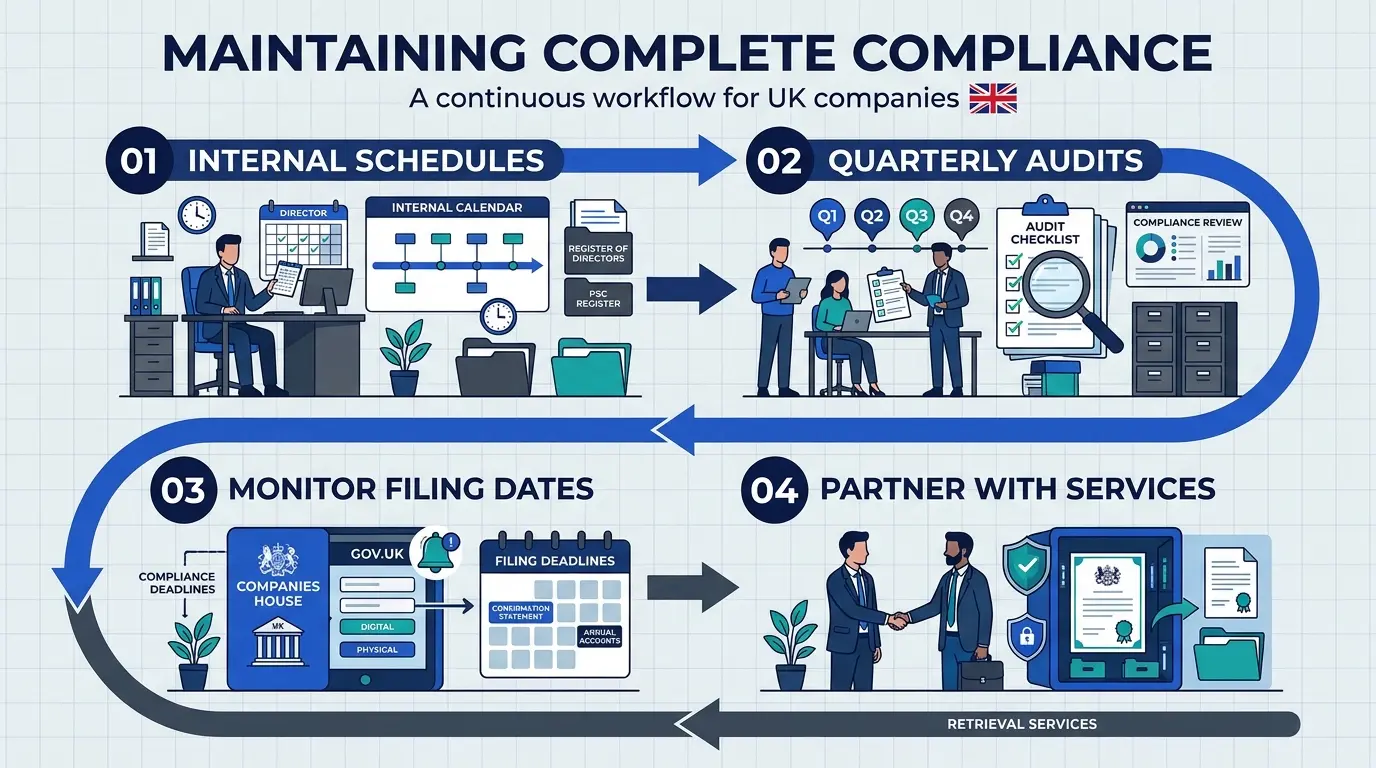
Systematic corporate record management prevents unexpected compliance failures. Businesses must track both public filing schedules and document certification dates. Assigning internal responsibility for record maintenance ensures documentation remains ready for immediate commercial presentation.
Three operational practices ensure seamless document compliance:
Audit corporate records quarterly to identify aging bank-facing documentation
File statutory confirmation statements promptly to maintain clear public standing
Partner with professional business services to automate document certification schedules
Maintaining continuous compliance requires tracking public register changes alongside certified copy issuance dates. Whenever shareholders execute corporate restructuring, corporate officers must update physical record portfolios immediately. Maintaining digital scans of valid certified copies allows rapid preliminary reviews while physical documents transit via courier. Utilizing external professional services streamlines official document procurement from Companies House. Establishing a structured schedule for Supplementary Company Documents simplifies ongoing corporate maintenance and ensures immediate readiness for sudden commercial opportunities.
How Do You Rapidly Order Updated Certified Company Records?
Companies can rapidly order updated certified records by requesting official digital or physical filings directly through Companies House or utilizing specialized legal document providers for fast-track processing and certification.
When urgent commercial opportunities arise, speed of procurement becomes vital. Business directors must obtain updated records quickly to satisfy tight transaction deadlines. Knowing how to fast-track document orders prevents costly commercial delays.
Three efficient methods secure fresh certified documentation:
Submit expedited digital search requests through official Companies House portals
Engage dedicated corporate document services to manage legal certification and notary stamps
Request combined apostille and legalisation services for international commercial compliance
Standard government processing times vary depending on registry workloads. Utilizing specialized corporate filing services ensures immediate document extraction and legal verification. Professional services coordinate directly with qualified UK solicitors to obtain fast turnaround times. They ensure certified copies match exact third-party formatting standards on initial delivery. Company managers can evaluate Do Certified Company Documents Expire or Go Out of Date? to better understand continuous legal validity rules. When preparing for major expansion projects, business owners choose to Renew Your Certified Company Documents With Form My Company to guarantee total compliance with banking and legal requirements. Efficient corporate record procurement maintains administrative continuity and supports sustainable business growth.
Explore More Supplementary Company Documents Guide,
How to Make Sure Your Certified Copies Are Accepted First Time
How to Speed Up Certification When a Deadline Is Close
Frequently Asked Questions
What are supplementary company documents in the UK?
Supplementary company documents are official legal filings beyond standard incorporation certificates, including Certificates of Good Standing, Articles of Association, and official corporate registers. Form My Company retrieves and certifies these supplementary company documents directly from Companies House to verify business standing and legal compliance for third-party institutions.
Why do banks require certified supplementary company documents?
Financial institutions require certified supplementary company documents to satisfy strict Anti-Money Laundering (AML) and Know Your Customer (KYC) compliance checks. Obtaining freshly certified records through Form My Company provides banks with official proof of current directors, active corporate status, and verified shareholding structures.
How do I obtain official certified copies of company records?
You can request certified copies of corporate records directly from Companies House or through a corporate service provider. Form My Company manages the full retrieval process for supplementary company documents, securing official solicitor certification or notary validation to ensure immediate third-party acceptance.
Do certified supplementary company documents expire?
Certified supplementary company documents do not have a statutory expiration date under UK law, but third parties like commercial lenders and overseas authorities usually require copies issued within ninety days. Requesting updated supplementary company documents via Form My Company ensures compliance with strict institutional recency guidelines.
What is the turnaround time to get certified supplementary company documents?
Standard processing for official document retrieval and legal certification typically takes three to five business days, though expedited options are available for urgent corporate transactions. Form My Company offers fast-track retrieval for supplementary company documents to help businesses meet tight commercial and banking deadlines.