
The simplest structure is not automatically the right one. How to legally structure a new business in the UK depends on how you want ownership, liability and tax responsibilities to work. A sole trader is personally responsible for business debts, while a limited company is legally separate from its owners, whose responsibility for debts is generally limited to their investment. Partnerships and limited liability partnerships offer other ways to share ownership and responsibilities.
It is understandable to focus on getting started quickly, but your structure can affect your personal financial risk, how profits are taxed and the administration you need to manage. The right choice depends on your circumstances and business plans.
This comparison explains the main UK structures, when each is typically used, and how their liability and tax responsibilities differ. You will also find a practical decision guide to help identify which options best suit your new business.
Key Takeaways
- Compare sole trader, partnership, LLP and limited company structures by personal liability, ownership and administration before choosing.
- An LLP can suit businesses with multiple members who want limited liability, but it comes with formal registration and reporting responsibilities.
- In a general partnership, partners share profits and each pays tax on their share; agree how decisions and responsibilities will be handled.
- According to HM Revenue & Customs, a sole trader must register for Self Assessment if they earn more than £1,000 in a tax year, which runs from 6 April to 5 April.
- Make your choice with your plans for ownership, funding and future growth in mind, not just the needs of the launch.
What are the main UK business structures and when is each typically used?
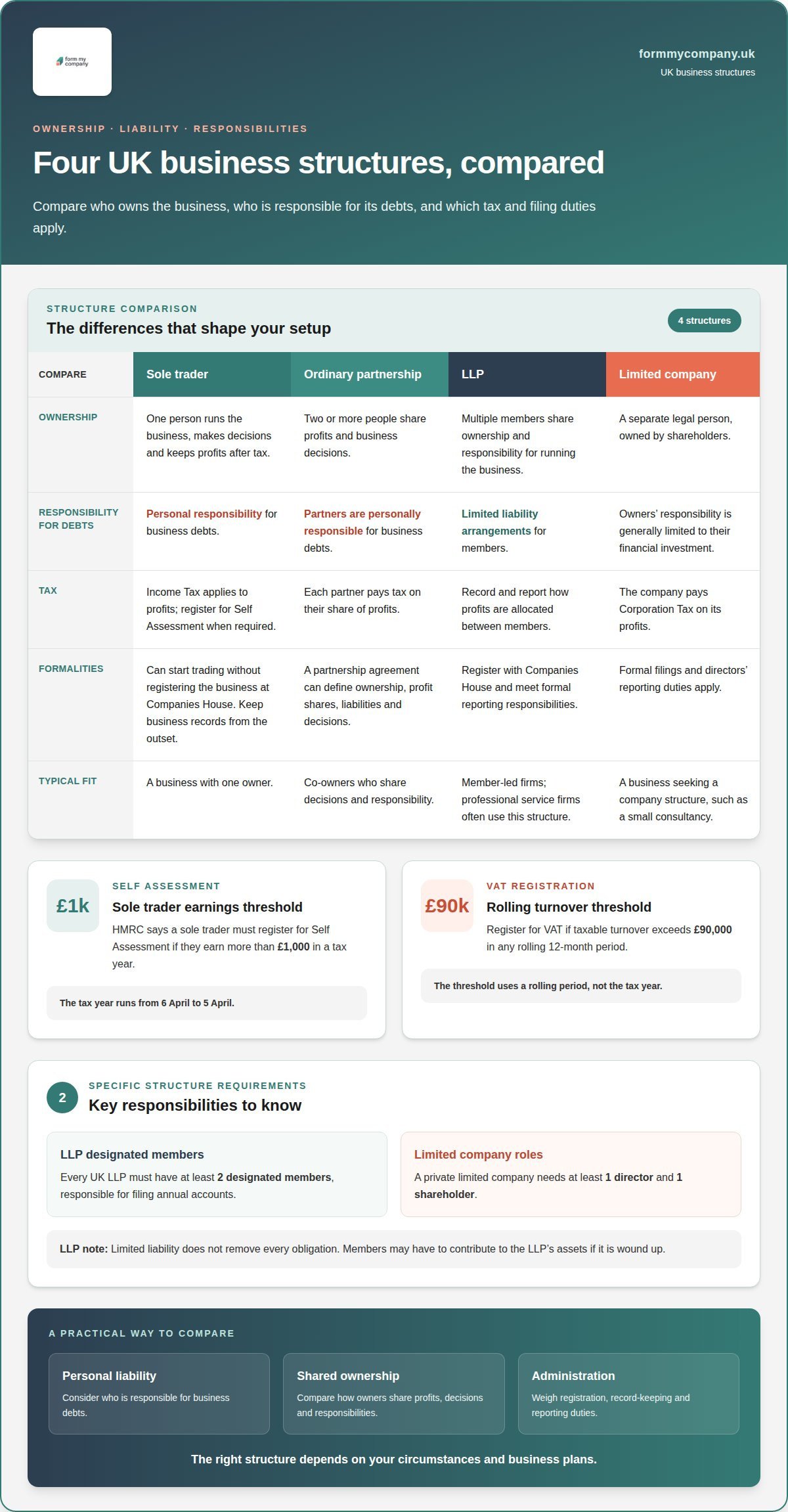
Compare who owns the business, who is responsible for its debts, and which tax and filing duties apply. These differences help narrow down the structure that fits your plans.
Sole trader structure
A sole trader runs the business personally, makes its decisions and keeps its profits after tax. Unlike a limited company, there is no separate legal identity protecting the owner from business debts. You can start trading without registering, but must keep business records from the outset. Register for Self Assessment with HMRC when required; Income Tax applies to profits.
Ordinary partnership structure
An ordinary partnership is owned by two or more people who share profits and responsibility for business decisions. Unlike a sole trader, each partner has a role in running the business. Unlike a limited company, partners are personally responsible for business debts. A partnership agreement can set out ownership, profit shares, liabilities and how decisions are made.
Limited liability partnership structure
An LLP combines multiple members with limited liability and formal reporting responsibilities similar to those of a limited company. It must register with Companies House, and its members share responsibility for running the business. Professional service firms often use this structure. Unlike an ordinary partnership, an LLP offers limited liability arrangements while retaining a membership-based structure rather than company shareholders.
Limited company structure
A private limited company is a separate legal person from its owners. Their responsibility for business debts is generally limited to their financial investment. For example, a small consultancy may register as a private limited company before trading. It needs at least one director and one shareholder. Directors may be employees or office holders and must meet the company’s reporting duties.
The core structures and Companies House framework apply across England, Scotland, Wales and Northern Ireland. The registration route depends on the structure: limited companies and LLPs register with Companies House, while sole traders can begin trading without registering their business there.
According to HM Revenue & Customs, a business must register for VAT if its taxable turnover exceeds £90,000 in any rolling 12-month period. The threshold is based on that rolling period, not the tax year; register when the requirement applies.
| Structure | Liability | Tax and administration | Typical fit |
|---|---|---|---|
| Sole trader | Personal responsibility for debts | Income tax; Self Assessment | One owner |
| Ordinary partnership | Partners personally responsible | Each partner pays tax on their share | Co-owners sharing decisions |
| LLP | Limited liability arrangements | Companies House registration and reporting | Member-led firms |
| Limited company | Separate legal identity; owners’ liability generally limited | Company tax and formal filings | Businesses seeking a company structure |
Choose by weighing personal liability, shared ownership and the administration you are prepared to manage.
Limited liability partnerships
An LLP suits a business with multiple members who want limited liability and shared management. It combines partnership-style ownership with formal registration and reporting responsibilities.
LLP liability and shared responsibilities
Members share responsibility for running the LLP, but its liability arrangements differ from an ordinary partnership, where partners are personally responsible for business debts. Limited liability does not remove every obligation: Section 1(4) of the Limited Liability Partnerships Act 2000 sets out members’ liability to contribute to an LLP’s assets if it is wound up.
Every UK LLP must register at Companies House and have at least 2 designated members responsible for filing annual accounts. Those designated members have specific duties, including acting for the business if it is wound up and dissolved. Agreeing who handles filings and key decisions helps members understand their responsibilities from the start.
Tax, records and fundraising
An LLP’s reporting and liability arrangements are similar to those of a limited company, but its members share ownership rather than holding company shares. Professional service firms often use this structure. For example, a consultancy’s members can agree how to divide profits and manage decisions, then keep records to support the LLP’s accounts and their own financial reporting.
Tax responsibilities depend on the business structure. In an ordinary partnership, each partner pays tax on their share of profits; a limited company pays Corporation Tax on its profits. For an LLP, plan how members’ profit shares will be recorded and reported. Keep the agreement and financial records aligned so each member can see how the business calculated their allocation.
Fundraising also depends on how ownership is organised. A limited company can have shareholders, whereas an LLP is organised around its members. If an LLP plans to bring in an investor, members need to agree how that person’s role, contribution and share of profits fit the existing arrangement. These decisions can affect control as well as financial returns.
Before registering, discuss the practical terms with the other members. Set out each person’s contribution, decision-making role, profit allocation and filing responsibilities. A written agreement gives members a shared reference point if someone wants to leave or the business changes direction. It also distinguishes members’ internal responsibilities from the LLP’s formal filing duties.
If you’ve chosen an LLP, explore formation package options as a practical next step for registering the structure.
Partnerships and other business structures
Partnerships let co-owners run a business together, but liability and tax arrangements depend on the structure they choose. Compare how decisions, responsibilities and a partner’s departure could affect the business.
General partnership risks and tax
A general partnership is owned by two or more people, and partners are personally responsible for business debts. This differs from an LLP, which has limited liability arrangements, and from a limited company, which is legally separate from its owners. Around 6% of UK businesses are partnerships, but this structure’s shared ownership does not separate personal finances from business liabilities.
Each partner must register for Self Assessment and submit a tax return to HMRC every year. Partners pay income tax on their share of profits, alongside Class 2 and Class 4 National Insurance. For example, two partners sharing profits must each report their own share, rather than treating the partnership as a limited company paying Corporation Tax.
A partner leaving can affect continuity directly: a UK general partnership is dissolved if one of its partners leaves. Exit arrangements are therefore particularly important for co-owners who expect the business to continue through changes in membership. Put a clear process in writing so owners understand how a departure affects the partnership and its decisions.
Partnership agreements and LLP arrangements
A partnership agreement can set out each partner’s liabilities, ownership, profit shares and what happens if someone leaves. It can also explain how partners make business decisions together. For example, partners can agree how to handle a disagreement about spending before it arises, giving them a shared reference point for running the business.
An ordinary partnership and an LLP both allow multiple owners to share a business, but their liability and reporting arrangements differ. In an ordinary partnership, partners are personally responsible for business debts. An LLP must register with Companies House and has reporting arrangements similar to a limited company. Professional service firms often use LLPs when they want members to run the business together under this structure.
Another distinction is legal identity. A Scottish limited partnership is considered a legal entity separate from each partner. Do not assume this applies to every partnership arrangement: an ordinary partnership and an LLP have different legal and reporting features. Identify the intended structure before setting up, especially if the owners operate across the UK or plan to change membership.
A social enterprise describes a business with a social, community or environmental mission, not a legal business structure. Its founders still need to choose a structure for ownership, liability and tax. A partnership agreement or LLP membership arrangement sets out how owners work together; the mission explains the business’s purpose. Keep these decisions separate when planning the organisation.
Sole trader examples and self-assessment responsibilities
A sole trader runs a business personally, keeps its profits after tax and manages its records. Self Assessment is the key tax reporting route for this structure.
Sole trader profits and tax
A freelance designer, for example, can trade as a sole trader without creating a separate legal entity. The owner makes the business decisions and keeps profits after paying tax, but is personally responsible for business debts. This differs from a limited liability partnership, where members have limited liability arrangements.
Sole traders do not pay Corporation Tax. Instead, they may pay Income Tax on business profits through Self Assessment, alongside National Insurance according to the profits they generate. Keep business records from the start of trading, including information supporting income and expenses. These records help establish the figures used to report profits.
Separate business and personal transactions in your records where practical. For example, a self-employed photographer can record client payments and business purchases, then use those records to calculate the business’s profit. The sole trader remains responsible for the business rather than drawing a salary from a separate company.
Self Assessment and HMRC registration
According to HM Revenue & Customs, a sole trader must register for Self Assessment if they earn more than £1,000 in a tax year, which runs from 6 April to 5 April. A sole trader can also register before registration is required. Keep the tax-year dates in mind when organising business income and records.
A sole trader submits a Self Assessment tax return to HMRC each year and pays Income Tax on taxable profits. The return reports the business figures for the relevant tax year. Use your records to calculate income and allowable business expenses accurately, rather than relying on memory or estimates.
Self Assessment also covers National Insurance responsibilities. Sole traders pay income tax and National Insurance according to the profit they generate, including Class 2 and Class 4 National Insurance. The amount due depends on the profits reported and the applicable thresholds. Keep the calculation and supporting records together with your tax documents.
A clear routine makes reporting easier: record each sale and business expense, organise receipts, then use those records to prepare your tax return. If your business grows or you bring in co-owners, reassess whether sole trader status still fits. Moving to a limited company changes the legal structure and filing responsibilities, so consider ownership, liability and administration before making the change.
Choosing a legal business structure
Choosing how to legally structure a new business in the UK starts with comparing personal risk, ownership, tax and filing duties. Map your funding and ownership plans for the next 12-24 months against those needs. Then choose a structure, record co-owner terms in an agreement, and complete the relevant registration and tax steps.
A business plan helps turn that choice into a practical decision. Include financial projections for revenue, expenses and profitability, then consider how each structure supports those plans. For example, a founder expecting new owners may prioritise a structure that accommodates shared ownership. A founder working alone may place greater weight on decision-making control and administrative responsibilities.
Assess personal liability alongside how the business will operate. A sole trader remains personally responsible for business debts, while a limited company is legally separate from its owners. An LLP has its own reporting and liability arrangements. Compare the implications for your circumstances rather than choosing solely because one structure seems simpler to set up.
Tax is another practical factor. Sole traders pay Income Tax on business profits through Self Assessment, while limited companies pay Corporation Tax on their profits. In the current Corporation Tax system, HM Revenue & Customs sets the main rate at 25% and the small-profits rate at 19%. The structure affects how profits are reported and how owners take money from the business.
Use these steps to organise the decision:
- List the owners. Record who will contribute, make decisions and hold an interest in the business.
- Set out the risks. Consider the debts and obligations the business could take on, and how personal liability differs by structure.
- Plan funding. Identify likely funding sources and ownership changes over the next 12-24 months.
- Compare administration. Weigh Self Assessment against company reporting and registration duties.
- Register the chosen structure. A limited company must register with Companies House before trading; a sole trader can start trading without registering the business there.
Match the structure to the purpose, too. A company limited by guarantee needs at least one guarantor, making it distinct from a company with shareholders. A social enterprise describes a social, community or environmental mission, not a legal structure. Identify which legal form supports the mission and planned ownership before deciding how to register.
Plan for future changes, too. Moving from sole trader to limited company is usually easier than changing in the opposite direction. Sole traders and limited companies can both employ staff, so hiring alone does not determine the structure. Instead, weigh liability, tax, ownership and filing duties when deciding how to legally structure a new business in the UK.
If you’ve selected a company structure, explore company formation package options as a next step towards registration.
Form My Company: Limited Liability Partnership (LLP) Formation
Form My Company offers Limited Liability Partnership (LLP) Formation for founders who have chosen an LLP and are ready to register. This is a practical next step after agreeing how members will share ownership, decisions and responsibilities.
If you are still comparing company formation options, Form My Company also offers the Digital Package, Digital & Print Package and Entrepreneurs Choice Package. Choose the route that matches the structure you have selected rather than treating an LLP and a limited company as interchangeable. An LLP has members, not shareholders, and its own registration and reporting responsibilities.
Once you have settled on an LLP, contact Form My Company to discuss formation.
Take your next step with confidence
Your business structure should support how you intend to own, fund and run the venture, not just get it through its first stage. Before acting, make sure the founders agree on responsibilities and that the chosen structure fits the business plan. These decisions provide a clearer foundation for putting your plans into practice.
If you are deciding how to legally structure a new business in the UK, Form My Company offers the Digital Package, Digital & Print Package and Entrepreneurs Choice Package. These formation options help entrepreneurs move from choosing a structure to setting up their business.
Use your chosen structure as the starting point for organising the next steps. Contact Form My Company to discuss your formation and move your new business forward with confidence.
Frequently Asked Questions
Can you change later, and what does it involve?
Yes, you can change your business structure, but the process involves more than updating a name. For example, moving from sole trader status to a limited company means setting up a separate legal entity and organising how the existing business will operate under it. Review contracts, assets, records, banking arrangements and tax reporting. Moving from sole trader to a limited company is usually easier than making the reverse change.
Do I need to register my business with HMRC?
It depends on your structure and tax responsibilities. A sole trader must register for Self Assessment if they earn more than £1,000 in a tax year, according to HM Revenue & Customs; the tax year runs from 6 April to 5 April. You can register earlier. A company has Companies House incorporation and separate HMRC tax responsibilities. VAT registration is a separate matter, linked to taxable turnover.
How do liability and personal risk differ by structure?
Personal risk is greatest where the owner or partners are personally responsible for business debts. A limited company is legally separate from its owners, and an LLP has limited liability arrangements. To assess the practical exposure, consider the commitments your business expects to take on, who will make decisions and whether more than one person shares responsibility. The structure affects how business liability relates to owners, but does not remove ordinary business risks.
Ownership, control and bringing others in: what changes with a company or LLP?
A company divides ownership through shares, while an LLP is organised around members. In a UK private limited company, ordinary shares give shareholders one vote per share. Share allocation therefore matters for control as well as ownership. An LLP’s members instead need clear arrangements for roles, decisions and profit shares. Before adding an owner or member, agree how their contribution and influence will fit the existing structure.
What do you need to consider when setting up a business?
Consider your customers, likely costs, expected revenue and how you will divide ownership before choosing a structure. Research your target market and competition, then identify any licences or permits relevant to your activity. If you plan to hire, account for employment responsibilities. If you collect customer information, plan how to handle it lawfully and securely. These practical requirements sit alongside decisions about liability, tax treatment and administration.
What is the process a new business must go through in the UK?
Start by defining the business activity, owners and planned structure. Prepare a business plan and decide how profits, responsibilities and decisions will be handled. Register a limited company or LLP with Companies House before trading; a sole trader can begin trading without registering there. Then organise the relevant HMRC tax registrations, keep business records and address any activity-specific licences, permits or certificates. The exact steps depend on the structure and business activity.
What legal business structures are available in the UK, and how do they compare?
Common choices include sole trader, ordinary partnership, limited liability partnership and limited company. A sole trader owns and runs the business personally; partnerships share ownership, while an LLP combines members with limited liability arrangements. A limited company is separate from its owners. Other forms include a public limited company and a company limited by guarantee. Compare each by ownership, personal liability, tax responsibilities and filing requirements.
What are the differences between a sole trader, limited company, and business partnership in the UK?
A sole trader operates as an individual, while a partnership has two or more owners who share profits and decisions. A limited company is a separate legal entity with shareholders and directors. For example, a founder working alone may value direct control, whereas co-founders may need agreed decision-making arrangements. A company’s shares can define ownership and voting rights. Compare these differences with the records and reporting duties you are prepared to manage.