Online marketplaces ask UK sellers for official company registration documents, proof of business address, director identity verification, and banking documentation. Providing valid official records ensures compliance with UK anti-money laundering regulations and prevents immediate seller account suspension.
Why Do Online Marketplaces Require Seller Verification Documents?
Online marketplaces require seller verification documents to comply with statutory UK anti-money laundering laws and Know Your Customer rules. These regulatory frameworks protect buyers, prevent financial fraud, and ensure all trading entities exist as legally registered UK corporate structures.
UK financial regulations require online platforms like Amazon, eBay, and Etsy to verify corporate identities. Platform compliance teams review official corporate registers to confirm company existence. They check Companies House filings to authenticate company numbers and registered office details. Failure to provide accurate records triggers immediate onboarding delays or permanent account rejection.
Marketplace compliance algorithms automatically flag mismatched account data during registration. Platforms validate company directors against sanction databases and national registries. Verifying corporate credentials prevents identity theft and unauthorized merchant operations. Compliance systems protect consumer confidence by maintaining traceable records of all active corporate sellers across UK digital sales channels.
Which Company Registration Records Do UK Marketplaces Demand?
UK marketplaces demand official Companies House documents including the Certificate of Incorporation, Memorandum and Articles of Association, and confirmation statements. These filings validate legal business incorporation, shareholder allocation, official company address details, and current active corporate standing in the United Kingdom.
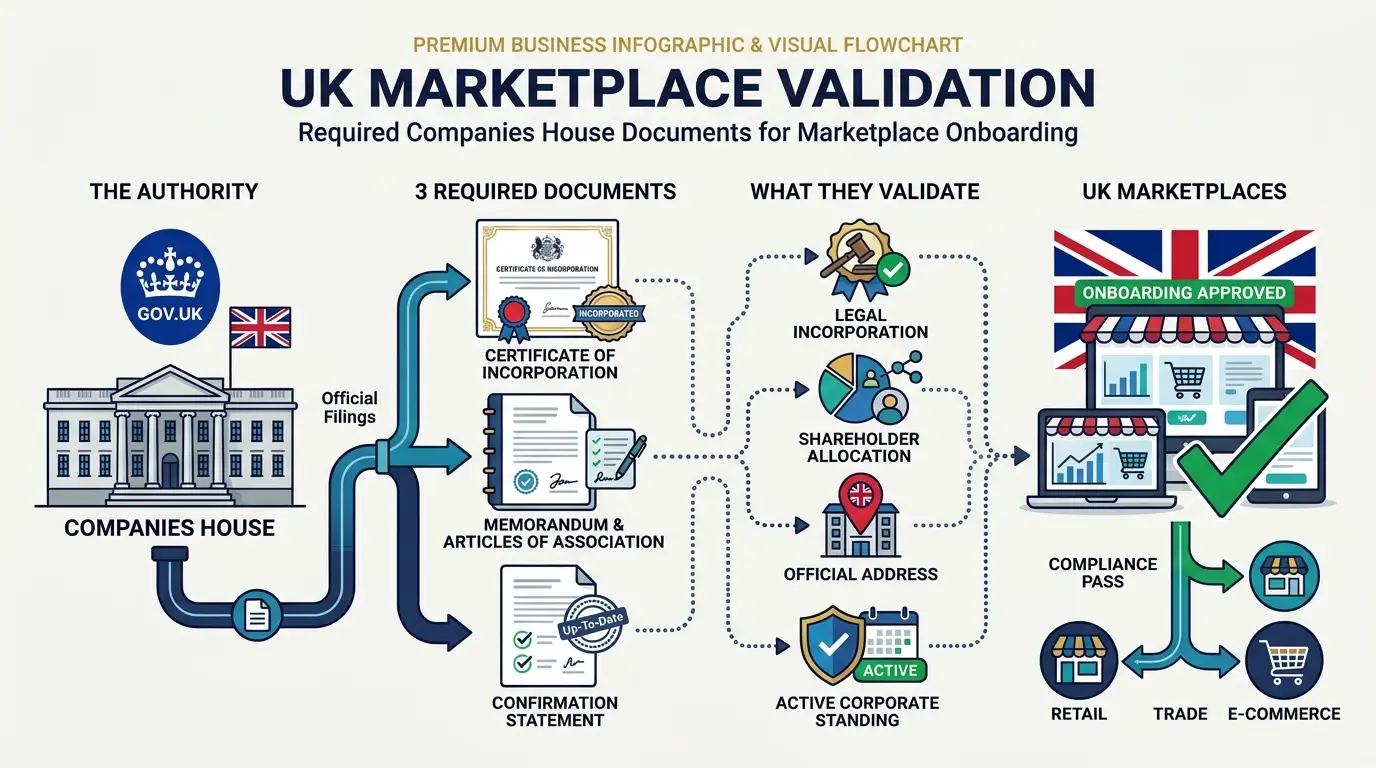
The Certificate of Incorporation serves as legal proof of company formation in the UK. Marketplaces inspect this file to verify the official corporate name and unique company registration number. Registration numbers must match Companies House database entries exactly. Spelling variations or incorrect legal suffixes like “Limited” cause instant automated registration rejections.
Platforms require the Memorandum and Articles of Association to review internal governance structures. Verification officers inspect ownership percentages to identify ultimate beneficial owners holding 25% or more voting rights. Submitting updated confirmation statements proves your business maintains active status and meets annual statutory reporting obligations. Companies seeking seamless platform onboarding often acquire supplementary company documents to verify legal standing during registration audits.
What Proof of Address Is Accepted for UK Marketplace Accounts?
UK marketplaces accept bank statements, utility bills, and government tax correspondence issued within the last 90 days as valid proof of address. The corporate name and physical address printed on these documents must match registered Companies House records identically.
Address validation requires clear copies of official paper or downloadable PDF statements. Accepted utility documents include council tax bills, electricity invoices, landline phone statements, and water services accounts. Mobile phone bills and informal invoices are rejected by platform verification systems. Every document must show the complete official address including street numbers, building names, and postcodes.
Financial statements issued by regulated UK banks serve as reliable proof of corporate operating addresses. HMRC tax letters, VAT registration certificates, and business rate demands provide valid proof of physical location. Discrepancies between billing addresses, operational headquarters, and registered offices delay verification timelines. Maintaining uniform address records across all public registries expedites merchant account approval across UK digital sales channels.
How Do Platforms Validate Director and Shareholder Identity?
Platforms validate director and shareholder identity using government-issued photo identification, proof of residential address, and biometric face matching. Verification officers cross-reference these submissions with official UK Companies House director registries to confirm operational control.
Every individual who owns or controls 25% or more of the company must submit primary identity documentation. Platforms accept valid passports, photocard driving licences, and national identity cards. Scanned identity documents must display clear images, full legal names, signatures, and unexpired validity dates. Platform algorithms compare uploaded identity documents against automated database records.
Verification teams verify residential addresses using personal bank statements or utility bills. Directors must ensure personal identification matches official entries listed on Companies House filing forms. Differences in middle names or former legal surnames require supplementary legal documentation like marriage certificates. Sellers seeking detailed guidance on navigating complex verification checks can learn how to pass online marketplace seller verification as a UK company before initiating registration applications.
What Banking and Tax Information Must UK Sellers Provide?
UK sellers must provide a UK business bank statement, a valid VAT registration certificate, and a Unique Taxpayer Reference number. Bank accounts must be registered in the exact legal company name to facilitate payout processing and statutory identity cross-matching.
Marketplaces process disbursements exclusively to verified commercial bank accounts established within supported jurisdictions. Submitting a business bank account statement confirms financial legitimacy. The account holder name on the bank statement must correspond directly with the registered corporate entity. Personal bank accounts owned by individual directors are rejected for corporate seller accounts.
VAT registration numbers are required once turnover exceeds statutory UK thresholds or when storing inventory in local fulfilment centres. Platforms cross-check VAT numbers against the HMRC online database to verify tax status. Sellers must also provide their 10-digit Unique Taxpayer Reference issued by HMRC. Aligning corporate tax records with marketplace financial profiles ensures uninterrupted payout processing and regulatory compliance.
How Do Digital Platforms Verify Ultimate Beneficial Owners?
Digital platforms verify Ultimate Beneficial Owners by inspecting official share registers, PSC filings, and corporate ownership charts. Compliance teams require documentation proving the identity of any individual holding more than 25% of company shares or voting rights.
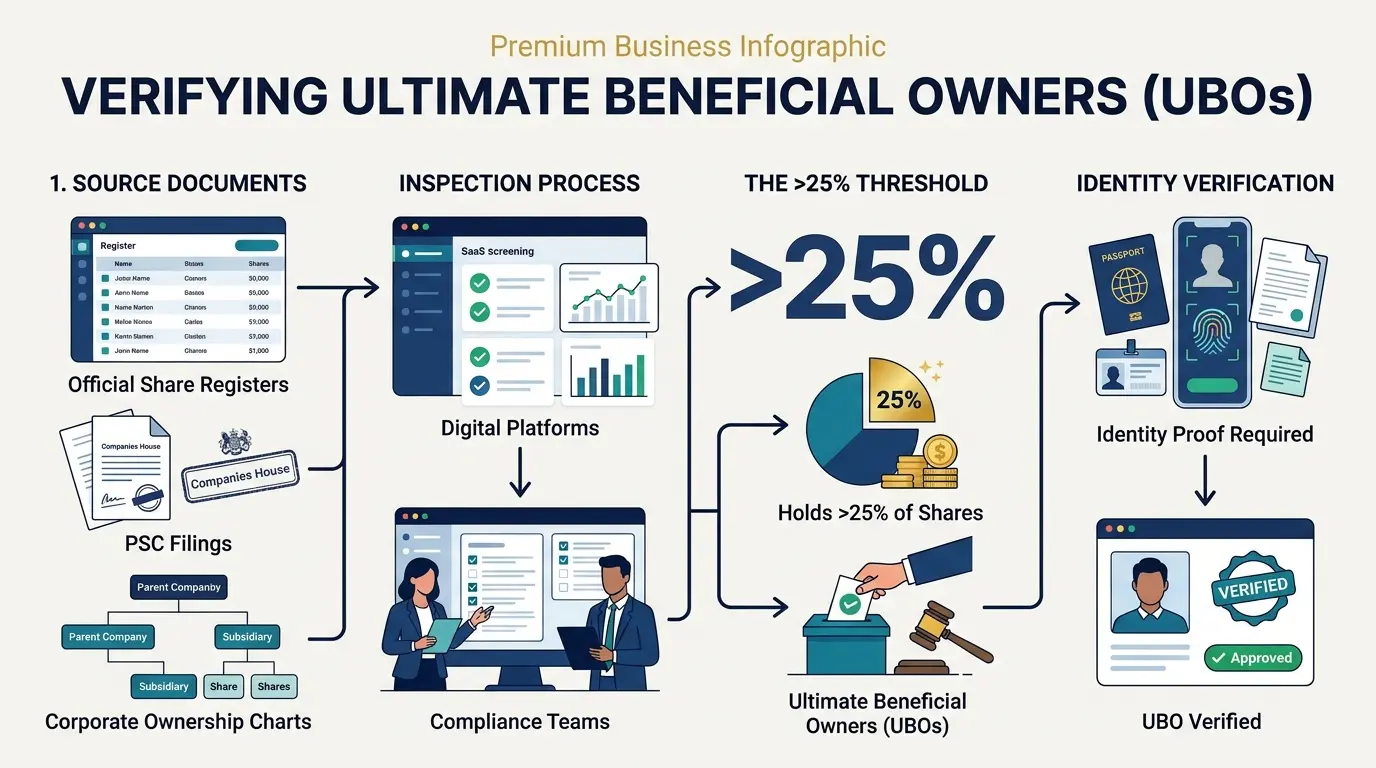
UK law mandates transparency regarding Persons with Significant Control (PSC). Platforms pull public PSC registers directly from Companies House during compliance checks. If corporate entities hold shares in your business, compliance officers request complete ownership charts. Ownership diagrams must map parent companies down to ultimate individual human shareholders.
Beneficial owners must submit identity verification documents identical to company directors. Submitting clear shareholder certificates proves exact equity allocation across corporate members. Complex corporate ownership structures require certified official records to clarify voting control. Providing verified corporate documentation simplifies platform compliance audits and prevents account holds. Businesses ready to secure certified platform documents can get marketplace verification documents from Form My Company to meet compliance standards rapidly.
What Triggers Marketplace Verification Document Rejections?
Marketplace document rejections are triggered by name mismatches, expired identity cards, uncertified translations, cropped document edges, and blurred image scans. Providing documents older than 90 days or using altered files causes instant automated verification failure.
Automated optical character recognition software evaluates every uploaded document file. Submitting low-resolution photographs or truncated document corners triggers system rejections. PDF files must remain unedited, uncompressed, and free from password protection. Altered files or altered metadata lead to permanent platform fraud flags.
Spelling variations between bank accounts, Companies House entries, and identity cards cause compliance flags. Using virtual office addresses without proper official registration creates location validation failures. Translation certificates must accompany non-English identity documents to satisfy UK regulatory officers. Ensuring all documentation features crisp imaging and identical corporate information prevents registration stalls.
Summary of Verification Requirements for UK Marketplace Sellers
Meeting UK marketplace verification demands total alignment between corporate records, physical address filings, director identity cards, and commercial bank details. Online platforms continuously monitor seller data against official UK regulatory databases to enforce statutory compliance standards. Preparing clear, current, and verified company documentation before starting registration ensures fast account activation and seamless trading across Amazon, eBay, and Etsy.
Form My Company provides comprehensive corporate services, official filings, and verified documentation to help UK businesses pass marketplace compliance reviews efficiently.
Explore More Supplementary Company Documents Guide,
Why Do Business Insurers Need Proof of Incorporation?
What Documents Prove Who Owns and Runs a UK Company?
Frequently Asked Questions
What are supplementary company documents for a UK business?
Supplementary company documents are official legal records—such as statutory registers, share certificates, and certificates of good standing—that extend beyond initial formation filings. Form My Company provides certified Supplementary Company Documents to verify real-time operational status, ownership structures, and compliance history for financial institutions and regulators.
Why do banks require supplementary company documents to open an account?
UK financial institutions require supplementary company documents during Know Your Customer (KYC) onboarding to prevent money laundering and fraud. Ordering verified records through Form My Company delivers authenticated statutory registers and shareholder details that confirm director authority and ultimate beneficial ownership.
How do supplementary documents differ from standard incorporation files?
Standard incorporation files establish a legal entity at formation, whereas supplementary company documents provide updated evidence of ongoing corporate standing. The Supplementary Company Documents service from Form My Company extracts current, timestamped data from statutory registers and Companies House filings to confirm present governance accuracy.
When should a company obtain a Certificate of Good Standing?
A business should obtain a Certificate of Good Standing when opening corporate bank accounts, applying for foreign trade visas, or entering commercial tenders. Form My Company supplies certified good standing records to validate that a UK firm maintains up-to-date annual filings and remains free from liquidation proceedings.
What records are included in a full supplementary document pack?
A complete supplementary pack includes official share certificates, Memorandum and Articles of Association, and statutory registers of directors, shareholders, and Persons with Significant Control (PSC). Ordering Supplementary Company Documents through Form My Company ensures businesses maintain audit-ready records that comply with the UK Companies Act 2006.