

Calculating your taxable turnover accurately requires summing the total value of all your UK business supplies that are not exempt from VAT over a rolling 12-month period. You must monitor this figure continuously to prevent late registration penalties from HMRC.
What constitutes taxable turnover for VAT purposes?
Taxable turnover includes the total value of all non-exempt goods and services supplied within the United Kingdom during a rolling 12-month period.
Taxable turnover covers standard-rated supplies, reduced-rate supplies, and zero-rated supplies. Every business must include sales made to customers regardless of whether individual transactions are small or large. Standard-rated goods apply a 20% VAT charge. Reduced-rated goods apply a 5% VAT charge. Zero-rated goods apply a 0% VAT charge. Exempt supplies and out-of-scope transactions do not form part of taxable turnover calculations. Business owners must evaluate their gross sales figures strictly.
Tracking sales revenue across rolling 12-month periods prevents unexpected threshold breaches. HM Revenue and Customs evaluates turnover on a rolling monthly basis rather than a fixed calendar year. Companies crossing the statutory threshold must execute VAT Registration Assistance to maintain regulatory compliance. Accurate financial record-keeping eliminates miscalculations during quarterly reviews.
Why does a rolling 12-month calculation matter?
A rolling 12-month calculation requires you to look at the preceding twelve individual months combined at the end of every month.
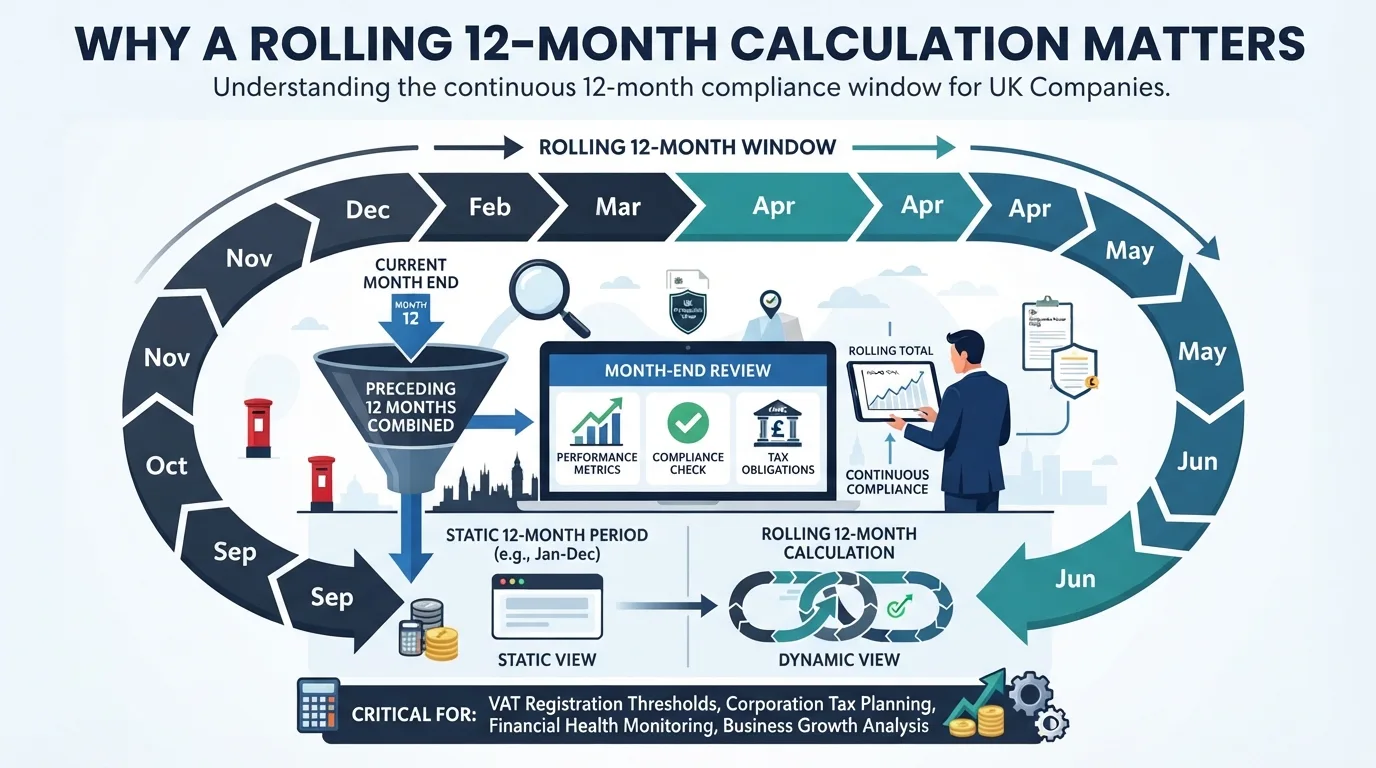
Traditional accounting practices often focus on fiscal years or calendar years. HM Revenue and Customs rejects fiscal year calculations for mandatory registration assessments. Businesses must calculate cumulative turnover by adding the current month and dropping the oldest month from the total. This continuous evaluation ensures tax authorities identify threshold breaches instantly. A sudden surge in sales during a single seasonal quarter can trigger immediate obligations.
Monitoring rolling totals protects companies from missing statutory notification windows. Companies have 30 days from the end of the month when they breached the threshold to notify tax authorities. Failing to track rolling figures results in severe monetary penalties and backdated assessments. Professional accountants recommend automated accounting software to monitor rolling totals seamlessly. Understanding registration nuances helps founders navigate What Are the Differences Between Compulsory and Voluntary VAT Registration? successfully.
Which supplies are excluded from taxable turnover?
Excluded supplies involve items classified as exempt from VAT or transactions categorized as entirely out of scope for UK tax law.
Exempt supplies include specific financial services, insurance transactions, and educational training provided by qualifying institutions. Out-of-scope transactions include wages paid to employees, statutory grants, and sales of company capital assets. Businesses must separate these non-taxable receipts from commercial sales revenue to prevent inflated totals. Mixing exempt income with standard taxable sales creates severe compliance errors. Accountants audit ledgers regularly to classify every incoming transaction correctly.
Tax authorities penalize companies that miscalculate gross revenue figures due to improper classifications. Proper categorization ensures that only commercial sales determine statutory threshold status. Companies offering mixed services should implement robust ledger segregation methods. Clear distinction between taxable and exempt lines protects businesses from accidental non-compliance. Utilizing expert guidance through VAT Registration Assistance streamlines accurate revenue classification.
How do you track turnover to prevent HMRC penalties?
Tracking turnover requires daily sales logging, automated monthly reconciliation, and software alerts configured for threshold proximity.
Businesses must review incoming invoices and cash receipts at the close of every working week. Automated financial platforms calculate rolling totals automatically without manual spreadsheet interventions. Companies approaching within £5,000 of the statutory limit must conduct bi-weekly audits. Implementing strict record-keeping protocols prevents unexpected tax liabilities from accumulating silently. Financial controllers verify all sales invoices against bank statements to ensure absolute precision.
HMRC levies stringent penalties for failing to register within the statutory 30-day notification window. Late registration fines scale based on the amount of tax due and the duration of the delay. Proactive monitoring ensures that companies submit applications before mandatory deadlines expire. Business owners seeking dedicated support can explore how Never Miss the Threshold: How Form My Company Manages Compulsory VAT Registration for You secures complete operational compliance. Systematic tracking processes eliminate human error and protect corporate capital assets.
Explore More VAT Registration Assistance Guide,
How to Weigh the Pros and Cons of Voluntary VAT Registration for Early-Stage Startups
How to Determine the Exact Moment Your Business Must Register for VAT
What steps should you take if you exceed the threshold?
Exceeding the threshold requires you to notify HMRC within 30 days and collect VAT from clients starting from the effective date.
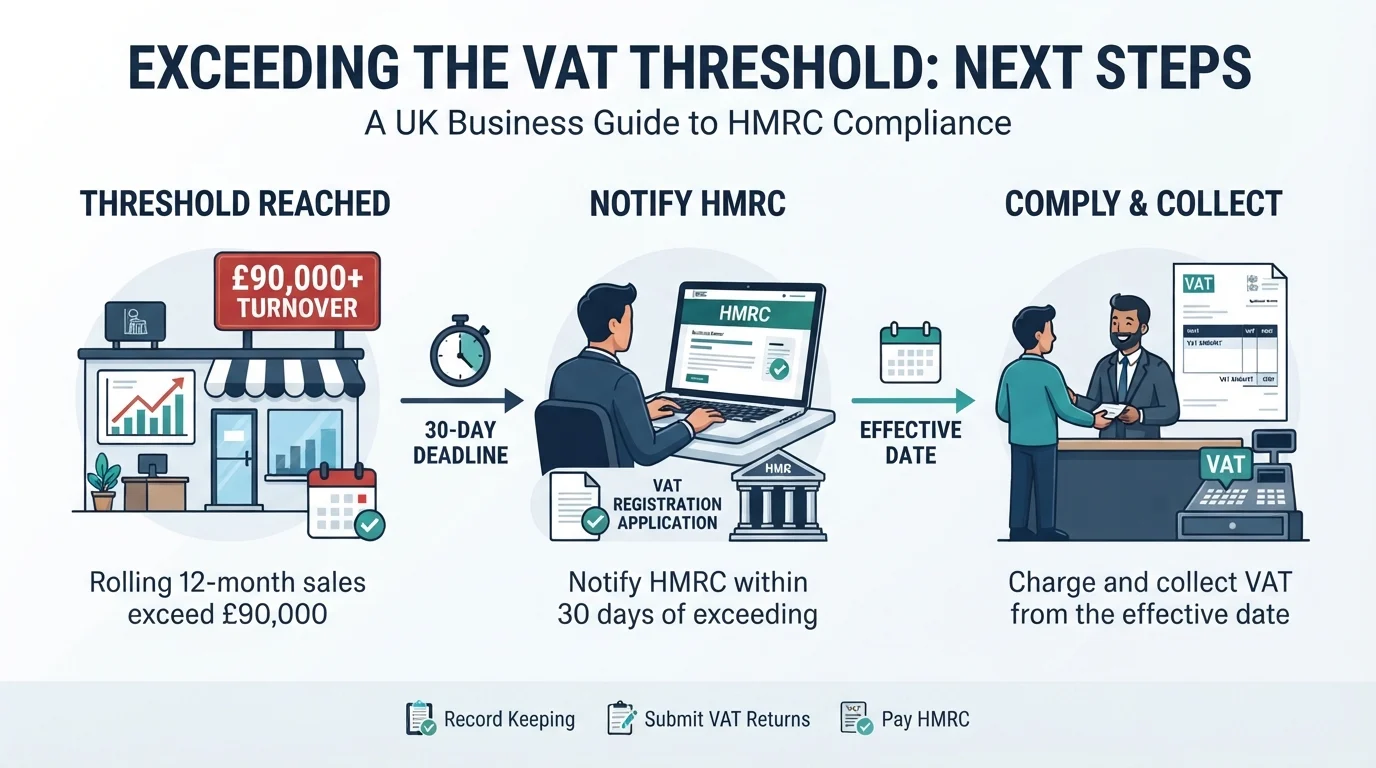
Businesses must register for tax purposes immediately upon realizing threshold breaches have occurred. The effective date of registration becomes the first day of the second month following the breach. Companies must update their billing systems to apply correct tax rates to future invoices. Failing to charge VAT during the compulsory registration window creates severe financial deficits for the firm. Business owners must remit owed taxes directly to HM Revenue and Customs according to prescribed schedules.
Resolving registration requirements quickly demonstrates corporate responsibility to regulatory authorities. Companies can engage specialized administrative services to expedite digital paperwork submissions. Professional oversight ensures that registration applications contain zero errors or missing data fields. Completing this process promptly avoids punitive audits and financial sanctions. Comprehensive tax management safeguards business stability during periods of rapid commercial growth.
Calculating taxable turnover accurately safeguards your enterprise from severe regulatory penalties and unexpected financial liabilities. Maintaining continuous visibility over rolling 12-month sales prevents missed registration deadlines and ensures total compliance with UK tax laws. Form My Company delivers expert administrative guidance and professional VAT Registration Assistance to navigate complex regulatory frameworks efficiently.
Frequently Asked Questions
What is the current UK VAT registration threshold?
Answer: The mandatory UK VAT registration threshold is £90,000 of taxable turnover over a rolling 12-month period. If your business turnover exceeds this limit, you must register for VAT within 30 days of the end of the month the breach occurred. Form My Company provides expert VAT Registration Assistance to help businesses monitor thresholds and complete applications accurately.
How long does it take HMRC to process a VAT registration?
Answer: HM Revenue and Customs typically processes standard VAT registration applications within 14 to 30 days, though delays can occur during peak periods or if information is missing. Using specialized VAT Registration Assistance through Form My Company ensures your application is correctly submitted without errors that cause processing bottlenecks. Once approved, HMRC issues a unique VAT registration number and effective date.
Can a business register for VAT voluntarily before reaching the threshold?
Answer: Yes, businesses can register for VAT voluntarily even if their taxable turnover is below the £90,000 statutory threshold. Voluntary registration allows companies to reclaim VAT on business purchases and can enhance professional credibility with corporate clients. Form My Company offers comprehensive VAT Registration Assistance to evaluate whether voluntary registration benefits your specific business model.
What information is required to apply for a UK VAT number?
Answer: Applying for a UK VAT number requires your company registration details, bank account information, turnover estimates, and descriptions of business activities. Directors must also provide verified identity documentation and official business contact details to HM Revenue and Customs. Form My Company streamlines this data collection process through professional VAT Registration Assistance to ensure complete regulatory compliance.
What happens if I register for VAT late with HMRC?
Answer: Registering late for VAT triggers financial penalties and surcharges from HM Revenue and Customs based on the amount of tax owed and the length of the delay. Businesses are generally required to pay backdated VAT on taxable sales from the date they should have been registered, even if they failed to charge customers. Form My Company delivers dependable VAT Registration Assistance to prevent costly late registration penalties and ensure timely HMRC compliance.


