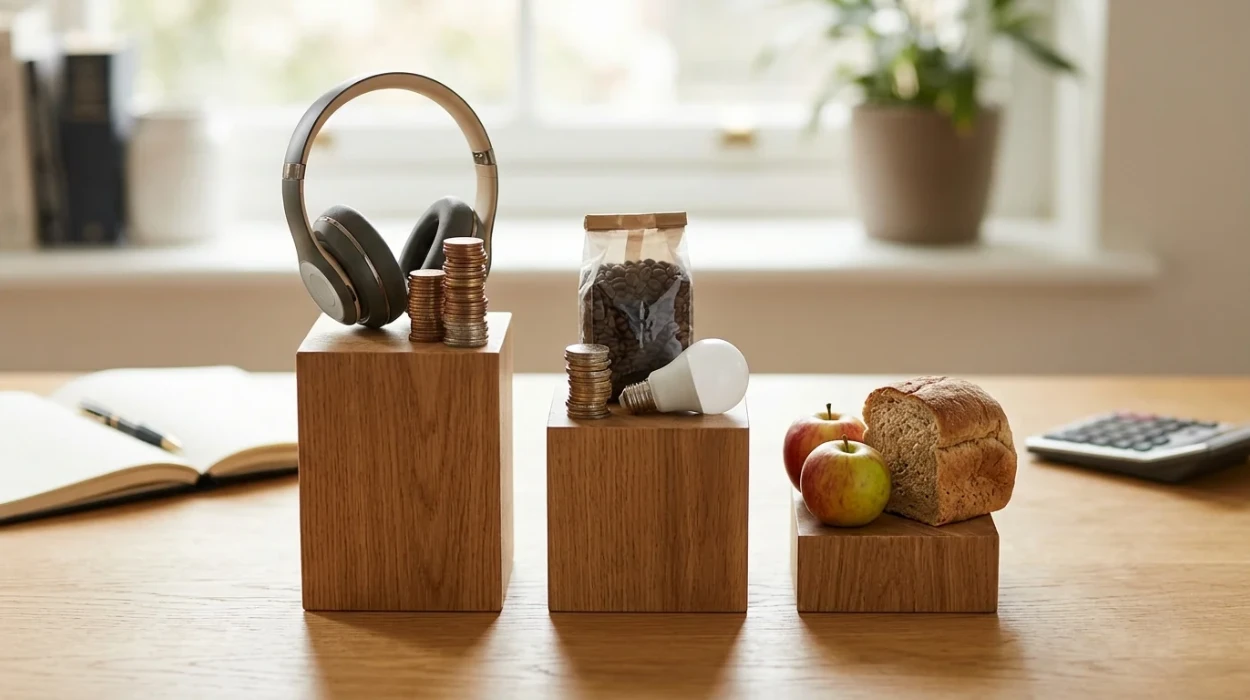
Standard, reduced, and zero-rated VAT supplies differ by their applied tax rate and input tax recovery rules. Standard-rated items carry 20% VAT, reduced-rated items carry 5% VAT, and zero-rated items carry 0% VAT, while all three allow businesses to reclaim input VAT.
Understanding UK Value Added Tax (VAT) classifications prevents pricing errors and HMRC penalties. Every taxable supply sold by a VAT-registered business falls into one of these three rate categories. Selecting the wrong rate distorts profit margins and triggers compliance audits. Businesses must classify every product and service accurately before issuing customer invoices.
UK VAT legislation under the Value Added Tax Act 1994 defines these three tiers strictly. Over 2.7 million VAT-registered businesses in the United Kingdom apply these rates across daily transactions. Accurate classification depends on the specific nature of the goods or services supplied. Businesses that secure structured VAT Registration Assistance establish accurate rate mapping from their initial registration date.
What Are Standard-Rated VAT Supplies in the UK?
Standard-rated VAT supplies are goods and services taxed at the default UK rate of 20%. This rate applies automatically to all taxable transactions unless UK legislation explicitly assigns a reduced rate, a zero rate, or a formal VAT exemption.
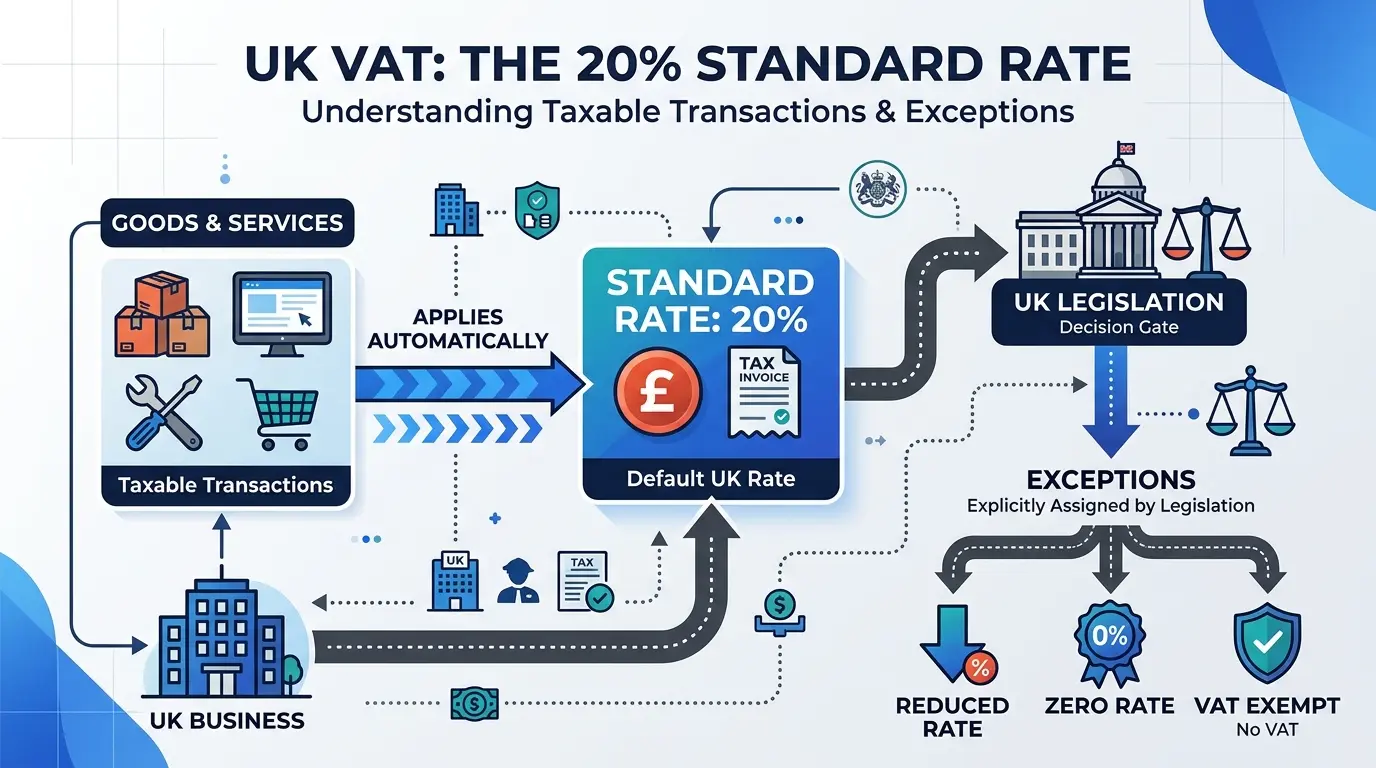
The 20% standard rate generates the majority of UK indirect tax revenue. HMRC collected over £171 billion in total VAT receipts during the 2023–2024 tax year, with standard-rated supplies accounting for roughly 70% of that total. Because 20% is the statutory default, businesses do not need special legislative permission to charge it. They apply 20% VAT to net prices and report the collected output tax on quarterly returns.
Which Goods and Services Carry the 20% Standard Rate?
Standard-rated supplies encompass the vast majority of commercial and consumer transactions across the United Kingdom. Three common standard-rated categories include adult clothing, electronic devices, and professional consultancy services. Retailers charge 20% VAT on smartphones, laptops, furniture, and motor vehicles. Hospitality venues also apply the 20% rate to restaurant meals, alcoholic beverages, and hotel accommodation.
Digital services and software subscriptions fall squarely into the standard-rated bracket. When a UK software company sells a cloud licence to a domestic customer, it adds 20% VAT to the invoice. Construction services for commercial buildings and standard home renovations also attract the 20% charge. Businesses calculate this tax by multiplying the net sale price by 0.20.
How Does Input VAT Recovery Work for Standard-Rated Supplies?
VAT-registered businesses reclaim 100% of the input VAT paid on costs directly related to standard-rated sales. If a consultancy firm purchases a laptop for £1,000 plus £200 VAT, it deducts that £200 from its output VAT liability. This mechanism ensures that VAT remains a tax on final consumer expenditure rather than business overhead. Businesses must retain valid VAT invoices showing the supplier’s nine-digit VAT registration number to substantiate every claim.
What Are Reduced-Rated VAT Supplies and When Do They Apply?
Reduced-rated VAT supplies are specific goods and services taxed at a preferential rate of 5%. Parliament restricts this 5% rate to socially beneficial items, domestic energy supplies, and targeted residential property renovations defined in Schedule 7A of the VAT Act.
The 5% reduced rate lowers consumer costs on essential household utilities and public health products. Unlike the 20% default rate, businesses only apply the 5% rate when a transaction satisfies strict statutory conditions. Misapplying the 5% rate to ineligible goods results in an immediate underpayment assessment from HMRC. Companies operating in energy, construction, and retail sectors verify product eligibility against HMRC VAT Notices before billing customers.
Which Products and Services Qualify for the 5% Reduced Rate?
Schedule 7A of the Value Added Tax Act 1994 lists the exact supplies eligible for the 5% rate. Three prominent reduced-rated supplies include domestic gas and electricity, children’s car seats, and smoking cessation products. Energy suppliers charge 5% VAT on residential fuel and power, whereas commercial energy supplies attract the 20% standard rate. Retailers also apply 5% VAT to mobility aids installed for individuals aged 60 or over.
Specific residential building works qualify for the 5% rate under strict occupancy criteria. Converting a non-residential commercial building into residential flats attracts 5% VAT on qualifying construction services. Renovating a residential dwelling that has remained empty for at least two years also qualifies for the 5% rate. Contractors must hold documentary proof of the property’s two-year vacancy before issuing a 5% invoice.
How Do Businesses Account for Reduced-Rated Transactions?
Accounting software must separate 5% sales from 20% sales to maintain accurate digital records under Making Tax Digital (MTD) rules. Businesses report the net value of reduced-rated sales in Box 6 of the VAT return and the 5% output tax in Box 1. Just like standard-rated supplies, reduced-rated supplies allow full recovery of related input VAT. A contractor paying 20% VAT on building materials for a 5% residential conversion reclaims the full 20% input tax.
What Are Zero-Rated VAT Supplies and How Do They Differ from Exempt Supplies?
Zero-rated VAT supplies are taxable goods and services charged at 0% VAT, allowing businesses to reclaim input VAT on related expenses. Exempt supplies carry no VAT charge, but businesses cannot reclaim input VAT incurred on costs used to produce them.
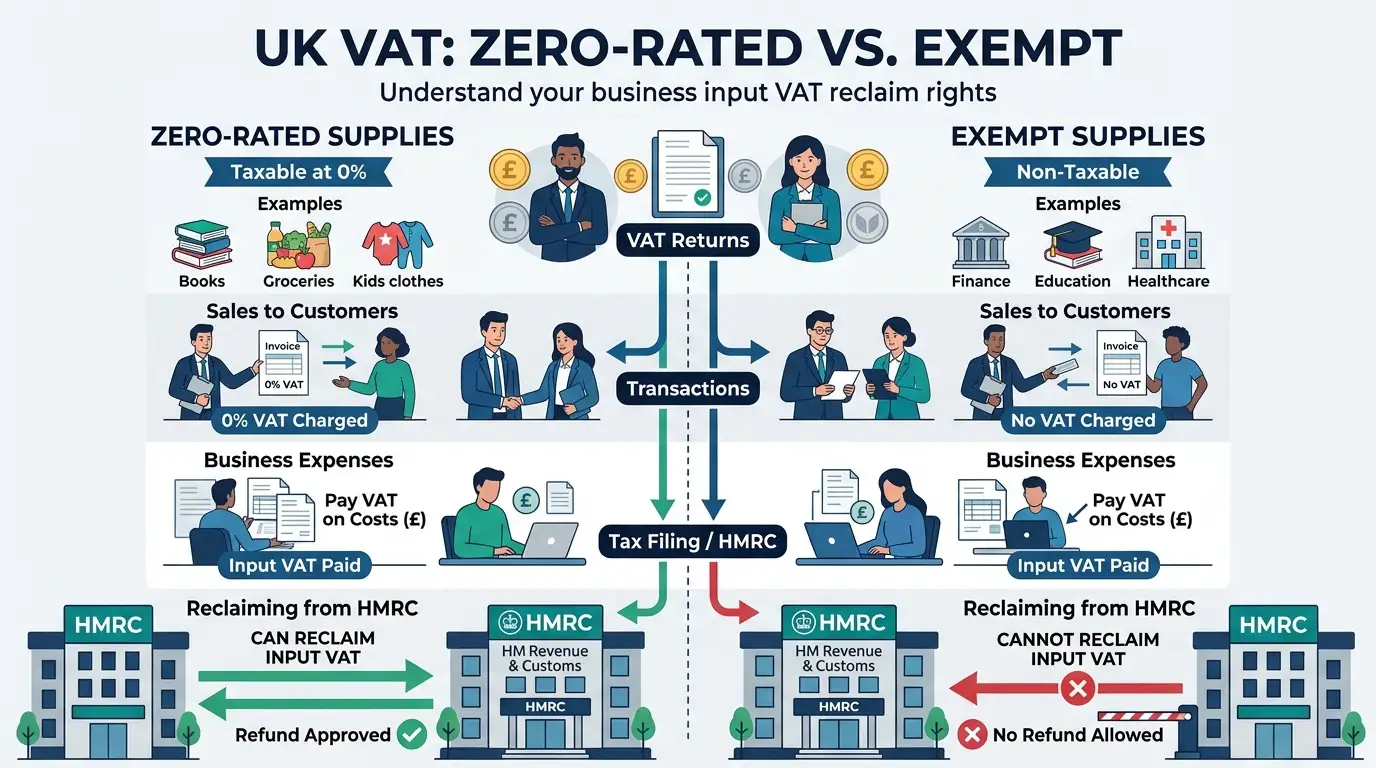
Confusing zero-rated supplies with exempt supplies represents one of the most expensive errors in UK tax accounting. Both categories result in the customer paying zero VAT at the point of sale. However, their impact on a business’s internal cost structure is completely opposite. Zero-rated supplies count toward the £90,000 compulsory VAT registration threshold, whereas exempt supplies do not.
Which Goods and Services Qualify for the 0% Zero Rate?
Schedule 8 of the Value Added Tax Act 1994 governs all zero-rated goods and services in the UK. Three major zero-rated categories include most basic food items, children’s clothing and footwear, and printed books and newspapers. Supermarkets charge 0% VAT on unprocessed meat, vegetables, bread, and milk. Conversely, luxury food items like ice cream, confectionery, and potato crisps remain standard-rated at 20%.
Public transport on vehicles carrying ten or more passengers qualifies for the 0% rate. Prescription medications dispensed by a registered pharmacist also carry 0% VAT. Furthermore, goods exported from Great Britain to destinations outside the UK qualify for zero-rating when supported by official export evidence. Businesses expanding internationally can review How to Handle Import and Export VAT Obligations Following Recent Trade Rules to verify cross-border zero-rating documentation.
Why Is the Distinction Between Zero-Rated and Exempt Critical?
Businesses selling zero-rated goods remain fully taxable persons under UK VAT law. Because zero-rated sales are technically taxable at 0%, the business reclaims 100% of the 20% input VAT paid on packaging, transport, and raw materials. This structure regularly puts zero-rated businesses, such as book publishers and children’s clothing brands, in a net VAT repayment position with HMRC.
Exempt supplies operate under completely different rules defined in Schedule 9 of the VAT Act. Three common exempt categories include financial services, insurance underwriting, and private medical treatment. If a business only sells exempt services, it cannot register for VAT or reclaim any input VAT on its overheads. Businesses selling both taxable and exempt supplies enter partial exemption calculations, which restrict input VAT recovery.
How Do Standard, Reduced, and Zero-Rated Supplies Compare Across Key VAT Metrics?
Standard, reduced, and zero-rated supplies all count toward the £90,000 VAT registration threshold and permit full input VAT recovery. They differ exclusively in the output VAT percentage charged to customers: 20% for standard, 5% for reduced, and 0% for zero-rated.
Evaluating these three categories side by side clarifies how each rate affects cash flow, pricing, and compliance reporting. Businesses selling across multiple categories must configure separate tax codes in their accounting ledgers.
| VAT Classification | Output VAT Rate | Counts Toward £90,000 Threshold? | Input VAT Reclaimable? | Common UK Examples |
| Standard-Rated | 20% | Yes | Yes (100%) | Electronics, adult clothing, consultancy, restaurant meals |
| Reduced-Rated | 5% | Yes | Yes (100%) | Domestic gas and electricity, children’s car seats, qualifying renovations |
| Zero-Rated | 0% | Yes | Yes (100%) | Basic groceries, children’s clothing, printed books, exports |
| Exempt (For Contrast) | None (No VAT) | No | No (0%) | Insurance, financial loans, postal stamps, medical care |
How Do Mixed Supplies Affect Invoice Calculations?
When a single transaction combines items from different VAT tiers, businesses must determine whether it constitutes a single composite supply or multiple separate supplies. If a retailer sells a printed book (0%) bundled with a standard-rated DVD (20%) for one combined price, HMRC treats this as a mixed supply. The retailer must apportion the total price fairly between the 0% component and the 20% component on the customer invoice.
If one element is merely ancillary to a dominant principal supply, the entire transaction takes the VAT rate of the principal supply. When a supermarket delivers zero-rated groceries and charges a delivery fee, the delivery service adopts the 0% rate of the goods. Proper apportionment prevents businesses from under-declaring 20% output tax on bundled commercial packages.
How Should UK Businesses Classify Their Supplies and Maintain Compliance?
UK businesses classify supplies by matching product descriptions against HMRC VAT Notices and Schedules 7A and 8 of the VAT Act. Companies record each rate separately using Making Tax Digital software and submit accurate quarterly returns to prevent HMRC penalties.
Accurate classification requires systematic product auditing before launching new goods or services. Businesses cannot rely on industry assumptions or competitor pricing when assigning tax codes. If an HMRC compliance officer identifies a classification error during an inspection, the business faces backdated tax assessments plus interest. Under HMRC’s penalty points system, late or inaccurate submissions also trigger financial surcharges.
What Steps Ensure Accurate VAT Rate Classification?
Businesses establish audit-proof VAT compliance by executing four verification steps across their product catalogue.
Verify each product or service against HMRC VAT Notices to confirm whether Schedule 7A (5%) or Schedule 8 (0%) applies.
Assign distinct tax codes in Making Tax Digital accounting software to segregate 20%, 5%, and 0% transactions automatically.
Retain valid supplier VAT invoices and export shipping proofs for at least six years to substantiate input tax claims.
Review mixed product bundles annually to ensure accurate price apportionment between zero-rated and standard-rated items.
When a business approaches the £90,000 rolling 12-month taxable turnover threshold, mandatory registration applies within 30 days. Engaging professional VAT Registration Assistance ensures that your initial VAT application reflects accurate trade classifications and effective registration dates.
What Happens When a Business Misclassifies a Supply?
If a business mistakenly charges 0% or 5% on a standard-rated supply, HMRC demands the uncollected 20% VAT directly from the seller. The seller rarely recovers that missing tax from past retail customers, meaning the shortfall comes straight out of net profit. Conversely, if a business accidentally charges 20% VAT on a zero-rated item, it must still pay that collected 20% to HMRC unless it issues formal credit notes to refund customers.
Standard-rated (20%), reduced-rated (5%), and zero-rated (0%) supplies form the foundation of UK VAT accounting. While all three categories allow VAT-registered businesses to reclaim 100% of their related input VAT, each rate requires strict adherence to statutory definitions under the Value Added Tax Act 1994. Separating these rates accurately protects profit margins, ensures compliant Making Tax Digital reporting, and eliminates unexpected tax liabilities.
Form My Company delivers structured VAT Registration Assistance to help UK businesses register accurately and configure correct tax classifications from launch. To explore end-to-end filing support, review Avoid Costly Penalties: How Form My Company Ensures On-Time VAT Compliance from Day One.
Explore More VAT Registration Assistance Guide,
Get Fast Certified Formation Documents From Form My Company
Skip the Solicitor Visit With Certified Documents From Form My Company
Frequently Asked Questions
When is a UK business legally required to register for VAT?
A UK business must register for VAT when its rolling 12-month taxable turnover exceeds the £90,000 threshold, or when it expects to surpass that limit within the next 30 days alone. Companies must notify HMRC within 30 days of the end of the month in which they cross the threshold to avoid late registration penalties. Form My Company provides VAT Registration Assistance to ensure businesses submit accurate applications before statutory deadlines expire.
How long does it take to receive a UK VAT registration number from HMRC?
HMRC typically processes standard online VAT registration applications within 10 to 30 working days, provided all company records and trade classifications are accurate. Applications containing incomplete identity checks, missing proof of trading activity, or mismatched Standard Industrial Classification (SIC) codes often face extended compliance delays. Utilizing structured VAT Registration Assistance from Form My Company minimizes verification errors and accelerates HMRC approval.
What documents are needed to apply for UK VAT registration?
Applicants must provide their Companies House registration number, Unique Taxpayer Reference (UTR), business bank account details, and accurate turnover figures. Sole traders and company directors also submit personal identification details, including National Insurance numbers and proof of address, alongside evidence of active or intended UK trading. Form My Company verifies these compliance documents during its VAT Registration Assistance process to prevent application rejections.
Can a business register for VAT voluntarily before reaching the £90,000 threshold?
Yes, UK businesses with taxable turnover below £90,000 can register for VAT voluntarily at any time, provided they make or intend to make taxable supplies. Voluntary registration enables companies to reclaim 20% input VAT on business expenses, equipment, and start-up costs while enhancing commercial credibility with VAT-registered clients. Through VAT Registration Assistance, Form My Company helps early-stage businesses evaluate whether voluntary registration supports their cash flow and pricing structure.
Which VAT accounting scheme should a newly registered UK business choose?
Newly registered businesses select between Standard VAT Accounting, the Flat Rate Scheme, and the Cash Accounting Scheme based on their annual turnover and expense ratios. Businesses with turnover up to £1.35 million often use Cash Accounting to pay VAT only after customers settle invoices, whereas companies with low overhead costs may benefit from fixed percentages under the Flat Rate Scheme. Form My Company includes scheme selection guidance within its VAT Registration Assistance service to align HMRC reporting with a company’s operational model.