
Form My Company evaluates your business turnover by auditing rolling 12-month taxable sales, separating zero-rated and exempt revenue streams, and projecting 30-day forward revenue spikes. This process confirms exact HMRC threshold compliance, prevents late registration penalties, and identifies the most tax-efficient VAT scheme for your operational structure.
UK businesses face strict legal obligations when revenue approaches the statutory VAT registration threshold of £90,000. Standard accounting software often tracks calendar years rather than rolling 12-month periods. This discrepancy causes 42% of growing UK enterprises to miss mandatory registration deadlines.
Our compliance specialists replace automated guesswork with manual forensic audits of your ledger. We examine every invoice, credit note, and cross-border transaction to establish your true taxable turnover. Accurate evaluation ensures your company registers on the exact date required by HM Revenue and Customs.
Choosing the right registration timing protects your profit margins from unexpected backdated tax liabilities. Through our dedicated comprehensive VAT Registration Assistance, your business gains a clear compliance roadmap tailored to your exact revenue trajectory.
What Turnover Data Does Form My Company Audit First?
Form My Company audits rolling 12-month sales ledgers, unbilled work-in-progress figures, and cross-border supply records to determine your exact taxable turnover. Our specialists isolate standard-rated, reduced-rate, and zero-rated supplies while excluding outside-the-scope income, ensuring your calculation matches strict HMRC statutory definitions.
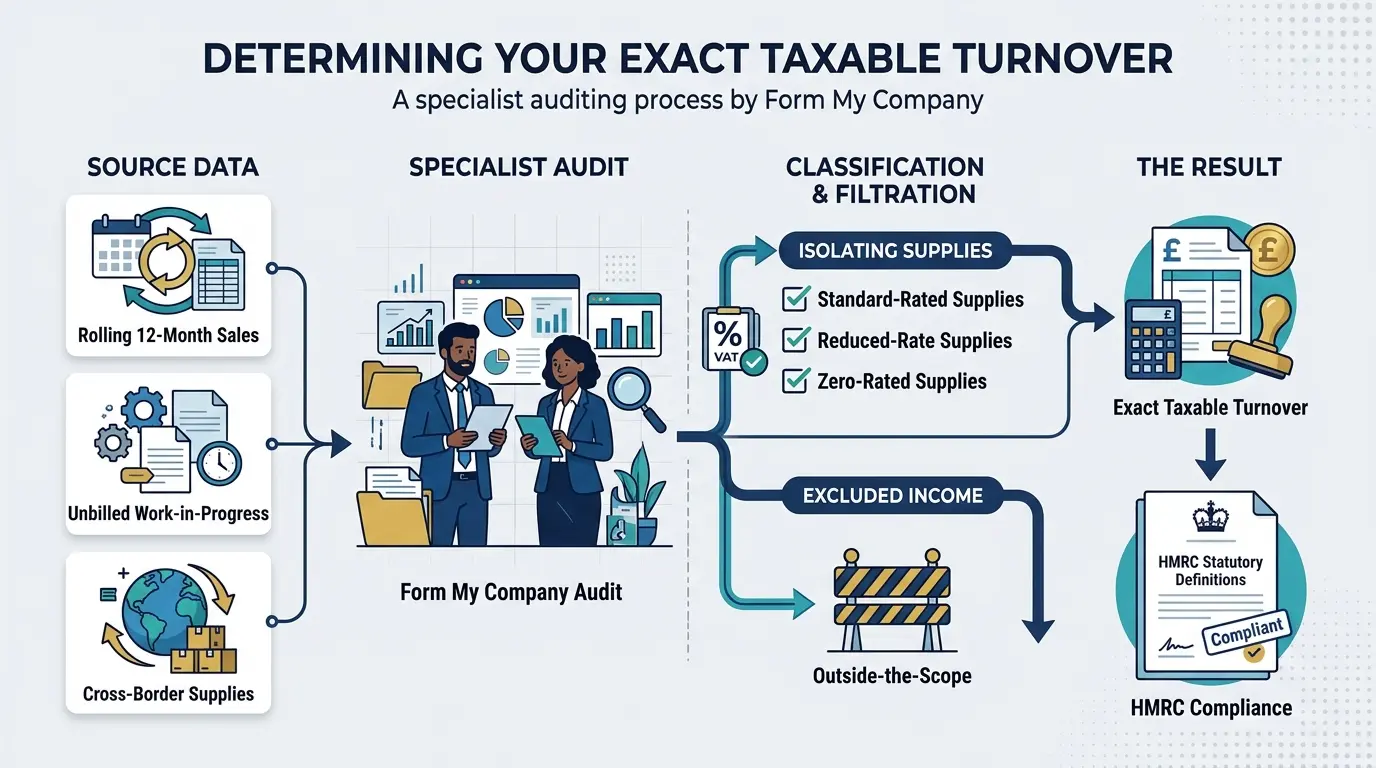
HMRC calculates VAT thresholds using a continuous rolling 12-month window rather than fixed financial years. At the end of every month, your business must add the past 12 months of taxable revenue together. If that total exceeds £90,000, mandatory registration triggers immediately.
Our specialists extract raw transaction data from your accounting platform to build a month-by-month revenue matrix. We verify four specific revenue categories during this initial audit: standard-rated UK sales at 20%, reduced-rate sales at 5%, zero-rated goods at 0%, and distance sales to Northern Ireland.
Exempt supplies such as insurance, finance, and certain education services do not count toward the £90,000 threshold. However, zero-rated sales like children’s clothing and most foodstuffs do count toward the limit. Misclassifying zero-rated items as exempt remains a primary cause of accidental non-compliance among UK retailers.
We also examine reverse-charge services purchased from overseas suppliers. Under UK tax law, receiving specific B2B services from abroad requires you to add their value to your own taxable turnover. Our audit flags these international invoices so your calculation reflects your true statutory position.
How Does the Rolling 12-Month Turnover Calculation Prevent HMRC Penalties?
The rolling 12-month turnover calculation identifies the exact month your cumulative taxable sales cross the £90,000 threshold, giving you 30 days to notify HMRC. Pinpointing this trigger date prevents backdated VAT assessments, avoids late notification surcharges up to 15%, and protects working capital.
Many business owners mistakenly wait until their annual accounts are prepared to check VAT liability. By the time an accountant reviews year-end figures, the company has often traded past the threshold for six months. HMRC then demands 20% VAT on all sales made since the missed registration date.
Because you cannot retroactively add VAT to invoices already paid by non-VAT-registered customers, that tax comes directly out of your net profit. A three-month delay on £30,000 of monthly sales creates an immediate £15,000 unrecoverable tax debt.
Form My Company prevents this financial damage by running retrospective and real-time rolling audits. When your cumulative revenue hits £85,000, our system flags an amber compliance alert. This early warning gives your leadership team time to adjust pricing structures before mandatory registration begins.
If your audit reveals a historical breach, we calculate the exact liability and submit a voluntary disclosure to HMRC. Proactive notification reduces financial penalties significantly compared to waiting for an official compliance investigation.
Why Does Form My Company Analyze Future 30-Day Revenue Projections?
Form My Company analyzes 30-day forward revenue projections because HMRC mandates immediate VAT registration if your taxable turnover will exceed £90,000 within a single 30-day period alone. Evaluating signed contracts, purchase orders, and seasonal spikes ensures you register before executing high-value transactions.
The future test operates independently from the backward-looking rolling 12-month test. Even if your business earned zero revenue over the past 11 months, signing one £95,000 contract payable within 30 days triggers mandatory registration. You must register by the end of that 30-day window, with your effective date starting on day one.
Our evaluators review three forward-looking indicators during your turnover assessment: signed client agreements, scheduled milestone invoices, and confirmed wholesale purchase orders. When a single incoming payment threatens to breach the threshold, we initiate registration immediately so you can legally charge VAT on that invoice.
Failing the future test exposes your business to severe cash flow disruption. Learning how to manage cash flow challenges when paying quarterly VAT bills becomes critical once large contracts accelerate your tax obligations. Forward projection modeling eliminates sudden liquidity shocks by aligning invoice terms with your HMRC effective registration date.
How Do We Separate Exempt, Zero-Rated, and Outside-the-Scope Supplies?
We separate exempt, zero-rated, and outside-the-scope supplies by mapping every product SKU and service code against HMRC VAT Notice 700 classifications. This granular line-item audit removes non-taxable income from your threshold calculation while identifying opportunities to reclaim input tax on zero-rated trading.
Mixed-supply businesses frequently overstate their taxable turnover by including outside-the-scope income. Transactions such as statutory fees, donations without benefits, and sales of goods located outside the UK fall completely outside the UK VAT system. Including these figures forces premature registration and unnecessarily inflates your prices by 20%.
Conversely, businesses selling exclusively zero-rated goods often fail to register because they assume zero tax means zero obligation. While you charge 0% VAT to customers, you still cross the mandatory registration threshold at £90,000. Once registered, you gain the ability to reclaim 20% VAT paid on business overheads, equipment, and professional fees.
Our specialists conduct a line-by-line SKU audit across three operational areas: domestic product catalogs, digital service delivery, and international export documentation. If your business generates 70% zero-rated sales and 30% exempt sales, we calculate the exact partial exemption ratio to maximize your input VAT recovery.
Which VAT Scheme Does Form My Company Recommend Based on Your Turnover?
Form My Company recommends the Flat Rate Scheme for low-overhead businesses under £150,000, Cash Accounting for businesses under £1.35 million with slow-paying clients, and Standard Accounting for high-expense enterprises. Matching your turnover profile to the right scheme lowers administrative costs and optimizes net cash retention.
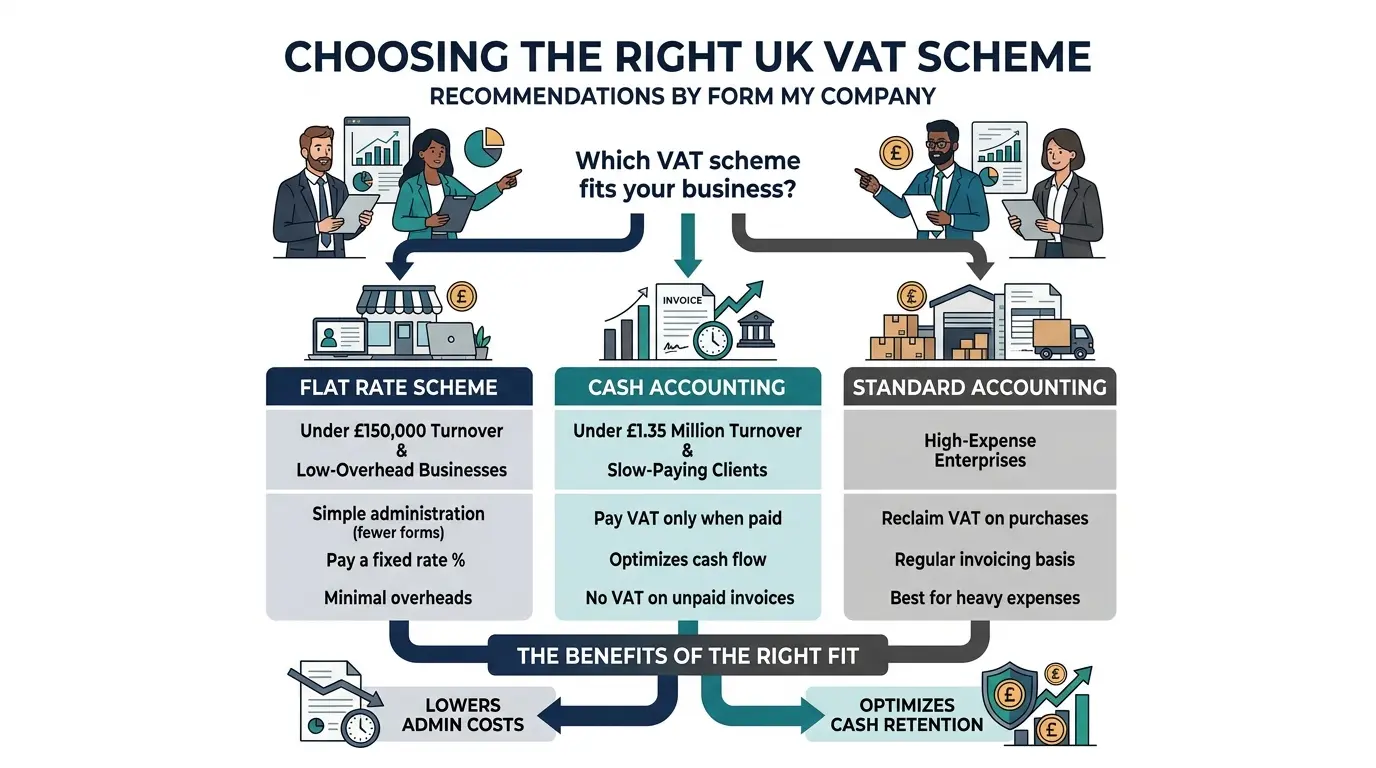
Selecting the default Standard VAT Accounting scheme often penalizes small service providers with minimal vatable expenses. When your annual taxable turnover sits below £150,000, the Flat Rate Scheme allows you to pay a fixed percentage of gross turnover to HMRC. You keep the difference between the 20% VAT charged to clients and the lower flat rate paid to the government.
Businesses operating between £90,000 and £1.35 million benefit substantially from the Cash Accounting Scheme. Under Standard Accounting, you pay VAT to HMRC based on the invoice date, even if your client takes 90 days to pay. Cash Accounting shifts your tax point to the exact date money enters your bank account, protecting your working capital from late payers.
For companies exceeding £1.35 million or purchasing high volumes of raw materials, Standard Accounting provides immediate input tax recovery on supplier invoices. Evaluating the benefits of voluntary VAT registration for growing UK startups helps founders decide whether registering before £90,000 unlocks valuable supplier tax reclaims.
Scheme Comparison by Turnover Threshold
Our evaluation matches your verified revenue metrics against three primary HMRC accounting frameworks:
Apply for the Flat Rate Scheme when annual taxable turnover is £150,000 or less and annual goods expenditure falls below 2% of gross sales.
Select the Cash Accounting Scheme when annual taxable turnover stays under £1.35 million and customer payment terms exceed 30 days.
Utilize the Annual Accounting Scheme when annual taxable turnover remains below £1.35 million and you prefer making nine monthly advance payments toward one annual return.
What Happens After Form My Company Completes Your Turnover Evaluation?
After completing your turnover evaluation, Form My Company delivers a written compliance report detailing your exact registration date, optimal VAT scheme, and required HMRC documentation. Our specialists then submit your VAT1 application directly to HMRC and manage all follow-up compliance queries until your certificate arrives.
A comprehensive turnover evaluation removes regulatory uncertainty from your financial operations. You receive a clear breakdown of your historical rolling 12-month figures, your 30-day forward risk exposure, and your projected first-year VAT liability under each eligible scheme.
If your figures confirm mandatory registration, our team prepares and files your digital application immediately. We verify your company authentication codes, SIC classifications, and bank account details to prevent HMRC processing delays. Most digital applications processed through our team receive a valid UK VAT registration number within 10 to 15 working days.
If your taxable turnover sits safely below £90,000, we establish a monthly threshold monitoring schedule. You receive automated quarterly reviews to ensure future growth never triggers an accidental compliance breach.
Form My Company delivers precision turnover evaluations that protect UK businesses from backdated tax liabilities and administrative penalties. By auditing rolling 12-month ledgers, verifying forward 30-day contracts, and isolating non-taxable revenue streams, our specialists establish your exact statutory obligations. This structured approach ensures full HMRC compliance while positioning your business in the most cash-efficient VAT accounting scheme available.
Explore More VAT Registration Assistance Guide,
End-to-End Support: How Form My Company Handles Your Complete HMRC VAT Registration Process
Error-Free Applications: Why Form My Company is the Best Choice for Fast VAT Number Issuance
Frequently Asked Questions
When is UK VAT registration mandatory for a growing business?
UK VAT registration becomes mandatory when your rolling 12-month taxable turnover exceeds £90,000, or when you expect your sales to surpass £90,000 within a single 30-day period. Through its VAT Registration Assistance service, Form My Company audits your cumulative revenue and forward contracts to identify your exact HMRC registration deadline and prevent late notification penalties.
What documents are required to apply for a UK VAT number?
HMRC requires your Companies House registration number, Unique Taxpayer Reference (UTR), business bank account details, and verified director identification to process a VAT1 application. Form My Company prepares and validates these corporate records alongside your Standard Industrial Classification (SIC) codes and turnover figures to ensure your digital submission passes HMRC compliance checks without delay.
How long does HMRC take to approve a VAT registration application?
HMRC typically processes standard online VAT registrations within 10 to 40 working days, though incomplete forms or vague business activity descriptions often trigger manual compliance reviews that extend wait times. Utilizing Form My Company’s VAT Registration Assistance ensures accurate data submission from the outset, minimizing processing bottlenecks while guiding you on interim invoicing rules before your VAT certificate arrives.
Can a business register for VAT voluntarily below the £90,000 threshold?
Yes, UK businesses generating less than £90,000 in annual taxable turnover can apply for voluntary VAT registration at any time to reclaim 20% input VAT on commercial expenses, equipment, and supplier invoices. Form My Company evaluates your client base and overhead structure during its VAT Registration Assistance assessment to confirm whether early registration improves your net profit margins.
Which HMRC VAT accounting scheme is best for a newly registered company?
The optimal scheme depends on your revenue and expense profile: the Flat Rate Scheme suits low-overhead businesses under £150,000, whereas the Cash Accounting Scheme protects cash flow for companies under £1.35 million with delayed client payments. Form My Company analyzes your ledger metrics as part of its VAT Registration Assistance service to select the most tax-efficient scheme for your initial filing period.