
You don’t need an accountant to form a limited company in the UK. There’s no legal requirement to hire one, so you can register without accountancy support. But incorporation is only the start: directors remain responsible for company records, accounts and filing deadlines, even if an accountant does the work.
It’s understandable to want expert help when setting up a business. An accountant can support ongoing financial tasks, tax and deadlines, but you don’t have to appoint one just to incorporate. To decide whether you need an accountant to form a limited company, separate the registration process from the responsibilities that follow.
This guide explains what an accountant can do, which duties remain with the director, and when managing the accounts yourself may be practical. It also compares a limited company with sole trader status, so you can consider which structure fits your plans before moving ahead.
Key Takeaways
- An accountant can support your company’s ongoing accounts, tax and filing deadlines, but isn’t needed simply to register it.
- Even with an accountant’s help, you remain responsible as director for your company’s records and compliance.
- Compare the administrative responsibilities and liability differences between a limited company and sole trader before choosing a structure.
- A formation provider can manage the company registration process, while accountancy support is a separate decision.
- Choose the level of financial support that fits your confidence, business plans and willingness to manage ongoing obligations.
1. How Can an Accountant Help When Setting Up a Limited Company?
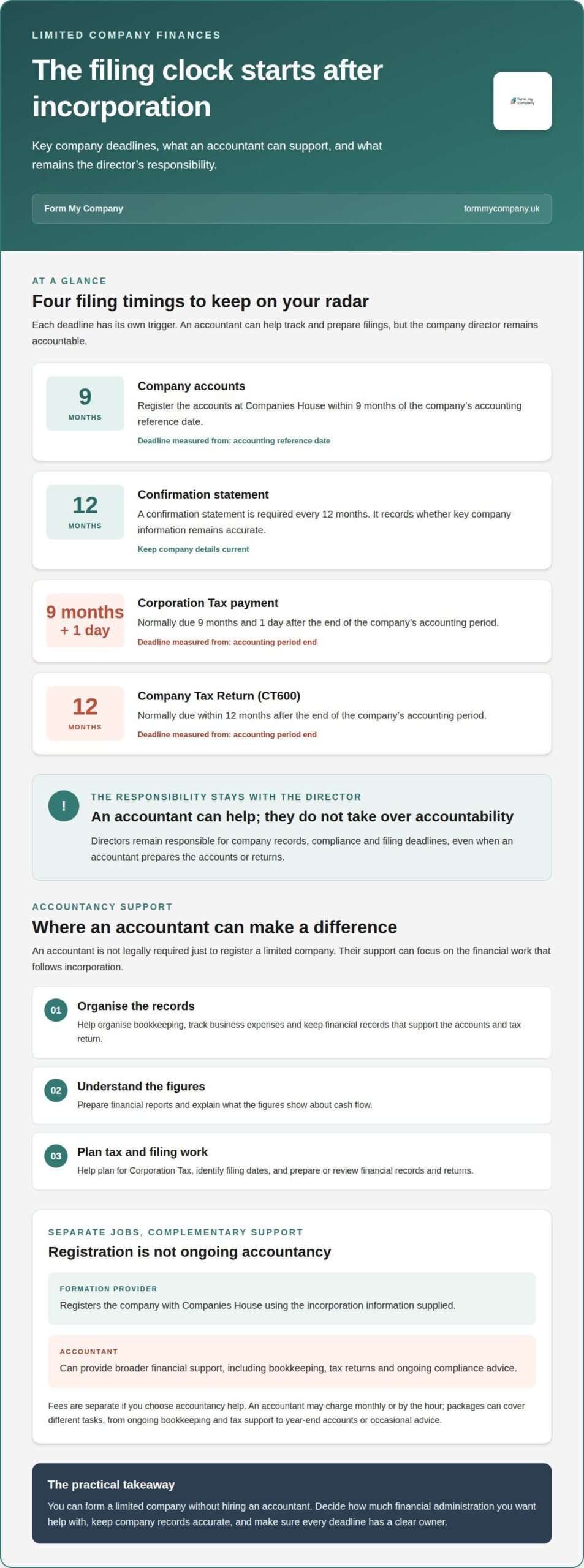
An accountant can advise on financial records, tax responsibilities and the practical work that follows incorporation. For example, they can help organise bookkeeping, track business expenses, prepare financial reports and explain what the figures show about cash flow. They may also help you plan for Corporation Tax and identify filing dates, but the director remains responsible for the company’s obligations.
An online company formation service registers a company with Companies House using the information provided for incorporation. An accountant can offer broader financial support, including bookkeeping, tax returns and ongoing compliance advice. The roles can complement each other: formation handles registration, while accountancy support helps manage the company’s finances after it starts operating.
Several recurring filings have separate deadlines. According to Companies House, UK companies must register their accounts at Companies House within 9 months of their accounting reference date. Companies House also requires a confirmation statement every 12 months. It records whether key company information remains accurate, so keeping its details current matters.
Corporation Tax has its own payment and return timetable. According to HM Revenue & Customs, a UK limited company’s Corporation Tax payment is normally due 9 months and 1 day after the end of its accounting period. HM Revenue & Customs says its Company Tax Return (CT600) is normally due within 12 months after that period ends. An accountant can track these dates and prepare the relevant filings.
An accountant may charge monthly or by the hour, depending on the work and service arrangement. Packages can cover different tasks, so distinguish ongoing bookkeeping and tax support from year-end accounts or occasional advice. The right fit depends on how much financial administration you want handled.
The cost to set up a limited company depends on the formation service, chosen package and any additional support. The service price is provided after a quote request, with the package and selected additions affecting the total. An accountant’s fees are separate if you choose continuing or one-off accountancy help.
To meet filing requirements, a new company needs records that support its accounts and tax return, alongside accurate information for its confirmation statement. An accountant can prepare or review financial records and returns; the company director remains accountable for meeting deadlines. If you need help with the confirmation statement itself, a confirmation statement filing service addresses that specific Companies House requirement.
2. Register as a sole trader or Limited Company?
Choose your structure by considering liability, administration and how you plan to run the business. A sole trader reports business income through Self Assessment, while a limited company is a separate legal structure with its own responsibilities. Limited company owners are generally responsible for business debts only up to the value of their financial investment. That distinction can matter if the business takes on commitments or faces financial difficulty.
Consider the work involved, not just the structure’s name. Sole trader status may suit someone who wants to operate independently and manage a simpler business setup. A limited company brings director responsibilities and separate company records. For example, a consultant working alone might prefer sole trader status, while a venture with co-founders may value a company structure that clearly records ownership and decision-making.
The right accountant should match the scale and complexity of your plans. A small accounting firm may suit a contractor, sole trader or micro company; a fast-growing start-up may prefer a larger firm with broader capacity. Look for an accountant with relevant UK qualifications, such as membership of ICAEW or ACCA, and experience with businesses like yours. Ask what the service covers, including bookkeeping, tax returns and year-end accounts.
Communication matters as much as firm size. Agree how you’ll share records, receive updates and raise questions, then establish who handles each task. A contractor who prefers regular contact may value a named point of contact, while a growing business may need a team able to cover different financial areas. Clear responsibilities help prevent gaps between the business owner and accountant, especially around reporting and deadlines.
A limited company also needs a SIC code, which describes its business activity on the company record. To select a suitable code, the formation provider needs a clear description of what the company will actually do. Describe the main service or product, who it serves and any secondary activities. For example, a business selling software and offering implementation support should explain both activities, rather than using a broad label that obscures its main work.
Make your decision by weighing your preferred structure against the work you’re prepared to manage and the support you want. If a limited company fits your plans, review the available formation options and consider which registration support suits your needs. An accountant can advise on financial management, but your choice of structure should reflect your business model, ownership plans and approach to administration.
Registering a limited company with Companies House: what a formation provider does
A formation provider prepares and submits the incorporation filing to Companies House using the company details you supply. This is a registration service, not ongoing accountancy: it focuses on setting up the legal entity rather than managing bookkeeping or preparing tax returns. A UK limited company must be registered before it starts trading, so the registration should reflect the business you intend to operate.
To prepare the filing, the provider needs the proposed company name, registered office address, director details and information about ownership. A UK private limited company must appoint at least one director, and a company limited by shares needs at least one shareholder. One person can hold both roles. The provider also needs a description of the company’s activity to select an appropriate SIC code.
Ownership details help identify people with significant control. A person with more than 25% of a company’s shares or voting rights is an example of someone with significant control. The provider uses the information supplied to record the company’s ownership and control correctly. Clear details matter when several founders hold different shares or voting rights.
The registration information will typically cover:
- The proposed company name and UK registered office address.
- The director and shareholder details, including how shares are allocated.
- The company’s business activity and relevant SIC code.
- The articles of association governing how the company operates.
A UK company must have a registered office address in the UK, and Companies House does not allow a PO box for this purpose. A director’s home address used as the registered office will appear publicly on the Companies House Register. Many small UK firms use standard Model Articles of Association, though the provider needs to know which articles the company will adopt.
Once the details are assembled, the provider completes the incorporation filing and submits it to Companies House. Directors and people with significant control have been required to verify their identity with Companies House since 18th November 2025. The director or PSC identity verification service relates to this requirement.
Accurate names, addresses, ownership information and activity descriptions help prevent avoidable corrections before submission. The provider’s role is to turn those details into a complete registration application. It does not remove the director’s responsibility for the company after incorporation, including keeping company information and records in order.
4. Whether an accountant is legally required
No. There is no legal requirement for a UK limited company to hire an accountant, and you can form one without accountancy support. An accountant is a professional choice, not a condition of registration. The separate question is whether you’re prepared to manage the company’s financial records, accounts and filing responsibilities yourself.
Those responsibilities continue after registration. UK companies must prepare and file company accounts every year, including dormant companies. A company director remains responsible for keeping proper records and meeting filing deadlines, whether an accountant prepares the paperwork or the director handles it.
Corporation Tax is another responsibility to plan for: a UK private limited company must pay it on its profits. A company must also register for VAT if it meets the relevant requirements. An accountant can help prepare returns and explain financial obligations, but hiring one doesn’t transfer the director’s legal responsibility for the company’s records and performance.
Doing the work yourself may suit a director who understands bookkeeping, can organise evidence for transactions and feels confident preparing accounts and filings. For example, a dormant company still needs annual accounts, despite having no active trading. So “not trading” doesn’t remove every company filing responsibility.
Errors can have consequences. Directors are personally liable for mistakes in their company accounts, and late accounts can lead to Companies House penalties. HMRC can also impose penalties for a late Company Tax Return. Keeping records organised and using a calendar for filing dates helps directors manage these risks, whether they work independently or use an accountant.
Accountancy support can be flexible rather than year-round. A company may use an accountant for year-end accounts or specific tax work while managing routine bookkeeping internally. The director remains responsible for accurate records and timely submissions. Agreeing who prepares each document helps avoid gaps, such as assuming the accountant handles a filing that remains the director’s task.
Consider your confidence with financial records, the complexity of the company’s activity and the time you have for administration. If you’re comfortable preparing accounts and tracking obligations, you can operate without an accountant. If Corporation Tax, VAT or year-end reporting feels difficult to manage, professional support can help with those tasks, while the director retains responsibility for the company.
5. Whether limited companies must hire an accountant
Limited companies in the UK don’t have to hire an accountant. A director can manage bookkeeping, prepare accounts and submit tax returns themselves, provided they meet the company’s responsibilities. The key question is whether you can keep accurate records, understand the required filings and set aside time to complete them properly.
Yes, you can prepare company accounts and tax returns yourself in the UK. You remain responsible for the figures and submissions, even if an accountant reviews your work or handles particular filings.
Start by separating routine bookkeeping from year-end work. Bookkeeping means recording sales, purchases and other transactions, then keeping evidence to support those entries. At year end, the records inform the company accounts and Corporation Tax return. For a company with straightforward transactions, a director who understands the records may choose to handle both stages without professional help.
Complexity changes the workload. A company with employees, VAT obligations, several directors or varied income may have more records and reporting to manage than a dormant company. An accountant can prepare accounts, advise on tax treatment, help monitor deadlines and respond to HMRC correspondence on the company’s behalf. You can also get support with selected tasks rather than appointing an accountant throughout the year.
Consider how you’ll manage the practical routine. Keep business transactions clearly recorded, store invoices and receipts, and reconcile recorded activity against bank statements. Then schedule time to review the books and prepare returns before their deadlines. If records are incomplete, even a straightforward business can be harder to report accurately at year end.
Directors remain responsible for the company’s records and filings, whether they work alone or appoint an accountant. Delegating preparation doesn’t mean handing over that responsibility. Agree which tasks the accountant handles, what information you must supply, and who submits each return. For example, clarify whether the engagement covers bookkeeping, year-end accounts, tax returns, HMRC correspondence or only a review.
Choose support according to your confidence and the company’s needs. If you can maintain reliable records and understand the filings, self-management may work. If you’re unsure how transactions affect the accounts or struggle to keep records current, an accountant can help with the areas that need attention. The decision is about support and capacity, not a legal requirement to appoint one.
If you’re ready to proceed with incorporation, start your limited company formation as a separate step from choosing accountancy support.
Form My Company
Form My Company helps with company registration, while accountancy remains a separate choice. If you’ve decided a limited company suits your plans, its Digital, Digital & Print and Entrepreneurs Choice packages offer formation options. You can focus on choosing the structure and supplying accurate details for registration, then decide separately how to manage bookkeeping, accounts and tax returns.
If your plans involve a partnership rather than a limited company, Limited Liability Partnership (LLP) Formation may be more relevant. The right route depends on your intended business structure and how you plan to operate. Formation support can help when you’re ready to register and want assistance with incorporation, rather than ongoing accounting.
For help taking the next step, contact Form My Company.
Make your next move with confidence
Your next decision is how you want the company formation process handled and what kind of support suits your plans. If you’re asking whether you need an accountant to form a limited company, separate the registration choice from decisions about financial support. You can arrange formation assistance now and consider accountancy based on how you intend to manage the business.
Form My Company offers Digital, Digital & Print and Entrepreneurs Choice packages for company formation. Consider which option fits the way you want to complete registration, then treat your longer-term financial arrangements as a separate decision. A clear plan for each stage helps you move forward without treating incorporation and accountancy as one bundled choice.
When you’re ready to take the next step, contact Form My Company today to discuss company formation. Choose a route that fits your business plans, then build the right support around the company as it develops. You’re ready to move forward.
Frequently Asked Questions
How Can an Accountant Help When Setting Up a Limited Company?
An accountant can help you plan the financial administration that begins after incorporation. For example, they can set up a bookkeeping approach, explain which business expenses to record and help prepare company accounts and tax returns. They may also help interpret financial reports, so you can use them when planning cash flow or deciding whether the business can afford a planned expense.
Register as a sole trader or Limited Company?
Choose the structure that fits your ownership plans, responsibility for debts and appetite for administration. A sole trader generally reports business income through Self Assessment. A limited company is a separate structure, and its owners’ responsibility for business debts is generally limited to their financial investment. If you expect co-owners, consider how the company will record shares and decision-making before choosing.
Is Hiring an Accountant for Company Formation Worth It?
An accountant can be worthwhile if you want help with financial decisions as well as incorporation, but one isn’t essential for registration. Consider what you’re paying for: formation support registers the company, while accountancy work may cover bookkeeping, returns or financial planning. If your immediate need is incorporation, assess formation support separately from any ongoing accountancy arrangement.
What are the risks of not using an accountant?
The main risk is making an error or missing a filing because you’re unfamiliar with company reporting. Inaccurate records can also make it harder to understand profits, expenses and tax obligations. An accountant can help spot issues and keep financial information organised, but their support doesn’t remove the director’s responsibility. The practical risk depends on your records, the company’s activity and your ability to manage deadlines.
What happens if you don’t use an accountant?
Your company can still operate, but you’ll need to manage its financial administration yourself or arrange help with specific tasks. That means keeping transaction records, preparing information for accounts and returns, and tracking relevant filing dates. You can also use an accountant for year-end work or a particular question rather than throughout the year.
How do I register a limited company with Companies House?
A formation provider can prepare and submit the incorporation filing using details about the proposed company, its directors, shareholders, registered office, ownership and business activity. The filing also needs the company’s chosen articles of association. Accurate names and share details matter, particularly when several founders are involved. Companies House registration is separate from arranging bookkeeping or tax-return preparation.
When does a limited company need an accountant?
A limited company doesn’t have to appoint an accountant at any particular point. Professional help may become useful when transactions grow more complex, the company takes on payroll or VAT responsibilities, or the director is unsure how to prepare its accounts and returns. A business can also use an accountant for a defined task, such as reviewing year-end figures, instead of arranging ongoing support.
What are the risks of setting up and running a limited company without an accountant?
Without an accountant, the director must manage financial records and reporting without that professional support. During setup, unclear ownership details or an unsuitable description of the company’s activity can lead to avoidable corrections. Once trading, incomplete bookkeeping can make reporting more difficult and obscure the company’s financial position. Organised records and a clear calendar help, but the director remains responsible for the company’s filings.