

Yes, voluntary VAT registration benefits early-stage startups that exceed £90,000 in taxable turnover or plan rapid growth. It enables 20% VAT recovery on purchases, cash flow advantages, and professional credibility, despite added compliance duties.
From My Company guides UK startups through this decision with expert VAT registration assistance.
What Is Voluntary VAT Registration?
Voluntary VAT registration lets UK businesses register for VAT before reaching the £90,000 compulsory threshold. Startups use it to reclaim input tax and issue VAT invoices.
UK law under the Value Added Tax Act 1994 allows registration at any time. Businesses apply via HMRC’s online portal. Approval takes 30 days. Startups verify eligibility with sales forecasts. Registration assigns a unique VAT number. This number appears on all invoices.
The process activates quarterly or monthly VAT returns. Businesses track input and output tax. HMRC audits compliance annually for 68% of registered SMEs. Startups calculate net VAT liability each period.
Who Qualifies for Voluntary VAT Registration?
Startups qualify if they make taxable supplies and forecast exceeding £90,000 turnover in 30 rolling days or 12 months. Sole traders, limited companies, and partnerships all apply.
HMRC assesses applications based on genuine business activity. Startups submit VAT1 form with business details. Evidence includes bank statements and sales projections. Approval confirms eligibility for input tax recovery.
Exclusions apply to non-taxable supplies like certain financial services. Startups in exempt sectors register only for partial recovery. HMRC rejects 12% of applications due to incomplete forecasts.
What Are the Key Pros of Voluntary VAT Registration?
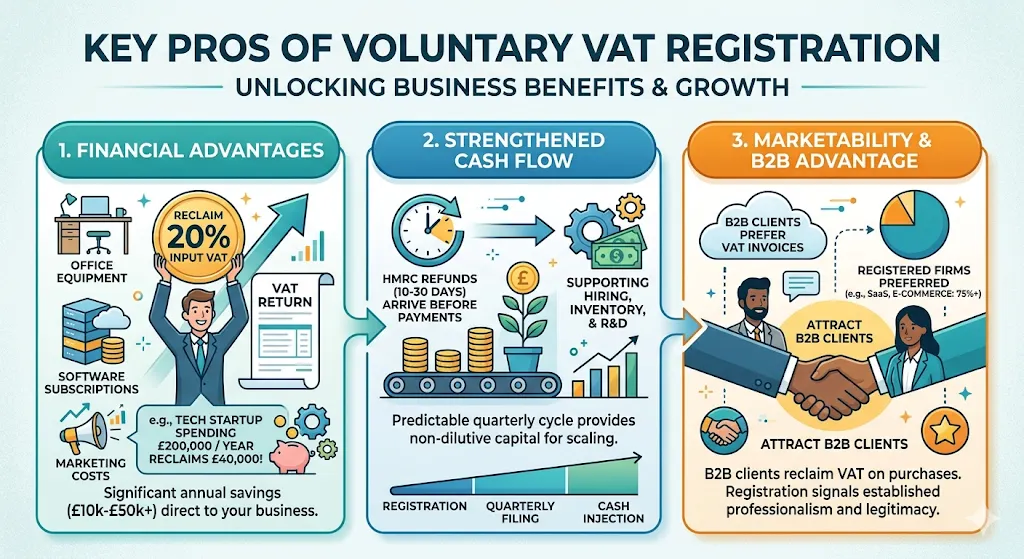
Key pros include reclaiming 20% input VAT on purchases, improving cash flow by £10,000–£50,000 annually for scaling startups, and attracting B2B clients who prefer VAT invoices.
Startups recover VAT on office equipment, software subscriptions, and marketing costs. A tech startup spending £200,000 yearly reclaims £40,000. These funds grow without debt.
B2B clients reclaim VAT on purchases. They favour VAT-registered suppliers. Sectors like SaaS and e-commerce see 75% preference for registered firms. Registration signals professionalism.
Cash flow strengthens as reclaimed VAT arrives before payments. Startups file returns quarterly. HMRC refunds within 10–30 days. This cycle supports hiring and inventory.
How Does VAT Recovery Boost Startup Cash Flow?
VAT recovery injects immediate capital by refunding 20% on business expenses before compulsory threshold. Startups regain £5,000–£20,000 per quarter on average purchases.
Purchases qualify if used for taxable supplies. Startups claim on laptops, cloud services, and travel. HMRC processes refunds electronically. Average refund time drops to 14 days for compliant filers.
Forecast rapid scaling? Register early. A fintech startup recovered £150,000 in year one. This funded product development. Track expenses via accounting software like Xero or QuickBooks.
Why Do Clients Prefer VAT-Registered Startups?
Clients prefer VAT-registered startups because they reclaim 20% input VAT on payments. 82% of UK B2B buyers select registered suppliers for cost savings.
Corporate buyers offset VAT against their liabilities. Unregistered suppliers burden clients with irrecoverable costs. E-commerce platforms mandate registration for marketplaces.
A professional image attracts investors. Venture capitalists view registration as a maturity marker. 65% of funded startups register voluntarily within 18 months.
What Are the Main Cons of Voluntary VAT Registration?
Main cons involve quarterly compliance costs averaging £2,000–£5,000 yearly, charging 20% VAT to customers which risks sales drop, and audit risks from HMRC errors.
Administrative burden rises. Startups file VAT returns every three months. Late filings incur 2%–15% penalties on due tax. 22% of SMEs face penalties annually.
Customers pay 20% more if final consumers. B2C startups lose price competitiveness. E-commerce firms report 10–15% cart abandonment from VAT display.
Audit frequency increases. HMRC inspects 15% of voluntary registrators yearly. Errors in input claims trigger back taxes plus 30% penalties.
How Do Compliance Costs Impact Early Startups?
Compliance costs drain £1,500–£4,000 annually from small teams. Startups hire accountants or use software, diverting funds from core operations.
Quarterly returns demand meticulous records. Software like FreeAgent costs £200–£500 yearly. Accountant fees add £1,200 for basic support.
Time investment equals 5–10 hours per return. Founders juggle this with product launches. Scale too fast? Costs double with complex partial exemption rules.
Why Might Charging VAT Deter B2C Customers?
Charging VAT raises prices by 20% for B2C customers unable to reclaim it. Startups see 12–18% sales decline in consumer markets post-registration.
Retail startups display VAT-inclusive prices. Consumers compare pre-VAT competitors. Fashion e-shops report higher bounce rates.
Mitigate with transparent pricing. List VAT separately for informed choices. Still, 70% of shoppers prefer lower headline prices.
When Does Voluntary VAT Registration Make Sense?
Register voluntarily when taxable turnover nears £85,000 or B2B sales dominate 60%+. Ideal for export-focused or high-purchase startups.
B2B-heavy models thrive. Tech consultancies reclaim vast input tax. Export startups zero-rate sales and fully recover VAT.
High fixed costs justify it. Manufacturing startups offset equipment VAT. Avoid if B2C sales exceed 70% and margins under 25%.
Compare thresholds: compulsory at £90,000. Voluntary starts anytime post-incorporation.
What Steps Follow VAT Registration Approval?
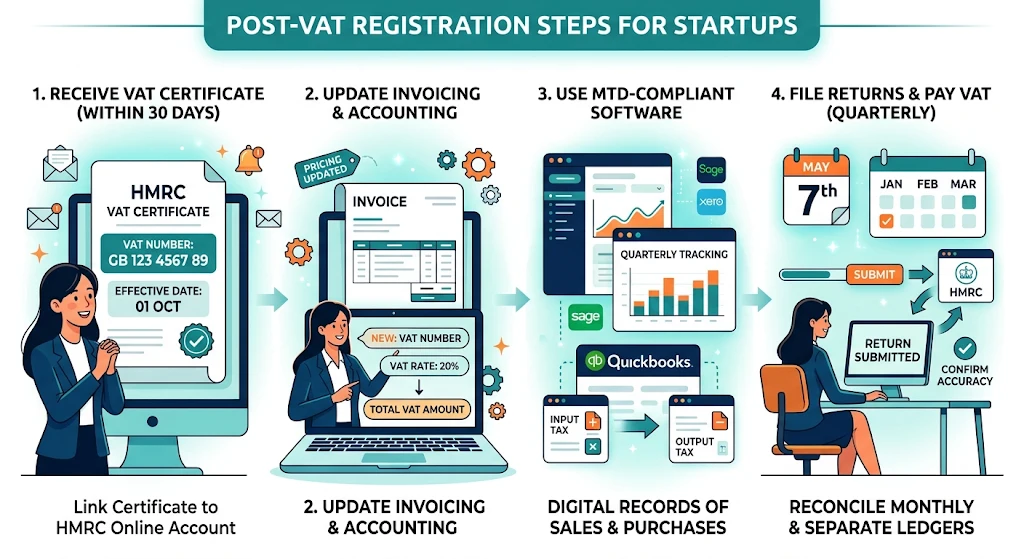
Post-approval, startups issue VAT invoices, track input/output tax quarterly, and file returns by deadlines. Use MTD-compliant software for submissions.
HMRC issues a VAT certificate within 30 days. Update invoices with VAT number and rates. Standard rate applies at 20%.
Install the Making Tax Digital software. Submit returns via the HMRC portal. Pay net VAT by the 7th of next month.
Reconcile accounts monthly. Separate VAT ledgers prevent errors. Annual reconciliation confirms accuracy.
How Does Deregistration Work If Needed?
Deregistration reverses registration if turnover drops below £88,000 for 12 months. Apply via HMRC form to cease VAT obligations.
Submit VAT7 form 30 days before quarter end. HMRC approves if eligible. Final return settles outstanding tax.
Retain records six years. Startups transition back to gross pricing. 18% of voluntary registrants deregister within two years.
Also explore,
Understanding the Current UK VAT Registration Threshold for Growing Small Businesses
Why Your Small Business Might Need to Register for VAT This Year
How Can Startups Minimise VAT Compliance Risks?
Minimise risks with MTD-compliant software, quarterly reconciliations, and professional VAT registration assistance. Accurate records cut audit penalties by 90%.
Choose Sage or VT Transaction+ for automation. Train staff on invoice validation. Conduct internal audits biannually.
Outsource to experts. VAT Registration Assistance from From My Company handles filings accurately.
Deeper insights await in Why Your Growing Business Needs Professional Help with Complex VAT Applications. Startups evaluate next steps there. And Buy Our Comprehensive VAT Registration Package for Total Peace of mind.
Voluntary VAT registration suits B2B-focused early-stage startups with high expenses and growth trajectories. Weigh recovery benefits against compliance demands. From My Company provides VAT registration assistance to ensure seamless compliance. Professional support validates forecasts and files accurately. Startups gain compliance confidence without operational strain.
Frequently Asked Questions
What is voluntary VAT registration for UK startups?
Voluntary VAT registration allows UK businesses to register for VAT before reaching the £90,000 compulsory threshold. Startups use From My Company’s VAT Registration Assistance to reclaim 20% input tax on purchases like equipment and software. This process complies with HMRC guidelines under the VAT Act 1994.
ow long does VAT registration take with HMRC?
HMRC typically approves VAT registration applications within 30 days of submission. From My Company’s VAT Registration Assistance streamlines the VAT1 form and supporting documents for faster processing. Use MTD-compliant software post-approval for seamless quarterly returns.
Can startups deregister from VAT if turnover drops?
Startups can deregister from VAT if projected turnover stays below £88,000 for 12 months by submitting HMRC’s VAT7 form. From My Company’s VAT Registration Assistance guides the process, including final return settlements. Retain records for six years after deregistration.
What are the costs of voluntary VAT registration for small businesses?
Voluntary VAT registration involves quarterly filing costs of £1,500–£4,000 annually, including software and accountant fees. From My Company’s VAT Registration Assistance minimizes these by handling compliance and MTD submissions. Benefits often outweigh costs for B2B startups reclaiming input VAT.
Who needs professional help with UK VAT registration?
Startups with complex supplies, partial exemptions, or rapid growth benefit from professional VAT registration assistance. From My Company verifies eligibility, forecasts turnover, and ensures HMRC compliance. This avoids penalties, which affect 22% of SMEs annually.