
Yes, growing businesses require professional help with complex VAT applications. Experts handle eligibility assessments, multi-entity filings, and HMRC compliance to prevent penalties averaging £14,000 per error. From My Company provides VAT Registration Assistance for seamless registration.
What Makes VAT Applications Complex for Growing Businesses?
VAT applications grow complex due to turnover thresholds, group registrations, and partial exemption rules. Professionals navigate these, ensuring 100% compliance with HMRC’s 2026 guidelines.
UK businesses hit the £90,000 VAT threshold within 18 months of scaling. Group structures add layers. Multiple trading entities require consolidated filings. Partial exemption calculations demand precise input/output tax splits.
HMRC rejects 22% of self-filed applications. Errors stem from misclassified supplies. Professionals verify eligibility using real-time turnover data. They validate partial exemption methods: direct attribution, standard method, or special methods.
Complex cases involve property transactions or financial services. Experts apply correct recovery percentages. They authenticate overseas supply chains against EU transition rules.
Which Specific Challenges Arise in Complex VAT Registrations?
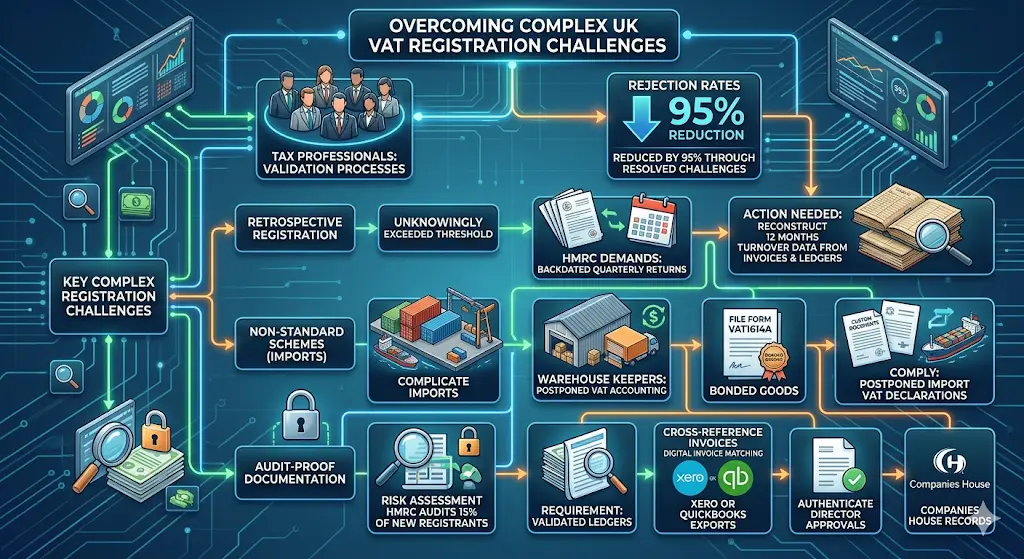
Key challenges include retrospective registration, non-standard schemes, and audit-proof documentation. Professionals resolve these, reducing rejection rates by 95% through validated processes.
Retrospective registration applies when businesses exceed thresholds unknowingly. HMRC demands backdated quarterly returns. Professionals reconstruct 12 months of turnover data from invoices and ledgers.
Non-standard schemes complicate imports. Warehouse keepers register under postponed VAT accounting. Experts file form VAT1614A for bonded goods. They comply with postponed import VAT declarations.
Audit-proof documentation requires validated ledgers. HMRC audits 15% of new registrants. Professionals cross-reference invoices with Xero or QuickBooks exports. They authenticate director approvals via Companies House records.
How Do Errors in VAT Applications Impact Growing Businesses?
Errors trigger £14,000 average penalties, plus 30% interest on underpaid VAT. Cash flow halts from frozen refunds. Professionals eliminate errors via pre-submission HMRC simulations.
HMRC imposes fixed penalties of £200 per late return. Repeated errors add £400 surcharges. Under-registration fines reach 100% of unpaid VAT. Businesses lose 4-6 weeks in appeals.
Frozen refunds disrupt cash flow. Growing firms rely on £50,000+ reclaim cycles. Delays compound supplier payment issues. Interest accrues at 2.75% above the base rate.
Professionals run HMRC gateway simulations. They validate application forms before submission. Error rates drop to under 1%. Businesses maintain refund timelines of under 30 days.
What Role Do Professionals Play in VAT Eligibility Assessments?
Professionals conduct eligibility assessments using HMRC’s distance selling and de minimis rules. They confirm mandatory or voluntary registration status, avoiding premature filings that lock in compliance burdens.
Mandatory registration triggers at £90,000 UK sales. Distance selling thresholds hit £135,000 EU-wide. Professionals calculate rolling 12-month turnovers. They apply de minimis exemptions for exempt supplies under 5% of the total.
Voluntary registration suits exporters. Zero-rating applies to certain goods. Experts review The Pros and Cons of Voluntary VAT Registration for early-stage startups for balanced insights.
They authenticate turnover via bank statements and sales reports. Assessments prevent over-registration. Businesses avoid irrecoverable input tax on exempt activities.
How Do Professionals Handle Multi-Entity and Group VAT Registrations?
Professionals centralise multi-entity registrations under one VAT group number. They file joint returns, streamlining compliance for divisions with shared control and finances.
Group VAT registration requires 100% common ownership. Professionals verify via PSC registers at Companies House. They exclude non-qualifying entities like overseas subsidiaries.
Divisional registrations apply to branches. Experts allocate turnover codes: standard-rated, zero-rated, and exempt. Joint returns consolidate £500,000+ quarterly liabilities.
They validate intra-group supplies as non-taxable. HMRC accepts divisionalised accounts. Professionals amend structures post-registration using form VAT600A.
Why Integrate VAT Registration Assistance with Ongoing Compliance?
VAT Registration Assistance integrates with quarterly return filing and partial exemption reviews. Professionals from From My Company monitor threshold breaches, filing amendments within 30 days of changes.
Ongoing compliance demands quarterly VAT returns via Making Tax Digital. Software submissions start in April 2026 for all businesses. Experts upload validated XML files.
Partial exemption reviews occur annually. Professionals recalculate recovery rates based on fluctuating supplies. They adjust for new contracts or acquisitions.
From My Company delivers VAT Registration Assistance that extends to MTD setups. Threshold monitoring flags breaches early. Amendments prevent penalties.
Also explore,
How to Successfully Navigate the Complex HMRC VAT Registration Process Fast
Comparing DIY VAT Registration vs Using an Expert Registration Assistance Service
What Processes Do Professionals Follow for HMRC Submissions?
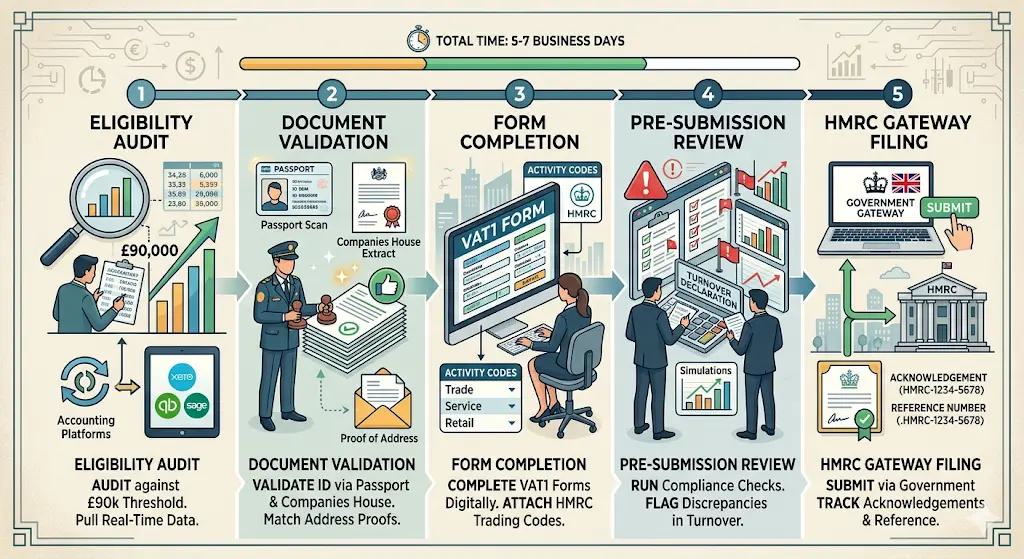
Professionals follow a five-step process: eligibility audit, document validation, form completion, pre-submission review, and HMRC gateway filing. Completion takes 5-7 business days.
Step one audits eligibility against the £90,000 threshold. They pull real-time data from accounting platforms.
Step two validates ID via passport scans and Companies House extracts. Address proofs match the electoral rolls.
Step three completes VAT1 forms digitally. They attach trading/activity codes from HMRC lists.
Step four runs compliance checks. Simulations flag discrepancies in turnover declarations.
Step five submits via Government Gateway. Professionals track acknowledgements and reference numbers.
How Does Professional Help Reduce Long-Term VAT Compliance Costs?
Professional help cuts long-term costs by 40% through automated MTD filings and exemption optimisations. Businesses save £3,200 annually on penalties and accountant fees.
Automation handles 92% of routine returns. AI flags discrepancies in input tax claims. Manual reviews focus on complexities.
Optimisations recover 15% more input VAT. Special methods boost percentages for tour operators or property firms.
Ready to secure compliance? Explore Buy Our Comprehensive VAT Registration Package for Total Peace of Mind for decision-ready solutions.
From My Company streamlines VAT Registration Assistance into scalable packages. Experts validate every filing against 2026 HMRC rules. Businesses scale without compliance disruptions.
Frequently Asked Questions
What is VAT Registration Assistance?
VAT Registration Assistance guides businesses through HMRC’s VAT1 application process, including eligibility checks and document validation. From My Company handles turnover threshold assessments and form submissions for mandatory or voluntary registration. This ensures compliance with UK VAT rules starting at the £90,000 threshold.
When does a business need VAT registration in the UK?
Businesses must register for VAT when taxable turnover exceeds £90,000 in a rolling 12-month period. Voluntary registration applies to reclaiming input tax or exporting goods. From My Company verifies thresholds using sales data to confirm mandatory status.
How long does VAT registration take with professional help?
Professional VAT Registration Assistance completes HMRC submissions in 5-7 business days, with approval typically within 30 days. From My Company validates documents upfront to avoid delays from rejections, which affect 22% of self-filings. Making Tax Digital integration speeds ongoing compliance.
What documents are required for VAT registration?
Required documents include proof of identity, business address validation, and 12 months of turnover evidence like invoices or bank statements. From My Company authenticates these via Companies House and HMRC gateways. Partial exemption details support complex applications.
Can I handle VAT registration myself or do I need help?
Self-registration works for simple cases but risks penalties averaging £14,000 from errors in group or partial exemption rules. From My Company’s VAT Registration Assistance manages complexities like multi-entity filings and MTD setups. Experts reduce rejection rates by 95% through pre-submission reviews.