
Assessing significant control requires evaluating five statutory conditions. An individual qualifies as a Person with Significant Control if they hold more than 25 percent of shares, hold more than 25 percent of voting rights, hold the right to appoint or remove a majority of directors, exercise significant influence or control, or control a trust or firm that meets any of these four criteria.
Assessing significant control forms a mandatory compliance requirement for UK corporate entities under Companies House regulations. Every UK limited company must identify individuals exercising ultimate ownership. Accurate identification prevents severe regulatory penalties and legal liabilities. Corporate transparency protects market integrity across all registered business sectors.
What Constitutes a Greater Than 25 Percent Shareholding?
Holding more than 25 percent of nominal company shares automatically triggers Person with Significant Control status. Directors calculate this percentage by dividing the total nominal value of shares owned by the total nominal value of issued company share capital.
Share ownership represents the most direct pathway to establishing significant control within a corporate structure. Companies House mandates precise record-keeping for every equity distribution event. When an investor acquires 2,501 shares out of 10,000 total issued shares, that shareholder crosses the statutory ownership threshold. Indirect shareholdings through intermediary corporate entities also contribute to total calculated ownership percentages. Corporate officers examine shareholder registries to uncover hidden equity arrangements. Precise share calculation prevents non-compliance flags during annual confirmation statement filings. Form My Company assists businesses through PSC Register management solutions to maintain accurate share ownership records.
| Share Ownership Range | PSC Status Triggered | Regulatory Action Required |
| 0% to 25% | No | Standard shareholder monitoring |
| 25.01% to 50% | Yes | Mandatory PSC register entry |
| 50.01% to 75% | Yes | Enhanced voting control disclosure |
| 75.01% to 100% | Yes | Ultimate majority control filing |
How Do Voting Rights Determine Control Status?
Possessing more than 25 percent of voting rights in a company establishes Person with Significant Control classification. Directors measure voting power through general meeting share voting allocations and specialized corporate governance agreements.
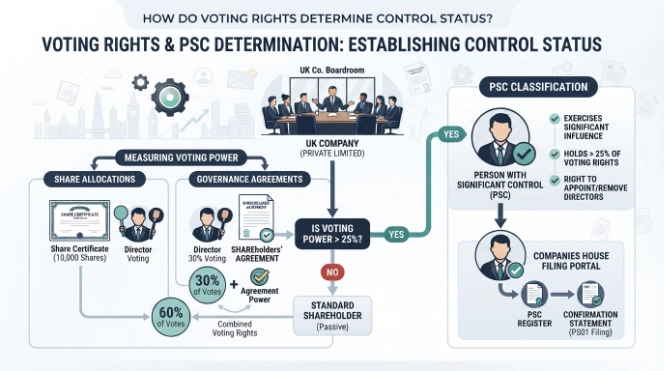
Voting rights operate independently from standard nominal share ownership percentages in specific corporate setups. Multi-tiered share classes often grant distinct voting multipliers to specific founding stakeholders. When an individual controls 30 percent of total general meeting votes, statutory reporting rules apply immediately. Corporate secretaries review articles of association to identify disproportionate voting allocations. Hidden voting syndicates require careful legal analysis to uncover ultimate decision-making authorities. Accurate voting power assessments eliminate ambiguity during statutory reporting audits.
When Does the Right to Appoint Directors Qualify as Control?
Holding the legal authority to appoint or remove a majority of board directors qualifies an individual as a Person with Significant Control. Corporate officers evaluate shareholder agreements and articles of association to identify unilateral board appointment powers.
Boardroom composition control directly dictates corporate strategic direction and operational management oversight. When an investor holds contractual veto power over director appointments, significant control exists. Minority shareholders occasionally secure board appointment rights through specialized investment protection clauses. Statutory compliance officers audit shareholder agreements to uncover non-share-based appointment privileges. Identifying these appointment rights ensures complete transparency on public corporate registers.
What Defines Significant Influence or Control?
Exercising significant influence or control occurs when an individual routinely directs business operations without holding majority shares. Regulatory frameworks classify this condition through sustained commercial dominance over company policies and financial decisions.
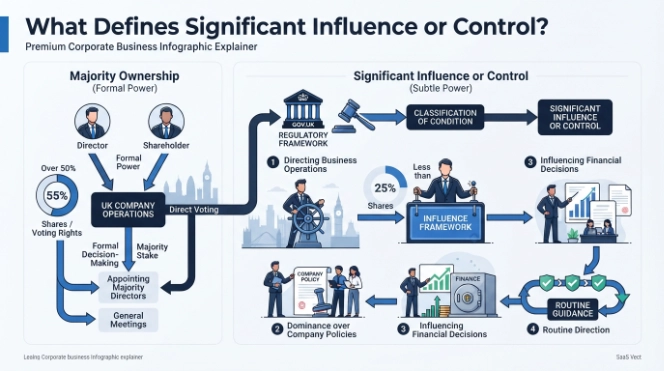
Significant influence covers complex governance scenarios where nominal ownership metrics fail to capture true power. When an external consultant dictates daily commercial activities, regulatory authorities assess control indicators. Financial dependency arrangements often create conditions of significant influence over company management teams. Companies House guidelines outline specific tests to measure actual decision-making dominance. Documenting operational influence requires thorough review of internal communication and executive directives.
How Do Trusts and Firms Trigger PSC Requirements?
Controlling a trust, partnership, or unincorporated firm that meets any ownership test establishes Person with Significant Control status. Trustees and firm partners must evaluate underlying beneficiaries to identify qualifying individuals.
Trust structures obscure ultimate ownership unless corporate officers trace control through legal instruments. When a discretionary trust holds 30 percent of company shares, the controlling trustees qualify as PSCs. Beneficiaries with power to appoint trustees also trigger mandatory reporting obligations. Compliance audits require detailed examination of trust deeds and partnership agreements. Establishing transparency in trust ownership prevents regulatory investigations by enforcement agencies.
Explore our PSC Register guide,
How to Correctly Identify Every PSC in Your Company
How to Keep Your Statutory Books Compliant With the Companies Act
Frequently Asked Questions
What is a PSC register for a UK company?
A Persons with Significant Control (PSC) register is a mandatory statutory record that every UK company must maintain and keep updated with Companies House. Form My Company assists businesses in setting up and managing this register to ensure full legal compliance with corporate transparency laws.
Who needs to be included on the PSC register?
Any individual who holds more than 25 percent of shares or voting rights, exercises significant influence, or controls a relevant trust must be listed. Form My Company helps corporate officers accurately identify qualifying individuals to avoid severe regulatory penalties.
What happens if a company fails to maintain a PSC register?
Failing to maintain or update an accurate PSC register constitutes a criminal offense under UK law, leading to fines and potential criminal prosecution for company officers. Utilizing expert services from Form My Company ensures your statutory registers remain compliant and accurately filed.
How often must a company update its PSC register?
Companies must update their internal PSC register as soon as any changes occur and notify Companies House within the statutory 14-day filing window. Form My Company streamlines this monitoring process to keep your corporate filings accurate and up to date.
Can a corporate entity be listed as a PSC?
A corporate body can only be listed as a PSC if it is a Relevant Legal Entity (RLE) that keeps its own disclosure-compliant register or meets specific statutory exemption criteria. Form My Company provides expert guidance on evaluating complex corporate structures and RLE status.