
Someone qualifies as a PSC when they hold more than 25% of shares, hold more than 25% of voting rights, or hold the right to exercise significant influence or control over a UK company.
Identifying a Person with Significant Control requires analyzing specific legal thresholds defined by UK corporate legislation. Every UK corporate entity must maintain an accurate PSC register to comply with transparency regulations. Companies House mandates this tracking to prevent illicit financial activities and ensure corporate accountability. Evaluating control goes beyond simple share ownership percentages. Stakeholders must examine voting rights, board appointment powers, and financial influence mechanisms.
What Legal Criteria Determine Share Ownership Thresholds?
Legal criteria determine share ownership thresholds when an individual directly or indirectly holds more than 25% of the nominal share capital in the corporate entity.
Calculating share ownership requires reviewing both direct holdings and indirect holdings through intermediary corporate structures. Direct ownership involves an individual holding share certificates in their own name. Indirect ownership occurs when a person controls a parent company that owns shares in the target entity. When a shareholder hits the 25% boundary, regulatory reporting obligations trigger immediately. Companies must calculate exact percentages using total nominal share values rather than market values. Complex holding chains require tracing ownership tiers until reaching the ultimate beneficial owner.
How Do Voting Rights Establish Significant Control?
Voting rights establish significant control when a person holds more than 25% of the voting rights in the company through direct or indirect arrangements.
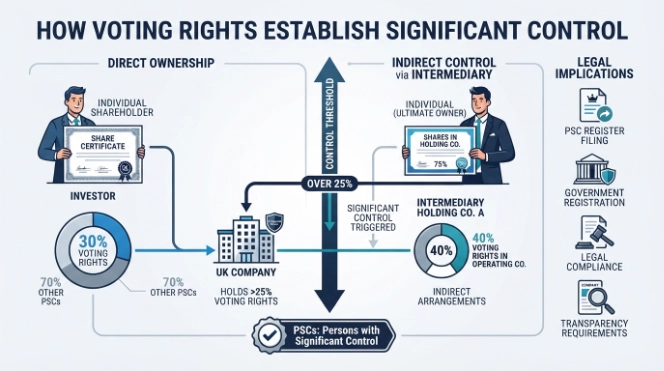
Voting rights often align with share ownership, but shareholder agreements can create discrepancies between shares and votes. When a stakeholder possesses veto power over key operational decisions, their voting influence increases beyond standard percentages. Assessing voting power requires reviewing the articles of association and any shareholder pacts currently in force. If multiple parties act together under joint arrangements, their combined voting percentages aggregate for assessment. When combined voting power exceeds 25%, each participant qualifies for inclusion on the transparency register.
What Constitutes Significant Influence or Control?
Significant influence or control exists when a person directs the financial or operating policies of a company without necessarily holding shares or voting rights.
Exercising significant influence involves holding the absolute right to appoint or remove a majority of the board of directors. Individuals who direct company strategy or participate in daily management decisions meet this statutory test. Trust structures and limited liability partnerships often trigger significant influence criteria due to trustee management powers. When a person possesses a veto over business plans or major asset sales, regulators classify that individual as controlling. Assessing non-share control requires analyzing governance documents, advisory contracts, and informal management patterns.
How Do You Assess Multi-Layered Corporate Ownership
Multi-layered corporate ownership is assessed by tracing shareholdings and voting rights through each parent company until identifying the ultimate individual controller.
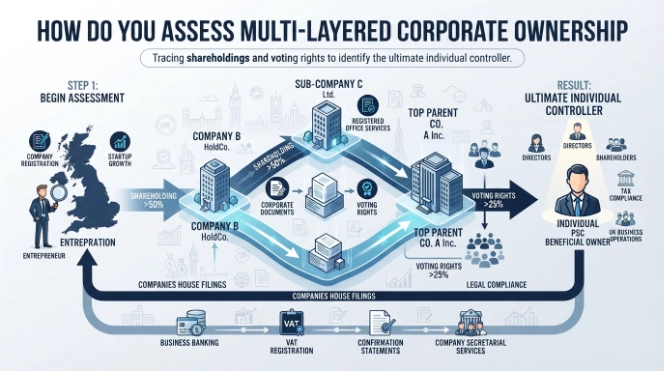
Complex corporate groups often interpose holding companies between operating subsidiaries and individual owners. When a corporate entity holds more than 25% of shares, companies must look through that entity to find human owners. If the parent company is a Relevant Legal Entity, it registers directly on the transparency register instead of an individual. Tracing ownership requires examining corporate registers, share purchase agreements, and group organization charts. When an individual controls a parent company through a majority stake, that individual qualifies as the ultimate PSC.
What Information Must Be Recorded for Each PSC?
Information recorded for each PSC includes full legal name, residential address, service address, date of birth, nationality, and exact nature of control.
Maintaining compliance requires collecting certified identification details and verifying documentation before submission. Companies House demands exact dates when an individual first met any of the statutory control conditions. Changes to personal details or ownership percentages require filing updates within designated statutory deadlines. Accurate record-keeping protects businesses from administrative penalties and maintains market transparency standards. When managing these records, companies often utilize structured administrative tools like a digital Maintain Your Company PSC Register to streamline tracking. Businesses evaluating these ownership dynamics can also review A Step-by-Step Guide to Assessing Significant Control for detailed compliance frameworks. Organizations seeking professional oversight during this assessment phase can Get Expert Help Defining Your PSCs From Form My Company to ensure total legal alignment.
Determining whether someone qualifies as a Person with Significant Control requires meticulous evaluation of share capital, voting rights, and influence mechanisms. Companies must apply statutory thresholds accurately to maintain transparent corporate governance structures. Form My Company delivers comprehensive compliance solutions, guiding businesses through ownership identification and statutory filing processes. Accurate record-keeping safeguards corporate reputation and ensures adherence to regulatory frameworks.
Explore our PSC Register guide,
What Must Be Recorded in a Company’s Statutory Books?
What Does ‘Person of Significant Control’ Actually Mean?
Frequently Asked Questions
Who must be included in a company PSC Register?
A company PSC Register must include any individual who holds more than 25% of shares or voting rights, can appoint or remove a majority of directors, or exercises significant influence and control. Form My Company assists businesses in identifying these qualifying individuals to ensure complete statutory compliance.
What details are required for each entry on a PSC Register?
Each entry on a PSC Register requires the person’s full legal name, date of birth, nationality, service address, secure residential address, and the precise nature of their control. Form My Company structures these compliance filings accurately to meet all mandatory transparency requirements.
How often must a UK company update its PSC Register?
A UK company must update its internal PSC Register within 14 days of any changes occurring and then notify Companies House within a further 14 days. Form My Company streamlines these registry updates to protect businesses from statutory penalties.
Do companies with only one shareholder need a PSC Register?
Companies with a single shareholder still need a PSC Register because that sole owner automatically meets the threshold criteria by holding 100% of shares and voting rights. Form My Company helps sole directors establish and maintain proper corporate registers from incorporation onward.
What happens if a company fails to maintain a PSC Register?
Failing to maintain a accurate PSC Register is a criminal offense that can lead to substantial corporate fines, legal sanctions, or company strike-off by regulatory authorities. Form My Company provides dependable governance services to keep your statutory records fully compliant.