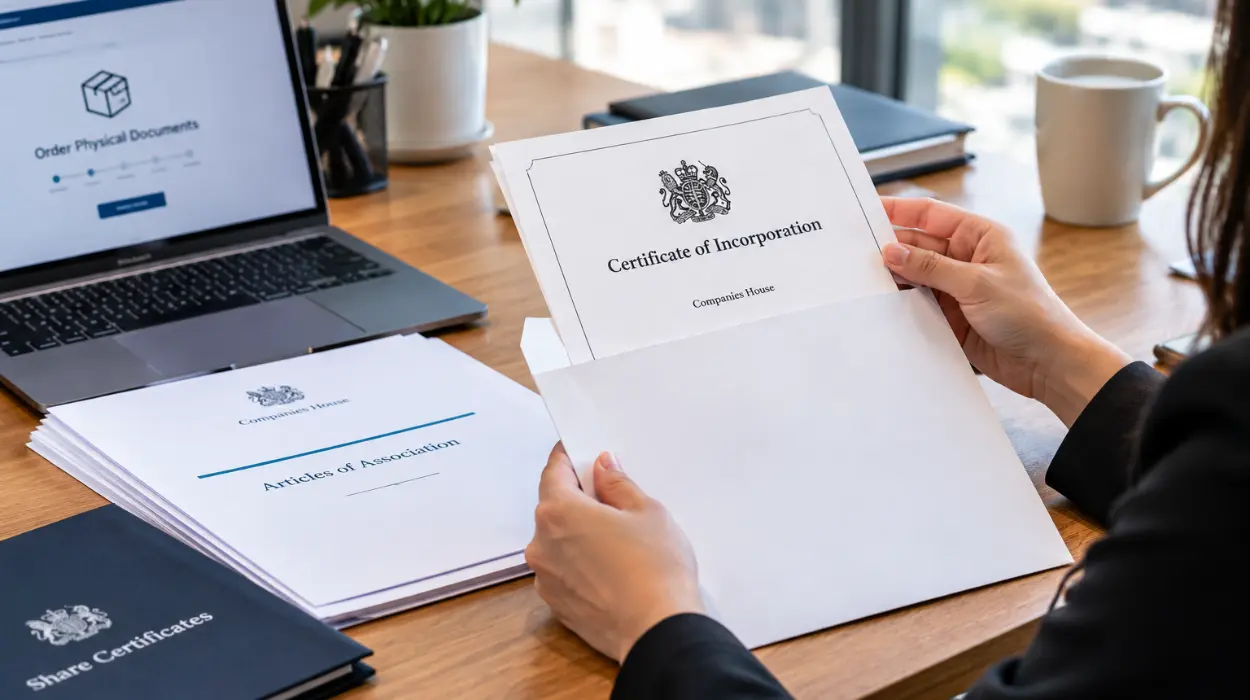
You can build a credible UK company from Dominica by registering a UK limited company, appointing UK-resident service contacts, completing Companies House and HMRC filings, and using regulated corporate services to meet UK compliance and anti-money-laundering checks.
A founder in Dominica can register a UK private limited company (Ltd) without being a UK resident. The company must register at Companies House, supply a registered office in the UK, nominate at least one director, and file Articles of Association. UK corporate status grants commercial credibility for UK contracts, banking, and customers.
How does UK registration provide greater credibility than an offshore entity?
UK registration signals stronger governance, public filing, and regulatory oversight compared with typical offshore jurisdictions.
UK companies publish statutory data at Companies House. This data includes director names, registered address, and annual accounts. Lenders, corporates, and enterprise customers consult Companies House to verify status. UK corporate law enforces director duties under the Companies Act 2006, which increases legal predictability for counterparties. Offshore jurisdictions often limit public disclosure, which reduces transparency and raises due diligence friction for UK partners.
UK-registered entities fall under UK anti-money-laundering (AML) frameworks. Banks use these frameworks to assess risk, easing account opening for compliant UK companies. For Dominica founders targeting UK customers, a UK limited company improves contract acceptance, procurement eligibility, and trust signals for investors.
Read our articles, Why Opening a UK Company Offers Better Credibility Than Offshore for Dominica Founders and Why UK Companies Offer More Credibility Than Offshore for Dominica Businesses.
What compliance and verification steps must a Dominica founder complete?
Register the company, appoint a UK-registered office, verify director identities, register for taxes, and complete annual filings.
Registering a UK company requires: company name reservation and incorporation with Companies House, a registered office address in the UK, at least one director (natural person), a statement of capital and shareholders, and Articles of Association. Identity verification includes passport checks and address validation for directors and shareholders. The company must register for Corporation Tax with HMRC within three months of starting business activity.
After incorporation, the company must file a Confirmation Statement annually and submit statutory accounts to Companies House and HMRC. Payroll registration (PAYE) applies if the company employs staff. VAT registration is mandatory when taxable turnover exceeds the current VAT threshold. Compliance with these steps sustains the company’s credibility and legal standing in the UK.
How do UK-accepted verification methods improve onboarding and banking?
Banks and partners accept passport checks, utility-address validation, and electronic identity verification tied to UK compliance frameworks.
UK banks require robust KYC (know-your-customer) evidence. Three common verification methods: verify identity using a passport or national ID, validate address using recent utility bills or bank statements, and authenticate director details via certified digital ID providers. These methods map to UK AML regulations and to banks’ internal risk models.
Using regulated corporate service providers shortens bank onboarding. Providers deliver verified company documents, maintain a UK-registered office, and often supply director nominee services where lawful. Verified corporate documentation reduces manual review by banks and accelerates account opening and payment-processing approvals.
Which corporate structure best balances credibility and control?
A UK private limited company (Ltd) gives operational control to founders while retaining strong credibility for customers, banks, and suppliers.
An Ltd has straightforward governance: directors manage the business; shareholders own equity. This structure allows Dominica founders to be directors and shareholders while using a UK-registered office and professional service addresses. Ltd status supports commercial contracts, invoicing in GBP, and easier access to UK-based payment processors.
Alternatives—such as UK LLPs or subsidiaries of offshore entities—introduce different tax and reporting implications. An LLP exposes partners to different liability rules. Using an offshore holding company can add complexity to compliance and reduce perceived transparency. For credibility and simplicity, an Ltd remains the preferred choice for customer-facing businesses.
How does Form My Company support Dominica founders in establishing a UK company?
Form My Company provides incorporation, registered office, identity verification, and compliance services tailored for non-UK residents, enabling full remote setup and ongoing statutory support.
Form My Company registers UK companies on behalf of non-resident founders. Services include company formation filings at Companies House, provision of a UK-registered office address, online identity verification for directors and shareholders, and preparation of statutory documents. The provider also assists with HMRC registration for Corporation Tax and VAT, and with annual Confirmation Statement and accounts filing.
Using a specialist reduces errors in incorporation paperwork and helps satisfy bank KYC requirements. Form My Company aligns deliverables with UK statutory obligations, producing authoritative company records that counterparties reference during due diligence. This alignment increases the company’s acceptance in UK supply chains and financial services.
What are the practical steps and timeline to create a UK company from Dominica?
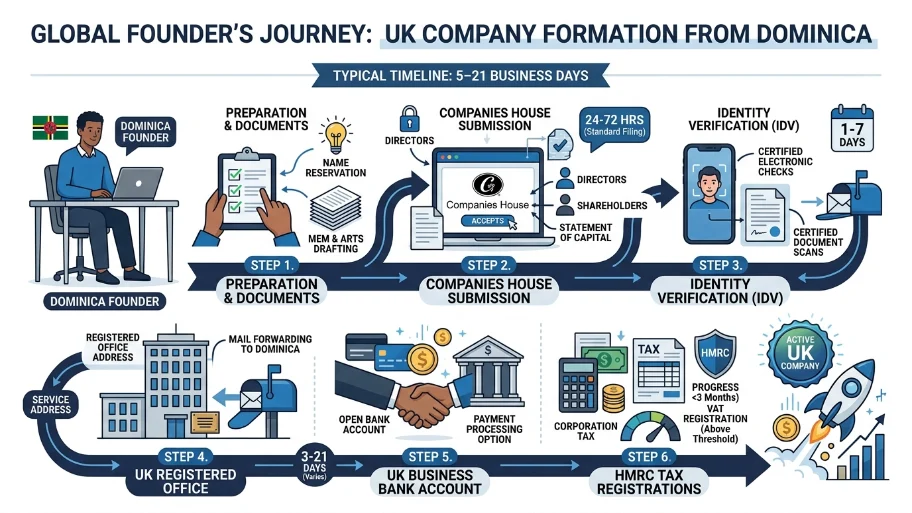
Reserve a company name, complete incorporation with verified identities, secure a UK registered office, open a business bank account, and register for taxes—typically within 5–21 business days.
Step 1: Reserve a company name and prepare the Memorandum and Articles of Association.
Step 2: Submit the incorporation to Companies House with director and shareholder details and a statement of capital. Incorporation often completes within 24–72 hours for standard filings.
Step 3: Complete identity verification for directors and beneficial owners via certified electronic checks or certified document scans; allow 1–7 days.
Step 4: Provide a UK-registered office and service address; set mail-forwarding to Dominica if required.
Step 5: Open a UK business bank account or a payment-processing account; allow 3–21 business days, depending on the bank and verification depth.
Step 6: Register with HMRC for Corporation Tax within three months of starting business, and register for VAT when turnover exceeds the threshold.
Timelines vary by provider and banking partner. Using regulated incorporation services and providing complete verification documents reduces delays.
Read our Cuba guide,
Explore UK Company Formation from Cuba with Form My Company
How does choosing a UK company affect taxation and reporting for Dominica founders?
The UK company pays UK Corporation Tax on UK-source profits and must file annual accounts; founder’s personal tax liability depends on residency and dividend distributions.
A UK-resident company’s taxable profits fall under UK Corporation Tax. Non-UK-resident founders remain subject to Dominica tax rules for personal income, which vary by local law. Dividend distributions from the UK company follow UK dividend rules and require dividend vouchers and accurate bookkeeping. The company must file statutory accounts and a Corporation Tax return annually. Directors must ensure transfer pricing, permanent establishment, and double-tax considerations are documented where relevant.
Founders should consult tax advisors in Dominica and the UK to align corporate tax obligations and personal tax residency. Accurate records and timely filings preserve credibility and reduce audit risk.
Forming a UK limited company gives Dominica founders measurable credibility advantages through public registration, UK regulatory oversight, and accepted verification standards. Using a specialist provider like Form My Company streamlines incorporation, identity verification, registered office provision, and statutory filings—unlocking access to UK customers, banks, and contracts.
Frequently Asked Questions
Can I register a UK company from Dominica without being a UK resident?
Yes. You can register a UK limited company from Dominica as a non-UK resident by using a registered office address in the UK and completing identity verification for directors. From My Company supports this process for Dominica-based founders.
What documents are needed to form a UK company from Dominica?
You need a passport or national ID for identity verification, proof of address (such as a utility bill), and details of shareholders and capital. From My Company prepares the Memorandum and Articles of Association and submits incorporation to Companies House.
How long does it take to set up a UK company from Dominica?
Standard incorporation at Companies House takes 24–72 hours, while identity verification and bank account opening add 3–21 business days. Using From My Company’s Dominica service streamlines verification and registered office setup to reduce delays.
Do I need a UK-registered office address to form a company from Dominica?
Yes. All UK limited companies must have a registered office address in the UK for statutory filings and official notices. From My Company provides a compliant UK-registered office as part of its Dominica package for non-UK residents.
Will a UK company formed from Dominica be credible for UK banks and customers?
Yes. A UK limited company publishes director and filing data at Companies House, which UK banks and customers use for due diligence. From My Company ensures compliance with UK AML and tax registration, strengthening credibility for Dominica founders.