

The registration form is only one part of starting a limited company. A checklist for starting a limited company in 2026 should cover your legal structure, startup costs, identity verification, insurance, licences and health and safety. Directors and people with significant control should check the identity-verification steps required before a company is incorporated.
The process can feel like a long list of unfamiliar tasks, but putting them in order makes each decision easier to manage. This guide explains what to consider before registration and which practical checks to make as you prepare to launch.
Work through the essentials: choose a structure, plan your budget, identify the people involved and check the requirements that apply to your activities. This gives you a clear route from business idea to launch.
Key Takeaways
- Choose the legal structure that suits how you plan to run the business before settling on a name and registering.
- New limited company directors and people with significant control must verify their identity and obtain a Personal Code before incorporation.
- Build a startup budget around your expected costs and funding sources, and plan for the financial demands of launch.
- Check which insurance, licences, health and safety measures and environmental requirements apply to your business activities and premises.
- Before registering, prepare a unique company name and a registered office address for the company.
Companies House identity verification
Build identity verification into your company formation checklist. Companies House identity verification began on 18th of November 2025. Every new limited company director and person with significant control (PSC) must verify their identity and obtain a Personal Code before incorporation. Existing directors and PSCs must also complete verification.
Identity verification links each director or person with significant control (PSC) to a real individual, helping keep Companies House records accurate. Complete verification for every relevant person, not only the lead director. A PSC has significant influence or control over the company, so identify who meets this definition before registration. Keep each person’s Personal Code secure for future filings.
Use the available identity verification service for directors or PSCs as part of your preparation. Follow its steps for each person who needs verification, and allow time for everyone to finish before incorporation. A company cannot be incorporated until its new directors and PSCs have completed the required identity checks and obtained their codes.
What information and documents are needed to form a UK limited company? Prepare a unique proposed company name, a registered office address, details for the people involved, and each new director’s and PSC’s Personal Code. Follow the Companies House application prompts for the specific information and documents required for your company.
What are the rules for choosing a company name and registered office address? A UK limited company needs a name that can be registered and a registered office address. Choose an address that can reliably receive official company communications and is appropriate for the company’s registered jurisdiction.
What taxes must a new limited company register for, and what are the deadlines? VAT registration is required when taxable turnover exceeds £90,000 in a rolling 12-month period, according to HM Revenue & Customs. Tax registrations and filing dates depend on the company’s activities and circumstances, so record the deadlines assigned to it.
What annual accounts, confirmation statements, and Companies House filings must a company submit? Plan to file annual accounts and a Confirmation Statement, and update Companies House when company details change. Directors must provide their Personal Code when filing a Confirmation Statement.
What are the risks and penalties for missing UK company filing and tax deadlines? Late filings can put the company out of compliance and may have financial or other consequences. Keep a calendar of Companies House and HMRC deadlines, and assign responsibility for each filing.
How do I set up a business bank account and keep company finances separate? Open a separate business bank account for company finances, as a UK limited company must keep its finances separate. Pay company income into that account and use it for company spending, rather than mixing transactions with personal funds.
Insurance, licences and health and safety
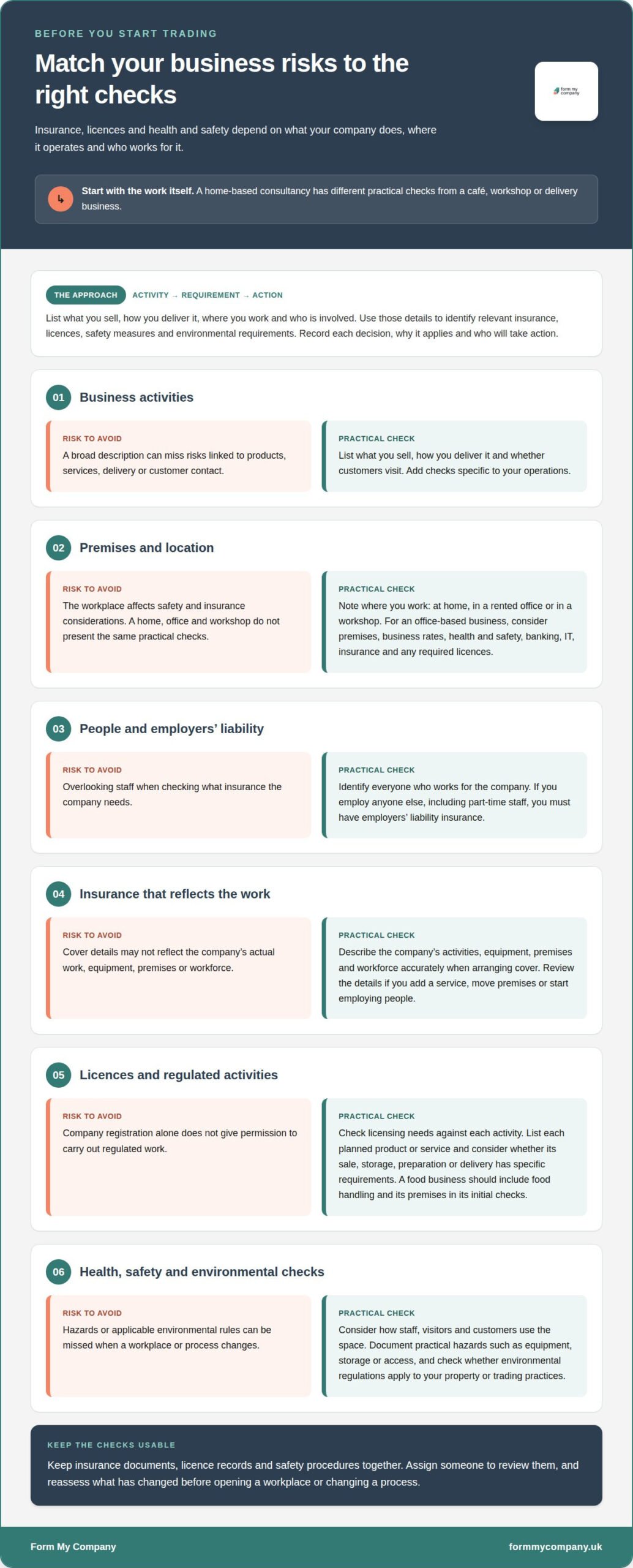
Match each requirement to your activities, premises and staff before trading. A home-based consultancy has different practical checks from a café, workshop or delivery business. Consider the work, equipment, customer contact and workplace when identifying relevant insurance, licences and safety measures. Record each decision, the reason for it and who will take action.
For an office-based business, consider premises, business rates, health and safety, banking, IT, insurance and any required licences. Treat these as starting points and add checks specific to your operations. A business that stores stock, serves food or welcomes customers on site should assess the risks and requirements for those activities.
- List your business activities. Include what you sell, how you deliver it and whether customers visit, so you can identify activity-specific risks.
- Review your premises. Note whether you work from home, rent an office or use a workshop, because the location shapes safety and insurance considerations.
- Identify who works for the company. If you employ anyone else, including part-time staff, you must have employers’ liability insurance.
- Check licensing needs against each activity. For example, selling a regulated product or running a particular type of venue may involve requirements beyond registering the company.
- Assess workplace health and safety. Consider how staff, visitors and customers use the space, and document practical hazards such as equipment, storage or access.
- Consider environmental rules. Check whether environmental regulations apply to your business property or trading practices.
Choose insurance that reflects the company’s actual work. A home-based designer, a business storing goods and a firm sending staff to customer sites face different risks. Describe the company’s activities, equipment, premises and workforce accurately when arranging cover. Review the details if the business adds a service, moves premises or starts employing people.
Licensing requirements depend on the activity, not limited-company status alone. List each planned product or service, then check whether its sale, storage, preparation or delivery has specific requirements. For example, a food business should include food handling and its premises in its initial checks. Incorporation itself does not grant permission to carry out regulated work.
Make your checks part of day-to-day operations. Keep insurance documents, licence records and safety procedures together, and assign someone to review them. Before opening a workplace or changing a process, assess what has changed and update the relevant records. This turns a launch checklist into a practical system for managing the company’s premises, people and activities.
and make them easy to review before accepting work. For a US trucking operation, build timing into the launch plan: motor carrier authority has a mandatory 21-day waiting period after insurance is filed before it becomes active. Most US brokers and shippers require trucking cargo insurance of at least $100,000. Confirm that the selected policy matches the freight and requirements involved, and retain evidence of cover for checks.
Startup costs and common launch mistakes
Build a startup budget around the work required to launch and operate, not registration alone. List premises, equipment, stock, software, insurance, licences, marketing and professional support where relevant. A home-based consultancy may need different resources from a café buying kitchen equipment and ingredients. Separate one-off purchases from regular operating costs to make cash needs easier to plan.
Consider possible funding sources, including personal savings, support from family and friends, high street banks and other options. Compare each with your expected cash flow and any repayment commitments. The Government’s Start Up Loan Fund provides advice, loans and mentoring to start-up businesses. Include funding decisions in your plan alongside expected sales and the costs of delivering them.
Plan for the realities of early trading. Customers may take time to find you, while rent, supplies and software still need paying. Estimate when money may come in and when bills are due, then identify costs that can wait until demand is clearer. For example, a new retailer could prioritise essential stock and payment systems before committing to larger premises.
Planning helps founders anticipate difficulties and consider finance suited to their needs. Use a business plan to set objectives, priorities and strategies for the next one or two years. Cover the business idea, costs and pricing, customers, sales methods and research. A clear plan also explains to lenders and potential supporters how the business will operate.
- Keep business and personal records separate. Track company income, purchases and funding independently, so you can see the business’s position clearly.
- Budget for the whole launch. Include setup items and recurring commitments, rather than focusing only on equipment or registration.
- Test assumptions before committing. Estimate customer demand and sales timing before taking on costs that are difficult to reduce.
- Set aside time for administration. Include tax registration, insurance and licence checks in the launch plan, not as last-minute tasks.
What are the 2026 Corporation Tax rates and VAT registration threshold in the UK? Corporation Tax applies to taxable profits, and the applicable rate depends on the company’s circumstances. According to HM Revenue & Customs, VAT registration is required when taxable turnover exceeds £90,000 in a rolling 12-month period.
A common mistake is treating turnover as money available to spend. Set aside funds for operating costs and tax obligations, and update your forecast when actual sales differ from expectations. A limited company’s Corporation Tax is based on taxable profits, not simply sales receipts. Keep reliable records of income and allowable business costs to support accurate reporting.
The East Midlands Combined County Authority checklist suggests considering personal savings, support from family and friends, high street banks and other sources when financing a business. Assess each option against the amount needed and its commitments rather than assuming one route suits every launch. Compare the alternatives with your budget and expected cash flow, keeping repayment obligations in view.
Choosing a legal structure
Choose the legal format before settling on a business name or starting registration. A practical checklist for starting a limited company 2026 begins with the business model, ownership plans and how you expect to trade. Your choice affects how the business is organised, who is involved and which records and responsibilities apply. Compare the options against your business idea, customers and plans for growth.
The main options include operating as a sole trader, forming a limited company or setting up a partnership. Sole trader status may suit someone building a business alone; a partnership may fit people planning to run a venture together. A limited company is a separate structure registered as a company. These options are not interchangeable, so consider which reflects your working arrangement.
Make the decision practical by writing down how the business will operate. For example, if two founders will share decisions and responsibilities, record how they expect to work together. If one founder will drive the business, clarify who owns it and who makes operational decisions. A checklist for starting a limited company 2026 can help organise these decisions before registration, rather than treating the legal format as a box to tick.
What are the director, shareholder and person with significant control requirements? Directors manage the company, shareholders own its shares, and a person with significant control (PSC) has significant influence or control. Identify everyone taking these roles and record their details accurately. Each director and PSC must complete Companies House identity verification.
- Map the people involved. List who will make decisions, own shares or exercise significant control, so the proposed structure reflects the actual arrangement.
- Consider how the business will trade. A freelance consultant, a retail venture and a business run by several founders may need different ownership arrangements.
- Plan for future changes. Consider whether ownership or decision-making might change as the business grows, and agree how founders expect to manage those changes.
- Account for administration. A limited company has registration and ongoing filing responsibilities, so include these alongside the practical demands of launch.
Base the decision on how the business will operate. A shop with two founders, for example, should consider how ownership and responsibilities will be shared. A solo designer should assess whether working alone or forming a company better suits their plans. The legal structure should reflect the actual business arrangement, not just a preferred name or software option.
Once you have chosen a structure, use it consistently in your plans and registration details. If you form a limited company, identify its directors, shareholders and any PSCs before filing. Decide on the legal structure before choosing a name and registering. This helps align the business idea, ownership and registration from the outset.
Registering a limited company with Companies House in 2026
Prepare the key details before submitting your company registration. A UK limited company needs a registrable name and a registered office address. You’ll also need details of the people involved, including directors, shareholders and anyone with significant control. Check that the information matches across your formation documents and application.
Identity verification is part of the 2026 registration process. New directors and people with significant control must verify their identity and obtain a Personal Code before incorporation. Have each person complete this step before the application is submitted, so the registration does not stall while someone is still verifying.
Use this sequence to organise the application:
- Settle the company name. It must be unique when registered, so prepare an alternative in case your first choice is unavailable.
- Choose the registered office address. The company must provide one as part of registration, so decide which appropriate address to use before filing.
- Confirm the people and roles. Check the proposed director, shareholder and significant-control details against the company’s planned ownership and management.
- Complete identity verification. Each new director and PSC needs a Personal Code before the company can be incorporated.
- Submit the application to Companies House. Enter the company and people’s details carefully, then review the application for omissions or inconsistencies.
A registered office address is the company’s official address for formal communications. Choose one where correspondence can be received and handled reliably. Keep the details accurate in your application, as Companies House includes the registered office in the company’s public record. A trading address and registered office serve different purposes, so consider how each will be used.
Before submitting, check each field against the decisions you have made. If two people will own shares, for example, make sure the application reflects the intended ownership. Check the spelling of names and addresses, and confirm each person’s role. Accurate information from the outset helps keep company records consistent after incorporation.
Registration starts the company’s formal record, but administrative responsibilities continue afterwards. Keep a copy of the submitted information and securely note the Personal Codes used during filing. Directors must provide their Personal Code when filing a Confirmation Statement, so good record-keeping remains useful after incorporation.
If you’re ready to organise the formation details and submit your application, start your company formation.
Form My Company
Form My Company helps you move from choosing a structure to registering your new business. Its company formation packages include Digital, Digital & Print, and Entrepreneurs Choice options, alongside formation for limited liability partnerships. Consider the structure and formation support that fit your plans, then prepare the company details and identity verification steps required for registration.
Ready to put your launch plans into action? Contact Form My Company to choose a formation package and start your company registration.
Take the next step towards launch
Turn your plans into a clear set of formation decisions. Use your checklist for starting a limited company in 2026 to organise the information needed for registration and choose support that fits your preferred format. Form My Company offers a Digital Package, Digital & Print Package and Entrepreneurs Choice Package for company formation.
You do not need to settle every detail of future operations before taking the next step. Start with the structure and formation information you have prepared, then build a practical plan for launch. A clear starting point leaves more time to focus on developing the business.
Contact Form My Company today to discuss your company formation. Your next step can be a confident one.
Frequently Asked Questions
How much does it cost to set up a limited company in the UK in 2026?
There’s no single total for every business. Costs depend on your registration route, whether you use formation support, and practical choices such as a registered office address or printed documents. Formation-service pricing depends on the case and is provided after a quote request. Also budget for the costs of preparing to trade, such as equipment, stock, software, premises and insurance where they apply.
What insurance, licences, and data protection rules may apply to a new UK company?
Requirements depend on your activities, staff and premises. Employers’ liability insurance is required if you employ anyone else, including part-time staff. A food business should consider requirements for food handling and its premises. If your website collects personal information, include a privacy policy explaining how you handle it and addressing GDPR compliance. Also consider whether environmental regulations apply to your property or trading practices.
What are the main differences between running a limited company and being a sole trader?
A limited company is a registered business structure with company records and filing responsibilities; a sole trader runs a business personally. A company must keep its finances separate, so record company income and spending distinctly from personal transactions. A sole trader who does not already have a Unique Taxpayer Reference must register with HMRC to obtain one. Consider the administration involved alongside your ownership and trading plans.


