
Your choice of legal entity is more than just a box-ticking exercise; it’s the foundation of your financial security and your most powerful tax-planning tool. Choosing a business structure uk founders can rely on is often the most stressful part of the startup journey, especially with the latest compliance checks from Companies House. It’s natural to worry about personal liability for debts or the complexity of reporting duties. You want to focus on your vision, not spend your nights deciphering the difference between a 19% or 25% Corporation Tax rate.
We understand that you need a setup that’s robust yet flexible enough to evolve as you scale. This guide removes the intimidation factor from UK business legalities, providing a clear path to selecting a structure that protects your assets and optimises your growth. We’ll compare the practical benefits of Ltd, LLP, and PLC models, whilst showing you how to secure your privacy from the moment you register. By the end of this article, you’ll have a streamlined plan to launch your venture with total confidence.
Key Takeaways
- Learn how to shield your personal wealth by establishing a separate legal personality for your venture.
- Compare the distinct advantages of Ltd, LLP, and PLC entities to ensure you are choosing a business structure uk investors and partners will value.
- Evaluate tax efficiencies and reporting duties using a decision matrix designed for modern founders.
- Master the 2026 digital formation process whilst protecting your personal data from public records.
The Core Business Structures in the UK Explained
Selecting the right vehicle for your venture is the first major hurdle you’ll clear. When choosing a business structure uk founders must weigh up administrative ease against long-term scalability. For a foundational overview, you can review UK Business Structures Explained to see how these entities apply across the country. The primary options include operating as a sole trader, a partnership, or a limited company.
A critical concept to grasp early on is “separate legal personality”. This means the business exists as an entity distinct from you. If you form a company, its bank account is its own; if you stay as a sole trader, you and the business are legally one and the same. This distinction dictates how much of your personal wealth is on the line if things go wrong.
You’ll deal with two main bodies throughout your business life. HMRC handles your tax, whilst Companies House manages the public record of your business existence. Getting this right from day one prevents a backlog of paperwork that could stifle your growth. Each structure carries different reporting duties, ranging from simple annual tax returns to complex statutory accounts.
Investors rarely back individuals. They back structures. A limited company allows you to issue shares, making it the only viable choice if you plan to raise venture capital later. If you start with the wrong setup, you might find yourself undergoing a costly and time-consuming restructuring process just when you need to be focusing on your seed round.
The Sole Trader: Simplicity vs Personal Risk
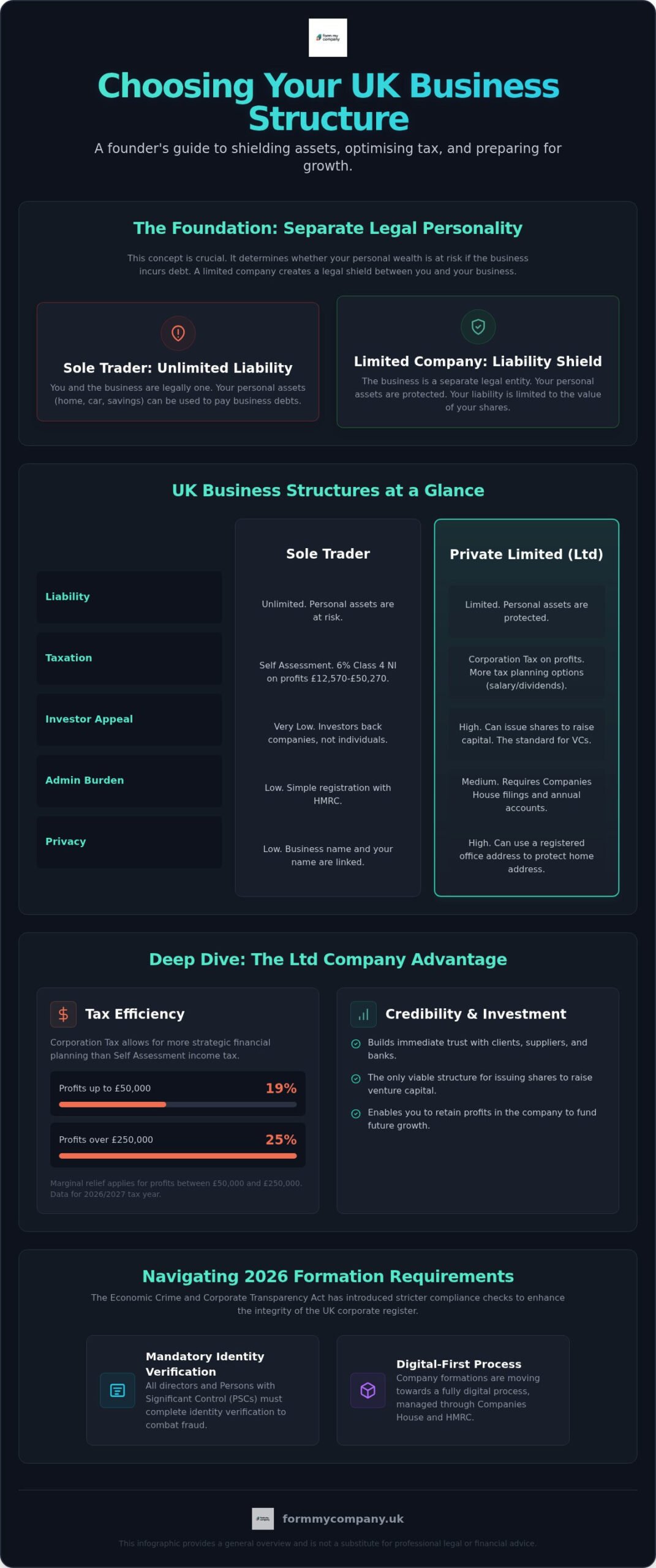
This is the quickest route to market. You register with HMRC, keep records of your income, and pay tax through Self Assessment. For the 2026/2027 tax year, self-employed individuals pay Class 4 National Insurance at 6% on profits between £12,570 and £50,270. However, this simplicity comes with a heavy price: unlimited liability. If your business faces a lawsuit, your personal assets, including your home and car, are at risk. Most brands use this as a temporary stepping stone before switching to a more secure model.
The Limited Company: The UK Business Standard
A private limited company (Ltd) is the gold standard for protection. By capping your liability to the value of your shares, you safeguard your personal wealth. In this structure, you act as a director to manage the company and a shareholder to own it. This professional setup builds immediate trust amongst clients and suppliers. With the 2026 Corporation Tax rates set at 19% for profits under £50,000, it also offers strategic tax advantages over the sole trader model as you scale. To get started quickly, you can explore our packages to find a formation route that suits your budget.
Deep Dive: Is a Private Limited Company (Ltd) Right for You?
For many founders, choosing a business structure uk relies on finding the right balance between liability protection and tax savings. Moving from a sole trader setup to a limited company is a logical step as turnover increases. This transition involves more than just a name change; it requires the formal transfer of business assets and a new relationship with HMRC. Whilst the administrative load is higher, the “limited” status means your personal finances remain separate from business debts, a safety net that every growing brand needs.
Compliance in 2026 is stricter than in previous years. Following the introduction of the Economic Crime and Corporate Transparency Act, identity verification is now mandatory for all directors and Persons with Significant Control (PSCs). This measure aims to reduce fraud and ensure the integrity of the UK’s corporate register. Failing to meet these requirements can lead to penalties, so it’s vital to handle this step correctly during your formation. Our identity verification service makes this process simple and secure.
Tax Efficiency and Corporation Tax
Corporation Tax is the primary levy on company profits. For the 2026/2027 tax year, companies with profits of £50,000 or less benefit from a 19% small profits rate. If your profits exceed £250,000, the main rate of 25% applies, with marginal relief available for those in between. This structure allows for sophisticated tax planning that isn’t available to sole traders.
Most directors opt for a mix of a small salary and dividend payments. Dividends are paid from post-tax profits and carry lower tax rates than regular income. By keeping your salary below the National Insurance threshold, you can significantly reduce your tax bill. Additionally, a limited company can retain profits within the business to fund future equipment or expansion, rather than being forced to draw them as personal income and paying higher-rate tax immediately.
Privacy and Professionalism
One of the biggest risks for new founders is the exposure of their personal data. When you register a company, your address becomes part of the public record at Companies House. Using a Registered Office Address prevents your home from appearing in these searches. This is a crucial step for maintaining personal safety and preventing unsolicited business mail at your residence.
Professionalism is another key driver. Using Virtual Offices provides a prestigious corporate image that builds trust with high-value clients and suppliers. A dedicated Business Address suggests stability and scale, even if you’re currently operating from a home office. This separation of your personal and professional life is essential for long-term brand health and officer privacy.
Partnerships and PLCs: Specialised Structures for Scale
Some founders find that a standard private limited company doesn’t quite fit their collaborative or high-growth goals. When choosing a business structure uk entrepreneurs often look towards Limited Liability Partnerships or Public Limited Companies to manage multiple stakeholders or prepare for a stock market debut. These structures offer sophisticated ways to distribute profits and manage risk amongst several partners. They’re designed for ventures that have moved beyond the initial startup phase and require a more complex framework for ownership.
Managing these entities requires a higher level of administrative precision. Because of the increased complexity in filings and statutory registers, many firms utilise a Company Secretarial Service. This ensures that every board minute, share transfer, and annual return meets the rigorous standards set by Companies House. It’s about removing the administrative bottlenecks that can stifle a growing business, allowing you to focus on high-level strategy whilst we handle the procedural heavy lifting.
Limited Liability Partnerships (LLP)
An LLP is a unique hybrid. It combines the flexible internal management of a traditional partnership with the robust liability protection of a limited company. Professional service firms, such as architects or solicitors, frequently choose this model because it allows partners to be taxed as individuals on their share of the profits whilst shielding their personal assets from the partnership’s debts. It’s a structure built on professional trust and shared responsibility.
The heart of an LLP is the partnership agreement. This private document dictates how profits are shared, how new partners join, and how decisions are made. Unlike a company limited by shares, an LLP doesn’t have directors or shareholders; it has members. This setup is ideal for ventures where the contributors’ expertise is the primary asset, and you need a structure that reflects a more horizontal management style. For those ready to form, our LLP formation service provides a fast, digital route to registration.
Public Limited Companies (PLC)
If your goal is to raise capital from the general public, a PLC is the necessary vehicle. To form one, you must have a minimum allotted share capital of £50,000, of which at least 25% must be fully paid up. This requirement acts as a barrier to entry, ensuring that only businesses with significant backing can reach public status. It’s a clear signal to the market that your company has reached a certain level of maturity and financial stability.
Operating a PLC brings intense scrutiny. You’ll face stricter audit requirements and higher transparency standards than a private company. However, the ability to list shares on a public exchange provides unparalleled access to liquidity. For founders with global ambitions, choosing a business structure uk investors recognise as “public” is a strategic move that facilitates large-scale investment and provides an exit route for early backers.
Decision Matrix: Choosing Your Best Path
Your business journey depends on the legal framework you build today. When choosing a business structure uk founders often struggle to balance administrative simplicity with the need for robust protection. If your primary goal is simplicity, the sole trader route is unmatched. However, if you prioritise growth and privacy, the limited company structure is the superior choice. This decision also dictates your ability to hire. A limited company allows for structured employee benefits and share incentive schemes, making it far easier to attract top tier talent as you scale.
Changing your structure later is possible, but it comes with significant administrative friction. Moving from a sole trader to a limited company requires a full transfer of assets and the closing of old tax accounts. It’s often more efficient to start with the structure you intend to keep. This foresight prevents future legal headaches and ensures your brand history remains cohesive from day one.
Structure Comparison: At a Glance
The following table provides a direct comparison of the three most common paths for UK entrepreneurs. It highlights why certain models offer better Fraud Protection than others, particularly through the use of monitored registered addresses.
| Metric | Sole Trader | Limited Company (Ltd) | LLP |
|---|---|---|---|
| Liability | Unlimited personal risk | Limited to share value | Limited to investment |
| Tax Basis | Income Tax (Self Assessment) | Corporation Tax & Dividends | Individual Member Tax |
| Setup Speed | Instant registration | Fast (24-48 hours) | Moderate |
| Reporting | Minimal (HMRC only) | High (HMRC & Companies House) | High (HMRC & Companies House) |
| Privacy | Low (Home address often used) | High (With service address) | High (With service address) |
Overseas Founders and Foreign Nationals
The UK remains one of the most attractive jurisdictions for global entrepreneurs. If you are a non-resident registering a company in the UK, you face a unique set of compliance hurdles. Whilst you don’t need to be a UK resident to be a director, you must provide a UK registered office address to satisfy Companies House requirements. This is where a virtual office service becomes indispensable, providing a physical footprint without the cost of a traditional lease.
International banking is often the biggest challenge for foreign nationals. Most global banks require Apostilled Documents to verify your company’s legal status. These are certificates that confirm the authenticity of your incorporation papers for use outside the UK. Securing these early ensures you can open business accounts and manage compliance whilst based amongst European or global markets. To get started with a setup tailored for international founders, browse our specialised formation packages today.
Implementing Your Choice: The Formation Process
Once you have finished choosing a business structure uk regulations require, the actual registration is remarkably swift. In 2026, the process is digital-first, designed to get your venture off the ground without the friction of traditional paperwork. You’ll need your chosen company name, the details of your directors, and your PSC Register information ready. This register identifies the individuals with significant control over your company, a mandatory transparency requirement for all UK entities that ensures the integrity of the corporate record.
Beyond the legal birth of your company, you must prepare for immediate trade. This usually involves setting up your tax infrastructure with HMRC. If you expect your turnover to exceed the 2026 threshold of £90,000, you should apply for VAT registration. Similarly, if you plan to pay yourself a salary or hire staff, PAYE registration is essential. Selecting the right Package streamlines these administrative hurdles into a single, cohesive workflow, allowing you to focus on your first sale rather than tax forms.
Digital vs Fully Inclusive Packages
Speed is the primary benefit of the Digital Package. It’s built for founders who need to move fast and be ready to trade, often within 24 hours of application. If you prefer a more comprehensive start, the Entrepreneurs Choice Package is the favourite amongst modern founders. It bundles essential services like VAT and PAYE assistance, ensuring you don’t miss a critical deadline in your first month. You’ll also receive a physical Company Pack, which provides a professional and organised home for your share certificates and articles of association.
Beyond Incorporation: Ongoing Compliance
Registration is just the beginning of your corporate journey. To keep your company in good standing and avoid penalties, you must File A Confirmation Statement annually. This document confirms that the information held by Companies House, such as your director list and share structure, is accurate. It’s a simple task that prevents your company from being struck off the register.
If you ever need to prove your status to international banks, lenders, or investors, you may require a Certificate Of Good Standing. This official document confirms your company has been in continuous existence and is up to date with all filings. As your operations grow, you might outgrow your home office for important discussions. Using professional Meeting Rooms or Boardrooms ensures that your high-level strategy sessions or investor pitches are hosted in a secure, prestigious environment that reflects your brand’s success.
Launch Your Venture with Confidence
Your journey from founder to business owner starts with a single, strategic decision. By now, you understand that choosing a business structure uk investors and clients respect is about more than just paperwork. It’s about securing your personal assets through limited liability and ensuring your private data stays off the public register. Whether you’ve settled on the tax efficiency of a limited company or the collaborative flexibility of an LLP, your foundation is now clear.
We’ve stripped away the complexity so you can focus on growth. From our Digital Package for rapid formation to specialised LLP and PLC support, we provide the tools you need to stay compliant from day one. Our Registered Office and Privacy services ensure your home address remains your own, whilst our streamlined process handles the 2026 identity verification requirements with ease.
Explore our UK Company Formation Packages and start your business today. You’ve done the hard work of planning; now it’s time to make it official and build something remarkable.
Frequently Asked Questions
What is the most tax-efficient business structure in the UK for 2026?
A private limited company is generally the most tax-efficient option for 2026. This structure allows you to benefit from the 19% small profits rate on earnings up to £50,000. You can also combine a low salary with dividend payments to reduce National Insurance contributions. Whilst sole traders pay income tax on all profits, limited company directors have more control over how and when they draw funds from the business.
Can I change my business structure from a sole trader to a limited company later?
Yes, you can transition from a sole trader to a limited company at any point. This process, known as incorporation, involves registering a new entity with Companies House and transferring your business assets into it. You’ll need to inform HMRC and close your self-employment record whilst opening a new Corporation Tax account. Choosing a business structure uk founders can grow into early on often saves time and administrative costs later.
Do I need to be a UK resident to choose a UK business structure?
You don’t need to be a UK resident to establish a business structure here. Form My Company provides specialised packages for foreign and European nationals to help international founders enter the British market. Whilst you can live anywhere, your company must have a physical registered office address within the UK. We offer address services to satisfy this legal requirement, ensuring your venture remains compliant regardless of your location.
What are the main differences between a limited company and an LLP?
The primary difference lies in taxation and management. A limited company is owned by shareholders and managed by directors, paying Corporation Tax on its profits. In contrast, an LLP is managed by members who are taxed individually on their share of the profits through Self Assessment. Whilst both offer limited liability protection, the LLP model is often preferred by professional service firms who value a flexible, partnership-based internal structure.
Is a Public Limited Company (PLC) better than a private limited company?
A PLC isn’t necessarily better; it simply serves a different purpose. Private limited companies are ideal for small to medium ventures due to lower administrative burdens. A PLC requires a minimum share capital of £50,000 and is essential only if you intend to offer shares to the public or list on a stock exchange. Most entrepreneurs find that a private Ltd structure provides the perfect balance of protection and simplicity for their growth.
How much does it cost to set up a business structure with Form My Company?
The cost depends on the level of support and additional services your venture requires. Form My Company offers various options, ranging from our streamlined Digital Package to the comprehensive Entrepreneurs Choice Package. These costs typically cover the mandatory Companies House filing fees, which increased in February 2026. You should review our current package list to find a solution that fits your specific formation needs and long-term compliance goals.
What documents do I need to provide for identity verification in 2026?
You’ll typically need to provide a valid government-issued photo ID, such as a passport or driving licence, along with a recent proof of address. Under the Economic Crime and Corporate Transparency Act, identity verification is now a mandatory digital process for all directors and Persons with Significant Control. We provide a secure, streamlined identity verification service to ensure your company formation meets these 2026 compliance standards without unnecessary delays.
Why should I avoid using my home address as my registered office?
Privacy is the most compelling reason to avoid using your home address. Your registered office address is placed on the public record at Companies House, making it accessible to anyone. This can lead to unsolicited mail, unexpected visitors, or personal security concerns. Using a professional Registered Office Address Service or Virtual Office solution keeps your domestic life private whilst presenting a more established and prestigious corporate image to your clients.