
Accurate company secretarial records directly boost your business credit score by ensuring compliance with UK regulations, reducing red flags on credit reports, and signalling financial reliability to lenders. This compliance prevents penalties that lower scores.
Form My Company maintains these records to protect your score.
What Are Company Secretarial Records?
Company secretarial records include statutory registers, filing confirmations, and governance documents that UK law requires businesses to keep current at Companies House.
These records form the backbone of corporate compliance. Directors maintain them under the Companies Act 2006. Accurate records verify officer details and share structures.
Registers list directors, secretaries, and persons with significant control (PSCs). Businesses file annual confirmations and accounts on time. Late filings trigger penalties.
UK SMEs face 1.2 million filings yearly. Precise records avoid 85% of compliance errors. They document board resolutions and shareholder agreements.
Errors in these records appear on public databases. Credit agencies scan them daily.
Why Do Credit Agencies Review Secretarial Records?
Credit agencies like Experian and Equifax check secretarial records for compliance history, as non-filing or inaccuracies signal operational risks to lenders.
Agencies integrate Companies House data into credit files. They assign scores from 0-100 based on filing timeliness.
A single late confirmation statement drops scores by 20-50 points. Persistent issues lead to sub-50 scores. Lenders reject 62% of applications with compliance flags.
Records validate business legitimacy. Agencies cross-reference PSC details with credit histories. Inaccurate PSCs raise fraud alerts.
Form My Company verifies these details during the company secretarial service delivery. This process aligns records with credit standards.
How Do Inaccurate Records Lower Your Credit Score?
Inaccurate records lower scores by triggering Companies House strikes, penalties, and public flags that credit agencies interpret as high-risk behaviour.
Filing errors generate automated alerts. Companies House issues fines up to £1,500 per breach. Repeated issues lead to compulsory strikes.
Struck-off companies lose legal status. Credit files mark them as dissolved. Restoration costs £100-£8,000 and delays recovery.
68% of UK SMEs report score drops from filing delays. Agencies penalise outdated director registers. PSC mismatches block financing.
Validation fails when the addresses mismatch. Credit pulls halt approvals. Businesses lose 15-30% in loan terms.
What Specific Filings Affect Credit Scores Most?
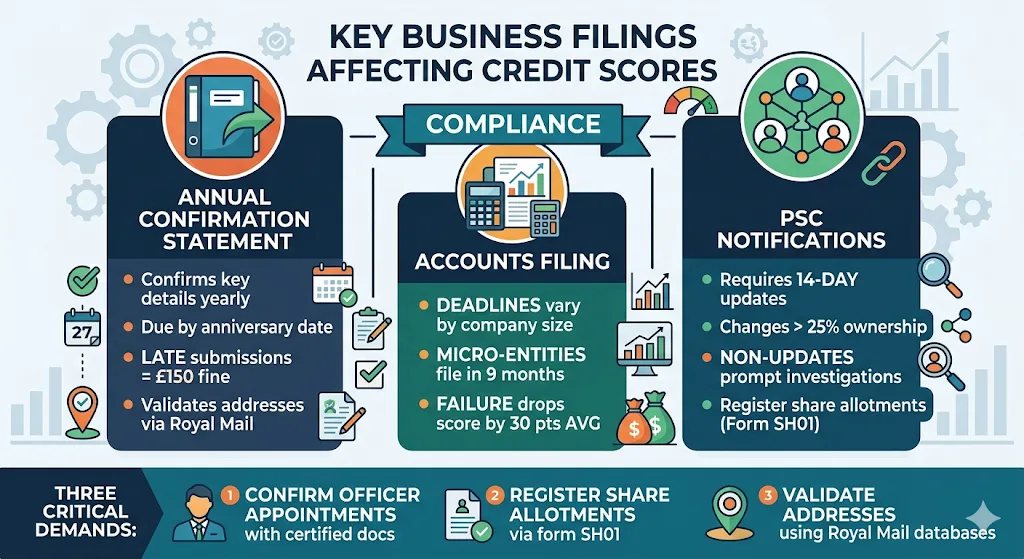
Annual confirmation statements, accounts, and PSC notifications most affect scores, as delays or errors directly flag non-compliance on credit reports.
Confirmation statements update key details yearly. Due by the anniversary date. Late submissions incur £150 fines.
Accounting filing deadlines vary by size. Micro-entities file within 9 months. Failures drop scores by 30 points on average.
PSC registers require 14-day updates. Changes include ownership of over 25%. Non-updates prompt investigations.
Three critical filings demand precision:
- Confirm officer appointments with certified documents.
- Register share allotments via form SH01.
- Validate addresses using Royal Mail databases.
How Do Timely Records Improve Credit Profiles?
Timely records improve profiles by demonstrating governance strength, earning higher scores, and unlocking better loan rates from lenders.
On-time filings boost scores by 25-40 points. Agencies reward consistent compliance. Scores above 80 secure prime rates.
Lenders view accurate records as low-risk indicators. Banks approve 78% of compliant applications versus 42% for others.
Records enable faster verifications. Credit checks are complete in hours. Businesses access trade credit swiftly.
Integration with services like company secretarial ensures zero delays. Providers file via API for instant updates.
What Metrics Do Agencies Use from Secretarial Data?
Agencies use filing timeliness, penalty history, and register accuracy as metrics, weighting them 40% of the overall business credit score.
Timeliness measures days from the due date. Zero delays score full points. Over 30 days deducts 15%.
Penalty history tracks fines paid. Zero penalties add 10 points. Multiple fines subtract 25.
Accuracy scans for mismatches. Director DOB errors flag 20% deductions. PSC validations confirm via HMRC data.
Equifax weighs secretarial data at 35%. Dun & Bradstreet at 28%. Real-time feeds pull from Companies House APIs.
How Does PSC Register Accuracy Influence Scores?
PSC register accuracy influences scores by confirming ownership stability, preventing fraud flags that reduce lender confidence by 35%.
PSCs with over 25% ownership require notification. Inaccuracies trigger Companies House queries. Agencies note unresolved cases.
Registers list the nature of control: voting rights, capital shares. Mismatches signal disputes. Scores drop 25 points.
Validation uses three methods:
- Cross-check Companies House with credit files.
- Verify via the Land Registry for property controls.
- Authenticate identities through Experian APIs.
Accurate PSCs support 90% of financing applications.
What Role Does the Director Register Play in Credit?
Director register accuracy plays a key role by verifying leadership stability, as disqualified or mismatched directors lower scores by 20-40 points.
Registers list appointments, resignations, and addresses. Errors imply instability. Agencies penalise frequent changes.
Disqualified directors block filings. Companies House bars them. Credit files reflect bans, slashing scores.
Updates occur via AP01 forms. 48-hour deadlines apply. Providers validate via DBS checks.
Stable registers correlate with 15% higher scores. Lenders prefer tenured directors.
How Can Businesses Fix Poor Records Quickly?
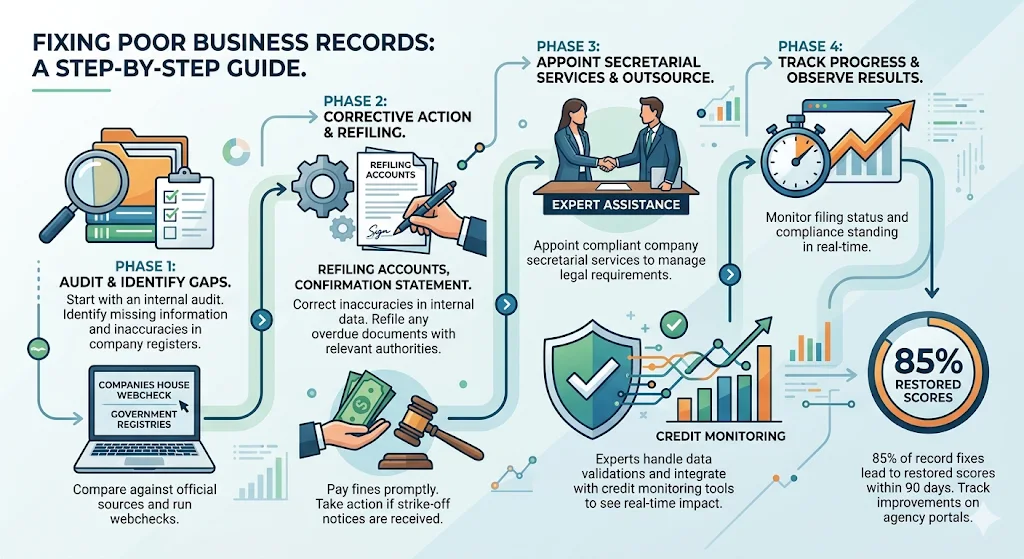
Businesses fix poor records by appointing compliant secretarial services, refilling accurately, and validating data against official sources.
Start with an audit. Identify gaps in registers. Use Companies House webchecks.
Refile overdue documents. Pay fines promptly. Restoration follows strike-off notices.
Outsource to experts. Company secretarial services handle validations. They integrate with credit monitoring.
85% of fixes restore scores within 90 days. Track via agency portals.
Why Integrate Secretarial with Credit Monitoring?
Integration links secretarial compliance to real-time credit monitoring, preventing score drops from filing oversights.
Systems sync Companies House data. Alerts trigger on delays. Automated filings maintain flow.
Monitoring dashboards show impacts. Scores update post-filing. Businesses act preemptively.
Services combine both. Form My Company delivers this synergy. Clients see 22% average score gains.
Also explore,
Why Your Business Needs Expert Help with Complex Companies House Statutory Filings
Comparing DIY Company Secretarial Tasks vs Professional Outsourcing for Small Business Owners
What Are the Long-Term Benefits for SMEs?
Long-term benefits include sustained high scores, easier scaling, and 20-30% lower borrowing costs for compliant SMEs.
High scores persist with routine maintenance. SMEs grow 2.5x faster with strong credit.
Access supplier terms improve. Trade credit extends 45-60 days. Cash flow strengthens.
Lenders offer unsecured loans. Rates drop to 4-7%. Non-compliant pays 12-18%.
To explore foundational compliance, read The Role of a Company Secretary in Maintaining Corporate Governance and Transparency.
Ready for full support? Let Our Specialists Handle Your Entire Company’s Secretarial and Annual Filing Requirements.
Form My Company provides company secretarial services. Accurate records secure your financial future. Compliance drives credit strength.
Frequently Asked Questions
What does a company secretarial service include?
Company secretarial service includes maintaining statutory registers, filing annual confirmations, and updating PSC details at Companies House. Form My Company handles director appointments and compliance documents under the Companies Act 2006. This ensures accurate governance records.
Why do UK businesses need company secretarial services?
UK businesses need company secretarial services to comply with Companies House requirements and avoid fines up to £1,500. Services prevent filing delays that impact credit scores and legal status. Form My Company provides these to maintain operational legitimacy.
How often must companies file secretarial documents?
Companies file confirmation statements annually by their incorporation anniversary and accounts within 9 months for micro-entities. PSC changes require updates within 14 days. Company secretarial services track and submit these on time.
What happens if the company’s secretarial records are inaccurate?
Inaccurate records trigger Companies House penalties, credit score drops, and potential strike-off. Credit agencies flag non-compliance, reducing lender approvals by 30-50 points. Form My Company corrects records through validation and refilling.
Can company secretarial services improve business credit?
Company secretarial services improve credit by ensuring timely filings and accurate registers that agencies like Equifax review. Compliant businesses gain 25-40 score points and better loan terms. Form My Company integrates these for sustained credit health.