
The company secretary ensures compliance with UK Companies Act requirements, maintains accurate statutory records, and facilitates transparent communication between directors, shareholders, and regulators. This role upholds governance standards and prevents legal penalties.
FormMyCompany provides expert company secretarial support to UK businesses. Directors rely on this function for seamless operations.
What Is a Company Secretary?
A company secretary is a mandated officer in UK private limited companies with two or more directors, responsible for statutory compliance and governance oversight as per the Companies Act 2006.
This role dates back to the 19th century but has evolved under modern regulations. Private companies appoint secretaries to handle filings with Companies House. Public companies require qualified professionals.
The secretary validates board decisions. They register changes in directorships. They maintain the public statutory book.
UK law specifies duties in Section 270. Secretaries act as governance gatekeepers. They ensure records reflect reality.
Why Does Corporate Governance Matter to UK Businesses?
Corporate governance establishes accountability, protects stakeholders, and builds investor trust through structured decision-making and ethical practices defined in the UK Corporate Governance Code.
Governance frameworks prevent fraud. They promote fair resource allocation. Boards follow principles from the Financial Reporting Council.
68% of UK SMEs face compliance audits annually, per ICAEW data. Strong governance reduces audit risks by 45%. It aligns operations with shareholder interests.
Directors delegate routine tasks. Governance ensures long-term viability. Transparency signals reliability to lenders.
How Does the Company Secretary Ensure Regulatory Compliance?
The company secretary files annual confirmation statements, registers director changes, and updates PSC registers within 14 days, as required by Companies House under the Companies Act 2006.
Filing deadlines prevent late penalties starting at £150. Secretaries submit forms electronically via the Companies House portal. They verify officer details against ID proofs.
Three key filings include:
- Annual accounts and confirmation statements
- Director appointments or resignations
- Significant control person notifications
Non-compliance triggers strikes off. Secretaries track economic crime updates from 2024. They implement verification protocols.
What Statutory Records Must a Company Secretary Maintain?
Company secretaries maintain registers of directors, secretaries, members, PSCs, and charges, accessible for inspection and updated in real-time to meet Companies Act transparency rules.
Registers reside at the registered office. Digital formats have complied since the 2015 reforms. Inspectors access them within one hour.
PSCs require 25% ownership disclosure. Charges register secures lender interests. Directors’ register lists service addresses.
Updates occur post-board resolutions. Secretaries archive minutes securely. Audits confirm completeness.
Annual reviews cross-check data. This process supports corporate governance integrity.

How Does the Company Secretary Promote Board Effectiveness?
Company secretaries organise board meetings, draft agendas, and minute resolutions to ensure decisions comply with governance codes and directors’ fiduciary duties.
Agendas circulate seven days prior. Minutes record votes and actions. Secretaries advise on conflicts of interest.
Four effectiveness tools include:
- Pre-meeting briefings
- Action trackers
- Quorum verifications
- Proxy voting records
They facilitate induction for new directors. Training covers Companies Act obligations. This sustains strategic focus.
Why Is Transparency Essential in Corporate Governance?
Transparency discloses material information via annual reports, PSC notifications, and public registers, fostering stakeholder trust and deterring misconduct under UK disclosure rules.
Public registers reveal ownership chains. Investors access filings instantly. Transparency deters money laundering.
92% of FTSE 250 firms publish governance statements, per FRC surveys. Disclosures include director pay ratios. This practice scales to SMEs.
Secretaries redact sensitive data legally. They publish summaries on websites. Regulators monitor adherence.
What Happens If Companies Neglect Company Secretarial Duties?
Neglect leads to fines up to £1,500 per late filing, director disqualifications, and compulsory strikes off, with 150,000 UK companies dissolved annually for non-compliance.
Companies House issues warnings first. Persistent delays escalate to court orders. Directors face personal liability.
Restoration costs average £500 plus legal fees. Credit scores suffer from a dissolved status. Lenders flag risks.
Prevention involves automated reminders. Secretaries audit quarterly. Outsourced services mitigate oversights.
Explore how the company secretarial service delivers compliant outcomes.
How Does Accurate Record-Keeping Impact Business Operations?
Accurate records enable seamless funding applications, partnership deals, and audits by providing verifiable data that lenders and partners demand.
Banks require PSC extracts. Auditors cross-reference registers. Delays halt transactions.
Digital tools sync with Companies House APIs. Secretaries validate entries daily. This streamlines operations.
Integration reduces errors by 70%, per Deloitte studies. Teams access shared drives securely.
Also explore,
Understanding the Difference Between a Director and a Company Secretary in the UK
How to Avoid Heavy Companies House Penalties with Proper Statutory Business Filings
What Evolving Regulations Affect Company Secretaries?
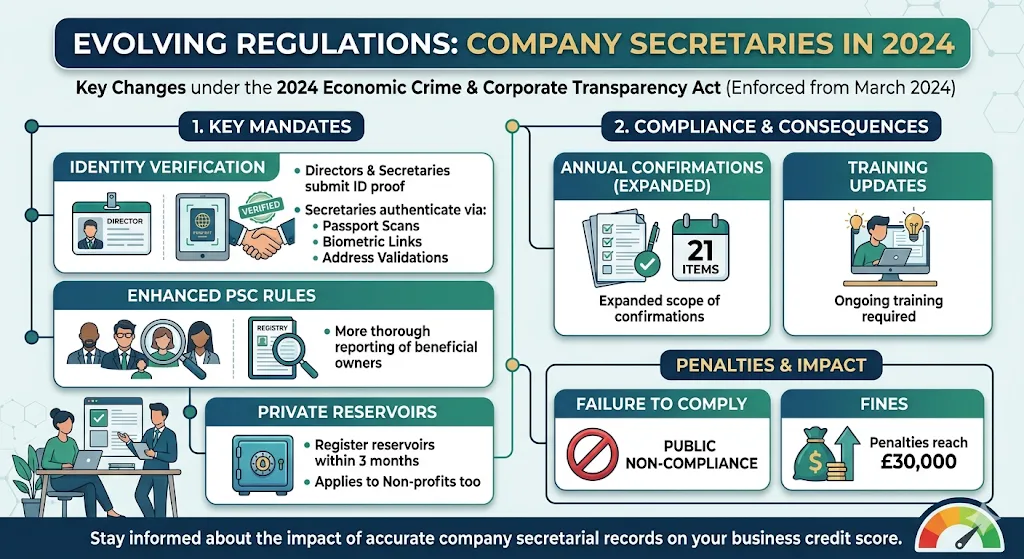
The 2024 Economic Crime and Corporate Transparency Act mandates identity verification, enhanced PSC rules, and private reservoirs, enforced from March 2024.
Directors submit ID proofs. Secretaries authenticate via three methods: passport scans, biometric links, and address validations.
Failure registers public non-compliance. Annual confirmations expand to 21 items. Training updates follow.
Secretaries register reservoirs within three months. Non-profits comply, too. Penalties reach £30,000.
Stay informed about
the impact of accurate company secretarial records on your business credit score.
How Can Outsourced Company Secretarial Services Help?
Outsourced services handle filings, register maintenance, and compliance advice, freeing directors for core activities while ensuring 100% adherence.
Specialists use licensed software. They scale for growth phases. Costs start at fixed monthly fees.
Experts navigate 2026 updates. They provide audit-ready files. This boosts efficiency.
UK firms outsource 42% of secretarial functions, per IoD data. Reliability prevents disruptions.
Let our specialists handle your entire company’s secretarial and annual filing requirements for decision-ready support.
Company secretaries anchor corporate governance and transparency through precise compliance and record-keeping. FormMyCompany delivers company secretarial solutions that align with UK regulations. Businesses achieve resilience via expert oversight.
Frequently Asked Questions
What does a company secretary do in the UK?
A company secretary in the UK handles statutory filings with Companies House, maintains registers of directors and PSCs, and ensures compliance with the Companies Act 2006. From My Company provides company secretarial services to manage these duties accurately. This role supports corporate governance and transparency for private limited companies.
Is a company secretary required for UK limited companies?
UK private limited companies with two or more directors must appoint a company secretary under the Companies Act 2006, while single-director companies are exempt. Company secretarial duties remain essential for compliance regardless. From My Company assists with outsourced company secretarial support to meet these requirements.
What are the penalties for late company secretarial filings?
Late filings with Companies House incur fines starting at £150 for confirmation statements, escalating to £1,500 or more, plus risks of director disqualification. Accurate company secretarial records prevent strikes off. From My Company ensures timely submissions to avoid penalties.
How often must companies file secretarial documents?
Companies file annual confirmation statements and accounts within 9 months for private firms, plus notify changes in directors or PSCs within 14 days. Company secretarial services track these deadlines. From My Company handles ongoing compliance for seamless operations.
Can I outsource company secretarial services in the UK?
Yes, outsourcing company secretarial services is common for UK SMEs, covering filings, register maintenance, and governance advice. From My Company offers expert company secretarial packages compliant with 2024 Economic Crime Act updates. This frees directors for business growth.