
Running a successful assessment day requires defining clear competency frameworks, designing structured group and individual exercises, training objective evaluators, and booking a professional workspace to observe candidate behaviours accurately without operational bias.
Assessment days represent a rigorous recruitment methodology. Organisations deploy this multi-stage evaluation process to filter top-tier talent through practical simulations rather than traditional interviews. Modern employers replace standard Q&A sessions with dynamic group tasks, role-plays, and cognitive testing. Data-driven hiring managers rely on structured observation matrices to eliminate personal bias.
Detailed planning dictates whether recruitment campaigns succeed or fail. Hiring teams establish precise evaluation criteria before candidates enter the building. Evaluators track specific performance indicators across multiple interactive modules. Structured scoring rubrics ensure every candidate receives an identical evaluation standard. Operational friction drops when coordinators map out minute-by-minute schedules weeks in advance.
What Defines the Structure of an Effective Assessment Day?
An effective assessment day structure integrates icebreakers, group challenges, technical presentations, structured interviews, and lunch breaks within a strict eight-hour timetable to evaluate cognitive, social, and functional competencies.
Structured timelines keep candidates engaged and evaluators focused throughout the hiring cycle. Morning sessions typically feature group-based problem-solving exercises. These tasks expose natural leadership styles, negotiation tactics, and communication breakdowns within teams. Observers track individual contributions without interrupting group dynamics.
Afternoon agendas shift toward individual assessments and technical tests. Candidates deliver presentations based on unseen case studies provided 60 minutes prior. Panel interviews follow, allowing senior directors to probe specific competency gaps identified during earlier simulations. Timetable management prevents candidate fatigue and ensures consistent scoring.
How Do Organisations Select and Train Qualified Evaluators?
Organisations select department leads, senior managers, and HR professionals, training them on behavioural scoring rubrics, implicit bias mitigation, and note-taking techniques to maintain absolute objectivity.
Evaluator calibration sessions eliminate subjective grading discrepancies. HR directors conduct workshops where raters review sample candidate performances and align scoring benchmarks. Observers record behavioural evidence rather than personal impressions. Notes must capture exact quotes, specific actions, and measurable outcomes.
Observer-to-candidate ratios directly impact evaluation accuracy. Teams maintain a 1:3 or 1:4 ratio during group tasks to capture every interaction. Multiple evaluators assess each candidate across different exercises. Committee meetings occur immediately after the event to reconcile score differences and finalise hiring rankings.
What Types of Exercises Provide the Best Candidate Insights?
Unseen case studies, simulated client negotiations, prioritisation in-tray exercises, and collaborative group design tasks provide actionable insights into candidate problem-solving, emotional intelligence, and technical proficiency.
Case studies test analytical depth under strict time constraints. Candidates digest 10 pages of financial data and market reports within 45 minutes. They formulate strategic recommendations and defend their positions during aggressive Q&A sessions with the evaluation panel.
Group design tasks reveal how professionals handle disagreement and resource scarcity. Teams receive limited building materials or incomplete project briefs to construct a viable solution. Observers look for active listeners, constructive negotiators, and resilient project drivers. Technical simulations test hard skills required for daily operations.
For a deeper dive into venue logistics without capital investments, review how to organise an assessment centre without owning space to streamline your next hiring cycle.
How Do Companies Manage Logistics and Candidate Experience?
Managing logistics requires securing a spacious multi-room facility, coordinating digital assessment tools, providing dietary-compliant catering, and dispatching detailed schedule itineraries to candidates 14 days prior.
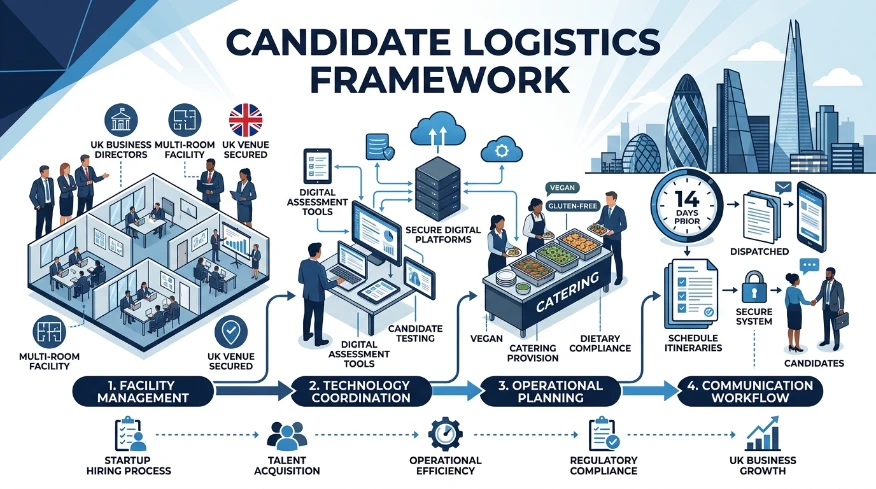
Candidate experience directly influences employer brand perception in competitive job markets. Clear communication reduces anxiety and brings out authentic candidate behaviour. Registration desks greet attendees with name badges, security passes, and schedule overviews. Dedicated runners guide participants between briefing rooms and testing areas.
Physical infrastructure dictates assessment quality. Companies require large open rooms for collaborative tasks and private boardrooms for confidential interviews. Reliable high-speed internet connections support digital testing platforms and video presentations. Soundproofing ensures candidate privacy during high-stakes panel evaluations.
When your internal office footprint is too small for multi-stage recruitment events, booking dedicated interview rooms provides the professional environment required to impress top talent and evaluate candidates fairly.
How Can Businesses Evaluate Assessment Day ROI?
Measuring assessment day return on investment requires tracking cost-per-hire reductions, 12-month employee retention rates, performance review scores, and time-to-productivity metrics against traditional interview methods.
Data-driven recruitment teams calculate financial efficiency by comparing group assessment costs with agency fees. Bringing 10 candidates into a single room for one day replaces 10 individual managerial interview hours. Reduced scheduling friction accelerates hiring timelines from 42 days down to 14 days.
Long-term retention serves as the ultimate benchmark for recruitment success. Hires sourced through practical assessment days typically exhibit lower 90-day turnover rates. Line managers report higher initial productivity because practical simulations pre-test job readiness. Continuous feedback loops refine future exercise designs and scoring weights.
To secure your ideal facility for upcoming recruitment drives, explore want to hire an assessment day venue from Form My Company to lock in premium corporate spaces today.
Explore our Interview Rooms guide,
Why Does ESG Reporting Now Include Corporate Events?
How to Get Printed Certificate of Incorporation and Share Certificates?
Frequently Asked Questions
How many interview rooms can businesses book at once through Form My Company?
Businesses can reserve multiple interview rooms simultaneously through Form My Company to accommodate large-scale recruitment drives and multi-stage assessment days. Our flexible booking options ensure hiring teams have access to private spaces for panel interviews and breakout areas for group exercises.
What amenities are included when renting professional interview rooms?
Professional interview rooms provided by Form My Company come fully equipped with high-speed Wi-Fi, presentation screens, conference call technology, and comfortable seating layouts. These amenities ensure that employers can conduct seamless in-person or hybrid evaluations with complete technical reliability.
Can companies hire interview rooms on an hourly basis for single candidate screenings?
Companies retain the flexibility to hire interview rooms on an hourly or daily basis depending on their specific recruitment schedule. This scalable booking model prevents businesses from paying for unused office space while still securing professional environments for candidate evaluations.
Why do growing businesses choose external interview rooms over internal office spaces?
Growing businesses utilise external interview rooms to eliminate operational disruptions, maintain candidate confidentiality, and project a polished corporate image. Dedicated external facilities provide a neutral, distraction-free setting that enhances the overall candidate experience during high-stakes hiring rounds.
How far in advance should businesses book interview rooms for assessment centres?
Businesses should secure interview rooms at least two to four weeks in advance to guarantee availability during peak hiring seasons. Early reservations allow recruitment coordinators to lock down optimal room sizes and configurations for complex, multi-candidate assessment days.