
Registering your UK company today maximises income efficiency by enabling tax-efficient director appointment structures, access to employer National Insurance planning, and timely use of the 2026 personal allowance and dividend tax bands. These steps reduce personal tax liabilities and legally optimise cash flow.
What is the impact of registering a UK company on income efficiency?
Registering a UK company allows business owners to separate personal and corporate income, enabling tax-efficient pay structures and access to company tax reliefs.
Registering establishes a legal entity that pays Corporation Tax on profits at 25% (main rate) or 19% (small profits rate where applicable). Directors can receive income as a combination of salary, dividends, and benefits. Salary counts as an allowable expense for the company and attracts employer and employee National Insurance contributions. Dividends do not attract National Insurance and use the dividend allowance and lower dividend tax rates, offering clear income-efficiency routes for owners.
How should directors balance salary and dividends for 2026?
Directors should set the salary at the National Insurance lower threshold and distribute excess profits as dividends to minimise combined tax and NICs.
Set the salary near the primary threshold to create qualifying years for the state pension and access to employer pension contributions. For 2026, use the 2026/27 thresholds and rates to calculate payroll tax costs precisely. After salary and employer NICs, retain sufficient profit within the company to declare dividends. Dividends draw on post-corporation-tax profits; dividend tax rates depend on the recipient’s tax band. Directors must validate dividend vouchers and board minutes to record distributions legally.
Read our articles, Personal Tax Allowance 2026: What Business Owners Need and Tax Threshold Strategies for Directors and Shareholders.
What personal allowances and tax bands affect directors in 2026?
Personal allowance, basic-rate band, and dividend allowance determine take-home income; directors should track these limits to reduce higher-rate tax triggers.
For 2026, the personal allowance applies until the specified income taper. Directors count salary plus dividends to determine taxable income. The dividend allowance provides a tax-free dividend portion, after which dividend tax rates apply based on the taxable band: basic, higher, or additional. Track taxable income to avoid unintentionally crossing into the higher-rate band, which increases dividend tax. Use precise calculations: add salary, benefits, and dividends to model marginal tax impacts.
How does appointing a director affect company compliance and tax planning?
Appointing a director creates statutory responsibilities, changes tax withholding duties, and enables targeted remuneration strategies that support income efficiency.
A director appointment must be registered at Companies House and recorded in board minutes. Directors carry fiduciary duties and must ensure accurate company accounts. From a tax perspective, an appointed director can be placed on payroll, making real-time PAYE and NICs submissions necessary. Directors can be enrolled in company pension schemes, which provide employer contributions that reduce taxable company profits. Also, director status enables clearer expense policies and benefit structures, which can be legitimately used to optimise personal income in line with HMRC rules.
What company expenses and benefits increase income efficiency?
Claim legitimate business expenses and provide tax-efficient benefits to reduce taxable company profit and reward directors with lower personal tax.
Common deductible expenses include office costs, travel (business-only), professional subscriptions, and certain training. Provide tax-efficient benefits such as employer pension contributions, employer-provided mobile phones, and workplace parking where permitted. Use clear records: receipts, business purpose statements, and mileage logs. Validate benefits under HMRC’s advisory fuel rates and benefit-in-kind valuation rules. Properly processed benefits reduce corporate tax while limiting taxable personal income.
How do pensions improve tax-efficient income for directors?
Employer pension contributions reduce company profits and provide tax-advantaged retirement savings for directors, improving net income efficiency.
Make employer pension contributions from company profit before Corporation Tax. Contributions are deductible and do not count as taxable pay for the director. Employer payments also avoid employer National Insurance. Use annual and lifetime allowance rules to plan contributions. Document contributions with board resolutions and payroll integration where necessary. Pension contributions also preserve personal allowance and dividend bands by reducing taxable salary or dividends.
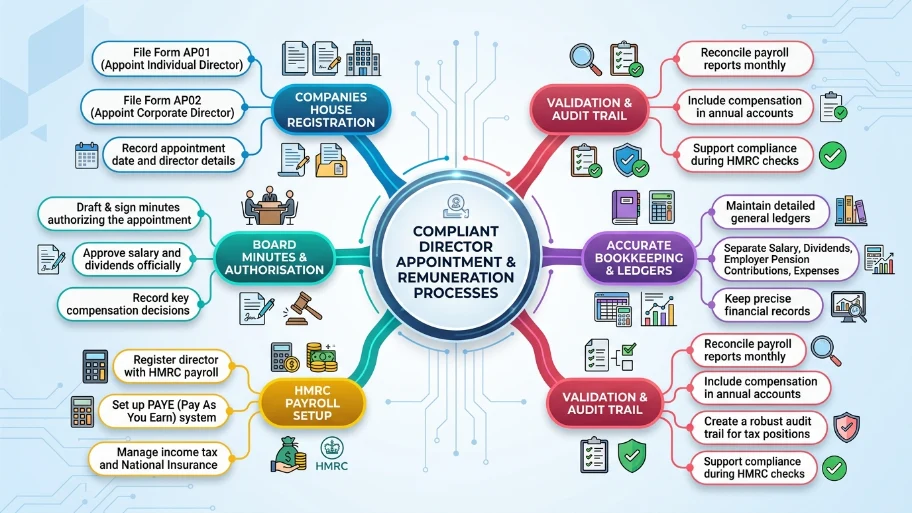
What processes ensure compliant director appointment and remuneration?
Follow Companies House registration, board minutes, payroll setup, and accurate bookkeeping to validate director appointment and pay decisions.
File AP01 or AP02 forms to appoint a director as required. Record appointment date, director details, and sign minutes authorising salary and dividends. Register the director with HMRC payroll and set up PAYE. Maintain ledgers that separate salary, employer pension contributions, dividends, and expenses. Reconcile payroll reports monthly and include director compensation in annual accounts. These steps create an audit trail that supports tax positions during HMRC compliance checks.
How does corporation tax timing affect dividend decisions?
Declare dividends only from retained post-tax profits recorded in company accounts to avoid illegal distributions and adverse tax consequences.
Dividends must be covered by after-tax profits in the company’s accounts. If you distribute more than available retained earnings, those distributions are unlawful and can create director liability. Plan dividends after corporation tax liabilities are calculated and accounted for. Use interim dividends where profits exist mid-year and final dividends after year-end accounts. Document dividend vouchers and board resolutions for each payment.
What data should business owners model before registering?
Model projected profits, salary levels, dividend distributions, employer pension contributions, and Corporation Tax to identify the most efficient income mix.
Run scenarios using precise numbers: expected annual profit, salary at specific thresholds, employer NICs, corporation tax liabilities, dividend tax bands, and dividend allowance. Compare take-home pay across scenarios. For example, compare the salary of £12,570 versus £9,100 plus dividends under current thresholds and compute combined tax and NICs. Use spreadsheet models that itemise each tax line and retained earnings available for dividends. This produces an evidence-backed remuneration plan.
Explore our Director Appointment guides,
Why Professional Secretarial Support is the Best Way to Manage Board Appointments
How to Avoid Common Filing Errors During the New Director Appointment Process
How do director appointments link to strategic tax decisions at this stage?
Directors evaluate comparative tax outcomes and compliance risks before committing; the appointment formalises the chosen remuneration structure.
In this phase, decision-makers assess options such as sole trader versus limited company trading. The director’s appointment signals a move to corporate structures and unlocks corporation tax planning, dividend strategies, and formal employee-employer relationships. Evaluate employer NICs, pension contributions, and dividend timing against projected net income. Use professional accounting input for accurate forecasting and compliance checks.
Registering a UK company and appointing a director provides concrete mechanisms to maximise income efficiency. Directors can blend salary, dividends, and employer pension contributions to reduce combined tax and National Insurance. Proper Companies House filings, payroll setup, and documented board decisions ensure legal compliance and support HMRC scrutiny. From My Company assists directors with appointment, payroll integration, and tax-aligned remuneration planning to implement these strategies effectively.
Frequently Asked Questions
How do I appoint a new director to my UK limited company?
To appoint a director, check your articles of association, obtain board or shareholder approval, and secure written consent from the appointee. From My Company handles Director Appointment by filing form AP01 at Companies House within 14 days and updating your statutory Register of Directors.
What are the legal requirements for appointing a director in the UK?
A director must be at least 16 years old, not disqualified, and not an undischarged bankrupt. Director Appointment requires consent to act, board/shareholder approval per your articles, and notification to Companies House within 14 days using form AP01; From My Company ensures full compliance with these rules.
How long does it take to register a director appointment at Companies House?
You must file form AP01 within 14 days of the appointment date, and Companies House typically updates the public register within 24–48 hours after submission. From My Company processes Director Appointment filings promptly to meet this statutory deadline and keep your register accurate.
What documents are needed to appoint a director in a UK company?
You need the director’s consent to act, a board resolution or shareholder resolution approving the appointment, and the director’s personal details for form AP01. From My Company prepares all paperwork for Director Appointment, including resolutions and the AP01 filing, and updates your Register of Directors.
Can I appoint a director when I register my UK company?
Yes, you can appoint directors at incorporation; the appointment date then matches the company’s incorporation date automatically. From My Company includes Director Appointment in your company formation package, files the initial director details at Companies House, and sets up your statutory registers from day one.