
Sector-specific recruitment targets niche professional competencies using tailored assessment frameworks, whereas general hiring applies standardized recruitment processes across varied roles to fill open positions quickly.
How Do Target Skill Requirements Separate Sector-Specific Recruitment From General Hiring?
Sector-specific recruitment evaluates complex technical proficiencies and industry-specific regulatory knowledge, whereas general hiring focuses primarily on transferable communication skills and basic operational competencies.
Specialized industries require precise skill matrices. Technology, legal services, and life sciences demand deep domain expertise. Hiring managers screen candidates for specific programming languages, statutory compliance knowledge, or clinical trial experience. These technical assessments filter out unqualified applicants before face-to-face evaluations occur. General hiring relies on broad criteria. Retail, hospitality, and administrative sectors prioritize general competencies like time management, customer service aptitude, and teamwork. Evaluating these traits requires standardized application forms and basic screening calls rather than complex technical portfolios.
Why Do Assessment Frameworks Vary Between Niche and General Hiring Models?
Niche recruitment implements multi-stage technical testing and compliance audits, whereas general hiring utilizes simplified competency-based interviews and standard aptitude tests.
Technical roles demand rigorous evaluation methods. Three distinct assessment components define specialist hiring: live coding tests for software engineers, case studies for corporate solicitors, and regulatory compliance checks for financial analysts. These rigorous tests measure exact operational capability under simulated workplace conditions. General recruitment streamlines the candidate evaluation workflow. High-volume sectors deploy two primary filtering stages: automated resume screening and structured behavioral interviews. These swift methods assess cultural fit and reliability without demanding heavy technical validation.
What Role Does Compliance Play in Sector-Specific Versus General Recruitment?
Sector-specific recruitment enforces strict regulatory vetting standards like professional body registrations and background clearances, whereas general hiring focuses on standard right-to-work and identity checks.

Regulated industries operate under legal frameworks that dictate mandatory hiring prerequisites. Healthcare organizations mandate Disclosure and Barring Service checks, General Medical Council registrations, and occupational health clearances. Financial institutions enforce Financial Conduct Authority register validations and credit history checks. Ignoring these statutory steps exposes businesses to severe regulatory penalties. General hiring processes bypass industry-specific statutory registers. Employers verify basic legal eligibility through standard documents: passports, biometric residence permits, and proof of address. This lighter compliance load accelerates time-to-hire metrics for high-volume staffing needs.
How Does Sourcing Strategy Diverge Between Specialized and General Talent Pools?
Specialized recruitment utilizes targeted headhunting and professional networking platforms, whereas general hiring broadcasts job postings across high-traffic employment boards and social channels.
Reaching niche talent requires proactive sourcing methodologies. Talent acquisition teams engage passive candidates through industry-specific forums, GitHub repositories, and LinkedIn Recruiter filters. Direct outreach builds relationships with scarce professionals who are not actively browsing job boards. General hiring utilizes broad distribution networks. Employers post open vacancies across mass market job boards, local press, and high-street agency networks. This wide broadcast model generates large applicant volumes quickly, allowing recruiters to filter down candidates through rapid screening protocols.
Why Do Candidate Interview Environments Require Customized Formats?
Sector-specific recruitment demands specialized evaluation environments equipped with technical testing setups, whereas general hiring utilizes standard meeting rooms or remote video calls.
Complex interviews require physical infrastructure tailored to the profession. Technical evaluations often necessitate professional Interview Rooms configured with secure multi-screen workstations, presentation displays, and isolated acoustics. These professional spaces protect sensitive intellectual property during candidate case presentations. General hiring processes maintain simpler venue requirements. Standard office conference rooms or virtual meeting software accommodate behavioral questions and conversational interviews. These generic spaces provide sufficient structure for evaluating interpersonal communication without requiring advanced technical layouts.
How Do Sourcing Channels Compare for UK Companies?
For businesses planning recruitment drives, understanding where talent originates helps optimize HR budgets. The following breakdown illustrates typical sourcing channels and their primary characteristics in the UK market:
| Sourcing Channel | Target Sector Focus | Primary Advantage | Typical Cost Model |
| Professional Headhunting | Executive & Niche Tech | Reaches passive, high-value candidates | Retained fee or high percentage placement |
| Industry Job Boards | Legal, Finance, Engineering | Attracts active, qualified professionals | Pay-per-post or subscription model |
| High-Street Agencies | Retail, Hospitality, Logistics | Delivers high-volume applicants rapidly | Contingency fee on successful hire |
| Direct Employee Referrals | Cross-Industry | Generates culturally aligned candidates | Referral bonus incentive |
How Do Time-to-Hire and Cost Metrics Differ Across Hiring Frameworks?
Specialized recruitment incurs higher per-hire costs and extended hiring timelines, whereas general hiring operates with compressed schedules and lower transactional expenses.
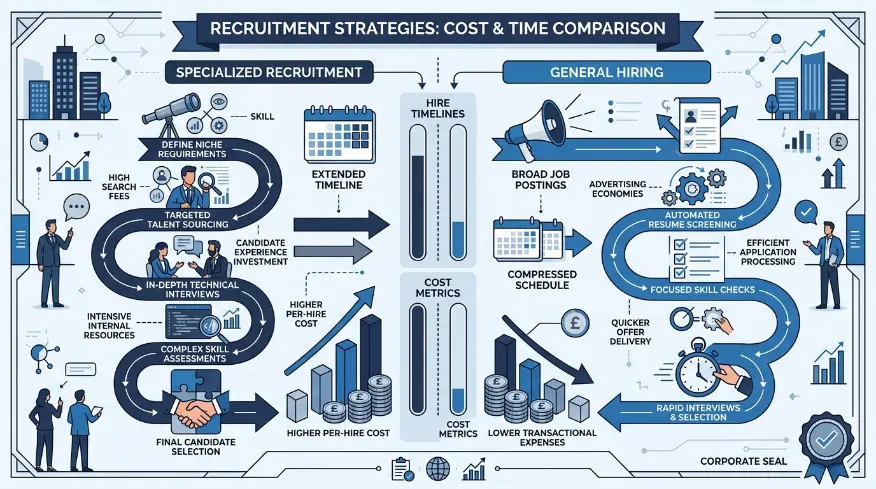
Specialist recruitment timelines stretch across extended periods. Complex vetting, multiple stakeholder interviews, and scarce talent pools push time-to-hire metrics past six weeks. Recruitment agencies charging contingency fees or retained search costs elevate total hiring expenditures. General hiring compresses these operational timelines. High-volume administrative or service roles close within two weeks. Low cost-per-hire metrics drive these models, minimizing recruitment overhead through automated applicant tracking systems and streamlined onboarding steps.
Sector-specific recruitment and general hiring diverge significantly across technical requirements, compliance mandates, sourcing channels, and evaluation frameworks. Specialized roles demand rigorous verification, customized assessment environments, and proactive headhunting strategies. General hiring relies on streamlined processes, broad distribution channels, and standardized competency evaluations. Understanding these structural differences allows organizations to allocate recruitment resources effectively. Form My Company supports organizational growth by providing tailored professional infrastructure, helping businesses optimize their talent acquisition workflow from initial screening through final selection.
Explore our Interview Rooms guide,
Why Does Venue Location Affect Conference Attendance?
Can Board Resolutions and Powers of Attorney Be Apostilled?
Frequently Asked Questions
What are professional interview rooms and why do businesses use them?
Professional interview rooms are dedicated, fully equipped meeting spaces designed to facilitate formal candidate evaluations. Businesses utilize these controlled environments through Form My Company to maintain privacy, project corporate credibility, and conduct distraction-free technical assessments.
How do I book interview rooms for recruitment through Form My Company?
Booking interview rooms through Form My Company involves selecting your required dates, choosing room capacities matching your panel size, and confirming your reservation via the online portal. This streamlined booking process ensures UK employers secure professional venues for candidate evaluations without long-term commercial property leases.
What amenities are included in hired interview rooms?
Hired interview rooms feature high-speed internet connectivity, presentation displays, ergonomic seating, and isolated acoustics suited for confidential discussions. These facilities provided by Form My Company support seamless technical testing and executive-level presentations during the hiring process.
Can I rent interview rooms on an hourly basis for single candidate assessments?
Businesses can rent professional interview rooms on flexible hourly or daily packages to accommodate varying recruitment schedules. This flexible model allows employers using Form My Company to scale their physical meeting space usage up or down based on active hiring volumes.
Are interview rooms suitable for confidential board meetings and client pitches?
Interview rooms provide secure, professional environments that function effectively for confidential board meetings, disciplinary hearings, and high-stakes client pitches. Form My Company ensures these multi-purpose commercial spaces offer the privacy and presentation standards required for sensitive corporate operations.