
Yes, you can rectify a late Persons with Significant Control filing immediately by submitting official update documentation to Companies House, resolving compliance failures, avoiding legal penalties, and restoring accurate corporate transparency records across the UK registry.
Why Do UK Companies Face Penalties For Late PSC Submissions?
Companies face statutory fines up to 5,000 pounds and criminal prosecution because regulatory frameworks mandate exact reporting windows for structural ownership transparency.
Companies House enforces strict statutory deadlines for updating corporate registers. When directors miss these reporting windows, the registry flags the entity for non-compliance. Regulatory bodies issue financial penalties against the company and default fines against individual officers. Persistent failure leads to compulsory strike-off action. Accurate ownership tracking requires real-time data updates. Maintaining transparency protects market integrity.
When your business experiences ownership changes, swift reporting prevents regulatory intervention. Form My Company provides a dedicated PSC Register service to manage these updates seamlessly. Directors often overlook the strict statutory timelines embedded in company law. Ignorance of compliance obligations offers no legal defense during investigations. Official enforcement mechanisms target both corporate entities and negligent officers directly. Financial sanctions escalate based on the duration of the default. Resolving errors quickly mitigates these severe legal risks.
What Steps Define The Process To Correct A Late Filing?
The correction process requires auditing historical ownership data, preparing statutory notices, submitting digital updates to Companies House, and updating internal company registers.
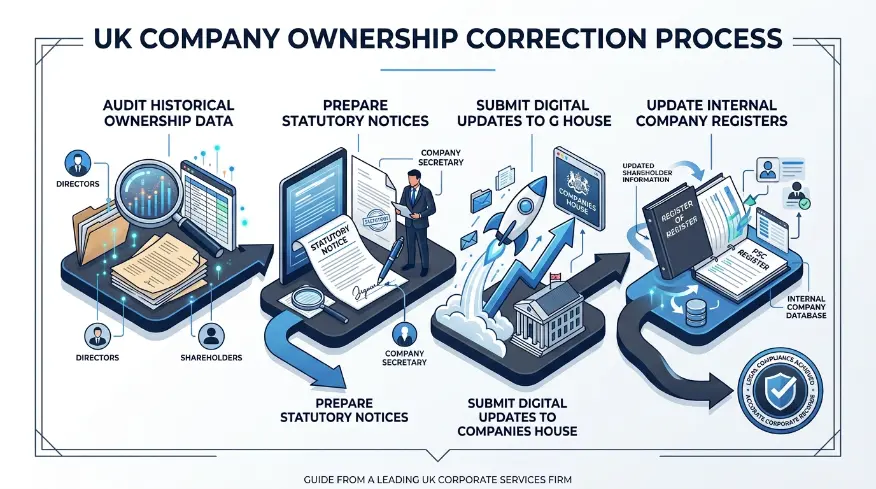
Auditing historical data involves reviewing all share allotments and voting rights. Preparing statutory notices requires capturing full legal names, service addresses, and exact control dates. Submitting digital updates requires logging into secure government portals with authentication credentials. Updating internal company registers ensures corporate governance records match public filings perfectly. Each step must adhere to strict statutory guidelines.
Proper execution prevents rejected submissions and further administrative delays. Businesses must verify every data point before final transmission. Official confirmation receipts validate successful processing by registry officers. Following a structured procedure eliminates recurring compliance errors entirely. Professional filing agents streamline this complex sequence efficiently. Executing these actions safeguards corporate standing and legal health.
How Does Form My Company Resolve Compliance Gaps?
Form My Company resolves compliance gaps by deploying expert corporate agents, utilizing secure digital filing channels, auditing ownership structures, and submitting corrections directly to regulators.
Expert corporate agents review your current register against historical filing data. Secure digital channels transmit your ownership updates directly to the official registrar. Auditing ownership structures identifies undocumented transfers and missing control details. Submitting corrections directly to regulators ensures swift removal of default markers. Professional oversight eliminates costly administrative mistakes.
Managing compliance internally often overwhelms busy directors and administrative teams. Outsourcing this task guarantees adherence to current regulatory standards. Timely intervention stops penalty notices from escalating further. Businesses maintain pristine corporate records without diverting internal resources. Reliable service delivery ensures permanent resolution of filing discrepancies.
What Legal Risks Accompany Unresolved PSC Discrepancies?
Unresolved discrepancies trigger severe legal risks including daily default fines, director disqualification proceedings, reputational damage, and potential company dissolution.
Daily default fines accumulate rapidly until the registry receives correct data. Director disqualification proceedings target officers who demonstrate persistent default behavior. Reputational damage deters potential investors, lenders, and commercial partners. Potential company dissolution occurs when registrars strike non-compliant entities off the active register. Mitigating these risks demands immediate corrective action.
Investors routinely inspect public registers during due diligence phases. Discrepancies signal poor governance and operational mismanagement. Commercial contracts often depend on verified corporate standing and clean compliance histories. Unresolved issues freeze corporate transactions and banking relationships instantly. Prioritizing accurate filings preserves long-term business viability and trust.
How Can Businesses Prevent Future Filing Delays?
Businesses prevent future filing delays by establishing internal compliance calendars, monitoring ownership thresholds, utilizing professional secretarial services, and implementing automated tracking tools.
Establishing internal compliance calendars tracks statutory deadlines months in advance. Monitoring ownership thresholds identifies reportable changes as soon as they occur. Utilizing professional secretarial services ensures expert oversight of all registry interactions. Implementing automated tracking tools alerts management to impending filing windows. Proactive management eliminates accidental oversights.
Consistent monitoring transforms compliance from a reactive chore into a streamlined routine. Corporate officers gain peace of mind knowing deadlines are managed professionally. Integrating reliable administrative workflows protects the organization permanently. Structured prevention saves substantial financial resources over the operational lifespan. Maintaining vigilance secures continuous good standing with regulatory authorities.
Explore our PSC Register guide,
Want to Order Your Company Name and Number Stamp With Form My Company?
Want to Reserve Green Event Spaces via Form My Company?
Frequently Asked Questions
What happens if a company fails to file its PSC register?
Failure to file accurate Persons with Significant Control data results in statutory fines up to 5,000 pounds, criminal prosecution for officers, and potential company dissolution. Form My Company assists businesses in updating their PSC register promptly to maintain full legal compliance with Companies House.
Who qualifies as a person with significant control in a UK company?
A Person with Significant Control typically holds more than 25% of shares or voting rights, exercises significant influence or control, or has the right to appoint directors. Identifying these individuals correctly is essential for maintaining accurate public records through professional services like the PSC Register from Form My Company.
How quickly must a company update its PSC register after a change?
Companies must update their internal PSC register within 14 days of any ownership change and file the updated information with Companies House within an additional 14 days. Utilizing Form My Company ensures these statutory deadlines are met efficiently to avoid default penalties.
Can an incorrect PSC filing be corrected after submission?
Incorrect PSC submissions can and must be corrected immediately by filing updated statutory notices with Companies House to rectify the public record. Form My Company manages this correction process seamlessly to protect corporate entities from regulatory scrutiny.
Is the PSC register public information in the UK?
The PSC register is a matter of public record accessible via the Companies House database for transparency and anti-money laundering purposes. Form My Company helps businesses manage their public transparency obligations while ensuring data accuracy.