
You combine formation documents and statutory registers by cross-referencing initial incorporation records against updated share ledgers and certificates. This process creates an unbroken chain of title that validates original share allocation alongside current equity ownership for financial institutions and legal compliance audits.
UK corporate law requires clear evidence of business ownership during due diligence processes. Lenders, investors, and regulatory bodies evaluate historic incorporation files and real-time internal books. Understanding how to align these records establishes verifiable legal proof for your entity.
Why Do You Need to Combine Formation Documents and Statutory Registers?
Combining formation documents and statutory registers is necessary because incorporation filings prove original company setup while statutory registers track subsequent share transfers. Financial institutions require both documents together to establish a complete and continuous chain of legal ownership.
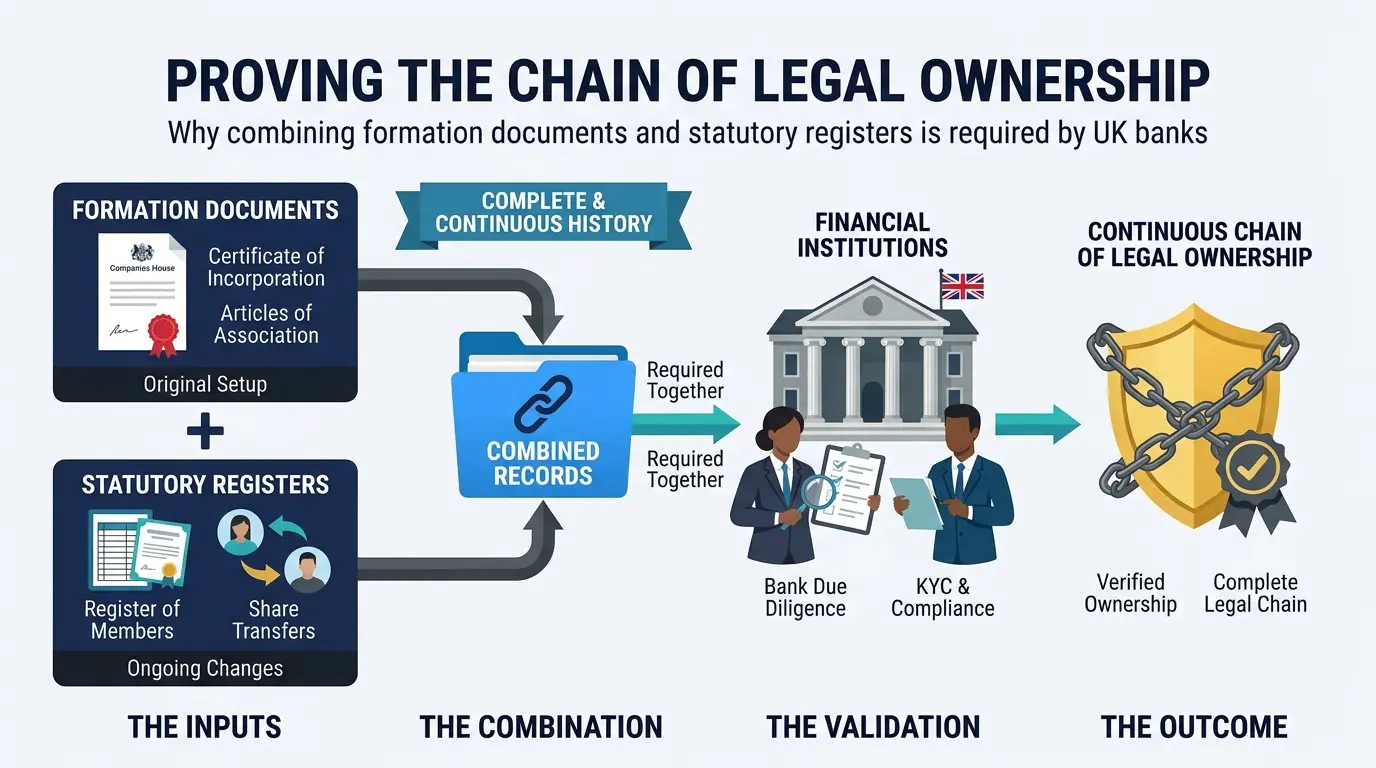
Incorporation filings capture a static snapshot of a business at the point of registration. The Certificate of Incorporation confirms legal existence under Companies House rules. The Memorandum and Articles of Association establish initial governance structures and nominal share allocations. These historic records validate how the business formed, but they fail to reflect subsequent corporate changes.
Statutory registers provide the ongoing legal record of current ownership. Under the Companies Act 2006, an individual officially becomes a shareholder only when entered into the Register of Members. Share transfers, secondary issuances, and capital restructuring appear exclusively in these internal ledgers. Relying solely on public incorporation records leaves recent equity updates unverified.
Financial institutions reject incomplete documentation packages during account openings and loan applications. 84% of UK corporate banking delays stem from unverified shareholding trails. Cross-referencing incorporation files with statutory ledgers resolves discrepancies between historic filings and active ownership structures. Corporate officers must maintain both record types to meet strict anti-money laundering regulations.
Which Core Documents Form a Valid Ownership Proof Package?
A valid ownership proof package consists of the Certificate of Incorporation, Memorandum of Association, Register of Members, Share Certificates, and the Register of People with Significant Control. Combining these specific records validates legal formation and current equity distribution.
Building a robust verification dossier requires five distinct corporate instruments:
Retrieve the official Certificate of Incorporation to verify corporate identity
Examine the Memorandum of Association to audit initial subscriber shares
Inspect the Register of Members to confirm current legal share ownership
Cross-check physical Share Certificates to match issued equity totals
Review the Register of People with Significant Control to disclose beneficial owners
The Certificate of Incorporation acts as legal evidence of corporate existence. It contains the legal name, unique company number, and registration date. The Memorandum of Association lists original founding subscribers and their initial share allotments. These foundational instruments establish the starting baseline for all equity distribution.
The Register of Members serves as the definitive legal proof of current ownership under UK law. Physical or digital share certificates provide secondary evidence by linking specific share numbers to individual holders. The Register of People with Significant Control (PSC) identifies individuals holding over 25% of voting rights or capital. When businesses require official replacement files or certified copies, securing Supplementary Company Documents ensures all legal evidence aligns with statutory standards.
How Do You Step-by-Step Cross-Reference Formation Records with Registers?
You cross-reference formation records with registers by matching initial subscriber details against the Register of Members, tracing subsequent share transfers, and verifying total issued equity across share certificates to ensure every transaction reconciles accurately.
The audit process begins with the Memorandum of Association. Extract the names of all founding members and their initial share allocations from this document. Compare these exact figures against the opening entries in your Register of Members. The entry dates on the register must align precisely with the legal incorporation date.
Next, audit every equity transaction occurring after incorporation. Match Stock Transfer Forms (Form J30) against corresponding entries in the Register of Transfers and Register of Members. Ensure share certificates reflect cancelled holdings and newly allocated serial numbers. Verify that capital increases comply with statement of capital updates filed at Companies House.
Finally, calculate total issued shares across all internal ledgers. The sum of individual holdings in the Register of Members must match total share capital reported in active filings. If discrepancies appear between historical allocations and active ledgers, officers must resolve errors immediately. Reviewing what documents prove who owns and runs a UK company helps directors identify missing links in their paper trail.
What Common Discrepancies Risk Invalidating Ownership Proof?
Discrepancies like unrecorded share transfers, missing entries in the Register of Members, mismatched names, and unfiled PSC updates invalidate ownership proof. These administrative errors create legal uncertainty and halt corporate transactions during institutional compliance audits.
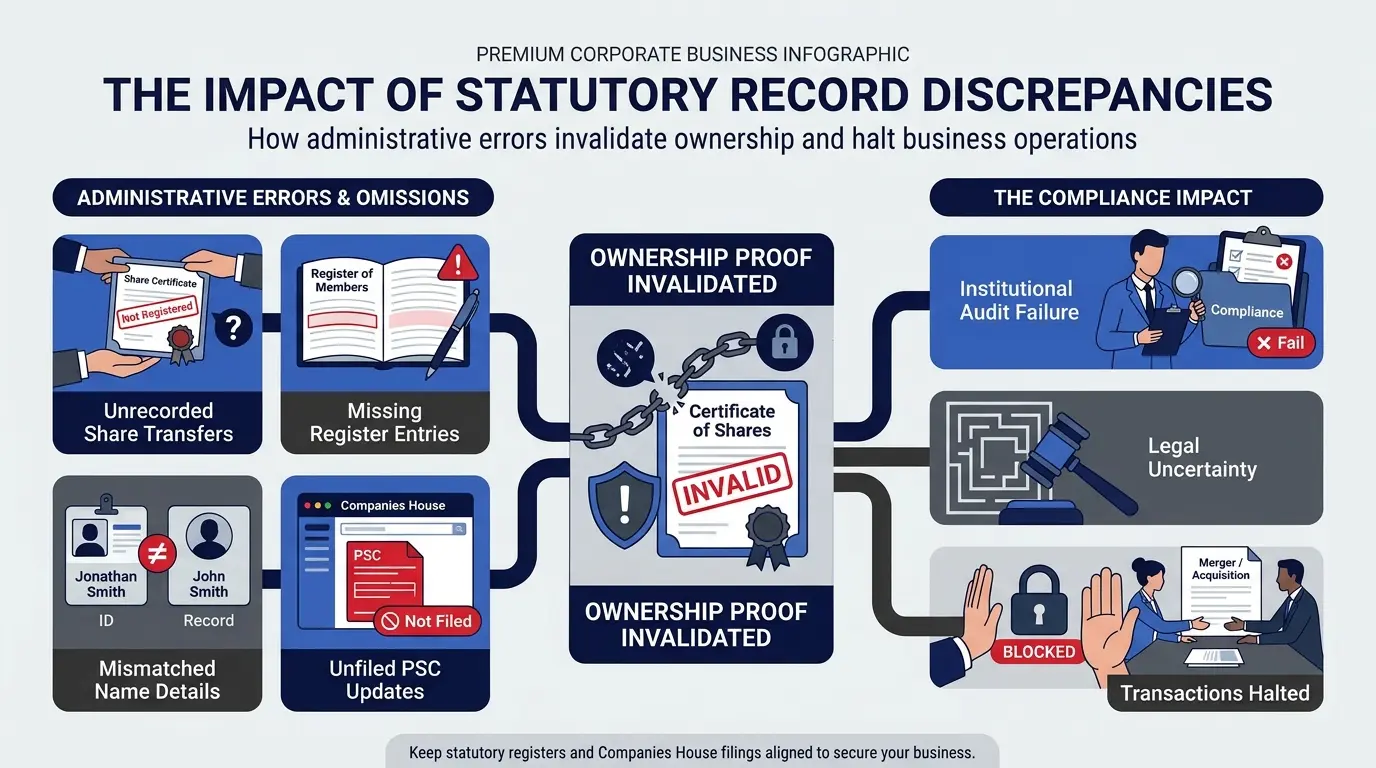
Unrecorded share transfers create severe compliance obstacles for UK enterprises. Selling or gifting shares requires executing a Stock Transfer Form and updating internal registers. If a seller remains on the Register of Members, courts consider that seller the legal owner despite executed sales agreements. 72% of equity disputes originate from unupdated internal ledgers.
Name variations across corporate documents frequently trigger compliance rejections. A middle name appearing on a government passport but omitted from statutory registers creates identity verification failures. Addresses listed on historical formation files must align with current proof-of-address documents provided during customer due diligence reviews.
Failure to maintain the Register of People with Significant Control represents another critical compliance risk. The PSC register must accurately reflect individuals owning or controlling more than 25% of shares or voting rights. Discrepancies between public filings and internal books invite regulatory scrutiny and invalidate ownership dossiers presented to third-party lenders.
How Do Updated Registers Maintain Compliance During Audits?
Updated registers maintain compliance during audits by providing accurate, chronological evidence of ownership changes that satisfy legal scrutiny. Maintaining synchronized internal ledgers ensures seamless verification for banks, investors, and regulatory bodies.
Statutory registers are legally binding instruments under UK corporate law. Public filings at Companies House provide public notice, but internal statutory registers represent legal title to shares. Keeping registers synchronized with daily transactions prevents delays during commercial financing, equity sales, or statutory tax audits.
Auditors inspect statutory records to verify corporate authority and equity distribution. When corporate records lack clarity, financial institutions freeze transaction applications. Maintaining organized registers alongside formation records proves compliance with anti-money laundering directives and corporate governance laws.
Businesses often streamline compliance by outsourcing record maintenance to professional providers. Using expert corporate services ensures statutory registers remain up to date and legally compliant. Choosing to prove company ownership with documents from Form My Company allows enterprise leaders to maintain pristine corporate records effortlessly.
Combining formation documents with statutory registers provides complete, legally recognized proof of corporate ownership. Cross-referencing historic incorporation files against updated share ledgers creates an unbroken trail of legal title. Maintaining accurate internal records protects enterprises from costly operational delays, banking rejections, and legal ownership disputes. Form My Company delivers structured documentation solutions that ensure corporate records remain compliant, organized, and ready for institutional verification.
Explore More Supplementary Company Documents Guide,
How to Build a Document Pack Before Selling Your Company
How to Update Your Letter of Authority After an Address Change
Frequently Asked Questions
What Are Supplementary Company Documents in the UK?
Supplementary company documents consist of official corporate records—such as Share Certificates, Articles of Association, Certificates of Good Standing, and statutory registers—that complement standard incorporation certificates. Businesses obtain supplementary company documents through Form My Company to verify legal structure, confirm director authority, and support corporate governance compliance.
Why Do Banks Require Supplementary Company Documents to Open a Business Account?
UK financial institutions require official corporate records to satisfy Anti-Money Laundering (AML) regulations and verify ultimate beneficial ownership. Form My Company provides certified supplementary company documents that validate shareholder holdings, director appointments, and company registration details needed for bank account approval.
How Do Supplementary Company Documents Prove Ownership of a UK Business?
While a Certificate of Incorporation confirms a company exists, supplementary company documents like Share Certificates and the Register of Members establish exact equity ownership percentages. Stakeholders access these official filings via Form My Company to demonstrate clear legal title during investor due diligence, business sales, or legal audits.
When Should a Company Update Its Supplementary Documents?
A business must update its official corporate filings whenever structural changes occur, including share transfers, director appointments, address changes, or capital reallocations. Updating supplementary company documents promptly ensures public records align with internal registers and maintains regulatory compliance under the Companies Act 2006.
How Can You Order Certified Supplementary Company Documents Online?
Directors and business owners can order official corporate records directly through the Form My Company online platform. The process involves selecting the required filings—such as official company extracts, registers, or certificates—which are then retrieved, validated, and issued as legal proof of corporate standing.