
Keeping personal addresses off the public PSC register requires utilizing a registered office address, a service address for directors, and corporate nominee director structures. These specialized compliance solutions prevent residential details from appearing on public Companies House records while maintaining total statutory compliance.
Protecting privacy as a business owner in the United Kingdom requires understanding public register transparency rules. Companies House maintains a Persons with Significant Control register for corporate transparency. Every UK registered company must identify individuals who hold more than 25 percent of shares or voting rights. Standard filing procedures automatically publish residential addresses alongside correspondence addresses. Privacy-conscious founders use designated service addresses to shield their private homes from public visibility.
What Is the Public PSC Register and Why Does It Expose Personal Addresses?
The public PSC register is a mandatory database displaying the names, service addresses, and partial birth dates of individuals exercising significant control over a company. Companies House publishes these records online because UK legislation demands absolute corporate transparency to prevent financial crime and illicit activities.
Transparency laws mandate that every limited company disclose beneficial owners to maintain market integrity. Official statutory filings capture both residential addresses and correspondence addresses during incorporation. Companies House displays correspondence addresses on the public portal for unrestricted public viewing. Residential addresses remain suppressed from public view automatically, but third parties can still access them under specific legal conditions or older historical filings. Privacy risks escalate rapidly when founders use home addresses for official correspondence. Corporate bad actors harvest these public data points for unsolicited marketing or malicious intrusions. Mitigating these exposures demands deliberate administrative adjustments during company formation.
How Can a Registered Office Address Shield Your Home?
A registered office address provides an official legal contact point for government agencies while keeping residential locations entirely private. UK law requires every registered company to maintain a visible official address for postal correspondence from Companies House and HM Revenue and Customs.
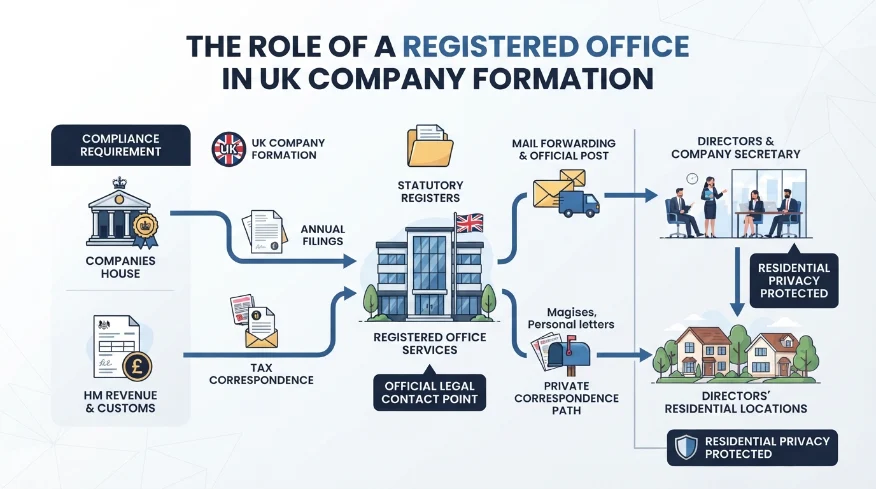
Official correspondence addresses appear on public indexes instead of private home locations. Business owners rent professional corporate addresses located in prestigious commercial districts. Mail handling services receive statutory notifications, scan documents, and forward correspondence securely to private inboxes. Professional service providers process official letters from regulatory bodies within 24 hours of receipt. Companies House accepts these commercial locations for all statutory compliance obligations. Utilizing a commercial base prevents the physical exposure of residential doorsteps to clients, suppliers, and members of the public.
When Should You Use a Director Service Address?
A director service address replaces residential coordinates on public records for every individual officer managing the corporate entity. Official statutes permit directors to submit a distinct correspondence location for public inspection to protect personal security.
Directors manage daily operations without sacrificing domestic privacy by separating official correspondence from private living quarters. Companies House displays the designated service address across all officer history logs and historical filings. Official notices regarding tax liabilities or regulatory updates arrive at this designated business location. Maintaining a separate service address ensures that legal summons and statutory notices bypass residential entryways. Directors update these records through standard administrative filings whenever operational locations change. This separation creates a distinct legal boundary between corporate duties and private domestic life. Professional corporate formations streamline this setup by integrating privacy protections directly into incorporation packages. Reviewing the foundational rules for these protections is essential, as explained in the How Is PSC Personal Data Protected Under UK GDPR? guide.
How Do Nominee Solutions Provide Maximum Privacy?
Nominee solutions appoint professional proxy directors or shareholders to hold official positions on public registers while beneficial owners retain ultimate control. Legal trust agreements establish clear operational authority without exposing personal identities on public databases.
Corporate nominee arrangements introduce a trusted intermediary between the company and the public registry. Nominee directors execute administrative documents on behalf of the beneficial owner under strict contractual terms. Public databases display the details of the nominee entity rather than the private individual’s credentials. Beneficial owners manage company finances and strategic decisions through private declaration of trust documents. Regulatory bodies receive ultimate beneficial ownership disclosures privately while public visibility remains restricted. This advanced structure safeguards high-profile founders against targeted harassment, industrial espionage, and unwanted public scrutiny.
| Privacy Method | Where Details Appear | Who Can Access Residential Data | Primary Protection Level |
| Residential Address | Public & Private Registers | General Public & Authorities | None |
| Service Address | Public Director Register | Authorities Only | Moderate |
| Registered Office | Public Company Register | General Public & Authorities | High |
| Nominee Structure | Private Trust Documents | Authorities Only | Maximum |
What Steps Are Required to Update Existing Public Records?
Updating existing public records involves filing statutory change forms with Companies House to replace exposed residential details with approved service addresses. Companies must submit form changes immediately whenever a director or PSC relocates or modifies correspondence information.
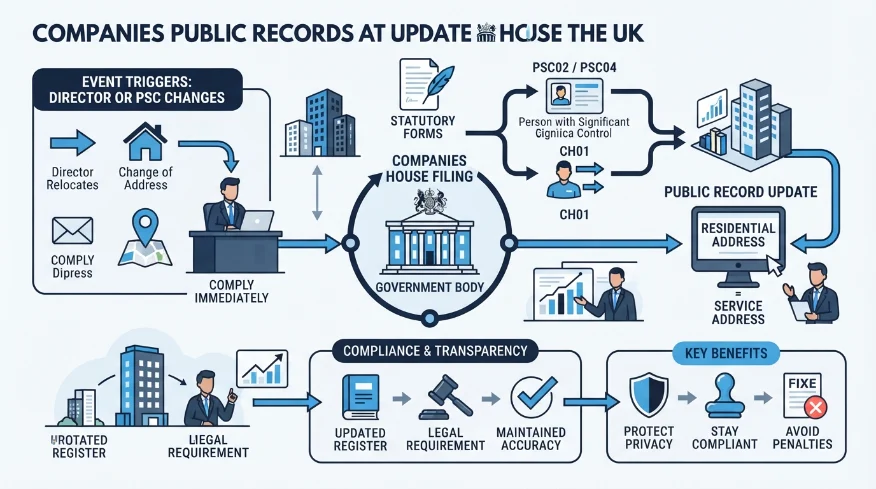
Removing historical home addresses from active public view requires submitting specific administrative correction notices. Companies House processes digital filings within 24 to 48 hours of electronic submission. Businesses must review historical confirmation statements to ensure old residential leaks are successfully superseded. Administrative oversights during these updates leave legacy records vulnerable to public data scraping tools. Maintaining pristine public registers requires continuous monitoring of compliance deadlines and officer changes. Founders seeking an effortless path can explore options to Keep Personal Addresses Private With Form My Company for comprehensive privacy management. Implementing these corrective measures secures long-term confidentiality across all digital corporate databases. Professional PSC Register services streamline these complex filings to guarantee absolute compliance and confidentiality.
Explore our PSC Register guide,
How to Protect a PSC’s Personal Details on the Register?
How to Meet Hiring Compliance Standards With Professional Venues?
Frequently Asked Questions
Can my home address be hidden from the public PSC register?
Yes, your residential address is kept off the public-facing Persons with Significant Control register by using a designated service address. When you set up your company with Form My Company, our PSC Register solutions ensure your private home details remain accessible only to authorized government authorities like Companies House and HMRC.
What is the difference between a registered office address and a director service address?
A registered office address serves as the official legal contact point for statutory mail from government bodies, whereas a director service address replaces your residential location on officer logs. Both options prevent your private domestic address from being published on public databases. Form My Company integrates these professional privacy addresses directly into our corporate formation packages.
Is it legal to use a virtual business address for Companies House filings?
Using a professional commercial or virtual address for Companies House filings is completely legal and fully compliant with UK company law. Regulatory bodies require a reliable point of contact rather than a physical residential dwelling for daily operations. Form My Company provides compliant business addresses that satisfy all statutory requirements while protecting your personal privacy.
Who can view my residential address on Companies House records?
Residential addresses submitted to Companies House are automatically suppressed from public view and cannot be seen by the general public or random website visitors. However, credit reference agencies, law enforcement, and specific regulatory authorities retain legal rights to view these confidential domestic details. Form My Company helps manage your filings to ensure your private data is never accidentally exposed on public records.
How do I update my personal details on the PSC register if I move?
You must file official statutory change forms with Companies House within 14 days of changing your residential address, service address, or personal particulars. Form My Company simplifies this administrative duty by managing your updates swiftly and accurately through our dedicated PSC Register management platform. Keeping these records current ensures your business maintains strict legal compliance without risking public data leaks.