

Navigating the HMRC VAT registration process requires determining threshold eligibility, creating a Government Gateway account, gathering director documentation, completing online application forms, and submitting business evidence. Completing these actions accurately prevents processing delays and secures your 9-digit VAT number.
What triggers mandatory HMRC VAT registration for UK businesses?
Mandatory HMRC VAT registration occurs when your taxable turnover exceeds £90,000 within a rolling 12-month period or if you expect turnover to exceed £90,000 in the next 30 days alone.
The £90,000 threshold applies to a continuous 12-month window rather than a fixed calendar or financial year. You must calculate your cumulative taxable sales at the end of every calendar month. If the total exceeds £90,000, you have 30 days from the end of that month to notify HMRC. Late notification results in financial penalties and retroactive tax assessments.
You must also register if you receive goods from the EU worth more than £90,000 in a calendar year. Overseas businesses selling goods or services to UK consumers face mandatory registration immediately, regardless of turnover volume. Monitoring monthly sales figures prevents unexpected non-compliance penalties.
Businesses whose turnover remains below the threshold may choose voluntary registration. Early registration allows companies to reclaim input VAT on commercial purchases, equipment, and start-up expenses. Evaluating your customer base determines whether voluntary registration offers financial benefits for your corporate growth.
What documentation is required for a smooth VAT application?
Submitting complete documentation including identity proofs, business bank details, company incorporation certificates, and operational evidence ensures HMRC processes your application without issuing information requests.
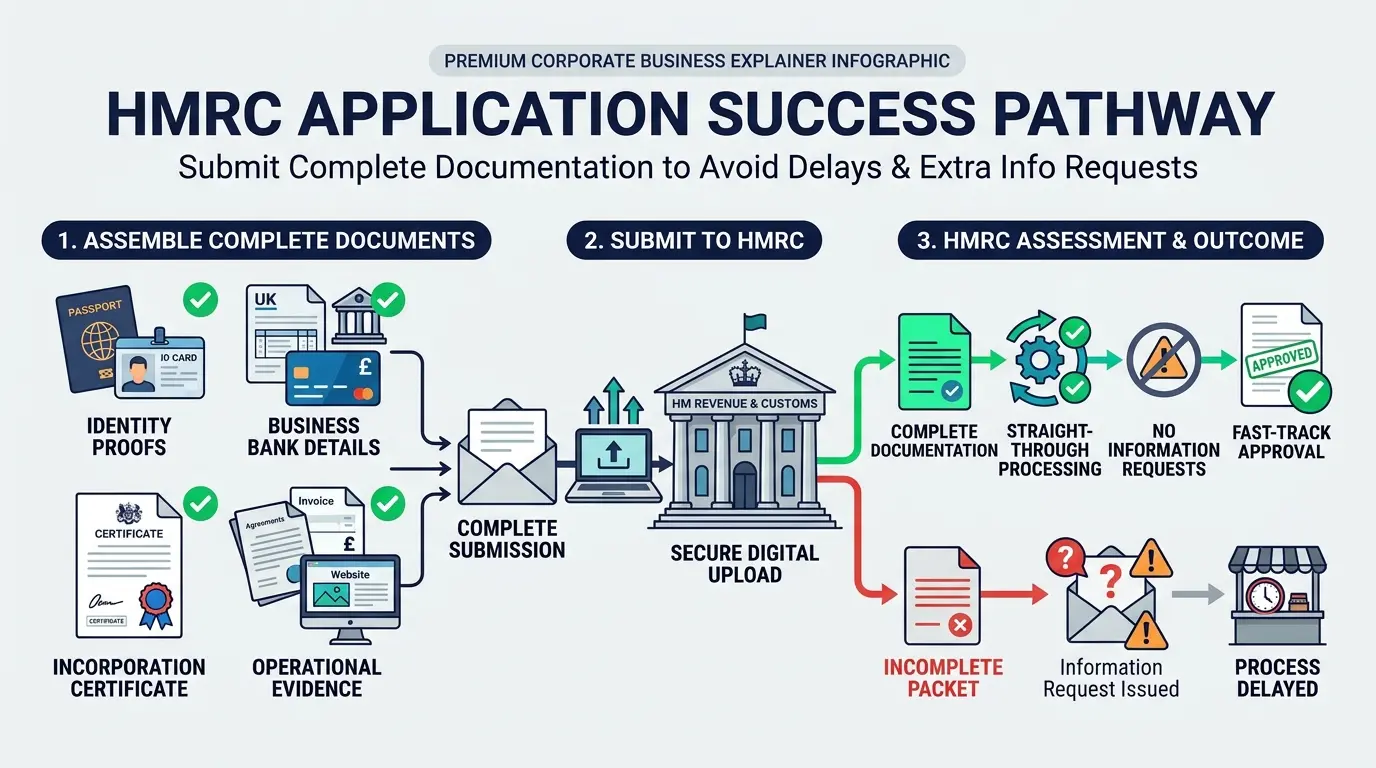
HMRC requires primary identification for business directors and sole traders. You must provide a valid passport number, national insurance number, or government-issued photo ID. Identity verification frameworks match director credentials against official records to prevent fraudulent tax applications.
Corporate applicants must supply exact company details. You need your 10-digit Unique Taxpayer Reference (UTR), legal company name, registered office address, and Companies House registration number. Providing incorrect company details automatically halts application processing.
Financial documentation proves operational legitimacy. You must submit UK business bank account details, sales invoices, supplier contracts, or commercial lease agreements. HMRC inspects bank statements and contract copies to confirm your company actively conducts business within the United Kingdom.
How do you complete the HMRC VAT application step-by-step?
Completing the application involves logging into your Government Gateway account, selecting your business structure, answering tax questions, uploading supporting evidence, and submitting your digital declaration.
First, access your business tax account using Government Gateway credentials. If your company lacks an existing account, create one using your corporate UTR and official business address. Select the option to add a tax service and choose Value Added Tax.
Next, choose your entity classification. You must specify whether you operate as a private limited company, sole trader, partnership, or overseas entity. Select your effective date of registration carefully because this date determines when you must start charging output VAT on sales.
Then, supply accurate business activity descriptions. Select the correct Standard Industrial Classification (SIC) code that reflects your primary revenue streams. Detail your projected taxable turnover for the upcoming 12 months alongside estimated exempt sales figures.
Finally, attach scanned copies of required verification documents. Review all data entries to confirm numerical accuracy across dates, addresses, and bank accounts. Submit the completed application form digitally to generate your unique HMRC submission reference number.
Why do HMRC VAT registration applications experience delays?
Applications experience delays due to mismatched director names, incomplete banking documentation, vague business activity descriptions, and submission of unverified international identity documents.
Discrepancies between application details and official registries trigger manual security reviews. If a director’s name on the application differs from Companies House records, automated systems flag the submission. Ensure spelling, middle names, and residential addresses match primary identification records exactly.
Unclear business descriptions force HMRC officers to issue formal information notices. Writing generic activity descriptions such as “consulting” or “trading” causes processing holds. You must provide specific operational details, such as “IT infrastructure consulting” or “wholesale footwear distribution.”
Inadequate bank account details generate verification failures. HMRC requires bank accounts opened under the legal business entity name. Providing personal bank details for a limited company application leads directly to rejection or extended correspondence loops.
Submitting applications without supporting commercial evidence creates backlogs. HMRC frequently requests proof of UK trading activity from newly incorporated entities. Failing to attach customer contracts, supplier quotes, or website links delays application approval by several weeks.
How does choosing the right VAT scheme affect your registration?
Selecting the correct VAT accounting scheme alters your reporting requirements, cash flow dynamics, record-keeping obligations, and total tax liability from your registration date forward.
The Standard VAT Accounting Scheme requires paying VAT based on invoice dates regardless of when clients settle their bills. This traditional method suits businesses offering short payment terms or companies making substantial capital purchases. Understanding [what is the standard VAT accounting scheme and how does it operate] helps founders determine if invoice-based accounting fits their operational cash flow model.
Alternative schemes provide simplified record-keeping options for qualifying businesses. The Cash Accounting Scheme allows companies with turnover under £1.35 million to pay VAT only when customer payments clear. This scheme protects growing businesses from paying tax on uncollected sales invoices.
The Flat Rate Scheme allows small businesses to pay a fixed percentage of gross turnover to HMRC while retaining the difference between billed VAT and paid VAT. You cannot claim input VAT on everyday purchases under this scheme, except for capital assets costing over £2,000 including VAT.
Annual Accounting Schemes reduce reporting frequency from quarterly to a single annual return. Businesses make monthly interim payments based on estimated annual liability, followed by a balancing payment. Evaluating reporting capabilities ensures you select a scheme matching your internal accounting capacity.
What happens after submitting your VAT registration to HMRC?
HMRC processes your application, issues a 9-digit VAT registration number, posts a paper certificate, and activates your online VAT account within 30 days.
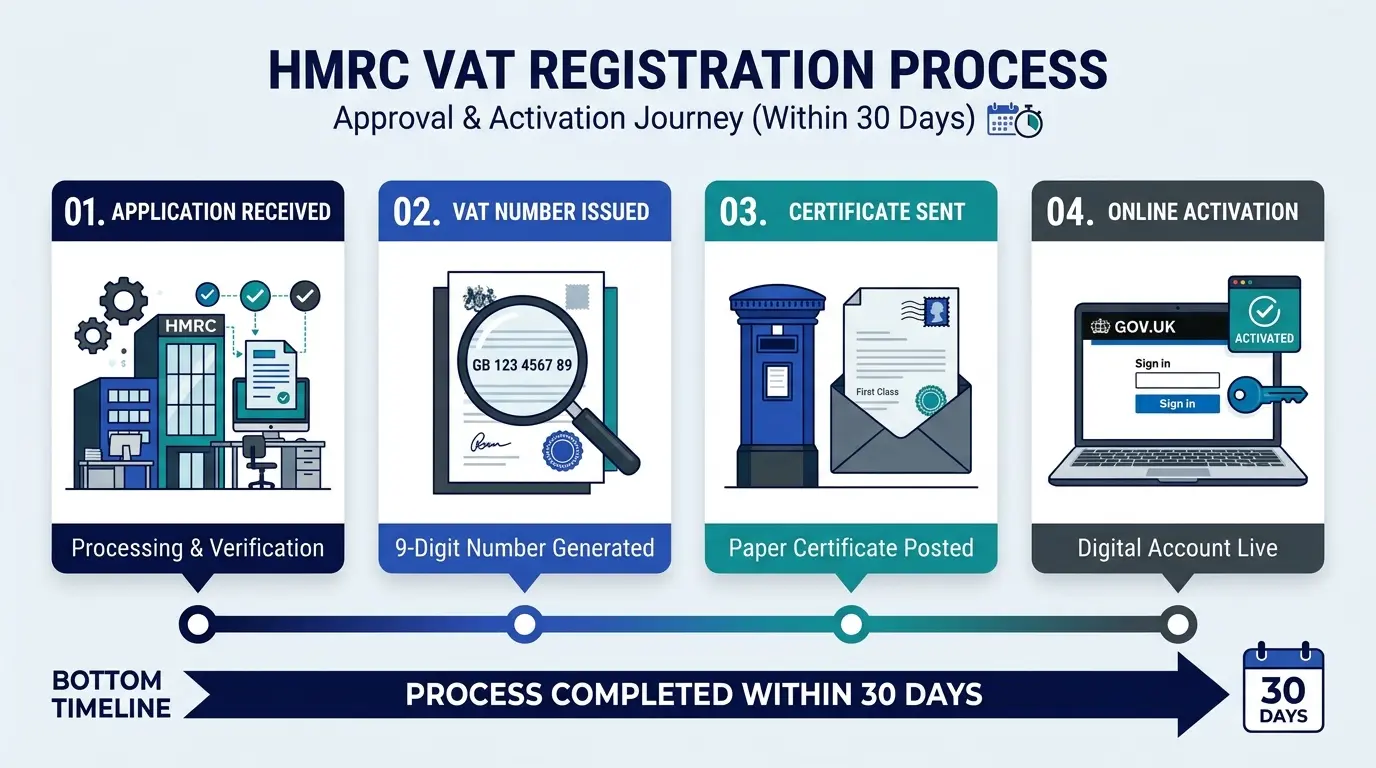
HMRC reviews digital submissions using automated risk assessments and manual verification checks. Processing times vary based on application accuracy and verification requirements. You receive an online reference number immediately upon submission to track processing progress.
Once HMRC approves your application, they issue your official VAT registration number. This 9-digit code appears in your online Gateway portal before the physical certificate arrives by post. You must display this number on all commercial invoices, contracts, and company websites.
HMRC sends a physical Certificate of VAT Registration (Form VAT4) to your registered office address. This document confirms your official VAT number, effective date of registration, and first VAT return due date. Keep this certificate in your corporate records for bank and supplier verification purposes.
You must immediately update your invoicing software upon receiving your VAT number. Calculate output VAT on sales made from your effective date of registration onward. If you issued invoices without VAT during the processing period, reissue amended invoices to account for tax liabilities correctly.
How can professional assistance prevent submission errors and delays?
Professional registration services verify application data, assemble compliant supporting documents, select appropriate accounting schemes, and submit applications directly to prevent rejection risks.
Navigating tax documentation requires meticulous attention to compliance details. Errors in director identification or corporate details create month-long delays that disrupt business trading. Engaging specialized [VAT registration assistance] ensures experienced specialists handle application submission, scheme selection, and direct communication with tax authorities.
Experienced specialists audit your business evidence before submission. Experts identify missing documentation, correct conflicting data points, and craft precise business activity statements. Pre-submission audits eliminate common triggers that send applications into manual review queues.
Professional management streamlines the entire onboarding process for business founders. Managing directors save valuable time while ensuring absolute compliance with HMRC regulations. Partnering with a reliable service provider ensures your business receives its VAT number without operational disruption. Choosing an established team like [Form My Company] delivers complete peace of mind throughout your tax registration process.
How do you maintain ongoing VAT compliance after registration?
Maintaining ongoing compliance requires issuing valid VAT invoices, keeping digital financial records, submitting quarterly returns under Making Tax Digital, and paying tax liabilities on time.
Registered businesses must issue compliant invoices to commercial customers. A valid VAT invoice displays your legal business name, address, 9-digit VAT number, invoice date, tax point date, itemized net costs, applied VAT rate, and total gross amount. Incomplete invoices create accounting issues for your corporate clients.
Making Tax Digital (MTD) rules require all VAT-registered entities to keep digital accounting records. You must use MTD-compatible software to record income, expenditure, and tax totals electronically. Digital linking ensures data transfers seamlessly between your accounting records and HMRC systems without manual intervention.
Quarterly VAT returns must be submitted no later than one calendar month and seven days following the end of each accounting period. You must calculate total output VAT collected minus eligible input VAT paid on business expenses. The net balance determines whether you pay tax to HMRC or receive a refund.
Timely payment prevents automatic surcharge penalties and interest charges. Set up a direct debit within your HMRC online account to ensure automated payments on due dates. Maintaining dedicated tax reserves in your business bank account guarantees sufficient capital to settle quarterly obligations effortlessly.
Explore More VAT Registration Assistance Guide,
How to Calculate Your Taxable Turnover Accurately to Avoid HMRC Fines
How to Determine the Exact Moment Your Business Must Register for VAT
Frequently Asked Questions
How long does HMRC take to process a VAT registration application?
HMRC typically processes VAT registration applications within 5 to 30 working days, depending on whether additional identity or trading checks are required. Delays can occur if application details mismatch official company records or if business evidence is incomplete. Utilizing professional VAT Registration Assistance from Form My Company helps prevent submission errors and ensures faster application processing.
When is VAT registration mandatory for a UK business?
VAT registration becomes mandatory when a UK business reaches a taxable turnover exceeding £90,000 within any rolling 12-month period, or expects to cross this threshold in the next 30 days. Non-UK entities selling goods or services to UK customers must register immediately, regardless of turnover volume. Businesses can also apply voluntarily to reclaim input VAT on commercial startup expenses.
What documents are required for HMRC VAT registration?
To complete a VAT registration application, applicants must submit official director identification, such as a passport or UK photo driving license, alongside the company’s 10-digit Unique Taxpayer Reference (UTR) and incorporation details. HMRC also requires proof of a UK business bank account and evidence of trading activity, such as sales invoices or contracts. Form My Company assists founders in auditing and preparing these documents prior to digital submission.
Can a business register for VAT before trading starts?
Yes, pre-trading businesses can apply for voluntary VAT registration by providing HMRC with evidence of intended commercial activity, such as business plans, supplier quotes, or domain registration receipts. Voluntary setup enables startups to recover input VAT incurred on equipment, software, and initial inventory purchases before launching operations. Expert guidance ensures startup applications clearly demonstrate commercial intent to satisfy HMRC requirements.
What is the difference between mandatory and voluntary VAT registration?
Mandatory VAT registration is legally required once your 12-month taxable turnover reaches £90,000, obligating your business to collect and report output tax to HMRC. Voluntary registration occurs below this threshold and is strategically used by growing companies to enhance commercial credibility and reclaim tax paid on business expenditures. Partnering with Form My Company’s VAT Registration Assistance helps founders select the right registration type and accounting scheme for their financial model.


