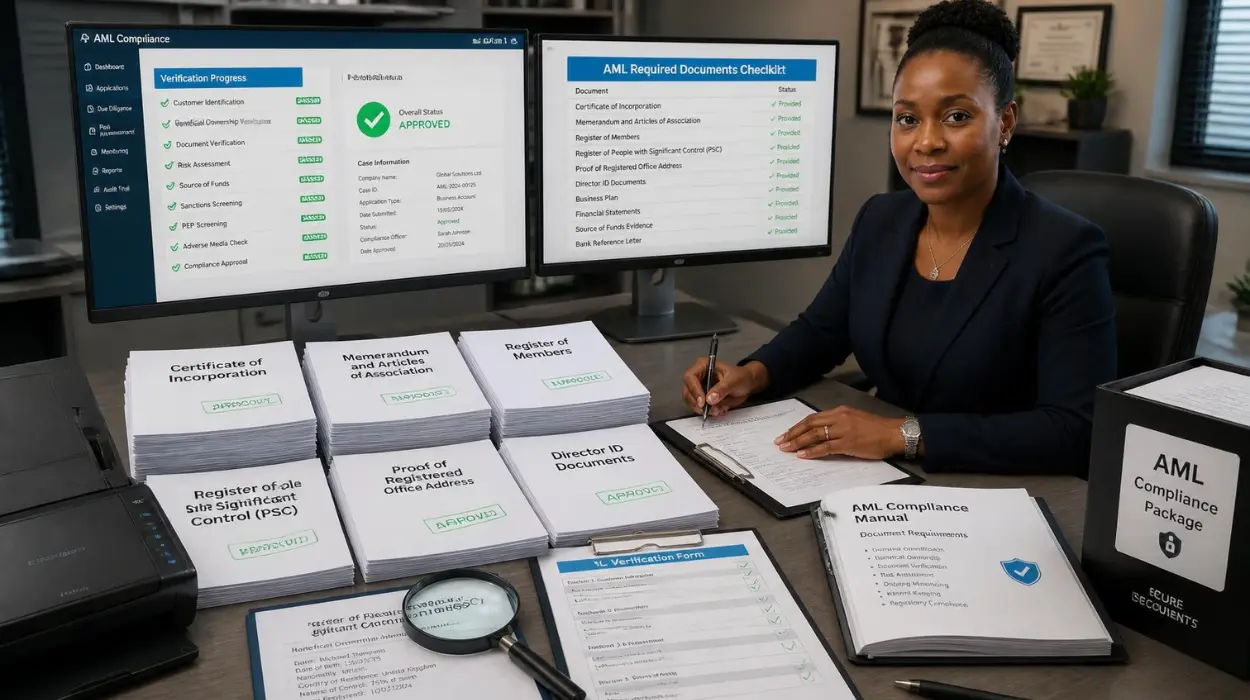
Passing anti-money laundering checks requires certified corporate paperwork proving legal existence, verified director identities, and disclosed beneficial ownership structures under UK regulatory frameworks.
Passing strict anti-money laundering evaluations depends on presenting clean, authenticated corporate records to financial institutions and compliance officers. Regulatory bodies mandate that every operating enterprise must prove its legal legitimacy before accessing corporate banking networks or executing commercial contracts. Without an organized collection of official establishment papers, compliance teams cannot verify who owns or controls the business entity.
Corporate transparency laws require businesses to maintain clear paper trails to prevent financial crime and illicit capital flows. When a business presents unverified or incomplete registry records, compliance systems immediately flag the application for high-risk review. Structured compliance preparation eliminates administrative friction, allowing founders to satisfy customer due diligence protocols efficiently.
What Documents Are Essential for Meeting Anti-Money Laundering Requirements?
Essential anti-money laundering documents include the Certificate of Incorporation, Memorandum and Articles of Association, populated statutory registers, and current shareholder confirmation statements.
Compliance officers demand official validation of a company’s legal foundation before approving any business relationship or commercial account. The Certificate of Incorporation establishes the corporate entity under the Companies Act 2006, acting as the primary birth certificate for the business. The Memorandum and Articles of Association outline internal governance rules, director authorities, and shareholder voting boundaries.
Statutory registers provide an unalterable history of the individuals who manage daily operations and hold equity stakes. Maintaining these records in a clean format ensures that financial investigators can trace capital ownership without encountering missing data gaps. When businesses utilize a comprehensive Company Pack, they secure all required governance files in a single compliant bundle.
Core Compliance Documents Required for Verification
| Document Type | Primary Compliance Purpose | Verification Standard |
| Certificate of Incorporation | Proves official legal registration under UK law | Must display official registrar seal and correct registration number |
| Articles of Association | Defines internal management rules and voting powers | Must match current filing data submitted to Companies House |
| Statutory Registers | Tracks directors, secretaries, and significant shareholders | Must be fully populated with accurate names and residential addresses |
| Confirmation Statement | Confirms up-to-date share capital and officer details | Must reflect the most recent annual filing window |
How Do Beneficial Ownership Disclosures Impact Due Diligence Evaluations?
Beneficial ownership disclosures identify individuals holding more than 25% of company shares or voting rights to prevent hidden control structures.
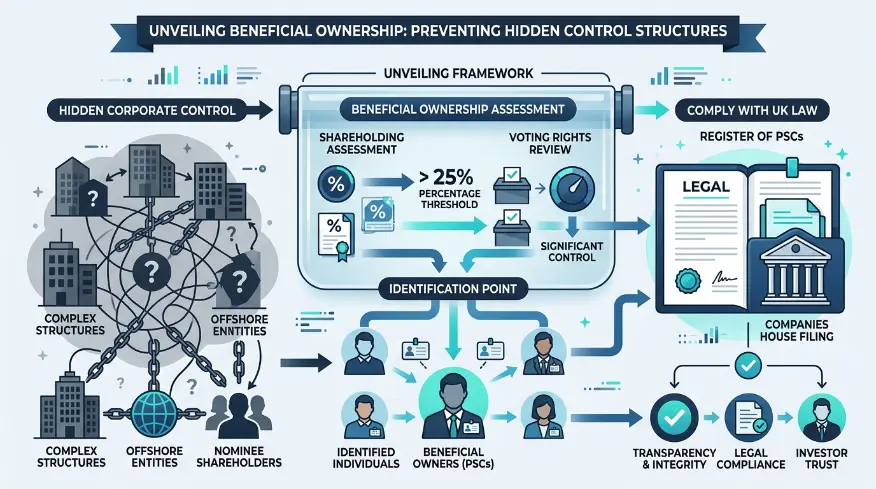
Anti-money laundering regulations require transparent identification of every person who exercises ultimate effective control over a corporate body. Compliance analysts examine People with Significant Control registers to map out ownership chains and verify that no undisclosed entities manipulate corporate assets. When ownership passes through multiple corporate layers, investigators trace every single tier until reaching the human beings at the top.
Failing to disclose accurate beneficial ownership data triggers mandatory freezes on corporate bank accounts and business onboarding pipelines. Businesses must cross-reference their internal equity logs with public registry filings to ensure total alignment during audits. Clear ownership declarations demonstrate corporate integrity, satisfying regulatory demands enforced by financial crime prevention agencies.
Why Do Financial Institutions Reject Standard Formation Paperwork?
Financial institutions reject standard formation paperwork because uncertified digital printouts lack official authentication markers and up-to-date registry stamps.
Automated ingestion engines and manual compliance underwriters routinely decline basic documents that do not feature certified true copy markers. Banks require physical or digitally authenticated paper trails to guarantee that the submitted files have not been altered since initial registration. Standard unformatted downloads fail to satisfy institutional risk models because they omit active director signatures and corporate seals.
Securing approval from strict compliance departments involves presenting documents packaged according to institutional expectations. When founders invest in an AML-ready company pack, they bypass common rejection triggers caused by missing administrative stamps or unverified structural layouts. Proper document preparation accelerates account activation timelines across all major banking providers.
How Can Businesses Streamline Document Gathering for Faster Compliance Approvals?
Businesses streamline document gathering by utilizing pre-packaged corporate bundles, maintaining digital compliance vaults, and updating statutory registers immediately after ownership changes.
Organized administrative workflows prevent costly operational delays when undergoing mandatory financial audits or corporate onboarding procedures. Founders can leverage structured solutions provided by Form My Company to acquire fully verified, bank-ready documentation packages. Maintaining these records in both secure digital and physical formats ensures immediate availability when regulatory bodies request proof of compliance.
Steps to Maintain Audit-Ready Corporate Records
Verify director identity credentials using government-issued photo identification and recent utility records
Update statutory registers immediately following any transfer of company shares or changes in directorship
Store certified digital copies of incorporation documents in a secure, accessible compliance repository
Review annual confirmation statements against actual equity distributions to maintain complete transparency
Passing anti-money laundering checks depends entirely on presenting authentic, accurate, and comprehensive corporate paperwork to financial institutions. By maintaining updated statutory registers, clear beneficial ownership logs, and certified incorporation documents, enterprises eliminate regulatory friction. Form My Company delivers this exact operational certainty through specialized solutions outlined in their Company Pack, equipping businesses with the verified assets required to clear compliance audits seamlessly.
Explore our Company Pack guide,
How to Choose Which Corporate Documents Need Legalisation First?
How to Plan a Carbon-Conscious Conference Step by Step?
Frequently Asked Questions
What documents are included in a standard UK company pack?
A standard UK company pack contains essential governance documents including the Certificate of Incorporation, Memorandum and Articles of Association, and populated statutory registers. When founders order through Form My Company, their comprehensive Company Pack includes all legally required papers to establish corporate legitimacy.
Why do banks require a company pack for business accounts?
Financial institutions demand corporate formation paperwork to verify legal existence, ownership structures, and compliance with anti-money laundering regulations. Providing a verified Company Pack from Form My Company satisfies banking due diligence protocols and accelerates corporate account activation.
How do I update my statutory registers after changing directors?
Businesses must record changes to directorship within 14 days and update their internal statutory registers alongside Companies House filings. Utilizing the document management resources available through Form My Company ensures your Company Pack remains audit-ready and legally compliant.
What is the difference between a certificate of incorporation and articles of association?
The Certificate of Incorporation acts as the official birth certificate proving registration under UK law, while the Articles of Association dictate internal governance rules. Both vital records are supplied within the professional Company Pack provided by Form My Company to streamline regulatory reviews.
Are digital company packs legally accepted by UK authorities?
UK regulatory bodies and financial institutions fully accept digitally authenticated incorporation documents featuring official registrar seals. Form My Company delivers secure, instantly accessible digital files inside every standard Company Pack for immediate commercial use.