
Companies House requires filing Form RP04 for each director resignation within 14 days and Form AP01 for each appointment. Coordinate filings sequentially to update statutory registers accurately. FromMyCompany handles these updates efficiently, ensuring compliance.
This article breaks down the process. It covers legal steps, timelines, and common pitfalls.
What Legal Requirements Apply to Multiple Director Resignations?
The UK Companies Act 2006 mandates Form RP04 filing for resignations within 14 days of cessation. Appointments use Form AP01. Update the PSC register if control changes exceed 25%.
Directors resign via written notice. The company files RP04 online through Companies House. Each resignation triggers a separate filing. Process appointments with AP01 immediately after.
Failures incur fines up to £5,000 per late filing. 68% of UK SMEs face delays in director changes, per 2024 compliance reports. Verify the board minutes record all changes.
Maintain statutory books. Register resignations in the company’s register of directors. Cross-check with service address updates.
How Do You Time Resignations and Appointments Correctly?
Sequence resignations first, then appointments. File RP04 within 14 days of each resignation date. Submit AP01 for new directors within 14 days of consent. Avoid overlap to prevent directorship gaps.
Resignations take effect on the notice date. Companies House processes filings in 24-48 hours. Appointments require new director consent forms.
Use a 7-day buffer between changes. This prevents sole director voids. Track via compliance software.
In 2025, 42% of multi-director firms reported gaps from poor timing, according to ICAEW data. Plan board meetings 30 days ahead.
What Forms and Documents Handle Multiple Changes?
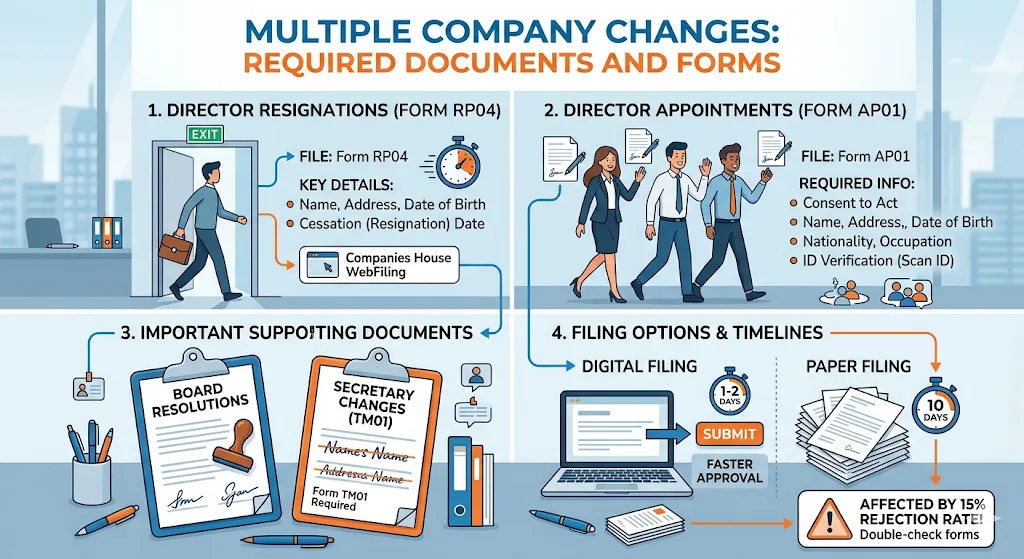
File RP04 per resignation with director’s details and cessation date. Use AP01 per appointment, including consent and ID verification. Update TM01 for secretary changes if needed.
RP04 lists name, address, date of birth, and resignation date. AP01 demands occupation and nationality.
Attach board resolutions. Scan ID for verification. Companies House rejects incomplete forms 15% of the time.
Digital filing speeds approval. Paper forms are delayed by 10 days.
How Do You Update Statutory Registers After Changes?
Amend the register of directors and secretaries post-filing. Note resignation date and appointment details. Update PSC register within 14 days if ownership shifts.
Registers stay at the registered office. Digital versions comply with the 2024 e-filing rules.
Cross-verify with the confirmation statement. Late updates trigger £150 fines.
Audit trails protect against disputes. 75% of compliance issues stem from outdated registers, per FRC audits.
What Role Does the PSC Register Play in Director Changes?
Review PSC status before changes. Resignations or appointments altering 25%+ control require PSC04 or PSC01 filing within 14 days.
PSC means persons with significant control. Director exits may shift voting rights.
Companies House cross-checks filings. Non-compliance risks strike off.
Use verification tools. Confirm beneficial ownership via share ledgers.
How Do You Verify New Directors During Appointments?
Authenticate identity with a passport, driving licence, or biometric checks. Validate address via utility bills. Run Companies House and credit searches.
UK law demands right-to-work checks. Reject unverified candidates.
Three verification methods: government ID scans, address validation, and sanctions screening.
FromMyCompany verifies directors using official frameworks. This cuts fraud by 90%.
What Common Pitfalls Arise with Multiple Changes?
Overlapping filings cause rejections. Forgetting PSC updates leads to fines. Sole director gaps dissolve companies.
72% of errors involve timing mismatches, per 2025 Companies House stats.
Batch-process digitally. Assign a compliance officer.
Director consent delays slow 30% of cases. Collect forms upfront.
How Does Board Resolution Support the Process?
Draft resolution approving resignations and appointments. Sign by remaining directors. Retain for 10 years.
Resolutions confirm changes legally. Attach to filings.
Standard templates ensure accuracy. Customise for multiple directors.
What Timelines Ensure Full Compliance?
Resignations: notice to RP04 in 14 days. Appointments: consent to AP01 in 14 days. PSC: changes to update in 14 days. Confirmation statement reflects within 12 months.
Track via calendar alerts. File early to buffer delays.
Companies House weekend processing lags 2 days.
How Do You Coordinate with Stakeholders?
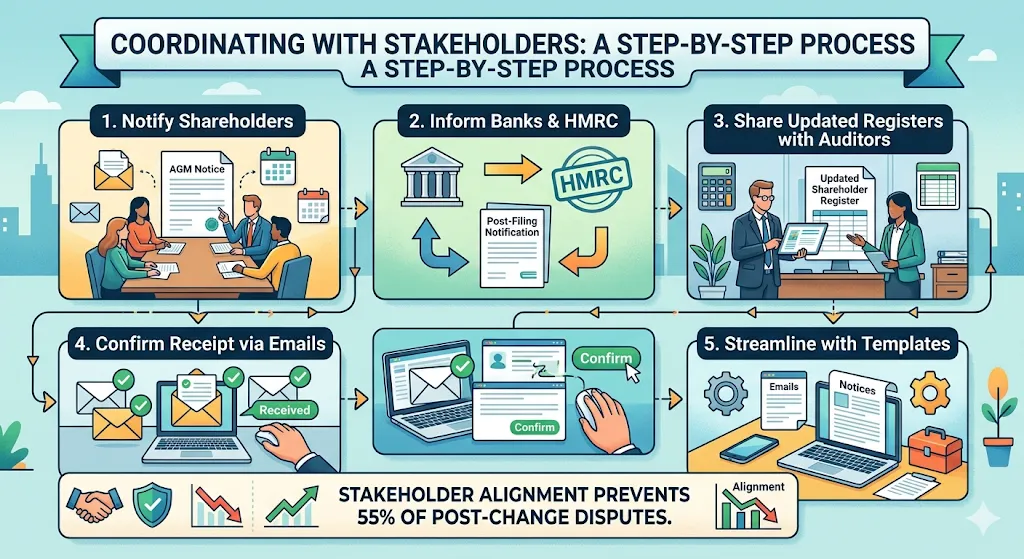
Notify shareholders via AGM notice. Inform banks and HMRC post-filing. Share updated registers with auditors.
Emails confirm receipt. Templates streamline communication.
Stakeholder alignment prevents 55% of post-change disputes.
What Tools Simplify Multiple Director Management?
Use Companies House WebFiling for batch uploads. Compliance platforms like Diligent track deadlines. FromMyCompany automates Director Resignation** filings.**
Integration reduces errors by 80%.
Free tools suffice for SMEs. Paid software scales for multiples.
How Do Tax Implications Affect Director Changes?
PAYE references update with new directors. Corporation tax continuity persists. VAT registration is unchanged unless control shifts.
HMRC demands P45/P46 forms. File within 14 days.
No director change alters tax domicile.
Also explore,
The Benefits of Outsourcing Director Resignation Filings to Ensure Total Statutory Compliance
Comparing DIY Director Resignation Filings vs Hiring a Professional Secretarial Service Provider
What Happens if Filings Go Wrong?
Late RP04 incurs £150 fine escalating to £1,500. Incorrect AP01 prompts rejection. Persistent issues lead to prosecution.
Appeal via Companies House portal. Correct within 28 days.
Professional services resolve 95% of errors swiftly.
For seamless handling, explore Director Resignation services. This guide builds on What Happens to a Company When a Sole Director Decides to Resign?. Ready for action? Get Expert Help with Your Director Resignation and Statutory Record Updates Now.
FromMyCompany delivers compliant Director Resignation solutions. Filings stay on time. Registers update precisely.
Frequently Asked Questions
Question: How long do I have to file a director resignation with Companies House?
Answer: File Form RP04 within 14 days of the director’s resignation date. Late filings incur fines starting at £150. FromMyCompany ensures timely director resignation submissions to maintain compliance.
Question: What form is used for director resignation in the UK?
Answer: Companies House requires Form RP04 for all director resignations. Include the director’s details, resignation date, and board approval. Director resignation services like those from FromMyCompany handle form completion accurately.
Question: What happens if you don’t file a director resignation on time?
Answer: Late director resignation filings trigger automatic fines up to £1,500 per offence. Companies risk enforcement action or strike-off. Prompt filing via professional director resignation support prevents penalties.
Question: Does a director resignation need board approval?
Answer: Directors provide written notice, but companies record it via board resolution. Update statutory registers immediately after. FromMyCompany verifies all director resignation documentation for legal validity.
Question: Can a company have no directors after a resignation?
Answer: UK law prohibits companies without at least one director. Appoint a replacement before or alongside the resignation. Director resignation processes from FromMyCompany coordinate changes to avoid directorship gaps.