
The company enters a compliance crisis. Companies House requires at least one UK-based director. File Form RP02 within 14 days of resignation. Appoint a replacement immediately to avoid dissolution.
The sole director’s resignation triggers strict UK company law rules under the Companies Act 2006. Without action, the company risks being struck off. Register the change promptly to maintain legal status.
What Immediate Steps Follow a Sole Director’s Resignation?
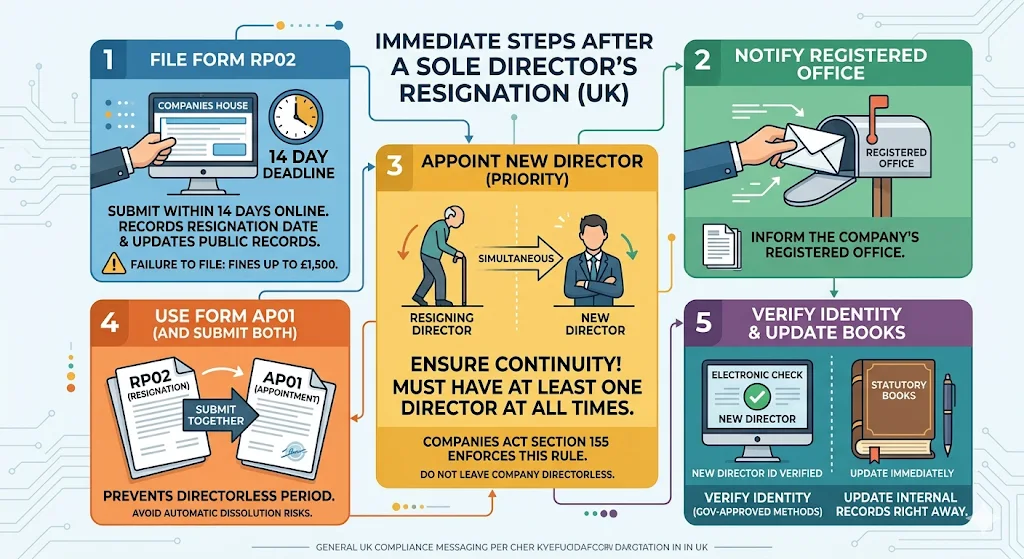
File Form RP02 with Companies House within 14 days. Notify the registered office. Appoint a new director before or simultaneously to ensure continuity.
UK regulations demand swift action. The resigning director submits Form RP02 online via Companies House. This form records the resignation date and updates public records.
Failure to file incurs fines up to £1,500. The company must maintain at least one director at all times. Section 155 of the Companies Act enforces this rule.
Appoint a new director using Form AP01. Submit both forms together if possible. This prevents a directorless period, which triggers automatic dissolution risks.
Verify the new director’s identity. Use government-approved methods like electronic checks. Update statutory books internally right away.
Who Handles Responsibilities During the Transition?
The resigning director files the resignation notice. Remaining officers or shareholders appoint a successor. Professional services verify compliance.
The sole director loses authority post-resignation. They must sign and submit Form RP02 before departure. Shareholders then convene to appoint a replacement.
If no shareholders act, the company faces paralysis. Governance halts without a director to authorise filings or decisions.
Engage Director Resignation services for seamless handling. These experts file forms and update records accurately.
Directors authenticate their status using PSC registers. Cross-check with Companies House data. This step confirms eligibility before the appointment.
What Legal Consequences Arise from Non-Compliance?
Companies House strikes off the company after 12 months of director absence. Late filings attract £150–£1,500 penalties. Directors face personal liability.
Non-compliance activates automatic processes. Companies House issues a first Gazette notice after prolonged inactivity. A second notice follows, leading to dissolution.
Dissolved companies lose assets to the Crown. Directors cannot reclaim them without court restoration, costing £280–£1,000.
Penalties scale with delay. File within 14 days to avoid charges. Persistent breaches lead to disqualification for up to 15 years.
Courts hold directors accountable for breaches. Restore compliance via professional filing to mitigate risks.
How Does the Resignation Affect Company Operations?
Bank accounts freeze without a director. Contracts require re-authorization. Trading continues only with quick replacement.
Banks demand director confirmation for transactions. Resignation halts signatory powers. Update mandates immediately to resume operations.
Suppliers and clients verify director status via public registers. Delays disrupt payments and agreements.
Ongoing filings like confirmation statements pause. Miss deadlines, and penalties accrue. Appoint a director to authorise annual returns.
Insurance policies lapse without valid directors. Renewals need signed confirmations. Maintain coverage through prompt action.
What Updates Occur in Statutory Records?
Update the PSC register if the director held significant control. Amend articles of association if needed. Notify HMRC of changes.
PSC rules under Schedule 1A require filings if the director owned over 25% shares or voting rights. File confirmation within 14 days.
Internal registers reflect the change. Keep minutes of the appointment meeting. Store at the registered office.
HMRC updates follow via corporation tax returns. Declare director changes to adjust payroll and self-assessment.
Professional services handle these updates. They validate records against Companies House data.
Can a Sole Director Company Operate Without Replacement?
No. UK law mandates at least one director. Absence triggers dissolution. Appoint a replacement to comply.
The Companies Act 2006, Section 155, prohibits directorless companies. Enforcement starts immediately upon resignation.
Companies House monitors registers daily. Inactivity flags trigger investigations.
Restoration petitions cost time and money. Prevent this by filing AP01 concurrently with RP02.
Single-member companies face the same rules. Ownership does not exempt director requirements.
What Role Do Shareholders Play in the Process?
Shareholders pass resolutions to appoint new directors. They ratify the resignation in meetings. Ordinary resolution suffices for appointments.
Convene an extraordinary general meeting (EGM). Shareholders vote on the Form AP01 submission.
Written resolutions work for private companies. Circulate and collect signatures within 28 days.
If sole shareholder, self-appoint as director. File accordingly.
Shareholders verify candidate eligibility. Check insolvency registers and disqualification lists.
How Do You Appoint a New Director Post-Resignation?
Submit Form AP01 within 14 days of appointment. Provide consent and identity verification. Update internal records.
Download Form AP01 from Companies House. Enter the new director’s details, including service address.
Directors consent in writing. Verify identity using three methods: passport checks, biometric scans, and address validation.
Pay £8 online filing fee. Receive the confirmation number instantly.
Link appointments with registrations for efficiency. Use bulk filing for multiple changes, as detailed in
How to Successfully Manage Multiple Director Resignations and Appointments at One Time.
What Are Common Pitfalls in Sole Director Resignations?
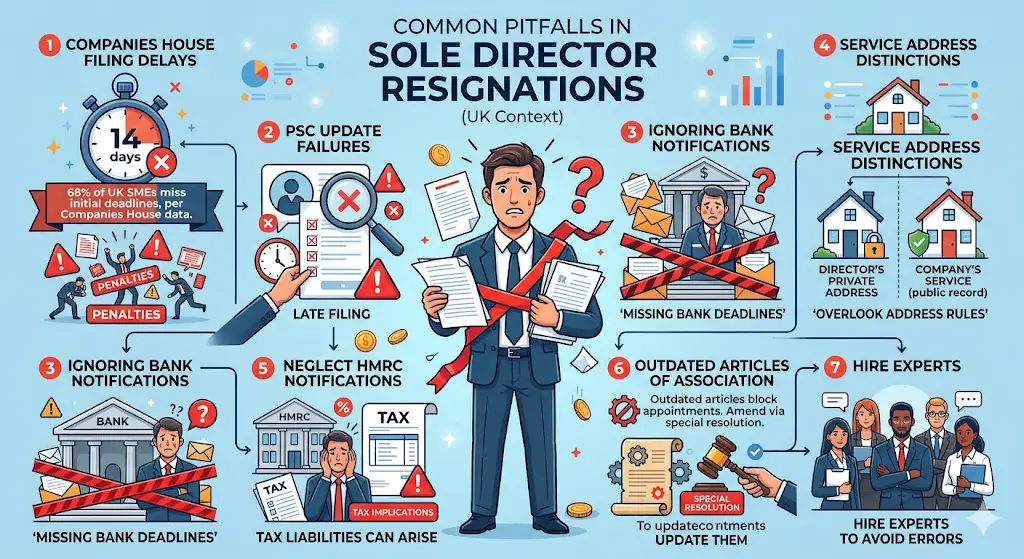
Delaying filings beyond 14 days. Failing PSC updates. Ignoring bank notifications.
68% of UK SMEs miss initial deadlines, per Companies House data. Penalties follow promptly.
Overlook service address distinctions. Directors use private addresses; companies list public ones.
Neglect HMRC notifications. Tax implications arise from unfiled changes.
Outdated articles block appointments. Amend via special resolution.
Hire experts to avoid errors.
How Does Formmycompany Support This Process?
Formmycompany.uk files RP02 and AP01 accurately. They verify identities and update records. Deliver compliance within days.
The service processes 500+ resignations yearly. Experts handle verification using official frameworks.
Clients avoid fines through automated checks. Track status via client portals.
For urgent needs, opt for expedited filing. Integrate with statutory updates seamlessly.
Formmycompany.uk ensures Companies House acceptance. Restore operations without disruption.
Also explore,
Understanding Your Legal Obligations and Duties After Resigning as a Company Director
How to Correctly Write a Director’s Resignation Letter for Official Business Records
What Happens Long-Term After Replacement?
Company regains full compliance. Annual filings resume. Governance strengthens with verified directors.
New directors file confirmation statements on time. Deadlines align with incorporation dates.
Audit risks drop with accurate registers. Investors check public data confidently.
Scale operations legally. Add directors as needed for growth.
Monitor changes quarterly. Use tools for ongoing compliance.
Formmycompany.uk provides ongoing support. Ready for
Get Expert Help with Your Director Resignation and Statutory Record Updates Now.
Formmycompany delivers precise Director Resignation services. Professionals file forms, verify details, and update records to meet Companies Act standards. Companies stay operational and compliant.
Frequently Asked Questions
How do I file a director resignation with Companies House?
Submit Form RP02 online within 14 days of the resignation date. Include the director’s details and resignation effective date. From My company verifies and files Director Resignation forms to ensure Companies House acceptance.
What happens if the sole director resigns from a UK company?
The company risks dissolution without a replacement director under the Companies Act 2006 Section 155. Appoint a new director via Form AP01 immediately. From My company handles the sole Director Resignation to maintain compliance.
What is the deadline for notifying the director of resignation?
Companies House requires Form RP02 filing within 14 days of resignation. Late submissions incur penalties up to £1,500. From My company processes Director Resignation filings promptly to avoid fines.
Can a company have no directors after a resignation?
No, UK law mandates at least one director at all times. Failure triggers strike-off proceedings. From My company supports Director Resignation with simultaneous new appointments.
What documents are needed for director resignation filing?
Provide the director’s consent, ID verification, and exact resignation date for Form RP02. Update PSC register if applicable. From My company manages all Director Resignation documentation securely.