A letter may prove that you can act for a business without proving that the business exists. That distinction matters when you’re asked for a Letter of Authority during a verification check. If you’re asking how to use a letter of authority for business verification, first confirm what the verifier needs the letter to show.
An official-looking letter won’t necessarily satisfy the request. A Letter of Authority usually confirms that someone has permission to act, contact a provider or access information on a business’s behalf. It is not standard proof that a company exists, and the organisation reviewing it decides whether it meets its requirements. Banks, platforms and other organisations may each have different formats and supporting evidence requirements.
This guide explains what a Letter of Authority can and can’t prove, who should sign it and what details to include. It also covers how to check the verifier’s instructions before submitting your document and what to do if it’s rejected. Checking the requirements first can help you avoid preventable delays and prepare a letter that fits the request.
Key Takeaways
- How to Use a Letter of Authority for Business Verification starts with identifying exactly what the requesting organisation needs the letter to confirm.
- Use the verifier’s instructions to shape the letter’s wording, details and format rather than relying on a universal template.
- Check how an LOA differs from identity evidence, company records and a Certificate of Good Standing before deciding what to submit.
- Follow the stated submission channel, send documents securely and keep a copy in case verification is delayed or rejected.
- If you need separate company documents, explore whether company administration support from Form My Company fits your needs.
What a Letter of Authority for business verification proves
A Letter of Authority (LOA) records permission for a named person to act for a business within a defined scope. That could mean contacting an organisation, discussing an account or carrying out a particular task. The terms “Letter of Authority” and “Letter of Authorization” are sometimes used for similar documents; Letter of Agency (LOA) provides background on the terminology.
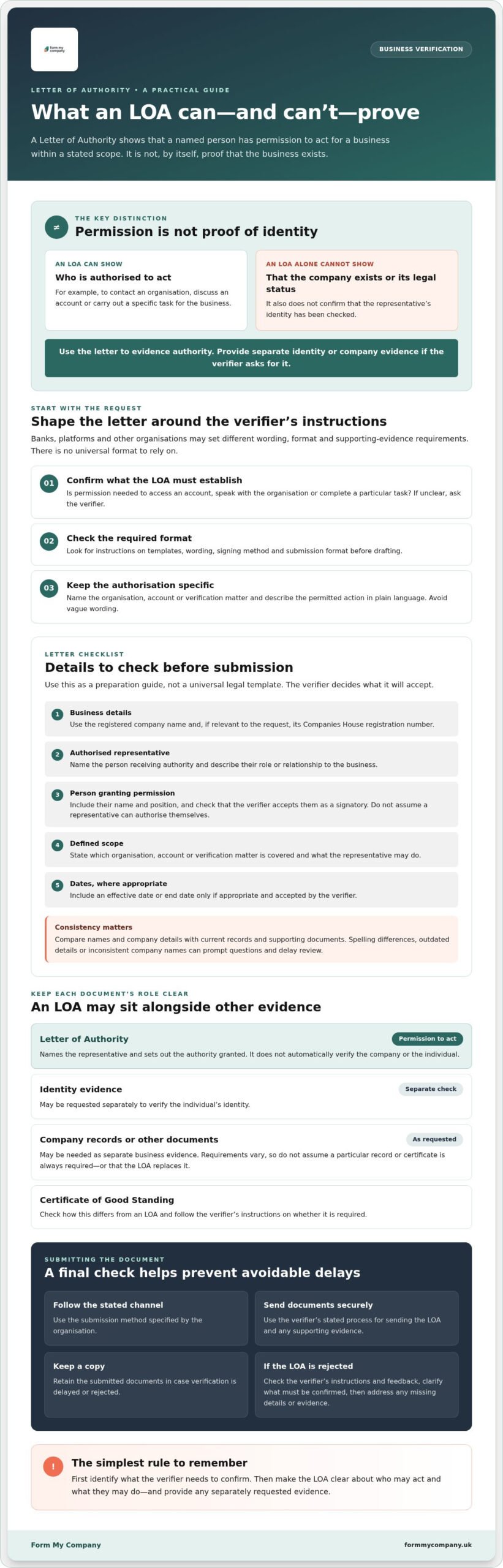
The important distinction is between authority and identity. An LOA can help show that a representative has the business’s permission, but it doesn’t automatically confirm that the company exists or establish its current status. Each verifier sets its own process and decides what evidence it will accept.
An LOA establishes that a person has been authorised to act within a stated scope. On its own, it cannot establish a company’s identity or legal status.
When might a verifier ask for a Letter of Authority?
A bank, payment provider or business platform may request an LOA when someone other than the business’s usual contact is handling a verification request. The verifier may want to confirm that the person can access an account, communicate on the company’s behalf or complete a particular task. These are examples, not universal rules. Before drafting a letter, confirm the purpose of the request and which actions the authorisation needs to cover.
Read the instructions carefully. Is the verifier asking for permission to access an account, speak with its team or perform a specific action? A broad or unclear letter may not answer a narrowly defined request. If the purpose isn’t clear, ask the organisation what the LOA must confirm and whether it has a preferred format.
What does a Letter of Authority not prove?
Permission for an individual to act doesn’t, by itself, verify the company’s name, identity or status. It also doesn’t confirm that the individual’s identity has been checked. These may be separate parts of the verifier’s process, so treat each requested document as serving a different purpose.
An LOA may need to accompany identity evidence or company documents rather than replace them. A verifier might ask for company records or other evidence, but there is no single supporting document that every organisation requires. Don’t assume that a certificate or register extract will be needed, or that an LOA makes other requested evidence unnecessary. Follow the instructions for your specific application.
That distinction is central to How to Use a Letter of Authority for Business Verification: use the letter to show the representative’s permission, then provide any separate evidence the verifier requests to confirm the business or individual.
What to include in a business verification Letter of Authority
Before drafting, check whether the verifier requires a particular template, wording, signing method or submission format. A checklist can help you gather relevant details, but it isn’t a universal legal template. Each organisation decides what it will accept. Make the purpose clear to the person reviewing the letter rather than leaving them to infer it.
An LOA can authorise someone to request information or communicate with another organisation. For example, Thomson Reuters Practical Law describes a Letter of Authority used to allow solicitors to obtain information from third parties. A business verification letter may serve a different purpose, so tailor yours to the request.
Identify the business, representative and signatory
Use the company’s registered name and, if relevant to the request, its Companies House registration number. Name the person receiving authority and describe their role or relationship to the business. Identify the person granting permission, including their position, and check that the verifier accepts them as a signatory. Don’t assume a representative can authorise themselves.
Compare names and company details with current records and any supporting documents you plan to submit. Differences in spelling, outdated details or inconsistent company names can prompt questions and delay the review.
Define the permission clearly
State which organisation, account or verification matter the letter covers. Then describe the permitted action in plain language, such as contacting the provider about a named account or responding to a specific verification request. Avoid vague wording such as “manage all business matters” unless the verifier has asked for that scope. Include an effective date or end date only if appropriate and accepted by the verifier.
A clear LOA identifies the business, names the authorised person, defines the permitted action and includes an accepted sign-off.
- Business identity: registered name and, if relevant, company number.
- Authorised person: full name and role or relationship to the business.
- Permission: the organisation and task covered, with any dates the verifier requires.
- Sign-off: the authorising person’s name, position and signature or other requested format.
For How to Use a Letter of Authority for Business Verification, make each detail fit the verifier’s stated purpose, then compare it with your supporting documents before sending. If you’re also organising separate company administration documents, explore company administration support from Form My Company.
Letter of Authority versus other business verification documents
Different business verification documents answer different questions. An LOA concerns permission to act; identity evidence concerns an individual; company records and certificates may provide information about the business. These documents aren’t interchangeable. The requesting organisation decides which it accepts and whether it needs more than one.
| Document type | What it may show | What it does not establish alone |
|---|---|---|
| Letter of Authority | A named person has permission to carry out a stated task for a business. | The person’s identity or the company’s existence and status. |
| Identity evidence | Information used to check the identity of an individual. | That the person is authorised to represent a business. |
| Company records | Details recorded about a company, such as its registered name or number. | That a particular person may act for it or that it meets every verifier’s requirements. |
| Certificate of Good Standing | Company-status information relevant to the certificate and the verifier’s request. | Authority for a representative to act or acceptance for every verification process. |
Use the table to identify what each document is intended to show, then follow the verifier’s instructions. One document may not cover every part of a check.
Does an LOA prove that a company exists?
No. An LOA records permission, while company evidence addresses separate questions about identity or status. A verifier may request both an LOA and company documents, but don’t assume a particular public record or certificate will satisfy the check. If a Certificate of Good Standing is requested, see the Certificate of Good Standing service as a separate company-status document, not a substitute for authority to act.
How is an LOA different from identity verification?
Identity verification concerns the individual. An LOA concerns whether that individual has permission to act for the business. Someone could provide identity evidence without being authorised to represent the company. Equally, a letter granting authority doesn’t confirm the person’s identity. The verifier’s instructions determine whether these checks are linked or handled separately. Submit each type of evidence as requested.
That distinction is central to How to Use a Letter of Authority for Business Verification: match each document to the question it is meant to answer. If the request is unclear, ask the organisation which evidence it needs for the company, the representative and the authority being granted.
How to submit an LOA and resolve verification problems
A complete letter can still be delayed if it arrives in the wrong format or through the wrong channel. Follow the verifier’s process rather than assuming another organisation will accept the same document. Check the recipient’s requirements before sending, even when the LOA appears complete.
Check the request before preparing the letter
Start with the request. Confirm which documents are needed, who must sign the LOA, the accepted file format and how to submit it. If the instructions aren’t clear, ask whether the verifier has a template or requires an original document, a signed scan or supporting evidence. Check the exact scope of permission, such as a particular account, service, transaction or period.
Use this workflow to organise your submission:
- Read the request: note each document and requirement, including any case or application reference.
- Confirm the format: check the signatory rules, file type and submission method with the verifier.
- Prepare the LOA: match its wording and scope to the stated purpose, and gather any separately requested evidence.
- Review the details: compare names, company information, dates, permission and sign-off with the instructions and supporting documents.
- Submit securely: use the verifier’s portal or specified channel, then keep a copy of the letter and other documents sent.
Keep the permission focused. A letter covering access to one account, for example, may not address a separate request to approve a transaction. Don’t broaden the authority unless the verifier has asked for it.
What should you do if the LOA is rejected?
Before resubmitting, ask the verifier which requirement remains unmet and whether the issue is a missing detail, a mismatch or an unacceptable format. A specific explanation helps you correct the problem instead of sending the same letter again.
Check the company and representative names, any company number included, dates, scope of permission and signatory details against the verifier’s instructions. If the issue is the signing method or file format, confirm what replacement it will accept before revising the letter. Send corrected documents through the requested secure channel and follow up using the existing case reference. Keep a record of what you submit.
Following these steps is a practical part of How to Use a Letter of Authority for Business Verification: meet the recipient’s requirements, make the scope clear and keep the submission traceable. If you’re also organising separate company administration, explore company administration support from Form My Company.
Get business verification documents organised with Form My Company
Prepare the evidence the verifier has requested, rather than assembling a larger bundle based on assumptions. A Letter of Authority may cover the representative’s permission, while separate company or identity documents may address other parts of the check. Form My Company supports UK company formation and related administration, which may be useful if you also need to organise company paperwork. The verifier decides what it will accept.
When may company administration support help?
If you need company documents as well as an LOA, company administration support may help you identify which paperwork is available and relevant to your next step. Form My Company lists supplementary company documents as a separate service. Check the details to see whether they match your needs, then confirm with the organisation requesting verification that the document is suitable. No service can guarantee that a verifier will accept particular evidence.
This guide covers how to prepare and use an LOA generally. It doesn’t confirm the current availability, eligibility, contents or delivery process of any specific LOA service. If you’re considering one, check the provider’s current service information directly before relying on it. Always follow the requesting organisation’s requirements for documents, format and submission route.
A final checklist before you submit
Check the whole submission against the request. A clear letter can still be returned if the named person, permission or accompanying evidence doesn’t match what the verifier asked for. Before sending, confirm:
- The business and representative are named consistently with the request and supporting paperwork.
- The signatory meets the verifier’s stated requirements.
- The permission describes the specific task, account or matter covered.
- You’ve checked whether company records or personal identity evidence must accompany the LOA.
- The documents are in the accepted format and ready for the stated submission channel.
That’s the practical finish to How to Use a Letter of Authority for Business Verification: confirm the request, prepare matching evidence and submit it through the channel specified by the verifier. Keep a copy so you can refer to it if the organisation asks a follow-up question.
For separate company administration needs, review Form My Company’s company services.
Prepare your verification documents with confidence
How to Use a Letter of Authority for Business Verification comes down to matching the letter to the verifier’s request. An LOA records permission for someone to act for a business, but it doesn’t prove the company’s identity or status by itself. Check who must sign, what task the authority covers and whether separate identity or company evidence is required.
Before submitting, confirm the accepted format and channel, compare the details with your supporting documents and keep a copy. If the verifier rejects the letter, ask which requirement needs attention and make a targeted correction rather than resending the same document.
If you also need help organising separate company administration documents, Form My Company supports UK company formation and related administrative needs. Check the current details of any specific service before relying on it for your request, and follow the verifier’s requirements first.
Explore Form My Company’s company services for support with separate company administration needs.
Frequently Asked Questions
What is a Letter of Authority for business verification?
A Letter of Authority is a written record that a business has permitted a named person to act for it within a stated scope. A verifier may request one to confirm who can communicate or complete a specific task on the company’s behalf. Understanding How to Use a Letter of Authority for Business Verification means recognising its limits: it doesn’t automatically prove the company’s identity or status, or the representative’s personal identity.
Who can sign a business Letter of Authority?
The signatory should have authority to grant the permission, but the verifier may set its own rules about who it accepts. Check the request before choosing a director or another business representative. Don’t assume the person seeking authority can sign their own letter. Some providers require permission to come from someone else authorised to represent the business, so confirm the signatory requirements before drafting.
What information should a Letter of Authority include?
Useful details commonly include the business’s registered name, the authorised person’s name and role, the signatory’s details, the action permitted and the relevant organisation or account. Dates and contact details may also be needed if the verifier requests them. A generic checklist may not meet every recipient’s requirements. Use the organisation’s template or instructions where provided, and check that the details match your supporting documents.
Is a Letter of Authority proof that a UK company exists?
No. An LOA records permission for someone to act; it doesn’t establish that a company is registered or confirm its current status. The verifier may separately request company records, identity evidence or other documents. Check the exact request rather than assuming one document covers every requirement. A Certificate of Good Standing is a separate company-status document, not a replacement for an LOA granting authority to act.
Can I use the same Letter of Authority for different organisations?
Possibly, but don’t assume one letter will meet every organisation’s requirements. Recipients may ask for different wording, signatories, formats, supporting documents or scopes of permission. A letter covering one account or service might not apply to another. Check with each verifier before reusing it, and update the document if the authorised person or permission has changed. Follow the recipient’s current instructions before submitting.
What should I do if my Letter of Authority is rejected?
Ask the verifier which requirement wasn’t met and whether it needs a revised letter or additional evidence. Check the business details, signatory, authorised person, permission scope, dates and file format against the instructions. Make the requested changes rather than resubmitting the same document unchanged. Send the revised documents through the stated secure channel, keep a copy of your response and use the existing case reference when following up.
Does a Letter of Authority need to be witnessed or notarised?
Not necessarily. Whether witnessing or notarisation is needed depends on the organisation requesting the letter and the purpose of the verification. Don’t arrange either unless the recipient asks for it or its instructions require it. Before signing, confirm which signing methods and file formats it accepts. If the verifier supplies a template, follow its directions rather than adding steps based on assumptions about other organisations’ processes.