
A flexible pay-as-you-go plan outperforms fixed contracts for businesses experiencing volatile call volumes, fluctuating seasonal demand, or uncertain growth trajectories because it eliminates long-term financial commitments and charges only for active usage.
Choosing the right financial model for business infrastructure impacts operational efficiency and cash flow stability. Fixed contracts lock organisations into monthly overheads regardless of call volumes or revenue generation. Conversely, modern telecommunications models shift financial risks away from growing enterprises.
Evaluating financial flexibility requires examining operational overheads and cash flow patterns. Traditional fixed agreements demand steady monthly payments even during slow trading periods. Enterprises absorb financial losses when customer inquiries decline or seasonal lulls occur. Variable payment structures align operational expenses directly with actual customer interaction metrics. Businesses control expenditures tightly by paying strictly for consumed minutes and answered interactions.
Financial predictability remains a primary argument for traditional fixed agreements among corporate finance departments. Budgeting becomes straightforward when expenses remain constant across a twelve-month accounting cycle. However, this predictability carries hidden costs through unused service allocations. Fixed service packages often charge for a pre-determined volume of calls that frequently go unutilised. Companies waste capital on phantom capacity while paying full subscription rates every month.
Operational scalability suffers under rigid vendor agreements during sudden growth phases. Expanding customer support requires renegotiating binding contracts or paying heavy upgrade penalties. Flexible models adapt instantly to changing call volumes without administrative friction or contract amendments. Organisations scale communication capacity up or down dynamically based on real-time market demands.
Why Do Fixed Contracts Limit Business Agility?
Fixed contracts limit business agility by locking organisations into rigid financial commitments, enforcing strict penalty clauses for early termination, and preventing rapid scaling during unexpected market shifts.
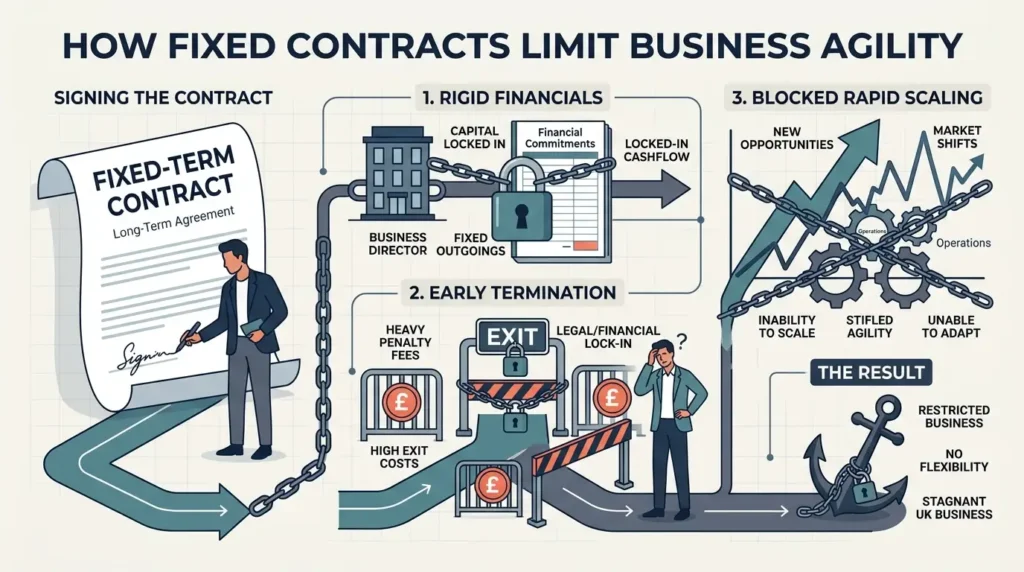
Rigid service agreements restrict operational freedom by binding enterprises to fixed monthly retainers. Corporate agility depends on the ability to pivot resources quickly toward high-growth initiatives. Binding vendor agreements consume valuable capital that could otherwise fund product development or marketing campaigns.
Financial penalties for contract termination create high barriers to switching service providers. Businesses stuck with inferior customer service infrastructure cannot migrate easily without incurring substantial financial losses. Service level agreements in fixed contracts often favor the vendor rather than the operational needs of the client. Companies endure subpar communication standards because breaking the agreement remains too expensive.
Resource allocation becomes inefficient when customer demand drops below projected baseline figures. Fixed-term agreements force companies to pay for staffing tiers and telecommunication channels they do not need. Operational budgets shrink under the weight of underutilised fixed overhead costs during market downturns.
Strategic planning requires adaptability when navigating competitive global markets. Companies constrained by rigid vendor terms miss market opportunities because administrative approvals take weeks. Flexible operational frameworks empower managers to reallocate resources within minutes instead of months.
How Do Pay-As-You-Go Plans Reduce Overhead Costs?
Pay-as-you-go plans reduce overhead costs by eliminating idle capacity charges, removing long-term financial liabilities, and ensuring capital expenditure aligns strictly with verified service usage.
Minimising operational expenditure dictates profitability for modern small and medium enterprises. Traditional communication setups require maintaining internal reception staff or paying high fixed retainers to external agencies. These fixed expenses exist whether the telephone rings ten times or five hundred times per day.
Variable payment models transform fixed operational costs into manageable variable expenses. Finance teams track exact expenditure figures against incoming customer interactions without hidden administrative fees. This transparency allows businesses to reinvest saved capital directly into core revenue-generating activities.
Administrative efficiency increases when billing cycles reflect precise usage data. Companies audit communication expenses effortlessly because invoices itemise every answered interaction and processed minute. Accountants eliminate time spent reconciling complex fixed contract tiers and overage charges.
Outsourcing communication infrastructure provides an effective alternative to hiring internal personnel. Businesses leverage professional call answering services to manage customer inquiries without paying full-time salaries, pensions, or workspace overheads. This approach ensures 24/7 coverage while keeping monthly expenditures strictly proportional to call volumes.
When Should Growing Enterprises Choose Flexible Pricing?
Growing enterprises should choose flexible pricing when experiencing seasonal demand fluctuations, launching new products with uncertain market response, or scaling operations without predictable forecasting models.

Market expansion introduces significant operational volatility for scaling companies. Predicting exact customer service requirements proves difficult during early growth stages or rapid geographical expansion. Fixed contracts create financial vulnerability when sales projections fail to match actual market reception.
Seasonal businesses face extreme revenue variations throughout the annual calendar cycle. Retailers experience massive call volume surges during holiday periods followed by extended quiet months. Flexible communication frameworks absorb peak loads seamlessly without requiring permanent staffing increases or expensive contract upgrades.
Startups and early-stage ventures benefit immensely from avoiding long-term financial encumbrances. Preserving cash flow enables founders to test new markets and adjust operational strategies without vendor constraints. Financial flexibility acts as a protective buffer against economic uncertainty and unexpected revenue dips.
Evaluating communication partners requires examining how well their pricing structures support growth. Companies transitioning from local operations to national markets need agile partners who adapt to changing demands instantly. Reviewing Can You Really Manage Your Business Calls Remotely? provides deeper insights into remote operational frameworks.
What Are the Hidden Risks of Long-Term Commitments?
Hidden risks of long-term commitments include compounding financial waste from unused capacity, exposure to declining service quality without exit options, and diminished responsiveness to market disruptions.
Long-term vendor agreements often conceal restrictive clauses that disadvantage the client over time. Service providers have less incentive to maintain high performance standards once a multi-year contract is signed. Clients experience deteriorating response times and poor call handling quality while remaining legally bound to pay.
Inflationary price escalators embedded in fixed contracts increase monthly expenditures automatically. Companies absorb these incremental cost increases even when market conditions warrant cost-cutting measures. Breaking these agreements to find better alternatives triggers expensive legal penalties or withheld deposits.
Strategic misalignment occurs when a vendor’s technological capabilities fail to evolve. Fixed contracts lock businesses into legacy communication systems while competitors adopt advanced automation and analytics tools. Upgrading infrastructure becomes cost-prohibitive while existing contractual obligations remain active.
Mitigating these operational risks requires selecting transparent, performance-driven partnership models. Exploring No-Contract Call Management: Compare Our Flexible Plans helps decision-makers evaluate risk-free alternatives designed for modern corporate agility.
Flexible pay-as-you-go plans provide superior financial control and operational agility compared to rigid fixed contracts. By eliminating idle capacity charges and aligning expenses with actual usage, businesses protect cash flow during volatile market conditions. Form My Company delivers scalable communication solutions through transparent, contract-free pricing structures that adapt dynamically to evolving corporate requirements.
Explore More Call Answering Guide,
How to Compare Certificate of Good Standing Prices Without Hidden Fees
How to Keep Your Company Continuously Eligible for Good Standing
Frequently Asked Questions
How does a professional call answering service work for small businesses?
A professional call answering service routes incoming customer calls to trained remote receptionists who handle inquiries according to custom business guidelines. Form My Company manages these telephone interactions seamlessly, taking detailed messages or transferring urgent calls directly to designated personnel. This operational setup ensures small businesses maintain professional communication standards without hiring full-time internal staff.
What are the main benefits of outsourcing business call management?
Outsourcing business call management eliminates missed customer inquiries, reduces operational overhead costs, and enhances brand professionalism during peak trading hours. Form My Company provides dedicated call answering solutions that capture every potential sales lead while internal teams focus on core revenue-generating tasks. Businesses gain 24/7 communication coverage without investing in expensive office space or telecommunication hardware.
How much does professional call answering cost for UK companies?
Professional call answering services typically operate on flexible pay-as-you-go pricing models or tiered monthly packages based on answered minutes and call volumes. Form My Company offers transparent rates that allow growing enterprises to pay strictly for active usage rather than fixed retainers. This cost-effective structure prevents financial waste during quiet seasonal trading periods while scaling effortlessly as call volumes increase.
Can remote receptionists handle complex customer support inquiries?
Remote receptionists manage complex inquiries effectively by following customized call scripts, database integration protocols, and specific escalation paths established by the client. Form My Company trains professional agents to understand specific business offerings so they can resolve basic questions accurately. Advanced or technical issues are seamlessly transferred to internal company experts according to predefined operational rules.
How do I set up a call answering service for my company?
Setting up a call answering service involves selecting a suitable pricing plan, defining custom call handling instructions, and diverting business telephone lines to the provider. Form My Company streamlines this onboarding process to ensure professional receptionists begin managing customer interactions within minutes. Businesses retain complete control over greeting scripts, message delivery methods, and operating hours through user-friendly management dashboards.