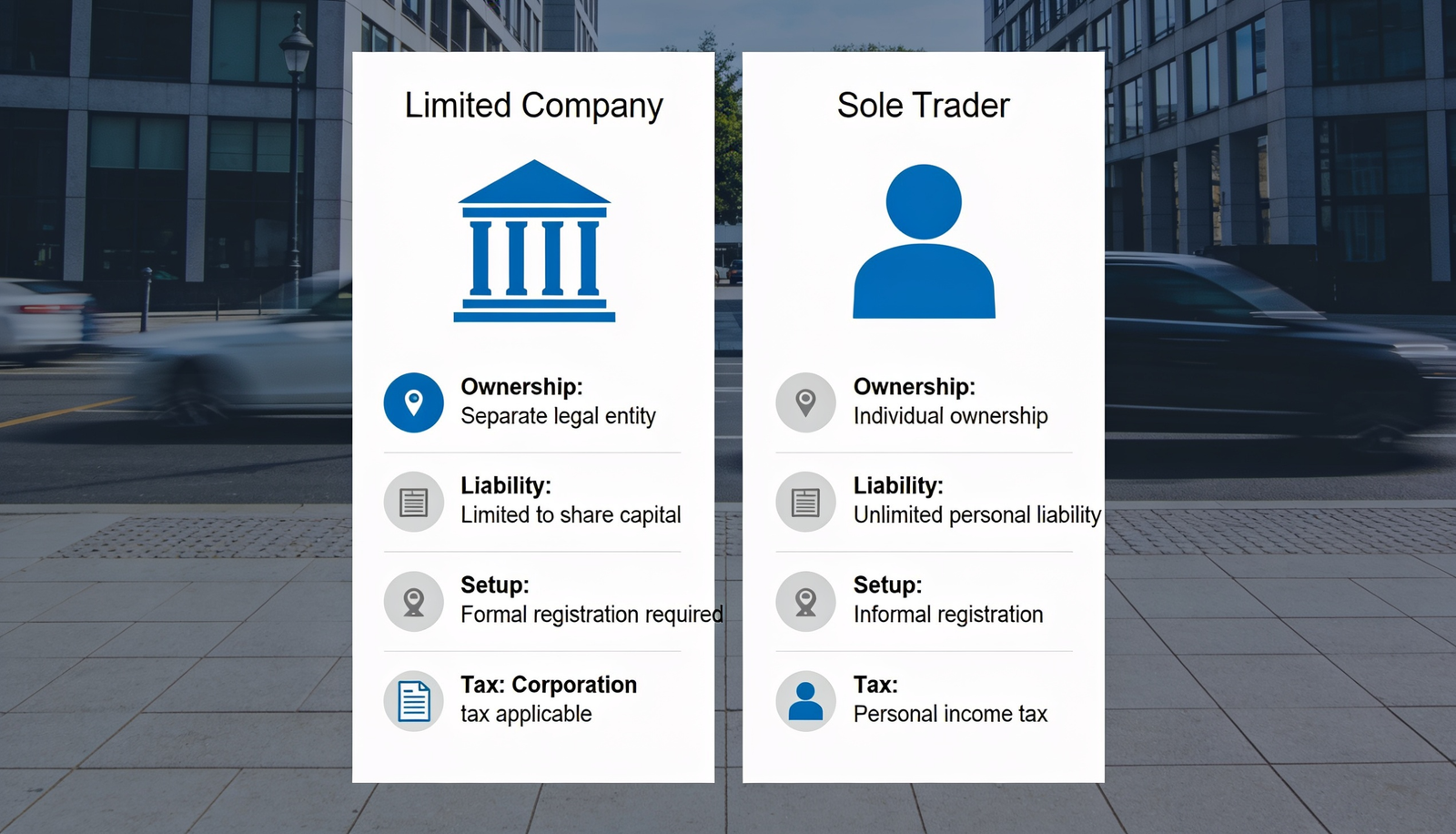
Limited Company vs Sole Trader
When you start contracting, choosing the right business structure shapes how you’re taxed, how much you take home, and how clients and agencies view you. For most contractors, the decision comes down to two options: operating as a sole trader or forming a limited company. Both are legitimate routes into self-employment, but they suit different situations. At Form My Company, we help contractors incorporate their own limited companies when that’s the right move, and in this guide we compare both structures fairly so you can decide what works best for your contracting career.
Because the choice carries real tax and liability implications that depend on your circumstances, this guide explains the principles, and we recommend confirming the specifics with a contractor accountant.
What Is a Sole Trader?
A sole trader is the simplest form of self-employment in the UK. As a sole trader, you and your business are legally the same person. You register for Self Assessment with HMRC, keep your profits after tax, and report your income each year. There’s very little paperwork, which makes it an easy way to begin freelancing or contracting.
The trade-off is that there’s no legal separation between you and the business. You have unlimited liability, meaning you’re personally responsible for any business debts or claims.
What Is a Limited Company?
A limited company, often called a personal service company (PSC) in the contracting world, is a separate legal entity that you own and run. When you incorporate, your business becomes distinct from you personally, giving you limited liability protection. Your contract income belongs to the company, and you pay yourself through a combination of salary and dividends, typically with an accountant’s help.
This structure offers greater tax efficiency and credibility, in exchange for more administrative responsibility such as filing annual accounts and a confirmation statement with Companies House and managing Corporation Tax.
Why Many Contractors Can’t Operate as Sole Traders
There’s an important practical point unique to contracting. Many recruitment agencies and end clients will not engage contractors who operate as sole traders, largely because of the way employment status and tax liability rules work. As a result, a great many contractors who find work through agencies need a limited company (or an umbrella arrangement) to be taken on at all. If you intend to work through agencies, this alone may decide the matter in favour of incorporation.
Limited Company vs Sole Trader for Contractors: Key Differences
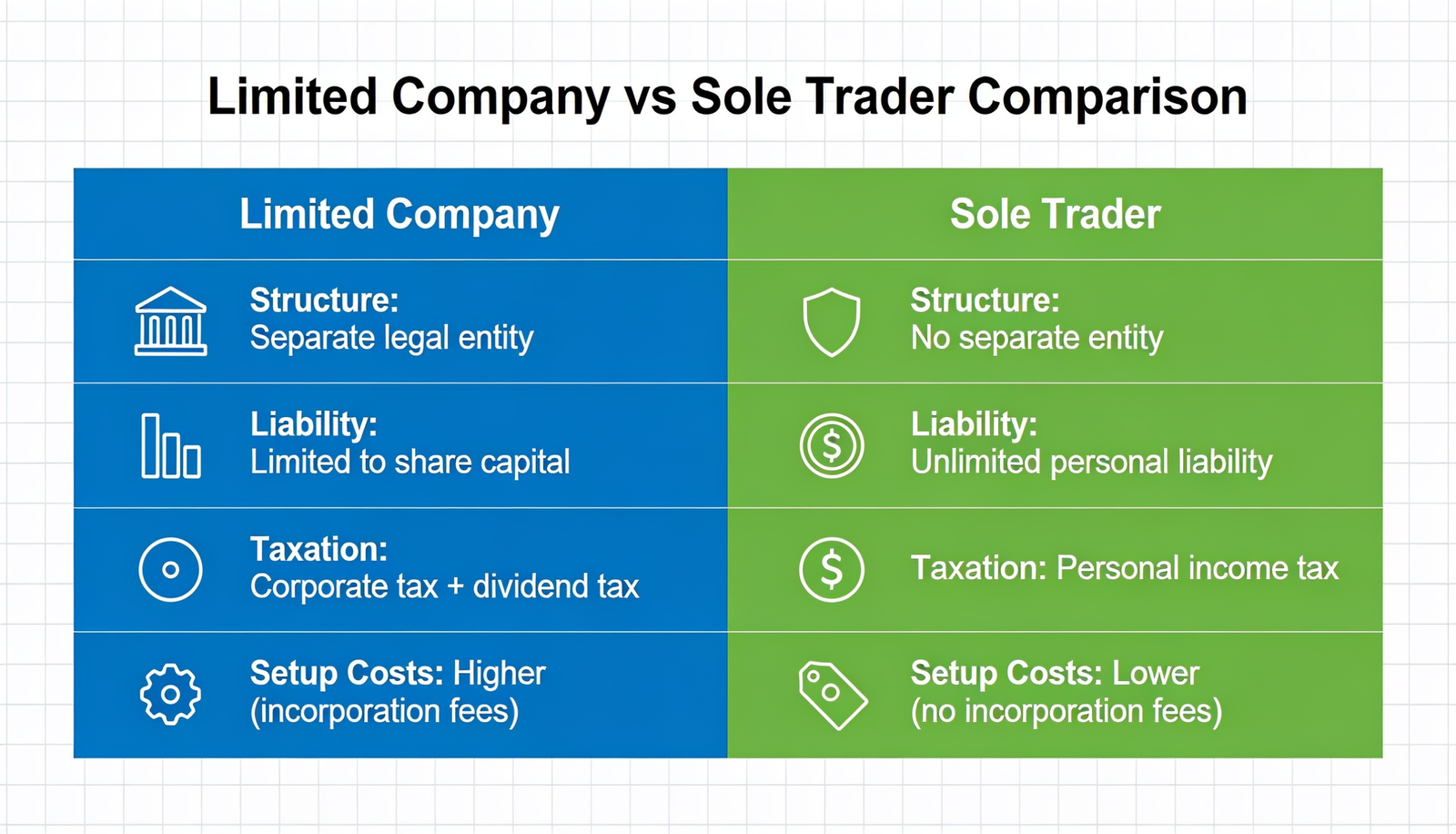
Here’s how the two structures compare across the factors that matter most to contractors:
- Legal status and liability. A sole trader and their business are one and the same, with unlimited liability. A limited company is separate, offering limited liability protection for your personal assets.
- Tax and take-home pay. Sole traders pay Income Tax and National Insurance on all profits through Self Assessment. A limited company can be more tax-efficient through a salary-and-dividends approach, often improving take-home pay, particularly for outside-IR35 contracts.
- Agency and client access. Many agencies and clients won’t work with sole trader contractors, whereas a limited company is widely accepted across contracting.
- Credibility. A limited company appears more established and professional to clients, which can help you win and retain contracts.
- Admin. Being a sole trader involves minimal paperwork. A limited company requires more, such as accounts, payroll, and statutory filings, usually handled with an accountant.
- Privacy. Sole trader details stay fairly private, while a limited company’s directors and registered office appear on the public register, though a registered office service can keep your home address off the record.
How IR35 Fits In
IR35, also known as the off-payroll working rules, is a key consideration for contractors, and it applies differently here. IR35 specifically concerns workers providing services through an intermediary, such as a limited company. Sole traders aren’t within the off-payroll working rules in the same way, though their employment status for tax can still be assessed by the engaging business.
For limited company contractors, being outside IR35 is what unlocks the tax efficiency of dividends, while inside-IR35 work is taxed much like employment. A recent change is also relevant: from April 2026, the thresholds defining a small company for IR35 purposes increased, meaning more contractors working for smaller private-sector clients are now responsible for assessing their own status. Because IR35 is complex and affects which structure benefits you, specialist accounting advice is strongly recommended.
Which Should Contractors Choose?
There’s no one-size-fits-all answer, but as a general guide:
Being a sole trader may suit you if you’re doing occasional freelance work, you find clients directly rather than through agencies, your earnings are modest, and you want the simplest possible setup with minimal admin.
Forming a limited company may suit you if you contract regularly, work through agencies that require it, have outside-IR35 contracts, want limited liability protection, and are looking for greater tax efficiency and a professional image, accepting some extra responsibility in return.
Many contractors find that the practical realities of agency work and the benefits of incorporation point toward a limited company, but the best choice depends on your specific situation, which is worth discussing with a contractor accountant.
How Form My Company Helps
If a limited company is the right structure for your contracting work, we make incorporation fast and simple. You get an instant company name check, expert handling of your Companies House filing, a professional UK registered office address to protect your privacy, identity verification support, and banking introductions. With the formation handled correctly, you can focus on winning contracts and building your self-employed career.
Choose the Right Structure Today
Deciding between sole trader and limited company is a foundational step for any contractor, and understanding the differences in tax, liability, and agency access helps you choose with confidence. If a limited company is right for you, Form My Company makes getting set up quick and fully supported. Get started today, and pair your decision with good accounting advice to be sure it fits your circumstances.
Frequently Asked Questions
Is it better to be a sole trader or limited company as a contractor?
It depends on your situation. Sole trader is simpler and suits occasional or direct freelance work, while a limited company offers tax efficiency, limited liability, and the credibility many agencies require, suiting regular contractors.
Can contractors work as sole traders?
Sometimes, but many recruitment agencies and clients won’t engage sole trader contractors due to employment status and tax liability rules. If you work through agencies, you’ll often need a limited company or umbrella instead.
Does a limited company give contractors higher take-home pay?
It can, particularly for outside-IR35 contracts, through a tax-efficient mix of salary and dividends. Inside IR35, the advantage narrows. Your circumstances and tax thresholds matter, so an accountant can model the difference.
Does IR35 apply to sole traders?
The off-payroll working rules (IR35) apply to those working through an intermediary like a limited company, not to sole traders in the same way. However, an engaging business can still assess a sole trader’s employment status for tax.
What are the main downsides of a limited company for contractors?
Mainly more administration, such as accounts, payroll, and statutory filings, plus accountancy costs. Most contractors find these very manageable with an accountant, given the tax and liability benefits incorporation brings.
Do I get limited liability as a sole trader?
No. As a sole trader you have unlimited liability and are personally responsible for business debts. A limited company provides limited liability, generally protecting your personal assets if the business runs into difficulty.
How quickly can I set up a limited company for contracting?
With Form My Company, your company can often be incorporated within hours of submitting your details and completing identity verification, so you can start contracting through it quickly.