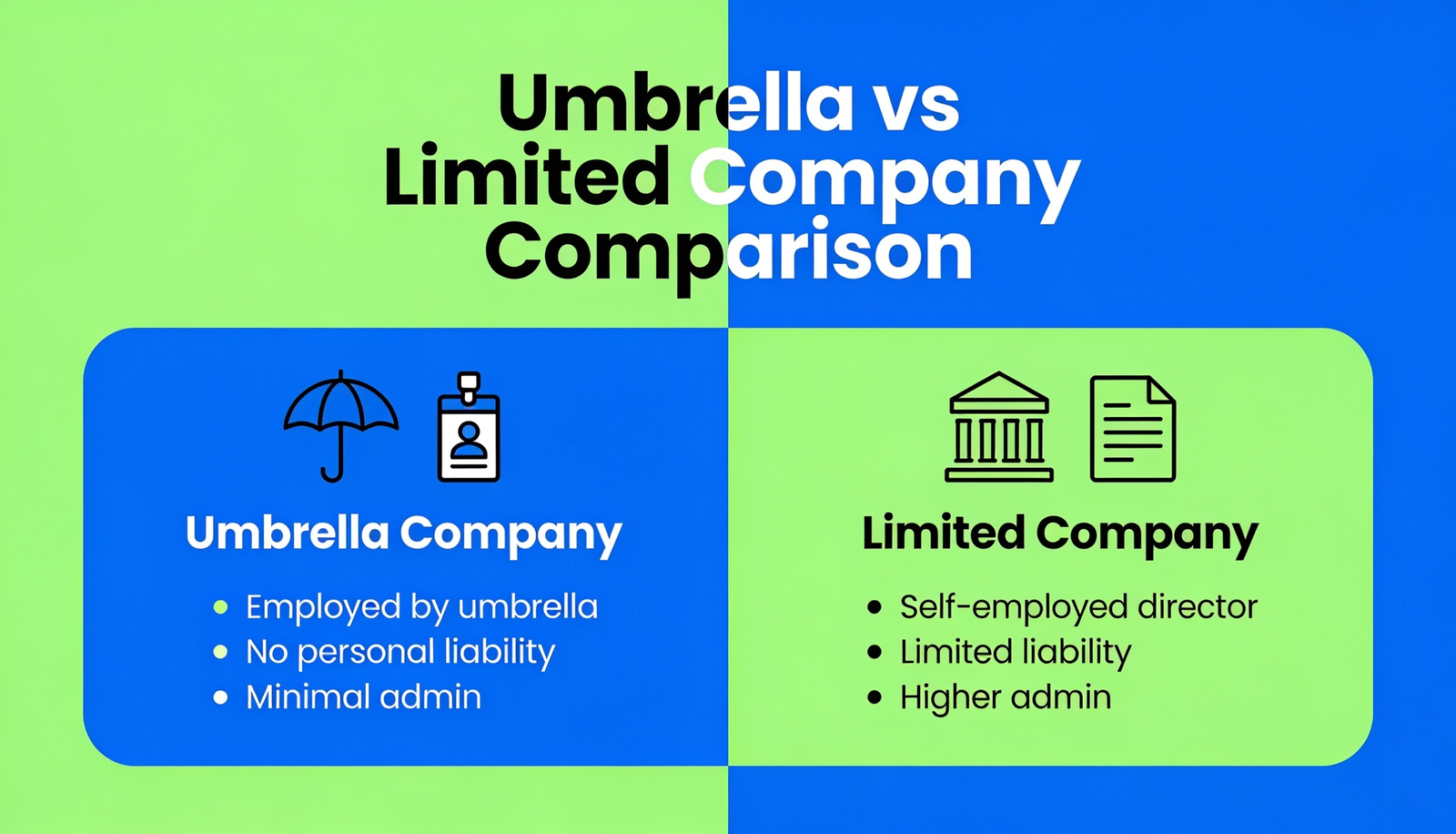
Umbrella Company vs Limited Company
If you’re starting out as a contractor, one of the first big decisions you’ll face is how to operate: through an umbrella company or your own limited company. Both are legitimate, widely used options, and the right choice depends on your circumstances, your contracts, and how hands-on you want to be. At Form My Company, we help contractors set up their limited companies when that’s the right route, and in this guide we compare both options fairly so you can decide what suits you best.
Because this decision has real tax implications that depend on your situation, this guide explains the principles, and we recommend confirming the specifics with a contractor accountant.
What Is an Umbrella Company?
An umbrella company acts as your employer while you carry out contract work for clients. You become an employee of the umbrella, which receives your contract income, deducts tax and National Insurance through PAYE along with its own margin, and pays you the rest as salary. The umbrella handles the admin, so there’s very little for you to manage.
This simplicity makes umbrellas popular with contractors who are new, working short-term assignments, or operating inside IR35.
What Is a Limited Company?
A limited company, often called a personal service company (PSC) in contracting, is your own business that you own and run. Your contract income goes to the company, and you pay yourself through a combination of salary and dividends. You take on more responsibility, usually with an accountant’s help, in exchange for greater control and potential tax efficiency.
This route tends to suit contractors who work regularly, plan to contract long-term, and have contracts outside IR35.
Umbrella Company vs Limited Company: Key Differences
Here’s how the two compare across the factors that matter most:
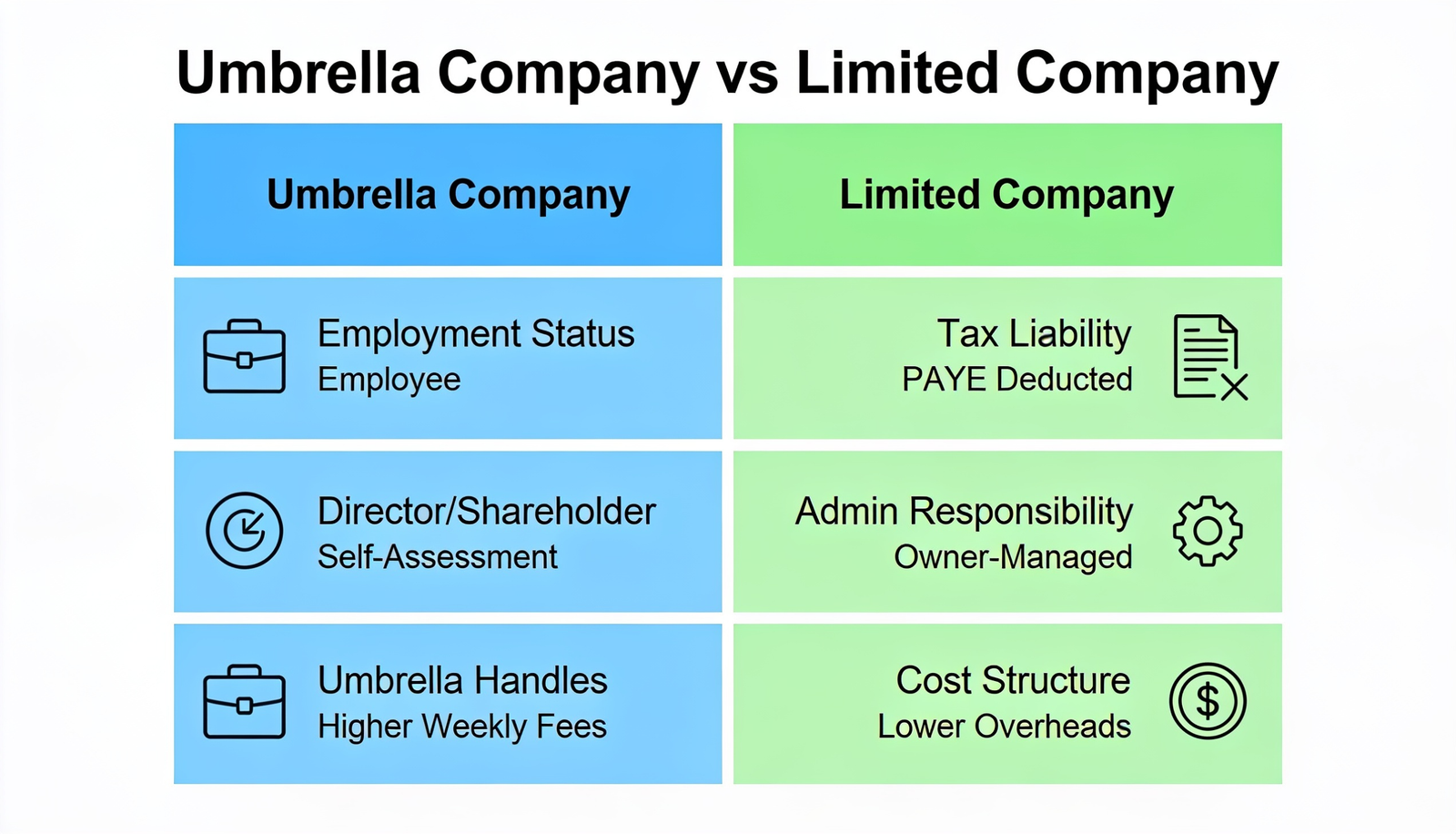
- Admin. An umbrella handles everything for you, with almost no paperwork on your side. A limited company involves responsibilities like accounts, payroll, and filings, usually managed with an accountant.
- Tax efficiency. With an umbrella, you’re taxed as an employee through PAYE. A limited company can be more tax-efficient, particularly outside IR35, through a salary-and-dividends approach.
- Take-home pay. A limited company often results in higher take-home pay for outside-IR35 contracts, while an umbrella’s deductions and margin reduce yours. Inside IR35, the gap narrows considerably.
- Control. A limited company gives you full control of your finances and business. An umbrella gives you very little, as it manages everything.
- Cost. Umbrellas charge an ongoing margin or fee. A limited company has formation and accountancy costs but no umbrella margin.
- Speed of setup. Joining an umbrella is almost instant. Setting up a limited company is also fast, often within hours with us, but involves a few more steps.
- Liability. A limited company offers limited liability protection. As an umbrella employee, this isn’t a factor in the same way.
How IR35 Affects the Decision
IR35 is one of the most important factors in choosing between the two. If your contracts are outside IR35, a limited company lets you pay yourself tax-efficiently, which is the main reason many contractors choose it. If your contracts are inside IR35, that income is taxed much like employment regardless of structure, which reduces the limited company’s advantage and often makes an umbrella the simpler choice.
There’s also a recent change to be aware of. From April 2026, the thresholds defining a small company for IR35 purposes increased, meaning more contractors working for smaller private-sector clients are now responsible for assessing their own IR35 status. Because IR35 directly shapes which option is better for you, and getting it wrong can be costly, specialist accounting advice is strongly recommended.
Which Should You Choose?
There’s no universally right answer, but as a general guide:
An umbrella company may suit you if you’re new to contracting, working short-term or inside-IR35 contracts, or you simply want minimal admin and don’t mind paying a margin for convenience.
A limited company may suit you if you contract regularly, plan to do so long-term, have outside-IR35 work, and want greater control and tax efficiency, accepting some additional responsibility in return.
Many contractors actually start with an umbrella and switch to a limited company as their career develops and their contracts justify it. The best choice for you depends on your specific situation, which is worth talking through with a contractor accountant.
How Form My Company Helps
If a limited company is the right route for you, we make setting one up fast and simple. You get an instant company name check, expert handling of your Companies House filing, a professional UK registered office address to protect your privacy, identity verification support, and banking introductions. And if you’re switching from an umbrella, we help you get your new company set up cleanly so the transition is smooth.
Make Your Decision Today
Choosing between an umbrella and a limited company is an important step in your contracting career, and understanding the trade-offs helps you choose with confidence. If a limited company is right for you, Form My Company makes getting set up quick and fully supported. Get started today, and pair your decision with good accounting advice to be sure it fits your circumstances.
Frequently Asked Questions
What’s the difference between an umbrella and a limited company?
An umbrella company employs you and handles your tax through PAYE for a margin, with minimal admin. A limited company is your own business offering more control and potential tax efficiency, in exchange for more responsibility.
Which gives higher take-home pay?
For outside-IR35 contracts, a limited company often gives higher take-home pay through a salary-and-dividends approach. Inside IR35, the difference narrows considerably, as that income is taxed much like employment.
Is an umbrella or limited company better for beginners?
Many beginners start with an umbrella for its simplicity, then switch to a limited company as they contract more regularly. The right choice depends on your contracts, plans, and IR35 status.
How does IR35 affect the choice?
IR35 is central. A limited company is most beneficial for outside-IR35 work. If your contracts are inside IR35, the tax advantage shrinks, often making an umbrella the simpler option. Your IR35 status is therefore key.
Can I switch from an umbrella to a limited company later?
Yes, and many contractors do exactly that as their career develops. It’s usually cleanest to switch around the end of a contract. We can help you set up your limited company when you’re ready.
Does a limited company involve more admin?
Yes. As a director you handle responsibilities like accounts, payroll, and filings that an umbrella would manage. Most contractors use an accountant, which makes the extra admin very manageable.
Do I need an accountant either way?
With an umbrella, generally not, as they handle the admin. With a limited company, an accountant isn’t legally required but is highly recommended for tax, dividends, payroll, and IR35.