
To verify identity as a Person with Significant Control at Companies House, you need one primary photographic identity document, such as a valid passport or photocard driving licence, alongside secondary proof of residential address, including a recent utility bill or bank statement issued within three months.
What Documents Are Valid for Primary PSC Photographic Identity Proof?
Primary PSC photographic identity proof requires a valid biometric passport, a current UK or photocard driving licence, or an official national identity card containing full legal name, date of birth, facial photograph, document number, and clear expiry date details.
| Accepted Document | Key Requirement |
|---|---|
| Biometric passport | Unexpired, issued by any recognised international government authority |
| UK or photocard driving licence | Current and valid, issued by DVLA or an equivalent international body |
| National identity card (EEA) | Must display active validation dates |
Instantly rejected: expired documents, provisional licences without a photo, cropped images, or heavy glare covering the document text.
What Secondary Documents Work for PSC Address Verification?
Secondary address verification requires an official document issued within the past three months displaying the full legal name and current residential address, such as a bank statement, utility bill, council tax statement, or official government correspondence.
| Accepted Document | Key Requirement |
|---|---|
| Utility bill (electricity, gas, water, landline) | Issued within the last 90 days |
| Bank or credit card statement | From a regulated financial institution, with official branding visible |
| Council tax letter | Valid for the current billing year |
Instantly rejected: PO Box addresses and screenshots of online banking apps.
How Does the Companies House PSC Verification Process Work?
The Companies House PSC verification process uses direct digital identity platforms combining biometric facial recognition, algorithmic document authenticity checks, and database validation to verify Person with Significant Control details against official government registers.
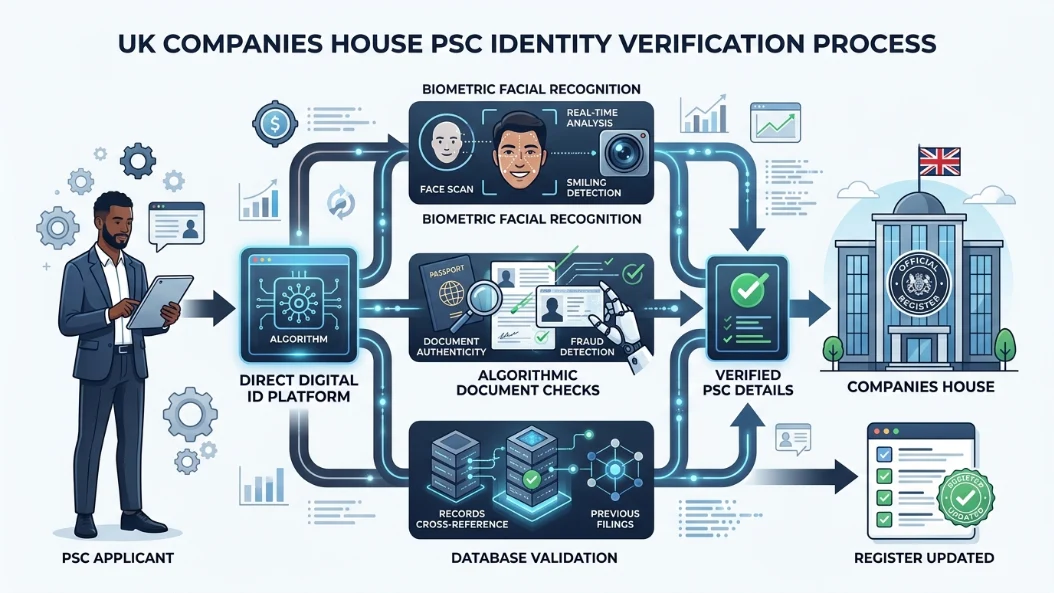
| Step | What Happens |
|---|---|
| 1. Upload ID | The PSC receives a unique verification link and uploads high-resolution images of primary ID; document engines check security features and the Machine Readable Zone. |
| 2. Liveness check | Biometric software captures real-time facial movement via smartphone or webcam and compares it against the ID photo. |
| 3. Database match & code issued | Details are checked against electoral rolls, credit registries, and government databases; Companies House issues a unique verification code to record in statutory registers. |
Why Must Every PSC Verify Their Identity at Companies House?
Companies House mandates PSC identity verification under the Economic Crime and Corporate Transparency Act 2023 to eliminate fraudulent corporate ownership, prevent money laundering, increase registry accuracy, and hold shadow directors legally accountable for business activities.
Historically, individuals could register UK companies using false, stolen, or unverified personal information without active verification controls. The Economic Crime and Corporate Transparency Act 2023 grants Companies House expanded regulatory powers to inspect, challenge, and reject suspicious corporate filings.
Unverified individuals face personal criminal fines, civil financial penalties, and disqualification from acting as corporate officers. To understand why regulatory frameworks require these statutory updates, review Why Must Every PSC Now Verify Their Identity at Companies House? for complete legal context.
Which Common Documentation Errors Cause PSC Verification Rejections?
PSC verification rejections occur due to name misstatement errors, expired identification documents, unapproved address document formats, blurry photo uploads, and truncated legal names failing database comparison checks.
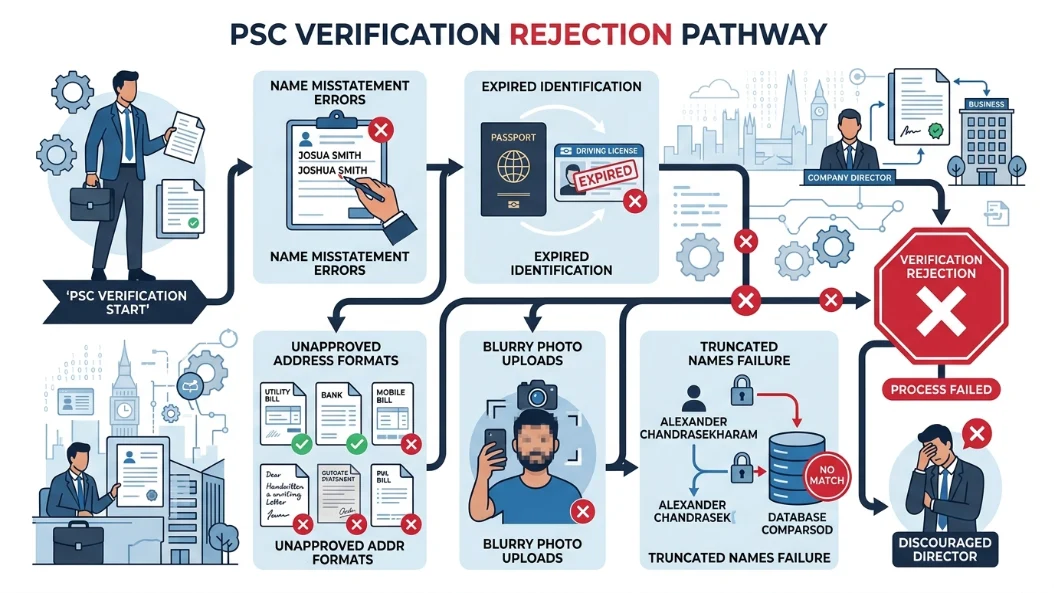
| Issue | Why It Fails |
|---|---|
| Name mismatch | Middle names, compound surnames, or suffixes omitted from Companies House filings |
| Expired documents | Expired passport/licence, or address proof older than 90 days |
| Unapproved document type | e.g. mobile phone bills, tenancy agreements, insurance policies |
| Poor image quality | Low resolution, glare, cropped borders, or poor lighting |
| Biometric mismatch | Artificial filters or inconsistent facial lighting trigger manual review |
How Do You Complete PSC Identity Verification Remotely?
Remote PSC identity verification completes through accredited digital compliance platforms using smartphone applications, encrypted document uploads, remote liveness testing, and secure third-party corporate service provider workflows.
| Step | What Happens |
|---|---|
| 1. Get your link | An Authorised Corporate Service Provider sends a secure digital verification link by email — no office visit or postal documents needed. |
| 2. Upload & confirm | Capture photos of primary and secondary ID; OCR extracts the text for you to confirm. |
| 3. Liveness video & review | A guided liveness capture prevents photo impersonation, then your provider reviews the package against AML/KYC guidelines before submitting it to Companies House. |
Businesses requiring expert assistance can explore our Identity Verification Service for Directors & PSCs, which streamlines corporate registry maintenance and compliance tracking.
What Are the Compliance Penalties for Unverified PSC Officers?
Unverified PSC officers face statutory criminal fines up to £2,000, daily default penalties, director disqualifications, corporate filing bans, and potential compulsory company dissolution under statutory UK corporate law.
| Consequence | Details |
|---|---|
| Criminal fines | Up to £2,000 |
| Daily default penalties | Accrue for every day the offence continues |
| Filing bans | Cannot submit confirmation statements, change registered office address, or register new officers |
| Banking disruption | Banks may freeze accounts linked to unverified entities |
| Dissolution risk | Compulsory strike-off is possible for continued non-compliance |
To secure your corporate standing and complete required filings seamlessly, see Get ECCTA-Compliant PSC Verification From Form My Company for professional verification management.
How Does Form My Company Streamline Your PSC Verification Workflow?
Form My Company streamlines PSC verification through automated compliance tracking, secure digital document collection, certified ACSP submission channels, and direct Companies House integration.
Navigating complex regulatory changes demands precise documentation handling and technical submission accuracy. Form My Company eliminates administrative burdens by managing the complete verification lifecycle for company directors and Persons with Significant Control. Our digital portal guides users step-by-step through identity uploads, ensuring document formatting meets exact Companies House standards prior to submission.
Our professional corporate services cross-reference personal data against registered company records to identify and correct documentation discrepancies before submission. By utilising accredited ACSP filing channels, Form My Company processes identity verifications rapidly while maintaining strict data security compliance, handling regulatory liaison directly so business directors can focus on core commercial growth.
Explore our PSC Register service to keep your statutory records accurate and compliant.
Frequently Asked Questions
How do I update my company’s PSC Register to comply with UK law?
To update your company’s register of Persons with Significant Control (PSC), you must record any changes to beneficial ownership details within 14 days and submit the official updates to Companies House within 15 days. Filing accurate PSC notifications ensures statutory compliance under the Companies Act 2006 and the Economic Crime and Corporate Transparency Act. Businesses can maintain their official record seamlessly using the PSC Register service from Form My Company.
Who counts as a Person with Significant Control in a UK business?
A Person with Significant Control is an individual who holds more than 25% of a company’s shares or voting rights, has the right to appoint or remove a majority of the board of directors, or exercises significant influence or control over the business. Identifying these individuals accurately is a legal requirement for every UK limited company and limited liability partnership. Form My Company assists corporate officers in identifying qualifying beneficial owners to ensure complete registry compliance.
What information must be included in a statutory PSC Register?
A statutory PSC record must contain the individual’s full legal name, service address, residential address, nationality, date of birth, and date of becoming a PSC, along with the specific nature of their control. Failing to maintain this information accurately can lead to regulatory penalties and statutory filing blocks. The PSC Register management tools by Form My Company help streamline data collection while safeguarding sensitive personal details.
What happens if a company fails to maintain an accurate PSC Register?
Failing to keep an accurate statutory register or neglecting to report changes to Companies House constitutes a criminal offense by both the company and its officers. Penalties include daily default fines, potential prosecution, and disruptions to corporate filing services. Utilizing professional registry solutions from Form My Company protects directors from non-compliance risks and preserves official corporate standing.
Can a corporate entity be listed as a Person with Significant Control?
A legal entity can only be listed as a PSC if it qualifies as a Relevant Legal Entity (RLE), meaning it is subject to its own legal disclosure requirements and holds a controlling interest in the company. Individual beneficial owners must be identified if an entity does not meet statutory RLE criteria. Form My Company provides expert guidance through the PSC Register service to help businesses correctly classify controlling individuals and entities.