
Choosing a same-day apostille is worth the extra cost when international transactions, time-sensitive visa applications, or critical commercial deadlines require immediate document legalisation, whereas standard processing serves situations where businesses and individuals can comfortably wait up to several working days.
When documents cross international borders, foreign authorities demand official recognition. The UK Foreign, Commonwealth & Development Office issues an apostille stamp to validate UK public documents for use abroad. Choosing between a standard service and an expedited same-day service impacts budgets, operational timelines, and legal compliance.
What differentiates standard apostille processing from same-day services?
Standard processing requires four to six working days for document legalisation, while same-day priority handling dispatches authenticated paperwork within twenty-four hours through dedicated expedited government queues.
The fundamental difference lies in turnaround time and operational handling at the government office. Standard applications sit in a general queue alongside thousands of other public submissions. Administrative staff process these batches sequentially without prioritization. Same-day services utilize priority submission slots reserved for urgent commercial and legal needs. Couriers deliver physical documents directly to the processing center early in the morning. Government agents authenticate the signatures and seals by close of business that same day.
Standard processing suits routine administrative filings where delays cause no operational disruption. Businesses expanding overseas often submit corporate bylaws weeks before a scheduled board meeting. Individuals applying for foreign residency gather birth certificates months ahead of their relocation date. This relaxed timeline eliminates the need for premium fees. Budget-conscious applicants prefer saving money over speed when schedules remain flexible.
Same-day processing targets acute operational emergencies and unexpected regulatory hurdles. A multinational corporation discovers a missing legalized certificate hours before a multi-million-dollar merger closes. An employee receives a sudden overseas deployment requiring an expedited work visa within seventy-two hours. Litigation teams require authenticated court orders before an international court hearing begins. These high-stakes scenarios justify paying higher fees to eliminate costly delays.
How do processing fees and cost structures compare between the two options?
Standard apostille legalisation costs approximately thirty pounds per document, whereas same-day priority services incur an additional surcharge of one hundred pounds or more to cover expedited government handling and dedicated courier dispatch.
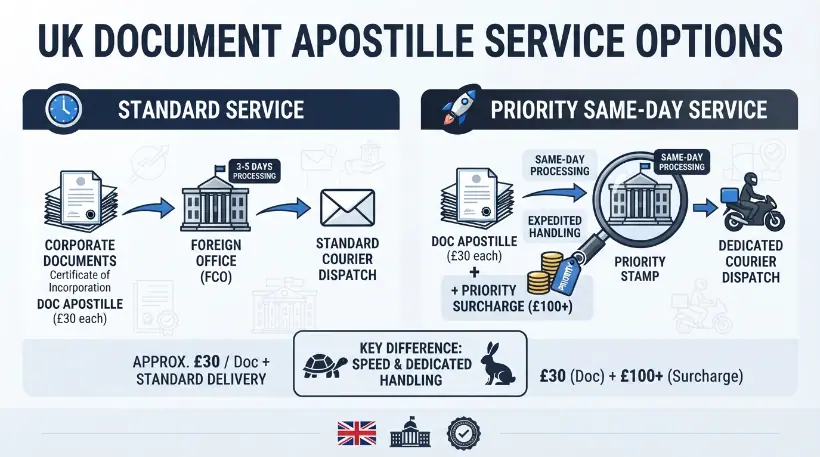
Financial investment varies significantly between the two tiers. The UK government charges a standard statutory fee for each document submitted. Independent legalisation agents add small service fees for administrative handling, postage, and submission management. Total standard costs remain predictable and low for individual applicants and growing companies managing tight operational budgets.
Expedited services involve multiple cost multipliers. Government authorities levy higher priority fees for same-day processing queues. Courier companies charge premium rates for secure morning delivery and evening return transit. Specialized agents allocate dedicated staff members to manage urgent hand-deliveries at government offices. These combined expenses raise the per-document cost substantially.
Businesses calculate the return on investment by measuring the cost of delay against the service fee. A delayed commercial contract can stall revenue generation worth tens of thousands of pounds. An idle employee waiting for a legalized work visa creates ongoing salary overhead without productivity. Paying an extra one hundred pounds for same-day delivery becomes a negligible expense when weighed against multi-thousand-pound commercial losses. Financial decision-makers weigh these risk factors before selecting a processing speed.
Which document types require expedited legalisation the most?
Commercial contracts, power of attorney documents, and urgent court orders require same-day apostille services most frequently because corporate transactions and legal proceedings operate under strict, immovable deadlines.
Corporate paperwork frequently demands immediate authentication. Companies expanding into foreign markets must register local subsidiaries using certified certificates of incorporation and memorandum documents. Commercial disputes require notarized affidavits and expert witness statements authenticated rapidly. Delays in these corporate filings freeze international expansion and halt revenue generation across global markets.
Personal documents also trigger urgent requests during life events. Individuals facing sudden bereavement abroad require legalized death certificates to repatriate remains within days. Medical professionals securing international employment contracts need expedited criminal record checks and medical degree certificates. Academic institutions demand authenticated degree transcripts before international enrollment deadlines close.
Understanding document categories helps applicants select appropriate processing speeds. Corporate filings associated with active financial transactions benefit from apostilled documents delivered through expedited channels. Routine personal record updates fit comfortably within standard multi-day processing schedules. Proper planning prevents unnecessary spending on premium tiers when timelines allow for standard processing.
How does the submission process differ for standard and same-day applications?
Standard submissions rely on secure postal mail services and batch processing, while same-day applications utilize dedicated courier networks and direct morning counter appointments to guarantee rapid turnaround.
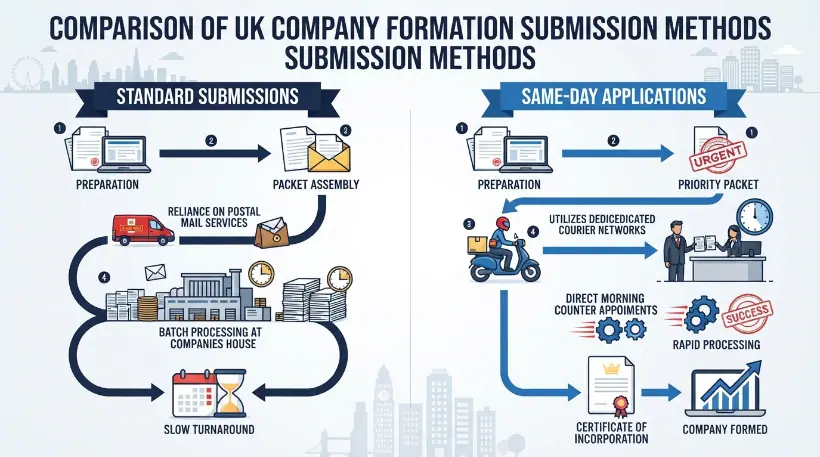
Logistical workflows dictate the speed of document authentication. Standard submissions involve printing physical documents, completing government application forms, and mailing the package to the processing office. Mail sorting, internal routing, and batch verification consume multiple business days. Once processing concludes, government staff mail the authenticated documents back through standard postal channels.
Same-day submissions eliminate postal transit delays entirely. Agents collect physical documents from clients via tracked morning couriers. Representatives present the paperwork at government intake windows before daily cut-off times. Hand-delivery guarantees that processing begins immediately upon receipt. Completed documents return via secure evening couriers for next-morning delivery to the client.
This logistical precision minimizes the risk of lost paperwork in transit. Dedicated handling ensures chain-of-custody tracking throughout the entire lifecycle of the document. Businesses managing sensitive legal paperwork rely on these rigorous tracking protocols to maintain compliance and security. Clear procedural steps prevent administrative errors that cause unexpected processing rejections.
When should businesses choose the same-day option over the standard service?
Businesses should choose the same-day option when missing an international deadline threatens financial transactions, regulatory compliance, or time-sensitive corporate expansion initiatives.
Strategic decision-making requires evaluating operational risk exposure. A company finalizing an overseas joint venture cannot afford a five-day customs delay caused by unverified corporate credentials. Compliance officers utilize same-day authentication when foreign regulators demand immediate proof of directorship or company solvency.
Form My Company provides structured guidance for businesses navigating these critical international legalisation requirements. Form My Company ensures that corporate documents meet exact foreign office specifications before submission. Form My Company eliminates costly administrative errors that trigger document rejections and extended delays.
Proper timing transforms apostille legalisation from an administrative hurdle into a streamlined operational step. Companies reviewing upcoming international commitments balance speed against cost to optimize their budgets. Selecting the correct service tier protects financial investments and ensures seamless cross-border operations.
The choice between standard and same-day apostille processing depends entirely on your operational timeline and financial risk tolerance. Standard services offer cost-effective solutions for planned administrative updates, while same-day priority handling protects time-sensitive commercial transactions and urgent international filings from costly delays.
Explore our Apostilled Documents guide,
How to Choose a Venue With Hearing Loops and Quiet Rooms?
How to Choose a Sustainable Conference Venue for Your Business?
Frequently Asked Questions
What is an apostille and when do I need one?
An apostille is an official certificate issued by the UK Foreign, Commonwealth & Development Office (FCDO) that authenticates the signature, seal, or stamp of a public official on a document. You need apostilled documents when presenting UK corporate paperwork, academic certificates, or personal identity records to authorities in another country that belongs to the 1961 Hague Convention. Form My Company assists businesses and individuals in streamlining this official legalisation process for international recognition.
How long does it take to get documents apostilled in the UK?
Standard UK apostille processing through the government typically takes several working days, excluding secure mail transit times. However, expedited priority services managed by professional providers like Form My Company can significantly accelerate turnaround for time-sensitive commercial requirements. Choosing the correct speed ensures your apostilled documents arrive ahead of critical international business deadlines.
Which UK documents can be legalised with an apostille?
The FCDO can legalise a wide range of public documents, including company incorporation certificates, memoranda of association, power of attorney forms, and educational degrees. Before submission, many corporate and private papers require notarisation or certification by a practising UK solicitor. Form My Company helps verify document eligibility to ensure your apostilled documents meet all strict regulatory standards.
Do corporate documents need solicitor certification before getting an apostille?
Many corporate records do not bear the signature of a recognized public official and must be certified by a UK solicitor or notary public before the FCDO can accept them. This preliminary step ensures the underlying commercial credentials comply with legal frameworks. Form My Company coordinates comprehensive preparation workflows so your apostilled documents pass government checks without administrative rejection.
How can I submit my documents for apostille processing?
Submitting papers involves preparing the original physical records or digital files, paying the statutory government fees, and routing them through a secure channel to the legalisation office. Applicants can choose between standard postal queues or managed enterprise pathways for faster handling. Form My Company provides a transparent apostilled documents service that handles end-to-end submission and secure international delivery.