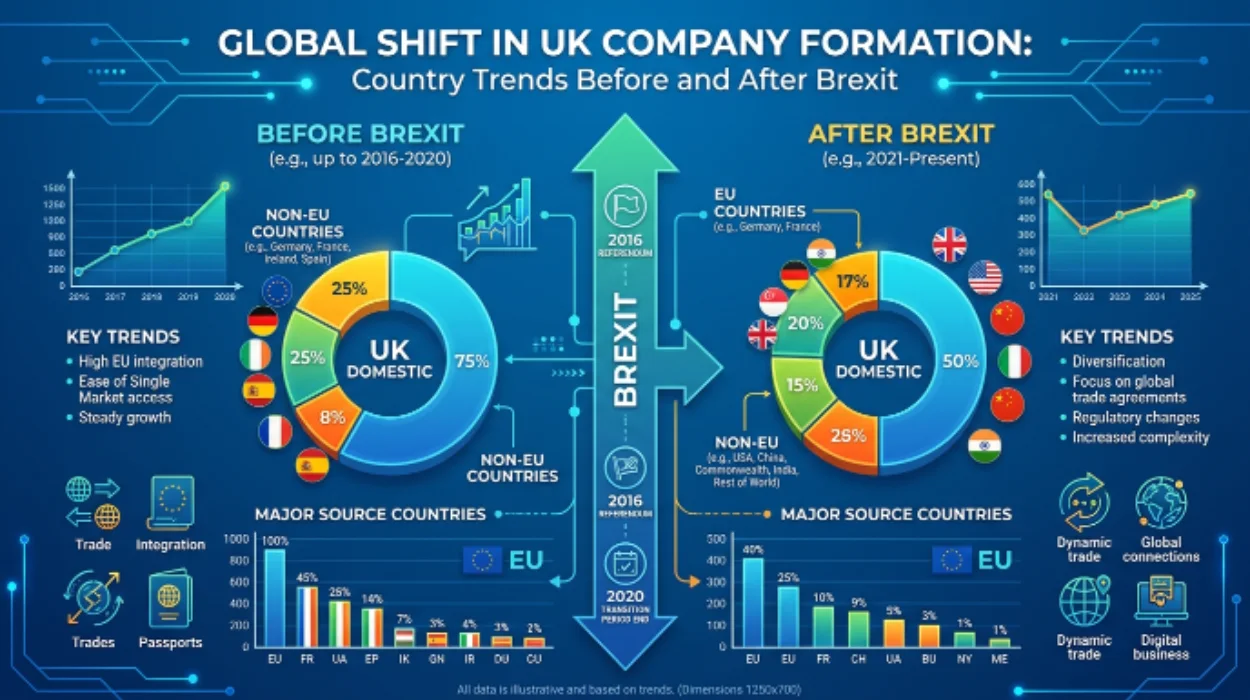
The global landscape of UK company formation has undergone a profound transformation in the wake of Brexit. Drawing on cross-country Google Trends data spanning 93 countries, the evidence shows a decisive structural shift in international interest in UK business registration. In the pre-Brexit era, the UK functioned as a strategic gateway into the European Union’s single market, driving strong incorporation demand from Europe, Asia, Africa, and Latin America. Post-Brexit, however, that role has largely diminished.
Across the dataset, 40 countries recorded an estimated 98% decline in UK company formation search interest, with only a small number of markets showing resilience or growth. While countries such as Argentina (+180%), Brazil (+47%), Djibouti (+400%), and Anguilla (+59%) bucked the trend, the overwhelming global direction is downward. This shift highlights how Brexit fundamentally altered perceptions of the UK as a corporate jurisdiction, particularly for non-EU founders who previously valued its regulatory bridge into Europe. Despite this, the UK retains residual strength in Commonwealth markets and among international entrepreneurs who continue to value English common law, digital incorporation, and global credibility.
What does the global dataset reveal about UK company formation trends after Brexit?
The dataset presents one of the clearest global indicators of post-Brexit economic repositioning. Out of 93 countries analysed, 74 recorded declines in UK company formation interest, while only 11 showed measurable growth. The remaining territories either remained flat or displayed anomalous fluctuations.
Key patterns include:
- 40 countries recorded declines close to or exceeding 98% in UK company formation search interest
- Argentina recorded the highest sustained growth at +180% post-Brexit
- Djibouti showed the strongest proportional increase at +400%
- Major European economies such as Germany (-3%) and Denmark (-11%) showed relatively stable demand
- Commonwealth-linked jurisdictions such as India (-53%) and Canada (-30%) showed moderate declines rather than collapse
- Offshore and financial hubs such as the British Virgin Islands and Bermuda saw steep reductions in interest
These findings suggest that Brexit did not simply reduce demand—it fundamentally reallocated global interest away from EU-access-driven incorporation toward niche, instability-driven, or bilateral trade-focused motivations.
How did Brexit reshape European demand for UK company formation?
European markets provide one of the most revealing contrasts in the dataset. Pre-Brexit, EU countries frequently used UK companies as low-friction access points to the single market. Post-Brexit, that incentive largely disappeared, although not uniformly.
Germany stands out as the most resilient major EU economy, declining only from ~30 to ~29 (-3%). This suggests continued structural use of UK companies for simplicity, brand credibility, or non-EU operations. Similarly, Denmark (-11%) and Sweden (-20%) show only modest reductions.
However, southern and eastern European countries experienced sharper contractions. Italy (-58%), France (-53%), Cyprus (-77%), and Romania (-93%) reflect a significant reduction in UK incorporation interest, likely tied to the loss of regulatory interoperability.
A key observation is that EU countries did not abandon UK company formation entirely—they recalibrated its use. Instead of EU-market access, UK entities are now more commonly used for:
- International trade outside the EU
- Holding intellectual property
- Accessing UK financial services
- Structuring Anglo-American business operations
This shift highlights a transition from “gateway utility” to “specialist utility.”
For businesses still considering incorporation pathways, guides such as register a UK company remain relevant, particularly for entrepreneurs seeking non-EU exposure rather than European integration.
Why did Commonwealth and diaspora-linked markets react differently?
Commonwealth nations and diaspora-heavy economies display a more nuanced post-Brexit pattern. While many show declines, they are generally less severe than those observed in developing or EU-adjacent countries.
India (-53%), Canada (-30%), and Australia (-44%) demonstrate moderate reductions rather than collapse. These markets maintain structural ties with the UK that go beyond EU considerations, including legal familiarity, migration links, and long-standing corporate networks.
In contrast, Caribbean jurisdictions such as Jamaica (-98%) and Barbados (-93%) show sharper declines, suggesting that Commonwealth status alone does not guarantee sustained incorporation interest. The key differentiator appears to be economic integration depth and the presence of active cross-border business ecosystems.
Interestingly, Anguilla stands out with a +59% increase, reflecting its status as a British Overseas Territory where UK corporate structures remain embedded in offshore financial services activity.
These differences highlight that post-Brexit demand is no longer driven by shared political identity but by practical business utility and financial infrastructure alignment.
Which countries experienced near-total collapse in UK company formation interest?
A striking feature of the dataset is the scale of collapse in many countries, particularly across Africa, Central Asia, and parts of Latin America.
Countries such as Armenia (-98%), Azerbaijan (-98%), Belarus (-98%), Indonesia (-98%), Guatemala (-98%), and Kazakhstan (-98%) all show near-total disappearance of search interest. These declines suggest that pre-Brexit activity in these regions was heavily dependent on the UK’s EU-linked corporate advantage or specific historical economic cycles that have since faded.
Other high-collapse countries include:
- Pakistan (-89%)
- Turkey (-96%)
- Malaysia (-92%)
- Sri Lanka (-96%)
- Vietnam (-98%)
- Nepal (-98%)
These patterns indicate that UK company formation demand in emerging markets was highly sensitive to geopolitical positioning. Once the UK exited the EU framework, the perceived strategic value of UK incorporation diminished significantly.
Top 10 Countries with Sharpest Decline in UK Company Formation Interest (Post-Brexit)
Hover bars for detailed country-level insights
Which countries are driving post-Brexit growth in UK incorporation demand?
While decline dominates the dataset, several standout countries demonstrate meaningful growth trajectories, suggesting that Brexit did not eliminate UK company formation appeal entirely—it redefined its audience.
Argentina leads with +180%, driven by macroeconomic instability and capital protection strategies. Brazil follows with +47%, reflecting growing demand from emerging-market entrepreneurs seeking international corporate structures.
Djibouti’s +400% increase is particularly notable. While small in absolute terms, it signals rising interest in UK entities for trade logistics and cross-border contracting in East Africa.
Other growth signals include:
- North Korea (+100%) and Yemen (+100%) — likely statistical anomalies or extremely low-base distortions
- Anguilla (+59%) — offshore financial integration
- Antarctica (+400%) — non-commercial anomaly driven by isolated digital activity
These cases highlight an important analytical distinction: some growth reflects genuine economic repositioning, while other spikes are statistical noise due to low search volumes.
Global Shift in UK Company Formation Interest (Post-Brexit)
Sharpest Declines
Strongest Growth
How does post-Brexit demand differ between developed and emerging markets?
A clear structural divide emerges when comparing developed and emerging economies.
Developed markets such as Germany, France, the Netherlands, Canada, and Australia show sustained but reduced engagement. These countries continue to use UK companies for strategic, high-value purposes such as IP holding, fintech structures, and international expansion.
Emerging markets, by contrast, exhibit two extremes:
- Complete collapse in many countries (e.g., Vietnam, Indonesia, Pakistan)
- Strong growth in select unstable economies (e.g., Argentina, Brazil)
This suggests that UK company formation is increasingly used either for:
- Stability arbitrage (protecting wealth in volatile economies)
- High-trust international structuring in advanced economies
The middle layer—where UK companies were once used as EU-access tools—has largely disappeared.
What is the foreign investment impact on UK company formation after Brexit?
The post-Brexit environment has significantly reshaped non-resident incorporation behaviour. Historically, many international founders used UK companies as entry points into EU markets. That motivation has now largely disappeared.
Instead, non-resident incorporation is increasingly driven by:
- Asset protection strategies in unstable economies
- Access to UK banking and financial credibility
- Expansion into US or global English-speaking markets
- Holding structures for intellectual property and digital businesses
This transition is visible in how entrepreneurs now approach UK company for non residents setups, where the emphasis has shifted from EU access to global flexibility.
Supporting services such as UK business bank account integration and compliance tools like UK VAT registration have also become more relevant in ensuring post-Brexit operational viability.
The broader implication is that the UK is no longer positioned as a gateway to Europe, but rather as a standalone global incorporation hub competing on legal stability and institutional trust.
What does the long-term Brexit impact mean for UK incorporation strategy?
The dataset underlying this analysis is summarised in Form My Company’s broader research publication, accessible via Pre-Brexit Interest to Post-Brexit Decline: UK Company Formation Down 98% in 40 Countries, which consolidates global shifts in incorporation demand across the pre- and post-Brexit eras.
The long-term implication is not simply decline, but transformation. The UK’s corporate identity has shifted from a geographically strategic platform to a legally and structurally specialised jurisdiction.
In practical terms, this means:
- Reduced EU-driven incorporation demand
- Greater reliance on niche international markets
- Increased importance of diaspora and instability-driven demand
- Stronger competition from EU jurisdictions like Ireland, Netherlands, and Luxembourg
For businesses navigating this landscape, selecting appropriate UK Company Formation pathways has become less about market access and more about structural optimisation. Businesses now evaluate UK incorporation not as a default choice, but as a deliberate strategic decision.
How should we interpret the global shift in UK company formation demand?
The global shift in UK company formation reflects a deeper geopolitical reconfiguration of business strategy. Brexit removed a key structural advantage that the UK once held: seamless access to the EU single market. In doing so, it redefined global perceptions of the UK as a business jurisdiction.
While the dataset clearly shows widespread decline, it also highlights resilience in specific markets where UK incorporation continues to serve distinct purposes unrelated to EU access. These include legal stability, financial credibility, and international structuring flexibility.
Ultimately, the post-Brexit world has not eliminated UK company formation demand—it has stratified it. High-volume, utility-driven demand has collapsed, while specialised, strategic, and instability-driven demand has persisted or even grown in select regions.
This creates a more polarised global pattern where the UK is simultaneously less central to global incorporation flows, yet more specialised in the flows that remain. The future of UK company formation will likely depend on how effectively it adapts to this narrower but more targeted global demand base.