
Yes, you can streamline your document legalization by using professional handling services that manage solicitor notarisation, Foreign, Commonwealth & Development Office submissions, and embassy legalisation directly, eliminating bureaucratic delays and rejection risks for international business expansion.
What Is an Apostille and Why Do Businesses Need One?
An apostille is an official certificate issued by a government authority that authenticates the origin of a public document for international use under the Hague Convention framework.
Cross-border commercial operations require verified corporate paperwork to establish legal validity abroad. When a UK enterprise expands into foreign markets, international regulatory bodies demand proof of corporate existence. Local authorities require verified certificates of incorporation, memorandum articles, and director resolutions before granting operational licenses. Without official document certification, foreign banks reject foreign corporate account applications outright.
Global compliance mandates strict adherence to international treaty standards. The Hague Apostille Convention simplifies document recognition across 124 member states. Instead of undergoing multi-tiered embassy authentication for every destination country, a single official stamp validates the paperwork. Form My Company secures these essential stamps efficiently. Businesses utilize professional apostilled documents to bypass administrative bottlenecks. Corporate expansion timelines accelerate when compliance specialists handle government submission workflows.
How Does the Apostille Process Work in the United Kingdom?
The UK apostille process requires primary document notarisation by a registered notary public followed by official submission to the Foreign, Commonwealth and Development Office.
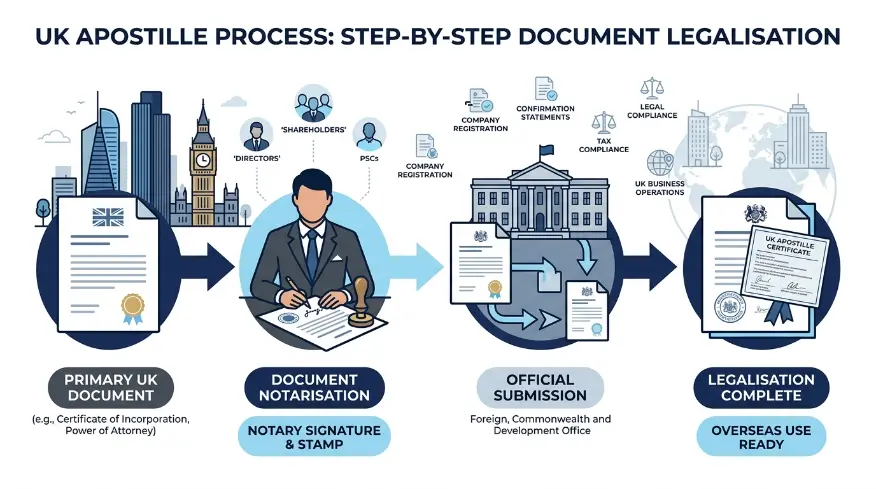
Executing international document authentication involves strict sequential verification steps. First, a certified notary public or practising solicitor inspects the physical paperwork. The legal professional verifies corporate signatures, checks company registration numbers, and signs an official attestation. Two verification methods secure this stage: wet-ink signature authentication and digital seal validation.
Second, the authenticated paperwork goes directly to the government processing office. The Foreign, Commonwealth and Development Office examines the notary seal against official government registries. Three processing routes exist for this stage: standard postal submission, premium counter service, and electronic apostille application. When government officials confirm the credentials, they attach the official stamped certificate. This final certificate binds securely to your original corporate document using specialized ribbons or metallic seals.
What Common Documents Require International Legalisation?
Commercial enterprises frequently require apostille stamps on certificates of incorporation, certificates of good standing, and board resolution documents.
International trade agreements demand verified proof of corporate identity. Overseas regulatory bodies inspect foundational company documents to verify legal standing before approving foreign subsidiary registrations. Three primary corporate document types undergo this verification process: incorporation certificates issued by Companies House, director appointment letters, and commercial power of attorney grants.
Foreign tax authorities also request certified financial statements and audited balance sheets. When companies acquire overseas assets, local legal systems require notarized property transfer contracts. Businesses preparing for international expansion can review our guide on What to Do Before You Submit a Document for Apostille? to ensure proper initial preparation. Proper preparation prevents costly administrative rejections during the government submission phase.
Why Should Companies Outsource Document Authentication?
Outsourcing document authentication eliminates administrative errors, reduces transit delays, and ensures strict compliance with complex international legal requirements.
Managing cross-border legalisation internally drains valuable corporate resources. Administrative teams often lack direct familiarity with evolving Foreign, Commonwealth and Development Office submission rules. Inaccurate form completions lead to immediate government rejection and financial losses. Professional compliance providers manage the entire workflow from initial notarisation to final delivery.
Expert oversight protects sensitive corporate paperwork from loss or damage during transit. Specialized courier networks transport confidential documents securely between legal offices and government departments. When companies leverage external expertise, internal legal teams focus entirely on core business expansion strategies. For foundational insights into the verification hierarchy, read our detailed overview on Who Signs and Verifies a Document Before It Is Apostilled?. Informed decision-making at every stage guarantees smooth international commercial operations.
Explore our Apostilled Documents guide,
Want to Get Your Articles of Association Apostilled Through Form My Company?
How Can You Suppress a PSC Home Address With Form My Company?
Frequently Asked Questions
How long does it take to get an apostille for UK company documents?
Standard apostille processing through Form My Company typically takes between 3 to 5 working days once the physical paperwork reaches the government office. Expedited premium services can reduce this turnaround time to 24 hours for urgent international business requirements.
Can documents be apostilled digitally without a physical stamp?
Electronic apostilles are available for specific digital documents issued by UK authorities, but traditional corporate filings still require physical notarisation and a wet-ink signature. Form My Company reviews your specific paperwork to determine whether an electronic or physical apostilled documents submission is required.
What is the difference between notarisation and an apostille?
Notarisation involves a registered notary public verifying the authenticity of a signature and witnessing the signing of corporate documents within the UK. An apostille is the subsequent government certificate issued under the Hague Convention that validates that notary’s seal for international recognition.
Do foreign authorities require translation alongside an apostille stamp?
Most non-English speaking destination countries require both the original corporate paperwork and the apostille certificate to be translated by a certified professional translator. Form My Company coordinates certified translation services alongside apostilled documents processing to ensure full compliance with foreign regulatory bodies.
What happens if an apostilled document is rejected by a foreign institution?
Rejections usually occur due to minor discrepancies in corporate names, outdated notary seals, or incorrect government submission formats. Form My Company minimizes these rejection risks by pre-verifying all company details against official UK registers before submitting paperwork for international legalisation.