
The Act mandates enhanced due diligence for companies, expanded gatekeeper duties, strengthened identity verification for directors and beneficial owners, and increased information-sharing powers for Companies House and enforcement agencies.
The Economic Crime Act 2023 raises verification standards across company formation and ongoing governance. It requires companies and certain agents to verify the identities of proposed directors and persons with significant control (PSC). The Act gives Companies House new powers to query filings and share data with law enforcement. Firms must update their policies and processes to validate identities, screen for sanctions, and retain more robust records.
What specific steps must a company take to verify a director under the Act?
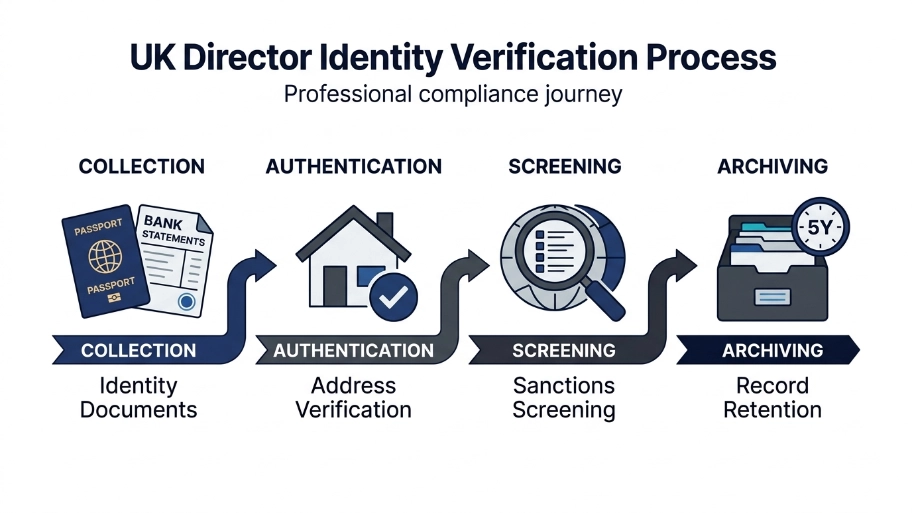
Verify identity using two independent documents, authenticate residential address, screen against sanctions and adverse-ownership registers, and retain verification records for at least five years.
Verification begins before the appointment. Collect a government-issued photo ID (passport, driving licence) and a second independent document (bank statement, council tax bill). Authenticate the address using utility bills, council tax notices, or electoral roll entries. Run sanctions and adverse-media checks using recognised screening tools. Record the verification method, date, and source. Keep records for a minimum of five years after the director leaves.
Read our articles, Compliance Changes Affecting UK Company Directors and Economic Crime Act 2023 Compliance Services | Form My Company.
How does the Act change Companies House’s powers and procedures?
Companies House can now query filings, require identity verification evidence, and share data with law enforcement, increasing the scrutiny of filings and creating new compliance touchpoints for companies.
Companies House acquired statutory powers to request supporting evidence when filings appear suspicious. It can delay registration or mark entries as verified or unverified. The body can pass information to law enforcement without a court order. Companies must be prepared to produce documents matching public filings, such as director IDs and PSC evidence, quickly and accurately.
Which businesses and agents have new “gatekeeper” duties?
In-scope gatekeepers include company formation agents, service providers handling incorporations, and professional advisers involved in appointments or significant ownership changes.
These entities must implement risk-based verification frameworks. Gatekeepers must verify the identities of individuals involved in creating or controlling legal persons. They must maintain auditable records, apply enhanced checks for higher-risk clients, and report suspicious activity. Many professional services firms must upgrade AML (anti-money-laundering) processes to meet the Act’s standards.
What are the penalties for non-compliance with the Economic Crime Act 2023?
Penalties include civil sanctions, fines, and potential criminal liability for reckless or deliberate breaches, plus refusal or reversal of registrations by Companies House.
Civil fines vary by offence and compliance failure. Deliberate false filings can lead to criminal charges and higher penalties. Companies House can refuse to register officers or dissolve entities where fraud is suspected. Organisations face reputational damage and operational disruption if records or processes fail to meet statutory standards.
How should companies update their director appointment processes?
Integrate identity verification into the appointment workflow, require documented PSC evidence, run sanctions and adverse-media checks, and store verifications in an auditable system.
Start by modifying director appointment checklists. Require submission of ID and address documentation before filing any appointment. Use electronic identity verification (eIDV) tools combined with manual checks for higher risk. Validate any claimed PSCs with corporate documents, trust deeds, or shareholder registers. Ensure storage in encrypted, access-controlled systems with retention schedules aligned to the Act.
What verification technology and methods meet the Act’s expectations?
Use government-ID checks, biometric authentication, address-validation databases, and reputable sanctions-screening platforms; combine automated and manual checks for high-risk cases.
Three recommended methods: confirm photo ID against a passport or driving licence, match biometric data such as a selfie with the ID photo, and validate address with utility or electoral data. Use sanctions and PEP (politically exposed person) screening from established providers. Log verification method, tool used, confidence score, and operator decisions to create audit-ready evidence.
How must companies handle beneficial ownership (PSC) under the Act?
Confirm beneficial ownership through documentary evidence, update PSC registers promptly, and validate any changes against underlying corporate or trust documents.
Identify anyone with more than 25% ownership or significant control. Collect share certificates, trust deeds, shareholder agreements, and identity documents for PSCs. When ownership changes, update the PSC register within the statutory timeframes and retain supporting evidence for inspection.
What internal governance changes will reduce legal risk?
Adopt formal AML and KYC policies, appoint a compliance officer, schedule regular audits, and train staff on verification procedures and red flags.
Create a written AML/KYC policy aligned to the Act. Designate a senior compliance lead responsible for oversight. Perform quarterly or biannual audits of appointment files. Train staff in document verification, sanctions screening, and reporting procedures to ensure consistent application across incorporations and officer changes.
How should professional advisers and formation agents adapt their service offering?
Embed enhanced due diligence in service contracts, disclose verification requirements to clients early, and price services to reflect compliance efforts.
Update engagement letters to include identity verification and data-retention clauses. Ask clients to provide ID before substantive work begins. Offer tiered services: standard verification for low-risk clients, and enhanced due diligence for high-risk jurisdictions or complex ownership. Document the processes used to support future enquiries by Companies House or regulators.
What practical recordkeeping and retention practices work best?
Keep digital copies of identity evidence, maintain an audit trail of verification steps, encrypt sensitive records, and retain files for at least five years after separation.
Store documents in a secure document management system with role-based access. Tag files with metadata: verification date, verifier name, method, and outcome. Use write-once logs or immutable storage for audit trails. Implement automatic retention deletion only after the statutory retention period expires.
Explore our Director Appointment guide,
How to Properly Notify Companies House About New Director Appointments and Filings
How does the Economic Crime Act affect cross-border incorporations and foreign directors?
Require the same identity and PSC verification for foreign directors, supplement checks with international data sources, and apply enhanced due diligence for high-risk jurisdictions.
Treat foreign directors identically to UK-based directors for verification. Use international ID databases, transliteration verification, and embassy-verified documents when needed. Apply enhanced checks in jurisdictions with weak AML regimes and document additional steps taken to achieve equivalent assurance.
The Economic Crime Act 2023 raises the bar for director appointment, identity verification, and beneficial ownership transparency. Companies must implement robust KYC, use reliable verification technologies, and maintain auditable records. From My Company helps organisations comply with these requirements through expert director appointment support and compliance guidance, reducing risk and streamlining filings.
Frequently Asked Questions
What are the legal requirements to appoint a director in the UK?
A director must be aged 16 or over, not disqualified, and not an undischarged bankrupt. For director appointment, the company passes a board resolution and files form AP01 with Companies House within 14 days, including consent from the new director.
How do I file a director’s appointment with Companies House?
Submit form AP01 for individual directors or AP02 for corporate directors to Companies House. From My Company handles the director appointment process by preparing the resolution, collecting ID verification, and filing AP01 electronically within the statutory timeframe.
What documents are needed for a director’s appointment in a UK limited company?
You need the director’s full legal name, date of birth, National Insurance number, residential address, and a signed consent to act. From My Company supports the director appointment by collecting verified ID, preparing the board resolution, and ensuring all documents meet Companies House requirements.
Can a non-UK resident be appointed as a company director?
Yes, directors do not need to live in the UK, but the company must have a UK-registered office address. Director appointment for non-UK residents requires the same AP01 filing and identity verification, and From My Company ensures compliance with cross-border appointment rules.
What happens if I fail to file a director appointment correctly?
Incorrect or late filing can lead to penalties, rejected appointments, and compliance issues with Companies House and HMRC. From My Company manages director appointment with verified identity checks, accurate AP01 submissions, and timely filing to avoid penalties and ensure the appointment is legally valid.