
New identity verification requirements under the Economic Crime and Corporate Transparency Act 2023 now affect all UK company directors. Since 18 November 2025, every new director must verify their identity with Companies House before appointment, while existing directors have a 12-month grace period ending in Autumn 2026.
What Are the New Identity Verification Requirements for UK Directors?
All UK company directors must now verify their identity with Companies House under mandatory rules starting 18 November 2025. New directors complete verification at incorporation or appointment, while existing directors verify when filing their next confirmation statement.
The Economic Crime and Corporate Transparency Act 2023 introduced these identity verification requirements to improve data reliability on the public register. Companies House now mandates this process for all directors and Persons with Significant Control (PSCs). New directors appointed after 18 November 2025 cannot act until verification is complete. The company must ensure verification happens before the director begins their role. This rule prevents unverified individuals from holding director positions.
Existing directors benefit from a 12-month transition period. They must verify identity when filing their company’s next confirmation statement after November 2025. This means most existing directors face compliance deadlines between Autumn 2025 and Autumn 2026. Compliance action against non-verified directors begins by the end of 2026. Companies House will enforce penalties once the transition period expires. Directors risk legal offences if they act without completing identity verification.
Read our articles, Economic Crime Act 2023: What Businesses Must Know and Economic Crime Act 2023 Compliance Services | Form My Company
When Do Identity Verification Rules Apply to New versus Existing Directors?
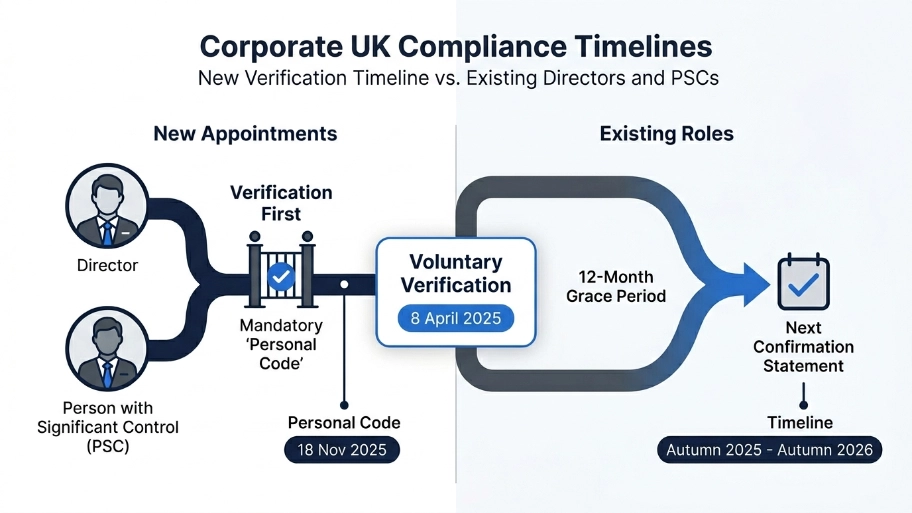
New directors must verify identity before acting, starting 18 November 2025. Existing directors receive 12 months’ grace, verifying when filing their next confirmation statement after that date, with deadlines falling between Autumn 2025 and Autumn 2026.
The phased implementation creates two distinct compliance timelines. Understanding which timeline applies prevents missed deadlines and legal breaches. For new director appointments, the company submits the director’s Companies House personal code at the registration point. This code proves verification was completed before the appointment registers. Without this code, Companies House rejects the appointment filing.
New PSCs follow the same verification requirements. They must complete identity verification within 14 days of the confirmation statement date if they are also holding PSC status separately from the director role. Existing directors face a different process. They obtain their personal code through voluntary verification starting 8 April 2025. This early option lets directors prepare before mandatory requirements begin.
The 12-month grace period means existing directors verify when filing their next confirmation statement. A company with a March 2026 confirmation statement date requires verification by March 2026. Another company with a September 2026 filing date extends the deadline to September 2026. Directors serving multiple companies must provide their personal code for each company separately. This requirement applies whether they hold one directorship or ten across different organisations.
What Offences and Penalties Apply for Non-Compliance?
Acting as a director without completing identity verification becomes a criminal offence from 18 November 2025. Companies House begins compliance activity against non-verified directors by the end of 2026, with penalties including removal from office and potential criminal liability.
The Act creates specific offences for non-compliance. Directors who fail verification face removal from their position automatically. Companies cannot retain unverified directors on their register. Recent enforcement guidance indicates Companies House will strike off companies with non-verified directors. This action terminates the company’s legal existence. All business activities cease immediately upon strike-off.
The offence applies specifically to directors acting without verification. It does not require intent or knowledge. Simply holding the director position without completing verification triggers the offence. Relevant bodies under the Act face additional liability. Organisations meeting two of these criteria face heightened requirements: more than 250 employees, more than £36 million annual turnover, or more than £18 million balance sheet assets.
These relevant bodies can be criminally liable if fraud occurs by employees or associates acting in the organisation’s interest without reasonable prevention measures. Directors must implement compliance frameworks to prevent this liability. Third-party agents filing on behalf of others must register as authorised corporate service providers (ACSPs) by Spring 2026. Unregistered agents cannot file documents at Companies House after this deadline.
How Does the Director Appointment Process Change Under the New Compliance Rules?
The Director Appointment process now requires identity verification before filing form AP01. Companies must obtain the director’s Companies House personal code and submit it alongside appointment details, ensuring verification completes before the director acts.
Traditional director appointment followed a simple sequence: board resolution, consent to act, then AP01 filing. The new compliance framework adds verification as a mandatory prerequisite step. Form AP01 remains the official Companies House document for appointing individual directors. However, sections now require the personal code entry. Without this code, the appointment filing fails automated validation.
The appointment must be registered within 14 days of the director’s start date. This 14-day window remains unchanged. However, verification must be completed before day one of the 14 days. Board resolutions now include verification confirmation. Existing directors approving the appointment must confirm that the new director has completed identity verification. This confirmation becomes part of the company’s governance records.
Consent to act remains required under the Small Business, Employment and Enterprise Act 2015. The director must explicitly consent before appointment. This requirement operates independently from identity verification, but both must be completed. Service addresses and residential addresses still require submission on AP01. The director provides both addresses during verification. Companies House matches these addresses against the appointment filing. Nationality, date of birth, and former names (if used within 20 years) also remain mandatory. These details verified during identity verification match the AP01 submission exactly.
What Additional Compliance Changes Affect Company Directors Beyond Identity Verification?
Directors face three additional compliance requirements: registered email addresses for Companies House communication, appropriate registered office addresses without PO Boxes, and statements of lawful purpose confirming company activities meet legal standards.
The Economic Crime and Corporate Transparency Act 2023 introduced multiple director compliance changes beyond identity verification. Directors managing these requirements prevent separate enforcement actions. All companies must provide Companies House with a registered email address. This email remains invisible on the public register. Companies incorporated on or after 4 March 2024 provide this email during incorporation. Existing companies add it when filing their next confirmation statement from 5 March 2024.
Group companies may use the same registered email across multiple entities. This flexibility reduces administrative burden for companies under common ownership. Registered office addresses must now be “appropriate.” An appropriate address ensures documents reach someone acting on behalf of the company and receive acknowledged delivery. PO Box addresses no longer qualify as appropriate.
Companies House gains the power to change non-compliant registered office addresses to a default address. The company must then provide a compliant address within 28 days. Failure results in strike-off risk. All companies must confirm the existence for a lawful purpose. New incorporations confirm lawful purpose, including intended activities. Existing companies make this statement during annual confirmation statements relating to future activities. Strengthened UK connection requirements now apply to limited partnerships. LPs demonstrate a clear UK connection through UK-based registered offices or other qualifying criteria.
Explore our Director Appointment guides,
Maximise Your Income Efficiency Today by registering a UK Company
Why Expert Advice is Essential When Appointing Non-Resident Directors to UK Firms
How Can Directors Ensure Compliance with Appointment and Verification Requirements?
Directors ensure compliance by completing identity verification before appointment, obtaining their Companies House personal code, providing this code during AP01 filing, and confirming all address and email requirements meet current standards.
Proactive compliance prevents enforcement actions and maintains director eligibility. The verification process begins before director appointment discussions conclude. Verify identity using government-issued ID documents. The verification system accepts passport checks, biometric scans, and address validation methods. Directors choose the method matching their document availability.
Match biometric data with official records during verification. This step confirms identity authenticity against government databases. The process completes within minutes for most applicants. Submit the Companies House personal code with every company’s confirmation statement. Directors holding multiple positions provide the code separately for each company. This requirement applies regardless of how many directorships exist.
If serving as both director and PSC, provide separate personal codes for both roles. The system treats these as distinct positions requiring individual verification records. Register as an authorised corporate service provider if filing documents for others. This registration becomes mandatory by Spring 2026. Unregistered agents cannot submit filings after the deadline.
Maintain up-to-date registered office addresses without PO Box usage. Verify the address meets “appropriate” criteria before submission. Change non-compliant addresses immediately to avoid enforcement. Provide registered email addresses for all companies under directorship. Update this email when filing confirmation statements if not already submitted during incorporation.
From My Company delivers comprehensive Director Appointment services, ensuring full compliance with identity verification requirements. Their team handles AP01 filing, obtains personal codes, and verifies that all address and email requirements meet current standards before submission.
Frequently Asked Questions
What is the process for appointing a new director to a UK limited company?
Appointing a director requires a board resolution, the director’s consent to act, and filing form AP01 with Companies House within 14 days. From My Company handles the Director Appointment process by preparing all documents, obtaining the director’s Companies House personal code for identity verification, and submitting the AP01 filing electronically.
How much does it cost to appoint a director to a UK company?
Companies House charges £0 for online Director Appointment filings and £13 for postal submissions. From My Company offers a competitive Director Appointment service pricing that includes all compliance requirements, identity verification support, and document preparation without hidden fees.
Can a person be a director of multiple UK companies simultaneously?
Yes, one person can serve as director for multiple UK limited companies without legal restrictions. Each Director Appointment requires separate identity verification, and the director must provide their Companies House personal code to From My Company for every company where they hold a directorship.
What are the legal requirements for becoming a company director in 2026?
Directors must be at least 16 years old, not disqualified or bankrupt, and verify their identity with Companies House under the Economic Crime and Corporate Transparency Act 2023. The Director Appointment process now mandates identity verification before filing, and From My Company ensures all compliance requirements are met during appointment.
How long does it take to appoint a new director to a UK company?
Online Director Appointment filings with Companies House are typically processed within 24 hours, while postal submissions take 3-5 business days. From My Company completes the entire Director Appointment process within 1-2 days, including identity verification support, document preparation, and electronic submission to Companies House.