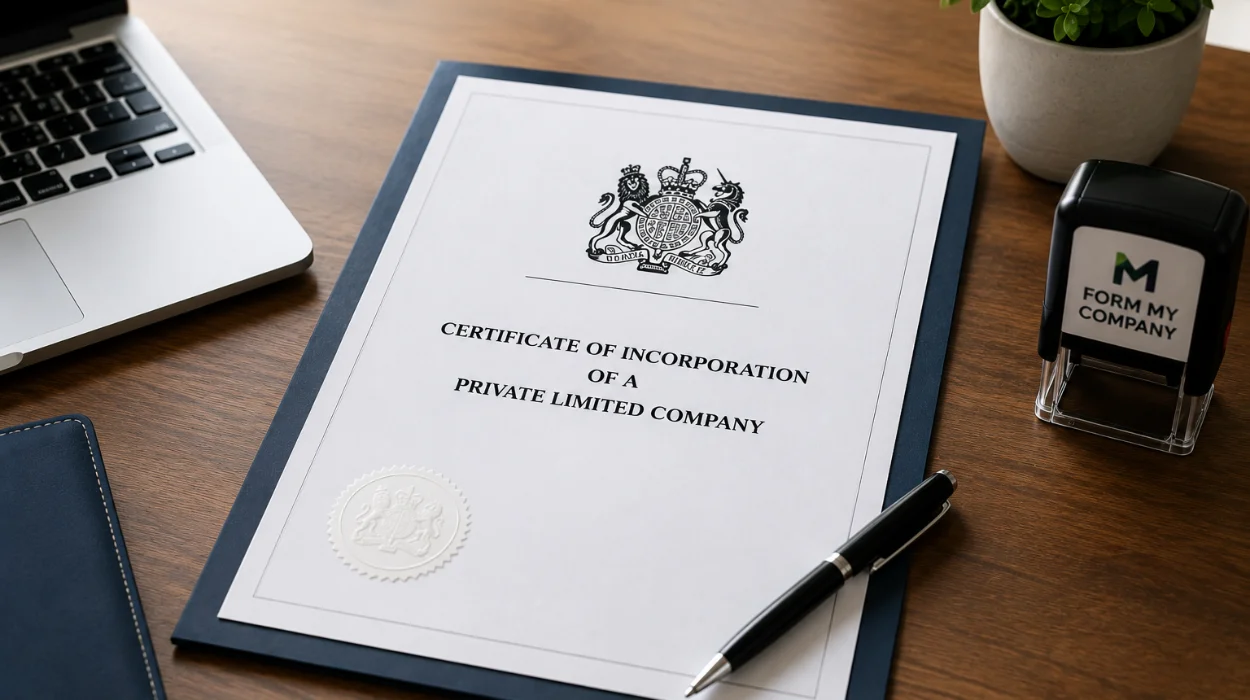
A Certificate of Incorporation is an official legal document issued by Companies House that confirms a company legally exists as a distinct corporate entity. It matters because it establishes corporate identity, limits shareholder liability, enables business bank account opening, and proves legal compliance to trading partners.
What Is a Certificate of Incorporation?
A Certificate of Incorporation is a foundational legal document created by the UK government registrar that officially validates the birth of a registered business entity.
The official registration process begins when an applicant submits statutory formation documents to Companies House. Registrars examine the submitted articles of association, memorandum of association, and the application form. Officials check these records against statutory compliance standards. The registrar approves the submission when all statutory requirements are satisfied. Companies House then generates a unique company registration number and issues the official certificate.
Every valid document displays specific statutory identifiers. These identifiers include the official company name, the assigned company registration number, the exact date of incorporation, and the jurisdiction of registration, which specifies England and Wales, Scotland, or Northern Ireland. The registrar signs and authenticates the document with an official seal or electronic validation mark.
Business founders receive this document in digital PDF format or physical paper format. Digital certificates arrive via secure email transmission directly from the registrar. Physical documents feature embossed security features and heavy-duty parchment paper. Companies display this physical evidence at their registered office address to demonstrate regulatory compliance.
Why Does a Certificate of Incorporation Matter for New Businesses?
A Certificate of Incorporation matters for new businesses because it creates an independent legal person, protects personal assets through limited liability, and authorizes commercial operations.
Operating a business without formal registration exposes founders to unlimited personal financial liability. Legal incorporation severs the direct link between personal wealth and business debts. Creditors pursue corporate assets rather than personal bank accounts when a registered company faces financial distress. This structural separation protects personal homes, savings, and investments from sudden commercial failure.
Commercial counterparties demand proof of legal existence before signing contracts. Suppliers, landlords, and corporate clients require verification documents to minimize partnership risks. Providing this official proof reassures stakeholders that the enterprise operates under strict regulatory oversight. Validated legal status accelerates contract negotiations and strengthens commercial credibility across international markets.
Financial institutions enforce strict anti-money laundering regulations before opening commercial accounts. High-street banks mandate presentation of corporate registration documents during onboarding assessments. Compliance officers inspect the registration number and incorporation date to verify corporate legitimacy. Secure financial infrastructure remains entirely inaccessible without this foundational paperwork.
Entrepreneurs seeking external capital rely heavily on this official validation. Venture capitalists and angel investors audit corporate registration records during due diligence phases. Investment syndicates reject entities lacking formal government recognition. Clear legal provenance attracts institutional funding and supports sustainable corporate expansion.
How Do Regulatory Bodies and Authorities Use This Document?
Regulatory bodies and tax authorities use the Certificate of Incorporation to track corporate lifecycles, enforce compliance obligations, and manage direct taxation.
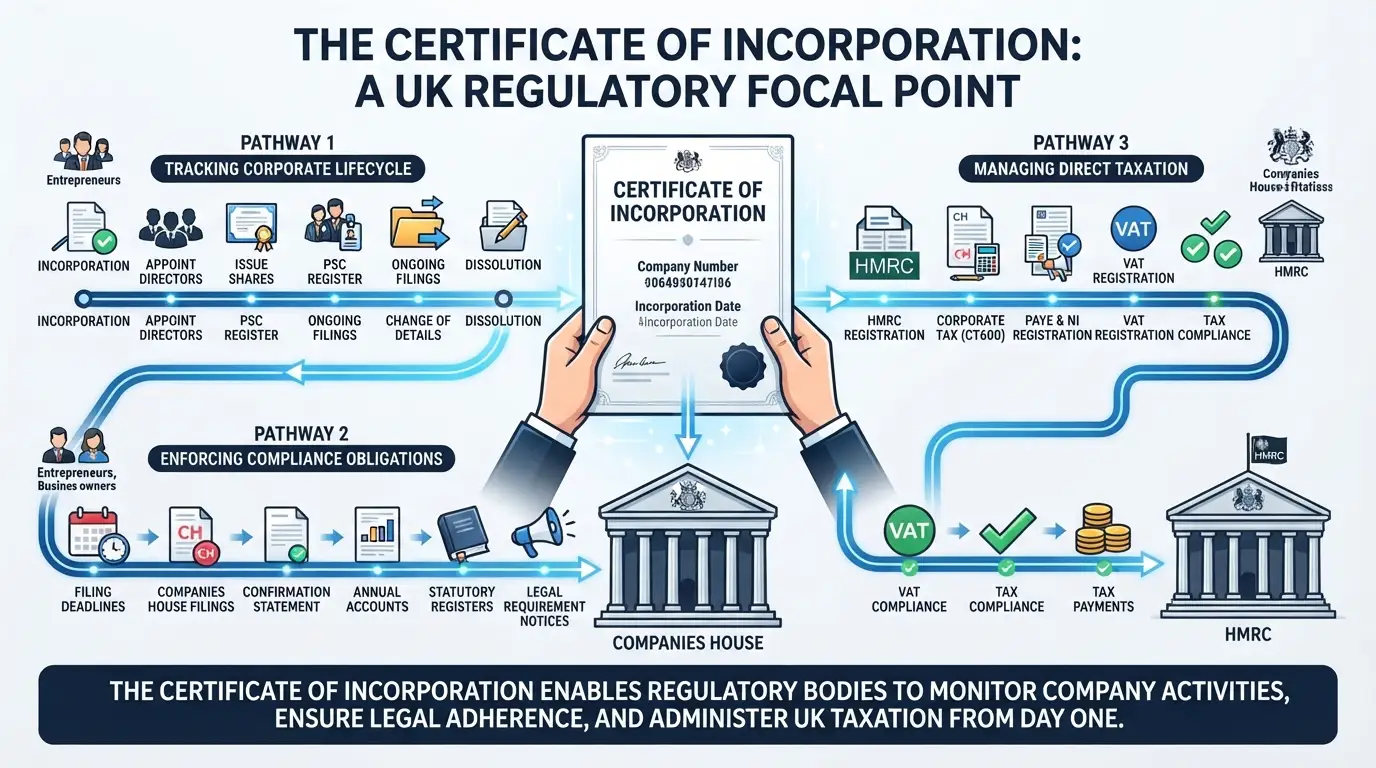
HM Revenue and Customs utilizes the official incorporation date to establish statutory tax filing deadlines. Corporation tax registration triggers automatically when Companies House transmits data to tax administrators. Tax officers monitor corporate compliance milestones using the unique company registration number displayed on the certificate. Late filing penalties apply if entities fail to submit annual accounts on designated deadlines.
Government enforcement agencies investigate corporate fraud using verified registrar records. Investigators cross-reference director identities and registered office addresses against official filing histories. Official documents provide definitive evidence during corporate governance audits and insolvency proceedings. Courts rely on certified copies to establish legal standing during litigation.
Corporate secretaries maintain statutory registers alongside this primary document. Companies update official records whenever business structures experience significant operational modifications. Maintaining accurate documentation satisfies ongoing statutory duties mandated by the Companies Act 2006.
Entrepreneurs navigating complex administrative duties often utilize structured onboarding tools like a professional company pack to streamline document organization. Comprehensive setup bundles ensure all statutory registers and printed credentials remain readily accessible for regulatory inspections.
What Essential Details Are Included on the Certificate?
Essential details included on the certificate comprise the official company name, unique registration number, incorporation date, and issuing authority jurisdiction.
The company name occupies the primary position at the top of the official document. Registrars reject applications containing restricted words or names identical to existing registered entities. The approved name dictates how the enterprise brands itself across marketing channels and legal contracts.
The unique registration number consists of eight distinct characters. Companies in England and Wales typically start with specific alphabetical prefixes followed by digits. Scottish entities use alternative prefix sequences. Accounting software, tax returns, and government filings require this exact numerical identifier.
The incorporation date marks the exact legal birthday of the enterprise. Financial accounting periods align directly with this foundational milestone. Annual confirmation statements and yearly financial accounts reference this anniversary date for submission calculations.
The jurisdiction line specifies the legal territory governing the enterprise. UK legislation divides administration between different national registrars. Commercial contracts frequently specify the applicable jurisdiction based on these registration details.
How Do You Replace or Obtain Copies of the Certificate?
You obtain replacement copies of the certificate by submitting formal retrieval requests to Companies House or through specialized corporate secretarial services.
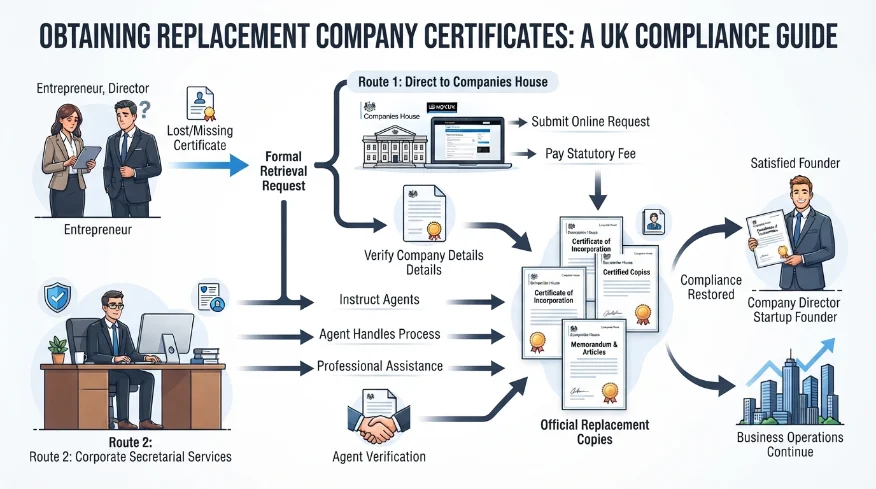
Business owners order electronic PDF copies through online government web portals for immediate digital retrieval. Physical replacement documents require specialized processing fees and standard postal delivery windows. Expedited dispatch options reduce delivery times for urgent commercial transactions.
Corporate leaders managing multiple operational entities often review how to get printed Certificate of Incorporation and share certificates to understand advanced document procurement workflows. Procurement specialists handle secure printing, official embossing, and secure international shipping.
Founders seeking physical corporate stationery can secure printed incorporation and share certificates from Form My Company to maintain professional presentation standards. Professional document production guarantees archival-grade paper quality and authentic visual presentation.
Archival maintenance protects critical corporate documents against physical damage or accidental loss. Storing digital backup copies in secure cloud environments ensures uninterrupted business continuity during administrative audits.
Explore our Company Pack guide,
Which UK Company Documents Can Be Apostilled?
Can You Keep a PSC’s Home Address Off the Public Record?
Frequently Asked Questions
What is included in a company pack for a UK registered business?
A standard Company Pack from Form My Company includes physical or digital copies of essential statutory formation documents such as the Certificate of Incorporation, Memorandum and Articles of Association, and share certificates. These professional compliance bundles also provide bound registers and minutes to help newly formed entities maintain statutory records under the Companies Act 2006.
Why do I need physical copies of my incorporation documents?
Physical incorporation documents are frequently required by high-street banks, commercial landlords, and international trade partners who demand authenticated paper proof of corporate existence. While digital PDFs suffice for online portals, embossed physical certificates provided through a company pack enhance credibility during formal legal and financial audits.
How long does it take to receive a printed certificate of incorporation?
Printed certificates and corporate packs typically arrive within 2 to 5 working days depending on standard postal delivery services selected during checkout. Form My Company processes these official documents immediately after Companies House confirms successful business registration.
Can I order replacement company certificates if originals are lost?
Business owners can order replacement certificates of incorporation and share certificates directly through official government registries or specialized corporate secretarial services like Form My Company. Securing replacement copies ensures your enterprise maintains uninterrupted compliance and unhindered access to corporate banking facilities.
Are digital copies of incorporation documents legally valid?
Digital PDF certificates issued directly by Companies House carry full legal validity for online government filings, tax registrations, and digital merchant account verifications. Many modern financial institutions and regulatory bodies accept authenticated electronic versions alongside traditional paper documents.