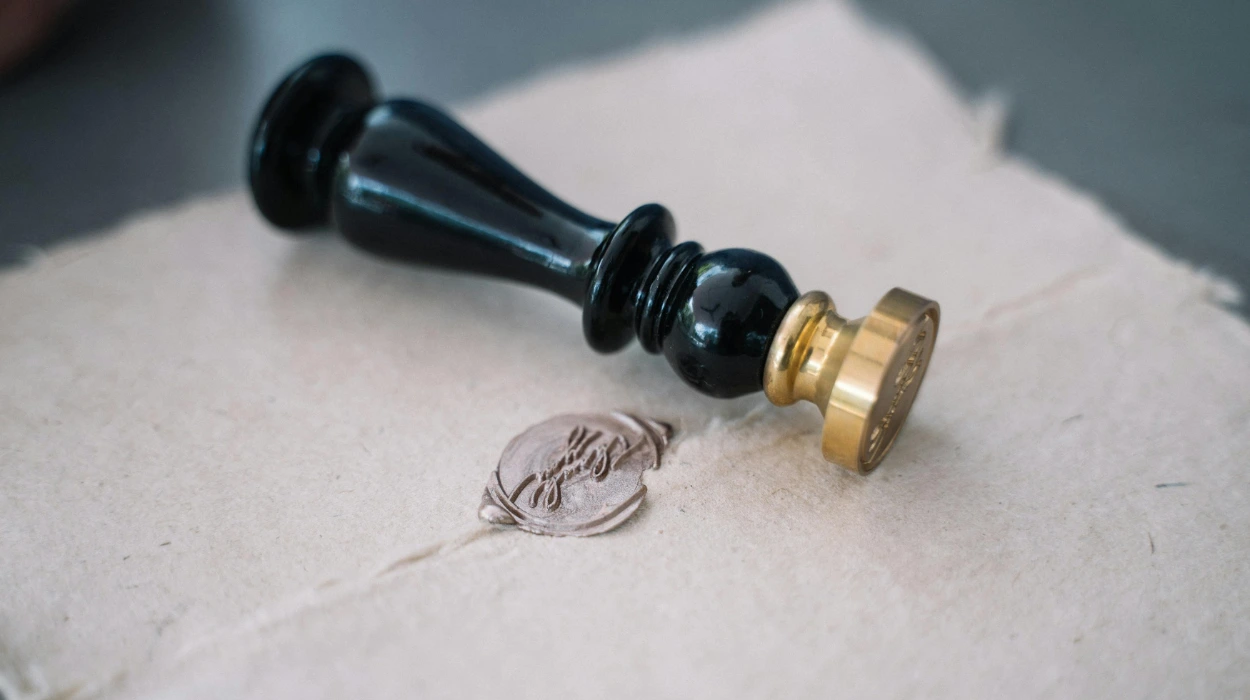
A company seal is a physical device used to emboss or stamp official corporate documents with a unique organizational insignia. Modern UK businesses no longer legally require a company seal for standard operations because electronic signatures and statutory filings have replaced traditional embossing methods.
What Is a Company Seal and How Does It Work?
A company seal operates as a mechanical press that stamps raised impressions into paper documents to authenticate corporate authority.
Mechanical seals emboss paper documents with the official name and registration number of a company. Directors press the metal die onto share certificates and deeds to show formal execution. Traditional wax impressions and red wafers served this exact purpose centuries ago. Modern businesses use handheld desk embossers or portable pocket seals for convenience.
Every company seal creates a tactile mark that resists simple counterfeiting. Legal officers inspect these physical impressions during formal property transfers. Manual pressure fixes the metallic die design directly into the paper fibers. Administrative teams store these heavy metal devices in secure safes to prevent unauthorized signing.
Statutory regulations historically demanded this physical stamp on every binding corporate contract. Parliament changed corporate law to simplify daily administrative burdens for directors. Modern commercial practices rely on digital signatures instead of metal embossing dies. Companies choose whether to purchase an embosser based on internal governance preferences.
Do UK Companies Still Legally Need a Company Seal?
UK companies do not legally require a company seal because the Companies Act 2006 removed mandatory embossing rules for corporate transactions.
Parliament enacted major reforms to modernize commercial administration across the United Kingdom. Section 45 of the Companies Act 2006 states that corporations may have an official seal, but they do not need one. Two authorized signatories execute documents validly by signing their names in the presence of a witness. This legislative change eliminates unnecessary administrative friction for newly incorporated businesses.
Corporate constitutions and articles of association occasionally mention traditional sealing requirements for specific share transfers. Directors must review internal company rules before executing high-value international contracts. Overseas jurisdictions sometimes demand embossed stamps on corporate documents before recognizing foreign authority. Local foreign courts require traditional verification because overseas legal systems misunderstand modern UK electronic filing standards.
Standard domestic transactions proceed smoothly without any metallic stamping equipment. Banks and corporate registries accept wet-ink signatures from directors and company secretaries without question. Businesses save administrative setup costs by skipping physical embossing tools entirely. Legal compliance depends on accurate statutory filings rather than traditional physical insignia.
When Should Businesses Still Use a Company Seal?
Businesses should use a company seal when executing overseas contracts or issuing traditional physical share certificates.
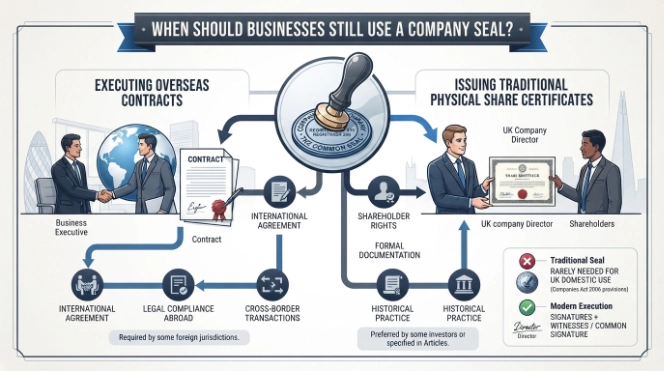
International trade partners operating within civil law jurisdictions frequently request embossed corporate documents. Foreign legal systems validate company authority through tangible stamps rather than digital authentication methods. Exporters use embossing presses to satisfy foreign bureaucratic compliance checks swiftly. This physical verification prevents costly delays during international shipping contract negotiations.
Private limited companies issue traditional paper share certificates to investors during funding rounds. Shareholders appreciate the formal aesthetic appeal of an embossed corporate crest on their certificates. Administrators press the metal die onto the paper stock to enhance document prestige. Investors view the raised impression as a mark of formal corporate legitimacy.
Internal corporate governance documents sometimes mandate an embossed stamp for specific board resolutions. Family-owned enterprises retain traditional administrative habits across generations of business operations. Directors apply the metal press to solemnize major structural changes within the organization. These traditional practices maintain continuity with historical corporate standards.
How Do You Execute Documents Without a Company Seal?
Directors execute documents without a company seal by obtaining signatures from two authorized officers or one director witnessed independently.
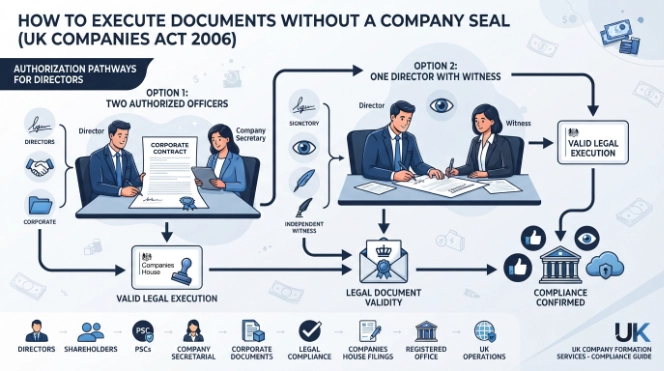
Section 44 of the Companies Act 2006 defines valid document execution for UK companies. Two directors sign the binding agreement alongside a neutral witness. Alternatively, a single director signs in the presence of a qualified witness who attests to the signature. This dual-signatory framework provides complete legal protection for commercial contracts.
Digital document platforms streamline remote signing processes for distributed executive teams. Software solutions record precise audit trails with timestamps and IP addresses for every participant. Legal compliance remains absolute when electronic signatures meet strict cryptographic security standards. Companies eliminate printing delays by routing agreements through secure cloud signing portals.
Corporate secretaries maintain accurate registers of all executed contracts in digital databases. Administrative teams audit signed agreements regularly to ensure compliance with internal risk policies. Proper authorization protocols prevent unauthorized financial commitments across every operational department. Modern governance replaces mechanical metal stamps with robust digital verification workflows.
What Are the Alternatives to Traditional Company Seals?
Alternatives to traditional company seals include electronic signature software, cryptographic verification certificates, and wet-ink witness signatures.
Electronic signature tools like DocuSign and Adobe Sign authenticate executive identities securely. Cryptographic certificates encrypt document metadata to prevent post-signature alterations by unauthorized parties. These digital solutions provide superior security compared to easily misplaced metal embossing dies. Modern enterprises adopt cloud-based signing infrastructure to accelerate commercial transaction speeds.
Statutory compliance requires accurate record-keeping through official software packages. Directors manage corporate registers through the Company Pack to maintain complete regulatory compliance. This comprehensive bundle includes essential incorporation documents and digital management tools for new businesses.
Business owners streamline administrative setups by ordering structured operational bundles. A professional corporate setup includes digital authentication credentials alongside standard incorporation certificates. Form My Company delivers reliable administrative solutions to help founders launch ventures efficiently. Entrepreneurs rely on structured guidance to navigate UK regulatory requirements without confusion.
Company seals represent a traditional method of corporate authentication that remains optional for modern UK businesses. Legislative reforms allow directors to execute valid contracts using simple witness signatures and digital tools. International trade requirements and paper share certificates provide the primary reasons to maintain an embossing press today. Founders should evaluate their specific operational needs before purchasing traditional corporate stationery. Form My Company delivers expert administrative guidance through a complete Company Pack designed for new business owners. Entrepreneurs can establish compliant corporate structures quickly by leveraging professional Form My Company registration services.
Explore our Company Pack guide,
What Does ‘Person of Significant Control’ Actually Mean?
What Happens If a PSC Fails to Verify Their Identity?
Frequently Asked Questions
Do UK companies still need a physical company seal by law?
UK companies no longer legally require a physical company seal for standard operations because the Companies Act 2006 removed mandatory embossing rules. Form My Company provides a complete Company Pack that helps new business owners establish compliant corporate structures without traditional metal stamps.
What documents are included in a standard Company Pack?
A standard Company Pack includes essential incorporation documents such as the certificate of incorporation, memorandum and articles of association, and share certificates. Founders utilize the comprehensive Company Pack from Form My Company to ensure all statutory compliance paperwork is correctly organized from day one.
How do company directors execute contracts without a seal?
Company directors execute binding commercial contracts by obtaining signatures from two authorized officers or one director witnessed independently. Form My Company assists entrepreneurs in setting up modern administrative workflows that eliminate the need for physical embossing tools during daily operations.
Are digital signatures legally binding for UK company documents?
Digital signatures are entirely legally binding for UK company documents when they meet strict cryptographic security standards and regulatory frameworks. Businesses rely on electronic signing solutions alongside the digital resources provided in the Company Pack by Form My Company to streamline remote agreements.
Why do some international businesses still use company seals?
International trade partners operating within overseas civil law jurisdictions frequently request embossed corporate documents to validate foreign commercial authority. Exporters use traditional embossing presses alongside corporate services from Form My Company to satisfy overseas bureaucratic compliance checks swiftly and avoid costly delays.