
New UK companies should first order a Certificate of Good Standing, a Certificate of Incumbency, and Certified Copies of Incorporation Documents. These core filings provide legal proof of active corporate registration, verify current director and shareholder structures, and satisfy immediate compliance requirements for business banking, commercial leases, and international contracts.
What Are Supplementary Company Documents for UK Businesses?
Supplementary company documents are official administrative certificates and verified corporate records issued beyond standard incorporation certificates. They provide verified proof of corporate existence, internal ownership structures, governance status, and ongoing statutory compliance with Companies House to third-party institutions, banks, legal authorities, and international commercial partners.
Standard incorporation packages deliver basic formation papers to new corporate entities. Modern commercial operations require additional verification steps during early growth phases. Financial institutions, legal advisors, and commercial landlords demand independent validation of corporate status. Supplementary corporate paperwork fulfills these legal verification requests efficiently.
A standard business filing package includes a basic Certificate of Incorporation alongside Memorandum and Articles of Association. Supplementary instruments extend this statutory baseline. They confirm ongoing operational viability, detail precise internal management structures, and present official verification of registered addresses.
Operating without these supplementary records creates operational friction during institutional onboarding. Banks reject applications that lack recent verified operational evidence. Overseas vendors refuse contract executions without official state authentication. Ordering these essential papers early prevents administrative delays during critical business expansion milestones.
Why Should a New Business Order a Certificate of Good Standing First?
A Certificate of Good Standing proves that a company remains active, registered, and fully compliant with statutory filing duties at Companies House. It confirms the business has submitted required confirmation statements and annual accounts without facing liquidation, striking-off, or administrative dissolution procedures.
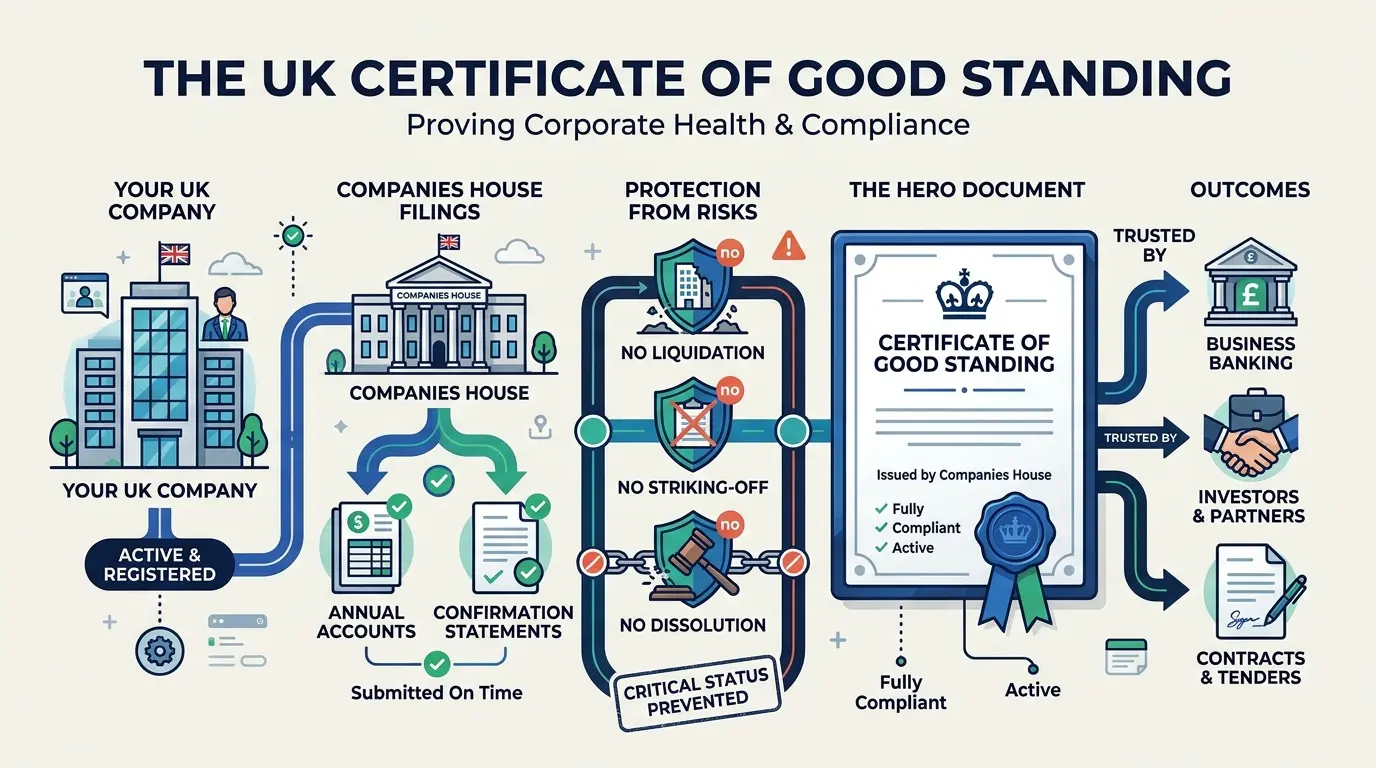
Third-party organizations evaluate operational risks before entering binding financial agreements. Banks demand this specific document during initial corporate bank account applications. Mortgage lenders, institutional creditors, and government procurement officers require confirmation of legal status before approving financing requests or awarding commercial contracts.
The document contains specific statutory indicators of operational integrity:
Verifies continuous registration on the official corporate register
Confirms zero outstanding statutory filing defaults or overdue accounts
Validates active director appointments and registered office address details
Attests to the absence of active court winding-up orders or insolvency proceedings
Overseas trade partners frequently demand a legalized Certificate of Good Standing before executing cross-border supply agreements. Foreign registration authorities require this proof when a UK firm opens an overseas branch or subsidiary. Acquiring this document early establishes immediate commercial credibility across domestic and international trade networks.
Companies seeking comprehensive administrative guidance can obtain essential supplementary company documents to streamline initial regulatory onboarding.
How Does a Certificate of Incumbency Protect Corporate Relationships?
A Certificate of Incumbency specifies the exact legal identity of active company officers, directors, and legal shareholders at a precise point in time. It prevents corporate identity fraud by confirming who holds legitimate authority to execute legal contracts and manage corporate financial assets.
Corporate governance structures change as companies expand. Counterparties require legal assurance that signatories possess genuine authority to bind the organization. A Certificate of Incumbency details complete officer rosters, appointment dates, official role titles, and exact equity distribution schedules across all share classes.
Financial institutions rely heavily on these verification instruments during high-value operations. Foreign bank account applications mandate explicit officer identification checks. Corporate transactions involving legal counsel, cross-border acquisitions, or property purchases require independent certification of signatory powers before closing transactions.
The document details essential management structure components:
Validates full names, appointment dates, and residential service addresses of directors
Confirms company secretary appointments and designated administrative powers
Outlines share capital structures, issued share totals, and voting rights distributions
Identifies significant controllers holding over twenty-five percent ownership shares
Maintaining updated officer certificates mitigates corporate vulnerability during contractual disputes. External vendors gain verified confirmation of signatory authority. Internal executives execute corporate transactions with complete confidence in their legally recognized mandates.
To evaluate which options align best with your operational setup, review our detailed guide on Supplementary Company Document Packages Compared: Which Fits You? for a full breakdown.
When Are Certified Copies of Incorporation Documents Required?
Certified copies of incorporation documents are officially authenticated duplicates of original formation papers verified by legal professionals or Companies House. Third-party institutions require certified duplicates to satisfy Anti-Money Laundering regulations, conduct Customer Due Diligence, and process high-value commercial transactions.
Original digital formation records often lack the formal certification stamp required by regulated industries. Solicitors, accountants, and financial underwriters demand physical or legally certified copies before authorizing business loans, processing commercial insurance policies, or executing real estate leases.
Regulatory compliance frameworks mandate strict identity verification protocols across the financial sector:
Authenticate original Certificate of Incorporation details for institutional compliance audits
Validate statutory Articles of Association governing internal corporate decision-making rules
Confirm historical Memorandum of Association filings defining initial subscriber commitments
Match biometric data with official records during executive background verification checks
Cross-border business activities amplify the need for certified documentation. Foreign governments require certified incorporation documents bearing Apostille certifications under the Hague Convention. This legalization step converts domestic company records into legally recognized international instruments across member nations.
Securing certified formation duplicates immediately following incorporation eliminates administrative bottlenecks. Fast-growing businesses can present instant verification to institutional auditors, foreign registries, and commercial partners without pausing core revenue-generating operations.
Which Additional Supplementary Documents Support Business Expansion?
Share Certificates, Registers of Statutory Members, and Official Change of Name Certificates support business expansion by verifying equity ownership, internal corporate registers, and legal rebrand history. These records enable smooth equity fundraising, investment rounds, corporate restructuring, and international trademark applications.
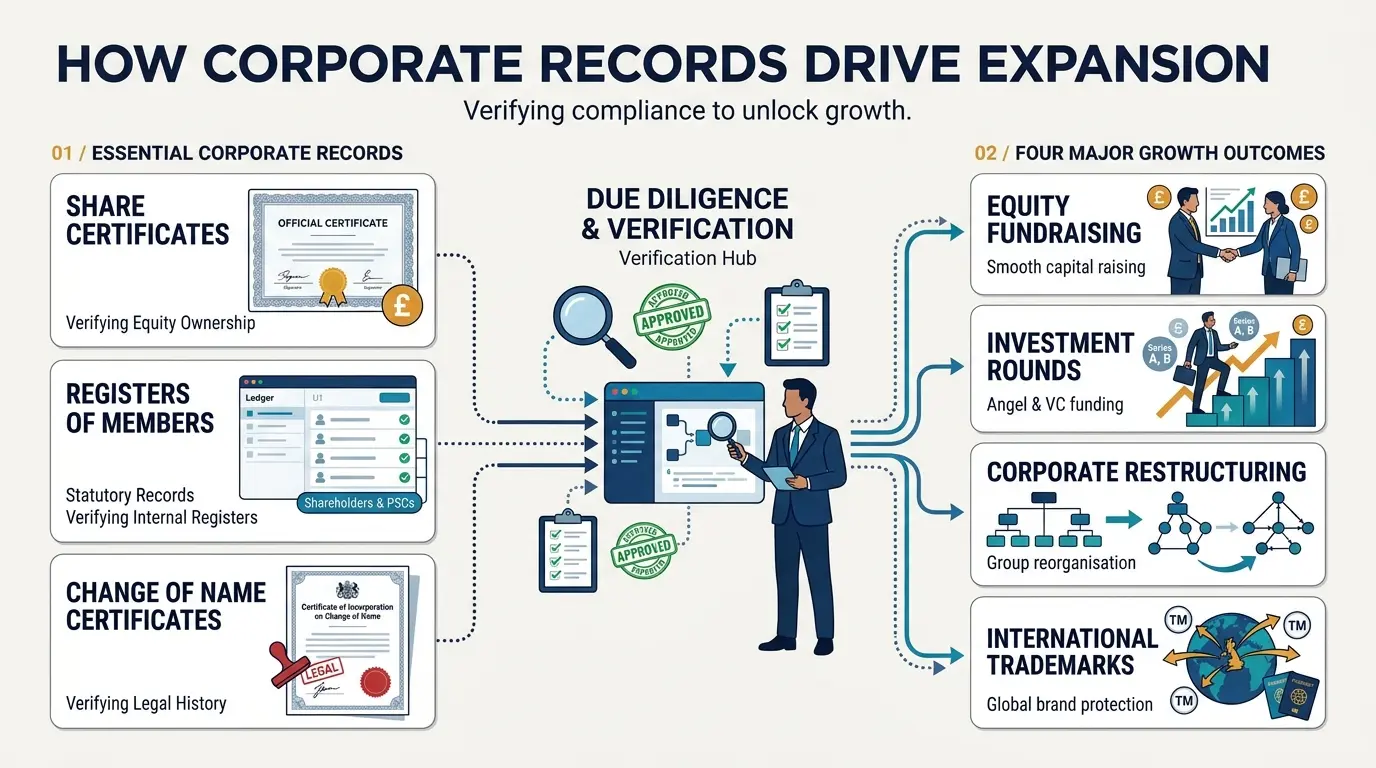
Early-stage growth requires robust administrative foundations. Investors conducting legal due diligence inspect physical share certificates and statutory registers before transferring capital. Banks require official verification when a firm changes its legal trading name during corporate rebranding initiatives.
Specific administrative documents solve distinct operational challenges:
Issue physical Share Certificates to substantiate equity transfers and shareholder rights
Maintain Statutory Register Books to comply with UK corporate record-keeping laws
Produce Official Change of Name Certificates to update banking and supplier records
Generate Registers of People with Significant Control to satisfy transparency mandates
Failing to maintain updated statutory records creates legal liabilities during corporate audits. Inaccurate shareholder registries block share issuances and delay venture capital injections. Maintaining complete supplementary documentation ensures ongoing compliance with UK corporate law standards.
Selecting the right administrative bundle accelerates institutional onboarding while reducing filing fees. Businesses can Choose the Right Supplementary Documents Package at Form My Company to secure all necessary statutory certificates in a single managed service order.
How to Order Supplementary Documents Efficiently?
Ordering supplementary documents efficiently involves selecting registered corporate service providers who deal directly with Companies House and accredited legal certifiers. Professional providers manage document retrieval, solicitor certification, Apostille legalization, and rapid physical delivery through streamlined corporate filing portals.
Manual document procurement creates administrative delays and risks formatting errors. Direct applications to public registries often require lengthy processing times. Experienced corporate service platforms expedite requests by utilizing direct digital channels and established legal certification networks.
The document procurement workflow follows a structured administrative sequence:
Identify specific document requirements based on institutional requests or banking demands
Select required certification levels including standard, solicitor-certified, or Apostille legalizations
Submit accurate company identification details through secure digital ordering platforms
Receive fully authenticated physical and digital document packages delivered directly to offices
Professional preparation guarantees complete compliance with legal standards. Certified documents arrive correctly formatted, signed, and stamped for immediate submission to financial institutions, courts, or international trade registries.
Ordering comprehensive supplementary document packages during early business setup guarantees uninterrupted commercial operations. Establishing verifiable corporate standing positions new UK companies for rapid scaling, seamless banking access, and long-term regulatory compliance.
Explore More Supplementary Company Documents Guide,
Why Do Accountants Ask for Your Company Formation Documents?
What Documents Prove Who Owns and Runs a UK Company?
Frequently Asked Questions
What are supplementary company documents for a UK business?
Supplementary company documents are official administrative certificates and legally verified corporate filings issued alongside or after initial business registration. Services provided by Form My Company allow businesses to obtain essential supplementary company documents like Certificates of Good Standing, Certificates of Incumbency, and certified incorporation copies to prove ongoing legal standing to financial institutions and regulatory bodies.
Why do banks require supplementary company documents from a new business?
Financial institutions demand supplementary company documents to complete statutory Anti-Money Laundering (AML) checks and verify corporate authority before opening business bank accounts. Obtaining these certified corporate filings through Form My Company confirms active registration status, validates director identities, and prevents fraud during high-value financial onboarding.
How quickly can a business obtain a Certificate of Good Standing?
A Certificate of Good Standing can be ordered and issued electronically through Companies House within 24 to 48 hours depending on the chosen processing speed. Form My Company manages the retrieval, verification, and legal certification process so businesses can receive physical and digital copies promptly for urgent transactions.
What is the difference between a Certificate of Incorporation and a Certificate of Incumbency?
A Certificate of Incorporation serves as legal proof that a business entity was officially created under UK law on a specific date. In contrast, a Certificate of Incumbency details the current management structure, confirming the active list of directors, shareholders, and authorized signatories at any given time.
When does a company need Apostille legalization for supplementary documents?
Apostille legalization is required whenever UK supplementary company documents must be presented to foreign governments, overseas registries, or international financial institutions. Form My Company facilitates this legal authentication process under the Hague Convention to ensure document validity across foreign legal jurisdictions.