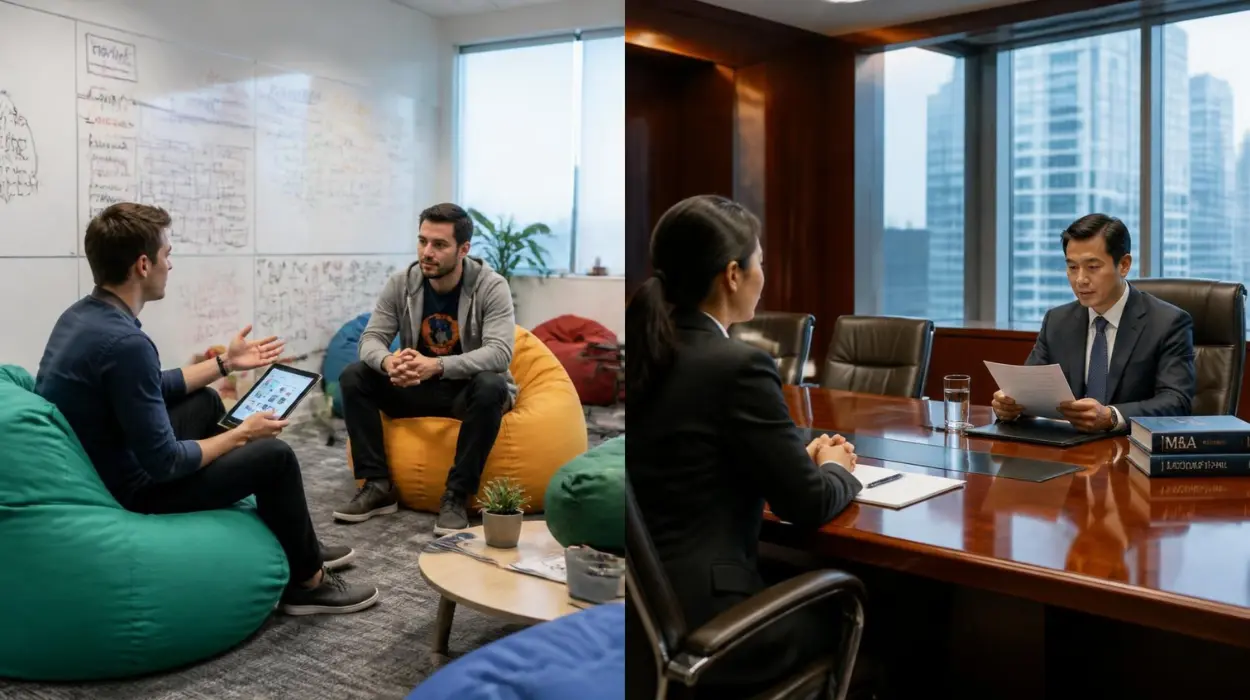
Industry-specific hiring requires a tailored interview space because regulated sectors demand strict confidentiality, secure document handling, and controlled physical environments. Standard offices fail to meet legal compliance standards, risk data breaches, and compromise the integrity of high-stakes professional candidate evaluations.
Regulated sectors operate under strict legal frameworks. Financial institutions, legal practices, and healthcare providers handle sensitive candidate data during recruitment. Standard meeting rooms often lack acoustic isolation and digital security controls. Interviews in open workspaces expose confidential career histories and proprietary assessment criteria. Professional recruitment demands dedicated environments designed for regulatory compliance and absolute privacy.
Candidate evaluation in specialized markets involves deep skill assessments. Panel members review physical certifications, compliance certificates, and secure portfolios. General office spaces lack the secure surfaces and technological infrastructure required for document verification. Specialized interview venues provide isolated networks, secure printing stations, and locked storage. These features protect sensitive candidate information from unauthorized viewing.
Compliance protocols govern every stage of regulated employment processes. Employers must document background checks and identity verifications on site. A tailored venue supports these operational necessities through integrated administrative zones. Interviewers execute compliance checks without disrupting the evaluation flow. Structured physical layouts reduce administrative friction during complex hiring cycles.
Professional impressions influence top-tier talent acquisition in competitive industries. Specialized executives expect discrete, high-end environments that reflect organizational prestige. Generic co-working spaces signal a lack of operational maturity to senior candidates. Premium interview locations elevate brand perception and reinforce corporate credibility. First impressions directly impact acceptance rates among sought-after professionals.
How Do Regulated Sectors Protect Candidate Data During Interviews?
Regulated sectors protect candidate data during interviews by enforcing strict access controls, utilizing encrypted digital networks, and maintaining isolated physical spaces. These security measures prevent unauthorized data exposure and ensure compliance with strict regulatory data protection frameworks.
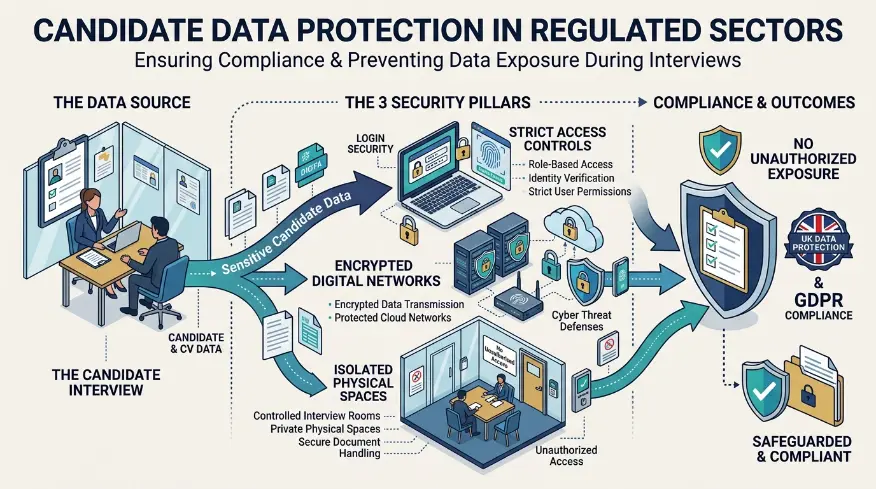
Data protection laws impose severe penalties on unauthorized disclosures. Recruitment teams handle criminal record checks, financial history reports, and medical disclosures. Standard meeting spaces leave physical documents exposed on conference tables. Tailored interview spaces eliminate these vulnerabilities through secure document disposal bins and encrypted local networks. Administrators restrict Wi-Fi access to prevent external data interception.
Physical security protocols begin at the building entrance. Security personnel verify visitor identities before granting access to interview floors. Candidate credentials remain logged in secure digital visitor management systems. Dedicated interview suites feature soundproofed walls and frosted glass panels. These architectural choices prevent acoustic leakage and visual espionage in corporate hubs.
Digital asset management requires dedicated hardware configurations. Interview panels access candidate files through secure terminal stations rather than personal devices. IT departments configure these stations with restricted USB ports and disabled printing capabilities. Data retention policies dictate the immediate purging of local files post-interview.
Internal protocols demand strict adherence from all participating staff members. HR coordinators complete mandatory data handling training prior to managing regulated recruitment cycles. Audit logs track every physical entry and digital file access event. These meticulous records satisfy regulatory inspections without compromising individual privacy rights.
What Environmental Factors Dictate Professional Interview Spaces?
Environmental factors dictating professional interview spaces include precise acoustic isolation, ergonomic furniture arrangements, and climate control systems. These physical elements reduce candidate anxiety, maintain focus during lengthy evaluations, and ensure optimal conditions for high-stakes professional assessments.
Acoustic privacy remains a primary consideration for corporate recruitment suites. Sound transmission class ratings above 50 prevent outside noise interference. Candidates speak freely about confidential employment history without fear of eavesdropping. Interviewers capture precise qualitative data without audio distractions. Acoustic panels absorb reverberation in compact rooms.
Ergonomic design directly influences cognitive performance during evaluations. Chairs feature adjustable lumbar support for extended panel sessions lasting three hours or longer. Table dimensions accommodate multiple interviewers and document layouts simultaneously. Proper spatial distribution prevents physical fatigue among participants. Lighting systems utilize dimmable LED arrays to reduce eye strain during digital assessments.
Climate control systems maintain consistent ambient temperatures across all interview rooms. Automated thermostats regulate airflow to prevent stuffiness in enclosed spaces. Fresh air filtration units eliminate stale odors and airborne allergens. Stable thermal conditions keep both candidates and interviewers comfortable throughout rigorous questioning.
Visual aesthetics communicate corporate stability and professional standards. Neutral color palettes promote calmness during high-stress interview scenarios. Minimalist interior designs eliminate visual clutter and distractions. High-quality finishes project authority and competence to prospective employees.
How Does Infrastructure Impact Compliance in Specialized Recruitment?
Infrastructure impacts compliance in specialized recruitment by providing dedicated power grids, certified secure communication channels, and segregated entry points. These structural capabilities ensure that hiring procedures meet legal standards set by regulatory authorities.
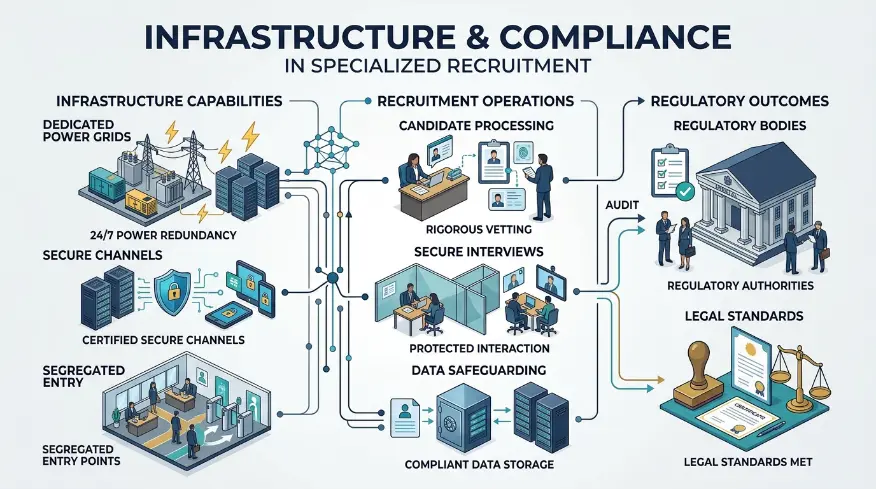
Regulatory authorities mandate verifiable audit trails for regulated hiring processes. Specialized interview infrastructure includes closed-circuit monitoring in approved common areas. Facilities feature isolated power supplies to prevent data loss during digital skill tests. Uninterruptible power supply units protect live recruitment broadcasts and remote panel link-ups.
Communication infrastructure must resist interception and cyber threats. Interview venues utilize dedicated fiber-optic lines for video assessments. Encrypted software prevents third-party eavesdropping during remote executive interviews. IT teams monitor network traffic continuously during active recruitment sessions.
Segregated entry and exit routes protect the anonymity of high-profile candidates. Public transit intersections often compromise candidate discretion in competitive markets. Private underground parking facilities allow direct, unobserved access to interview suites. Separate corridors guide candidates away from general office populations.
Regulatory inspections require proof of facility compliance upon demand. Venue managers maintain updated building safety certifications and privacy compliance logs. Facilities pass rigorous annual reviews conducted by independent auditing bodies. These administrative safeguards guarantee uninterrupted compliance for hiring organizations.
What Makes Dedicated Interview Rooms Essential for Executive Hiring?
Dedicated interview rooms are essential for executive hiring because they provide absolute privacy, facilitate complex panel configurations, and support seamless multi-stage evaluations. These specialized environments accommodate senior leadership requirements that standard office meeting rooms simply cannot support.
Executive searches involve delicate negotiations and sensitive compensation discussions. Standard meeting rooms in corporate offices frequently lack adequate sound masking. Dedicated interview rooms feature advanced acoustic barriers that protect confidential discussions. Senior candidates demand total discretion when exploring new career opportunities.
Panel structures for executive roles typically include six to eight participants. Standard rooms create spatial crowding during large multi-person evaluations. Tailored interview spaces offer expansive layouts with circular or modular table designs. This spatial arrangement fosters balanced communication among all board members and candidates.
Multi-stage evaluations require persistent setup across multiple days. Dedicated spaces allow recruitment teams to leave assessment materials securely in place. There is no need to disassemble and rebuild testing environments between candidate sessions. Operational continuity accelerates complex executive search timelines significantly.
Organizations seeking optimized environments can Book Professional Interview Rooms designed specifically for high-stakes corporate recruitment. Utilizing purpose-built spaces ensures that leadership evaluations occur in secure, compliant, and professional surroundings.
Industry-specific recruitment demands rigorous adherence to compliance, absolute data privacy, and optimized physical environments. Standard corporate offices introduce unacceptable risks of data breaches and acoustic leakage. Tailored interview spaces resolve these vulnerabilities through advanced infrastructure and strict access controls.
Organizations navigating complex regulatory landscapes must prioritize secure physical settings for candidate evaluations. Form My Company delivers specialized solutions that align with strict legal and operational frameworks. Professional recruitment outcomes improve when supported by purpose-built facilities.
Explore our Interview Rooms guide,
What Is a Paperless Conference and Why Does It Matter?
What Information Should Appear on a Company Stamp?
Frequently Asked Questions
How do interview rooms ensure data security during candidate assessments?
Interview rooms ensure data security through strict physical access controls, soundproof architectural designs, and secure local networks. Form My Company equips these specialized spaces with private infrastructure to protect confidential applicant profiles and sensitive hiring records from unauthorized exposure.
Why do regulated industries require specialized interview spaces?
Regulated industries require specialized interview spaces to comply with strict legal frameworks governing data protection and professional confidentiality. Standard open offices expose sensitive candidate history, whereas dedicated facilities ensure absolute privacy and verifiable compliance audit trails.
What features make interview rooms suitable for executive hiring?
Executive hiring requires interview rooms featuring expansive table configurations, high-end acoustic insulation, and secure multi-day assessment setups. These specialized environments accommodate large evaluation panels while projecting corporate prestige and absolute discretion.
How do physical environmental factors impact recruitment success?
Physical environmental factors like ergonomic seating, precise climate control, and high STC acoustic ratings reduce candidate stress and maintain evaluation focus. Form My Company provides optimized consultation spaces that foster productive, high-stakes professional dialogue without external distractions.
Can companies book dedicated interview rooms for short-term recruitment drives?
Companies can book dedicated interview rooms on flexible terms to support high-volume hiring drives or confidential executive searches. Utilizing purpose-built spaces through Form My Company guarantees fully equipped, professional environments without long-term commercial lease commitments.