
Global founders choose UK companies over offshore jurisdictions for stronger banking access, clearer tax exposure, and higher commercial credibility, delivering reliable corporate transparency, established legal frameworks, and easier access to regulated UK payment and banking providers.
Why do founders prefer UK companies for banking access?
Founders prefer UK companies because UK incorporation gives direct access to UK-regulated banks and payment providers, avoiding the onboarding barriers common with many offshore registries.
UK banks and payment processors apply strict Know Your Customer (KYC) and anti-money-laundering (AML) rules. A UK-registered company presents local incorporation documents, Companies House records, and verified director data. These records reduce manual verification time and lower the likelihood of account rejection. UK banking access also supports multicurrency accounts, Faster Payments, and access to SWIFT corridors used by 90% of international banks.
Read our articles, UK vs Offshore: Tax Exposure, Credibility, and Banking Access Compared and Launch a UK Company That Banks, Scales, and Stays Compliant.
How does tax exposure compare between UK and offshore firms?
UK companies have transparent tax obligations: corporation tax, VAT where applicable, and PAYE for employees; offshore entities often shift taxable presence but attract scrutiny and economic substance requirements.
A UK company pays the UK corporation tax rate on UK profits and registers VAT when turnover exceeds £85,000. Directors who are UK tax residents trigger personal tax and National Insurance reporting. Offshore jurisdictions sometimes offer lower headline tax rates. Tax authorities worldwide now apply substance and controlled foreign company (CFC) rules. For example, the OECD’s Pillar Two rules set a 15% minimum tax for large multinationals, increasing reporting obligations for cross-border structures.
Do UK companies offer stronger commercial credibility than offshore entities?
Yes. UK incorporation boosts credibility with investors, partners, and customers because Companies House records, annual filings, and regulated director data enable independent verification.
Investors use corporate filings to validate ownership and director history. Procurement teams often require suppliers to demonstrate financial transparency and regulatory compliance. UK corporate governance standards and mandatory filings reduce perceived fraud risk. For example, venture capital funds and corporate buyers frequently prefer suppliers incorporated in established jurisdictions for easier due diligence and contract enforcement.
Will UK incorporation reduce banking rejections and delays?
Yes. UK registration reduces account rejections and onboarding delays by providing verifiable records, local address proof, and clear director documentation valued by UK banks.
Banks reject applications when the source of funds or ownership cannot be verified. A UK-registered company supplies Companies House entries, certified incorporation documents, and UK service addresses. These materials map directly to banks’ internal KYC checklists. As a result, onboarding timelines shorten from months to weeks in many cases. UK incorporation also facilitates relationship management with account managers in UK branches.
How does compliance differ between UK and offshore setups?
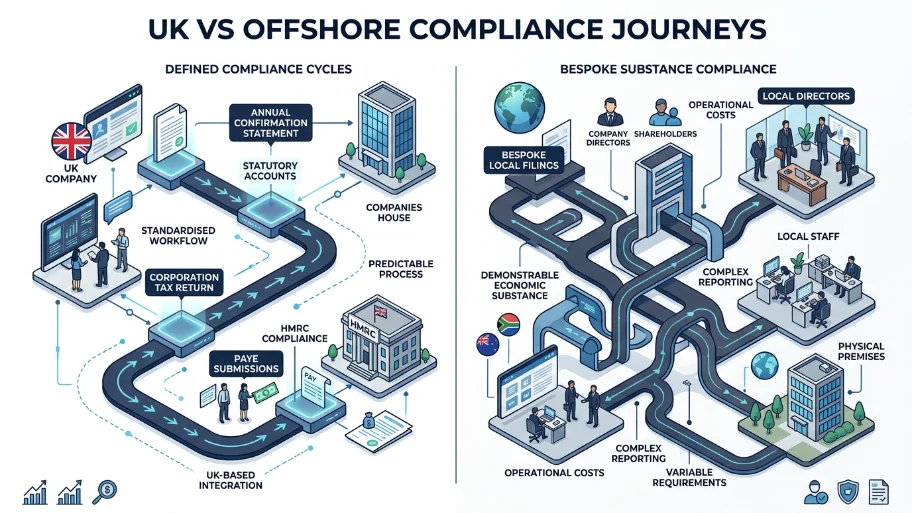
UK companies follow defined compliance cycles: annual confirmation statements, statutory accounts, corporation tax returns, and PAYE submissions; offshore setups often require bespoke substance compliance and local filings.
UK compliance tasks include filing a confirmation statement annually, submitting statutory accounts to Companies House, and filing corporation tax returns to HMRC. UK compliance is centralised and standardised. Offshore jurisdictions often demand demonstrable economic substance, such as local directors, local staff, or physical premises. These substance requirements create operational costs and complex reporting. UK obligations are predictable and easier to integrate into UK-based corporate service providers’ workflows.
What are the cost trade-offs of choosing the UK?
UK incorporation has higher direct costs for tax and governance but lowers indirect costs from banking friction, failed partnerships, and investor scepticism.
Corporate service fees for a UK company include registered office, annual accounts preparation, and tax filings. Tax rates and employer contributions represent ongoing costs. However, reduced time to open bank accounts and smoother supplier and investor acceptance lower opportunity costs. For international founders targeting UK markets, the incremental operational cost often outweighs the savings from offshore tax rates.
How does a UK company support fundraising and exit planning?
UK companies simplify fundraising and exit planning by providing transparent ownership records, recognised governance structures, and easier legal enforceability in UK courts.
Investors require cap tables, shareholder agreements, and legal opinions. UK filings at Companies House establish share classes and director appointments. These items support valuation, escrow arrangements, and due diligence processes. Exit events such as trade sales or IPOs benefit from jurisdictional certainty; buyers often prefer clear corporate histories. A UK structure speeds legal closure and reduces negotiation friction during acquisitions.
Are there specific business types that gain most from UK incorporation?
Product-based exporters, fintech firms, and digital platforms gain the most because they need bank accounts, payment rails, and market credibility in the UK and EU.
Exporters use UK bank accounts for multicurrency settlements and GBP revenue collection. Fintech firms require access to regulated payment and custody providers. Digital platforms seeking UK customers use local incorporation to meet platform policies and payment provider rules. Service companies that do not engage with UK banking or clients may still choose offshore options, but the commercial benefits of a UK company remain strong for cross-border trading.
How does choosing a UK company affect regulatory relationships?
A UK company creates direct regulatory lines with HMRC and Companies House, enabling clearer dispute resolution and faster compliance responses.
Regulators operate on public registers and defined timelines. Companies House updates reduce ambiguity about ownership and control. HMRC issues clear tax notices and penalties that align with published rules. These formal relationships provide predictable enforcement outcomes and simplify remedial actions, such as voluntary disclosure to rectify prior reporting errors.
What operational steps do founders follow to incorporate and bank in the UK?
Founders incorporate with Companies House, appoint directors, register for corporation tax and VAT if applicable, obtain certified incorporation documents, and present these to banks with identity verification.
Founders register digitally with Companies House and obtain a certificate of incorporation. They submit a company tax registration to HMRC within three months of starting business activity. Banks require certified copies of the certificate, a board resolution for signatories, and verified ID documents for directors and beneficial owners. Using local corporate services accelerates document certification and address verification.
UK incorporation gives founders measurable advantages in banking access, tax clarity, and commercial credibility. UK corporate records, standardised compliance, and regulatory certainty reduce onboarding friction for banks and partners. For founders targeting UK customers, UK incorporation delivers practical benefits that often exceed offshore tax savings.
From My Company helps founders register, maintain, and operate compliant UK entities through Company Services. Our processes validate director credentials, prepare statutory filings, and support bank onboarding to reduce delays and improve acceptance rates.
Frequently Asked Questions
What is Company Services, and how does it help founders register a UK company?
Company Services from From My Company guides founders through UK company registration, including director appointments, registered office setup, and Companies House filing. The service validates director credentials and prepares statutory documents to ensure compliant incorporation.
How quickly can I register a UK company using Company Services?
Company Services typically processes UK company registration within 24–48 hours after receiving verified director documents and address proof. From My Company streamlines certification and submission to Companies House to accelerate onboarding.
What documents do I need to register a UK company with Company Services?
You need government-issued ID for each director, proof of residential address, and details of share structure when using Company Services. From My Company verifies identity using passport checks, biometric scans, and address validation to meet UK compliance frameworks.
Does Company Services include ongoing compliance support for UK companies?
Yes, Company Services includes annual confirmation statements, statutory accounts preparation, and corporation tax filing support for UK companies. From My Company maintains compliance calendars and submits filings to Companies House and HMRC on schedule.
Can international founders use Company Services to register a UK company remotely?
International founders can register a UK company remotely using Company Services, which handles digital submission, certified document collection, and remote director verification. From My Company provides a UK registered office and service address to satisfy incorporation requirements without physical presence.