
Finding a reliable service that provides annual company secretarial compliance and filing support helps UK limited companies maintain accurate records, meet statutory deadlines and manage their ongoing responsibilities. Form My Company provides company secretarial support for businesses that need assistance with Companies House filings, statutory records and corporate administration.
Annual company secretarial compliance involves more than submitting documents once a year. Directors must ensure that company information remains accurate, statutory records are maintained, annual accounts are filed and relevant tax obligations are addressed. Some responsibilities arise annually, while others must be handled whenever a company experiences a change.
This guide provides a practical annual company secretarial compliance checklist, explains the main filing deadlines and explores how professional company secretarial services can help businesses manage their obligations.
What Does Annual Company Secretarial Compliance Involve?
Annual company secretarial compliance refers to the administrative and statutory responsibilities that UK companies must manage to maintain accurate corporate records and meet their legal obligations. These responsibilities include filing confirmation statements, submitting annual accounts, maintaining director and shareholder information, reviewing people with significant control details and recording important company decisions.
The requirements are governed by the Companies Act 2006 and other applicable legislation. Companies House administers company registration and statutory filings, while HMRC manages Corporation Tax and other relevant tax obligations.
A company secretary can coordinate many of these activities, although private limited companies are not generally required to appoint a company secretary. Directors remain responsible for ensuring that the company meets its legal obligations.
For a broader understanding of these responsibilities, read our guide to company secretarial management and long-term UK regulatory compliance.
Annual Company Secretarial Compliance Checklist: 10 Essential Tasks
A structured checklist helps directors organise recurring responsibilities and identify changes that require action during the year. The following ten tasks provide a practical framework for annual compliance management.
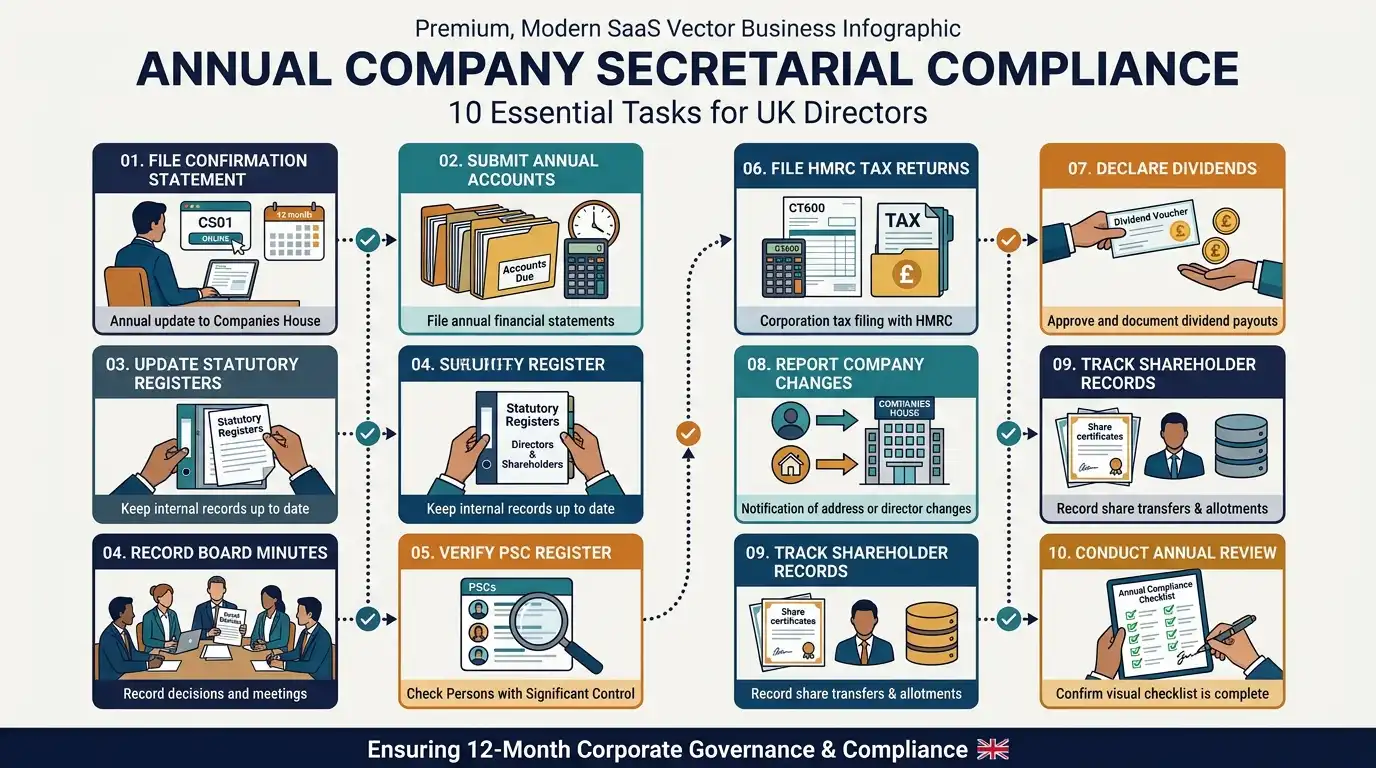
1. Review and File the Confirmation Statement
Every UK company must file a confirmation statement at least once every 12 months, including companies that are dormant or not trading.
The confirmation statement, submitted using form CS01, confirms that the information held by Companies House is accurate and up to date. Directors should review the registered office address, company officers, shareholders, statement of capital, SIC code and people with significant control information.
The filing deadline allows up to 14 days after the end of the review period. Companies should check their individual confirmation statement date and complete any necessary changes before submission.
2. Prepare and Submit Annual Accounts
UK companies must prepare annual accounts and submit them to Companies House, whether they are trading, dormant or actively generating revenue.
For most private limited companies, subsequent annual accounts must be delivered within nine months of the end of the financial year. First-year filing deadlines can differ depending on the incorporation date and accounting reference period.
The accounts must reflect the company’s financial position and comply with the applicable accounting framework. Micro-entities and small companies may qualify for simplified reporting arrangements, depending on their eligibility.
Directors should review and approve the accounts before submission and ensure that the correct filing format is used.
3. Review Corporation Tax Responsibilities
Companies must assess their Corporation Tax obligations in accordance with their accounting periods and HMRC requirements.
Where HMRC has issued a notice to deliver a Company Tax Return, the company must submit the return even if it has made a loss or has no Corporation Tax to pay.
The standard Company Tax Return filing deadline is 12 months after the end of the accounting period. Corporation Tax payment normally falls due nine months and one day after the accounting period ends for companies within the standard payment rules.
These are separate deadlines and should be recorded independently in the company’s compliance calendar.
4. Check Director Information and Appointments
Directors’ information should remain accurate throughout the year. Companies must report relevant appointments, resignations and changes to Companies House within the applicable statutory deadlines.
The annual review should check:
Current director appointments and resignations.
Director names and service addresses.
Changes to occupation or other reportable information.
Companies House identity verification requirements and personal codes.
Accuracy of the company’s internal director records.
New director appointments and resignations require the appropriate Companies House notifications. Changes should not be left until the annual confirmation statement.
5. Review People with Significant Control Information
Companies must identify and report their people with significant control, commonly known as PSCs, in accordance with the applicable requirements.
A PSC may be an individual or relevant legal entity that meets one or more statutory conditions, including holding more than 25% of shares or voting rights, or exercising significant influence or control.
Companies should review changes in ownership, voting rights and control arrangements. Relevant changes must be reported to Companies House within the required timeframe.
6. Maintain Shareholder and Share Capital Records
Companies with share capital should maintain accurate information about their shareholders, shareholdings and share transactions.
Annual compliance reviews should examine:
Changes in share ownership.
New share allotments.
Share transfers.
Changes to share classes or rights.
Updates to the register of members.
Relevant shareholder resolutions.
Where new shares are allotted, the company must generally submit form SH01 to Companies House within one month of the allotment.
Accurate share records help maintain transparency and support future corporate transactions.
7. Review Articles of Association and Company Governance
The articles of association establish the internal governance rules of a company. They determine how directors exercise their powers, how shareholder decisions are made and how certain corporate procedures operate.
Companies should review whether their governance arrangements remain appropriate following changes in ownership, management or business activities.
Any proposed amendments must follow the applicable legal procedures, including the relevant shareholder resolutions and Companies House notifications.
Our guide to Articles of Association and their importance for UK companies explains how these documents support corporate governance.
8. Maintain Board Meeting Minutes and Statutory Records
Companies should maintain accurate records of important corporate decisions, board proceedings and shareholder resolutions.
Section 248 of the Companies Act 2006 requires companies to record the proceedings of directors’ meetings and retain those minutes for at least ten years.
The annual compliance review should confirm that relevant records are complete, accessible and securely maintained.
These records may include board meeting minutes, shareholder resolutions, director information, member records and other statutory documentation.
For further guidance, read our article on board meeting and minute-taking requirements for UK companies.
9. Check Registered Office and Company Contact Details
A company’s registered office is its official address for receiving statutory correspondence and communications from Companies House and other relevant authorities.
Directors should verify that the registered office address remains suitable and that official correspondence is received and handled promptly.
Companies must also keep their registered email address and other reportable company information accurate. Relevant changes should be notified through the appropriate Companies House procedures.
Maintaining reliable contact arrangements helps prevent missed notices, filing reminders and important regulatory communications.
10. Review Employment, VAT and Other Business Compliance
Company secretarial compliance should be considered alongside other business responsibilities that affect the company’s legal and administrative position.
Depending on its activities, a company may need to review:
PAYE registration and payroll reporting.
VAT registration and returns.
Employment records and workplace obligations.
Data protection responsibilities.
Business licences and relevant regulatory requirements.
Accounting records and financial reporting arrangements.
Not every company has the same obligations. Directors should identify which requirements apply to their business and maintain separate deadlines for each.
What Are the Key Annual Company Filing Deadlines?
Understanding filing deadlines is essential for effective company secretarial management. Companies House and HMRC operate separate reporting systems, and their deadlines should not be confused.
| Compliance requirement | Standard deadline |
|---|---|
| Confirmation statement | At least once every 12 months, with up to 14 days after the review period to file |
| Annual accounts for a private company | 9 months after the financial year-end |
| Corporation Tax payment | Usually 9 months and 1 day after the accounting period |
| Company Tax Return | 12 months after the accounting period |
| SH01 share allotment notification | Within 1 month of allotment |
| Director appointment or resignation notification | Generally within 14 days of the relevant change |
| Board meeting minutes | Retain for at least 10 years |
First-year accounts, changes to accounting reference periods and certain company circumstances can affect normal filing deadlines. Companies should check their individual Companies House and HMRC records.
Why Is a Compliance Calendar Important?
A compliance calendar provides a central record of filing dates, internal review periods and upcoming administrative responsibilities.
Companies should record the confirmation statement date, annual accounts deadline, Corporation Tax payment date and Company Tax Return deadline separately.
It is also useful to include reminders for director changes, PSC updates, share allotments and other reportable events.
An organised calendar gives directors sufficient time to review documents, correct discrepancies and arrange professional assistance before deadlines approach.
What Happens If a Company Misses Its Filing Deadlines?
Missing statutory filing deadlines can expose companies and their directors to financial and legal consequences.
Late Annual Accounts Penalties
Companies House applies automatic late filing penalties when annual accounts are delivered after the deadline.
For private limited companies, the standard penalties are:
| Delay | Penalty |
|---|---|
| Up to 1 month | £150 |
| More than 1 month up to 3 months | £375 |
| More than 3 months up to 6 months | £750 |
| More than 6 months | £1,500 |
These penalties apply to late accounts, not as a universal penalty scale for every company secretarial filing. The penalty doubles if accounts are filed late in two successive financial years.
Confirmation Statement Non-Compliance
Failure to file a confirmation statement can result in enforcement action, financial penalties and potential company strike-off proceedings.
Companies should not assume that no changes during the year remove the filing requirement. A confirmation statement is still required even when company information remains unchanged.
Corporation Tax Filing and Payment Consequences
HMRC may impose penalties for late Company Tax Returns, even where the company has no Corporation Tax to pay.
Late payment can also result in interest and other charges. Companies should distinguish between submitting the tax return and paying the amount due.
Risks to Directors and Business Operations
Poor compliance management can affect a company’s legal standing, commercial reputation and ability to complete important transactions.
Directors may face additional consequences where statutory responsibilities are repeatedly neglected or where misconduct is involved.
Read our guide to the risks of poor company secretarial management for UK limited companies to understand how administrative failures can affect business operations.
How Can Professional Company Secretarial Services Help?
Professional company secretarial services help businesses coordinate statutory filings, maintain corporate records and manage recurring administrative responsibilities.
Instead of handling every filing independently, directors can use an experienced provider to organise compliance activities and receive support with the relevant documentation.
Managing Annual Companies House Filings
A professional service can help prepare and submit confirmation statements and annual accounts within the applicable deadlines.
It can also help identify discrepancies in company information before documents are submitted, reducing the risk of avoidable administrative errors.
Maintaining Statutory Records
Professional company secretarial support can assist with maintaining director, shareholder and other company records.
This includes coordinating relevant changes, organising corporate documentation and maintaining accurate records of important company decisions.
Supporting Director and Shareholder Changes
Changes in company management and ownership can create additional filing requirements.
A company secretarial provider can assist with director appointments, resignations, share allotments, shareholder information and relevant Companies House notifications.
Organising Corporate Governance
Professional support can help businesses maintain consistent governance procedures, coordinate board documentation and manage corporate records.
Our guide to the role of a company secretary in maintaining corporate governance and transparency explains how effective administration supports accountability.
Supporting Growing Businesses
As a company expands, its administrative and reporting requirements can become more complex. Additional directors, shareholders, employees and commercial activities can increase the amount of information that needs to be maintained.
Our article on why growing startups need professional company secretarial support explores how outsourced assistance can support business development and ongoing compliance.
How to Choose a Company Secretarial Compliance Service
Choosing the right provider involves understanding which responsibilities it handles and whether its services match the company’s requirements.
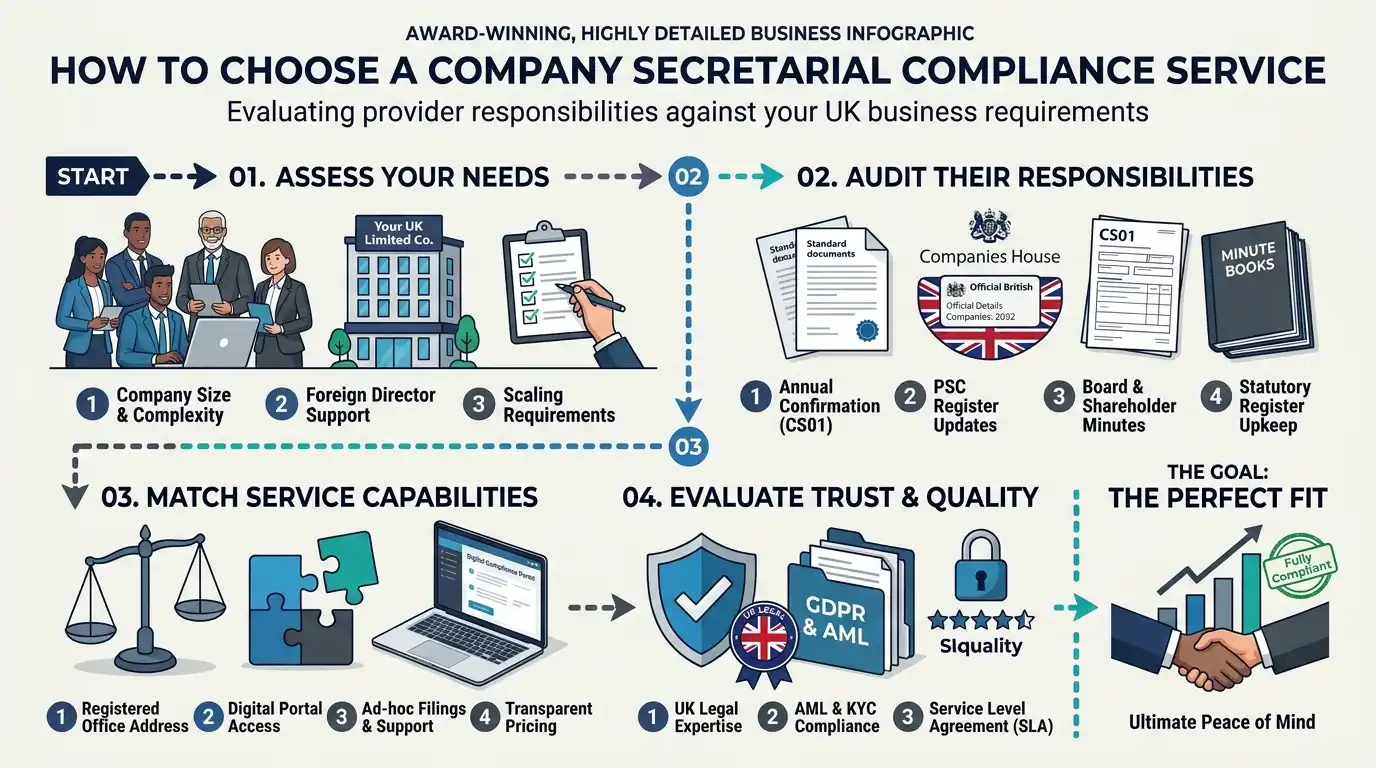
Before engaging a provider, consider the following factors.
Scope of Annual Compliance Services
Check whether the service covers confirmation statements, annual accounts coordination, statutory record maintenance and other relevant company secretarial tasks.
Corporation Tax returns, VAT returns and payroll may be separate services, so confirm exactly what is included.
Companies House Filing Support
A suitable provider should understand the applicable Companies House filing requirements and be able to assist with relevant submissions.
Ask how the provider handles document reviews, filing deadlines, company information changes and submission confirmations.
Record Management and Communication
Reliable record management is important for maintaining accurate corporate information.
Check how the provider stores documents, communicates upcoming deadlines and handles requests for updated company information.
Experience and Ongoing Support
Consider whether the provider offers continuing support rather than only assisting with individual filings.
A consistent working relationship can help businesses manage recurring responsibilities and respond to changes throughout the year.
Annual Company Secretarial Compliance Service from Form My Company
Form My Company provides company secretarial services for UK businesses that need assistance with corporate administration and statutory compliance.
The service is designed to support companies with important administrative responsibilities, helping directors manage filing requirements and maintain appropriate company records.
Businesses looking for professional assistance can explore the Form My Company Company Secretarial Service to review the available support.
Before selecting a service, confirm the exact scope of work, included filings, document requirements and applicable fees to ensure the package meets your company’s needs.
Frequently Asked Questions
What is annual company secretarial compliance?
Annual company secretarial compliance involves managing recurring company administration and statutory responsibilities, including confirmation statements, annual accounts, corporate records and relevant Companies House updates. Other obligations, such as Corporation Tax returns, should also be coordinated where applicable.
Where can I find a service that provides annual secretarial compliance and filing?
Form My Company provides a Company Secretarial Service for UK businesses requiring assistance with corporate administration and statutory compliance. Visit the Company Secretarial Service page to review the available support and service details.
How often must a UK limited company file a confirmation statement?
A UK limited company must file at least one confirmation statement every 12 months. It can generally be submitted up to 14 days after the end of the review period. This requirement also applies to dormant and non-trading companies.
When must a private limited company submit its annual accounts?
Most private limited companies must submit their annual accounts within nine months of their financial year-end. Different deadlines can apply to first accounts and companies that change their accounting reference period.
Is Corporation Tax included in annual company secretarial compliance?
Corporation Tax is a separate tax responsibility rather than a Companies House company secretarial filing. Companies that receive a notice to deliver a Company Tax Return must submit it to HMRC within the applicable deadline. Professional providers may offer tax support separately or as part of a wider package.
Do dormant companies need annual company secretarial compliance?
Yes. Dormant companies must still meet applicable Companies House obligations, including filing annual accounts and a confirmation statement. Their reporting requirements may be simplified, but dormant status does not remove the need for statutory filings.
Can a company outsource annual secretarial filings?
Yes. A company can engage an external provider to assist with company secretarial administration and statutory filings. Directors remain responsible for ensuring that the company’s legal obligations are fulfilled, even when professional assistance is used.
What happens if a company fails to submit annual accounts?
Companies House automatically imposes late filing penalties when accounts are delivered after the applicable deadline. Persistent non-compliance can also result in enforcement action and potential strike-off proceedings.
Find Professional Annual Company Secretarial Compliance Support
Managing annual company secretarial compliance requires accurate records, organised filing procedures and consistent attention to statutory deadlines. From confirmation statements and annual accounts to director information and corporate governance documentation, every responsibility contributes to maintaining an accurate company record.
Form My Company supports UK businesses with company secretarial administration and compliance requirements. Explore the Company Secretarial Service to find out how professional support can help your business manage its ongoing filing responsibilities.