
Anyone considering becoming a company director in the UK must meet specific legal eligibility requirements under the Companies Act 2006 and related legislation. Understanding who can be a director of a company is essential before taking responsibility for managing a business, making corporate decisions and meeting statutory obligations. Generally, an individual must be at least 16 years old, must not be disqualified from acting as a director and must complete the required Companies House identity verification.
UK company law does not impose a maximum age limit or require directors to be UK residents. However, prospective directors must understand their responsibilities, maintain appropriate company records and comply with the rules governing their appointment and ongoing conduct.
This guide explains director eligibility, age requirements, legal restrictions, residency rules and how to become a director of a company in the UK. It also outlines the practical considerations individuals should review before accepting a directorship.
Who Can Be a Director of a Company?
An individual aged 16 or over can generally become a director of a UK limited company if they are legally eligible, are not subject to a restriction preventing the appointment and complete the required identity verification. There is no general requirement for directors to be UK citizens or residents. However, directors must understand and fulfil the legal responsibilities associated with the position.
The Companies Act 2006 establishes the minimum age requirement, while the Company Directors Disqualification Act 1986 sets out important restrictions on individuals who have been disqualified or are subject to certain insolvency restrictions.
The following table summarises the main eligibility considerations.
| Eligibility requirement | UK legal position |
|---|---|
| Minimum age | 16 years |
| Maximum age | No statutory upper age limit |
| Nationality | No general UK nationality requirement |
| Residency | UK residency is not compulsory |
| Disqualification | Disqualified individuals generally cannot act without court permission |
| Bankruptcy restrictions | Certain bankruptcy and debt relief restrictions prevent directorship without court permission |
| Identity verification | Mandatory Companies House identity verification |
| Mental capacity | The individual must be able to undertake the relevant decisions and responsibilities |
Eligibility is only the starting point. Becoming a director also means accepting responsibility for company management, financial oversight, statutory reporting and compliance.
Age Requirements for UK Company Directors
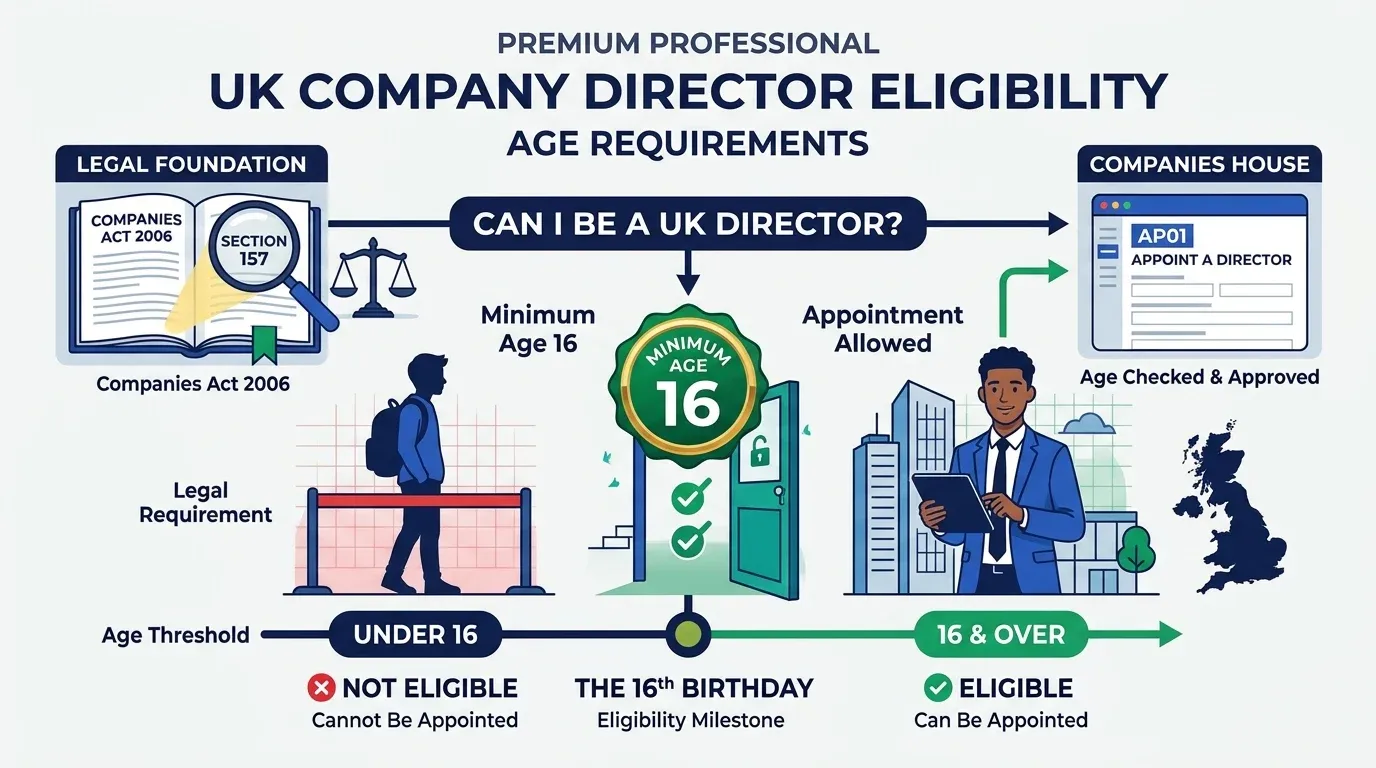
Age is one of the first legal requirements to consider when assessing director eligibility. Section 157 of the Companies Act 2006 establishes 16 as the minimum age for appointment as a company director.
What Is the Minimum Age to Become a Company Director?
An individual must have reached their 16th birthday before being appointed as a director of a UK company. An appointment made in breach of this requirement is generally void.
The minimum age applies to ordinary private and public limited companies. Companies should confirm the individual’s date of birth before proceeding with an appointment to ensure that the statutory requirement is satisfied.
Can a 16 or 17-Year-Old Become a Company Director?
Yes. Individuals aged 16 or 17 can legally become company directors in the UK. The law does not establish a separate maximum age for young directors once they have reached the statutory minimum.
However, appointing a younger director requires careful consideration of the responsibilities involved. Directors must understand their legal duties, make informed decisions and act in the company’s interests.
Businesses considering younger directors should assess their ability to undertake the role responsibly, particularly where financial decisions, contractual commitments and regulatory obligations are involved.
Is There a Maximum Age Limit for Company Directors?
No. UK company law does not establish a general maximum age for company directors.
An individual can continue serving as a director beyond retirement age provided they remain legally eligible and capable of fulfilling the responsibilities of the position.
Companies should assess directors based on their ability to perform their duties, decision-making capacity and contribution to effective governance rather than relying solely on chronological age.
What Disqualifies Someone from Becoming a UK Company Director?
Meeting the minimum age requirement does not automatically establish eligibility. Certain legal restrictions prevent individuals from becoming or continuing to act as company directors.
Company Director Disqualification Orders
An individual who has received a director disqualification order is generally prohibited from acting as a director during the restriction period.
Disqualification can result from serious misconduct, including allowing a company to continue trading when it cannot pay its debts, failing to maintain proper accounting records, misusing company assets or repeatedly neglecting statutory responsibilities.
Disqualification periods depend on the circumstances and can extend to 15 years.
Before accepting a directorship, individuals should check whether any current restrictions apply to them.
Bankruptcy and Debt Relief Restrictions
Certain insolvency restrictions can prevent an individual from acting as a company director without court permission.
These restrictions include:
Being an undischarged bankrupt.
Being subject to a bankruptcy restrictions order or undertaking.
Being subject to a debt relief restrictions order or undertaking.
Being subject to certain restrictions associated with a debt relief order.
The applicable restriction and its duration depend on the individual’s circumstances and the relevant insolvency legislation.
An individual who is subject to these restrictions should obtain appropriate legal advice before accepting a directorship.
Criminal Convictions and Company Misconduct
Certain criminal convictions and findings of unfit conduct can result in director disqualification.
The Insolvency Service investigates director misconduct and can pursue disqualification proceedings where the legal conditions are satisfied.
Prospective directors should understand that their previous involvement in a failed company does not automatically make them ineligible. The nature of the conduct, relevant court orders and any current restrictions determine whether they can legally become a director.
Do You Need to Live in the UK to Become a Company Director?
No. A person does not need to live in the UK to become a director of a UK limited company.
Overseas individuals can serve as directors, provided they meet the applicable eligibility and identity verification requirements. UK company law does not generally restrict directorship based on nationality or residential location.
However, companies must maintain a registered office address in the appropriate UK jurisdiction, and directors must provide the required service address for Companies House records.
Can a Non-UK Resident Become a UK Company Director?
Yes. Non-UK residents can become directors of UK limited companies without relocating to the country.
An overseas director must still provide the necessary personal information, complete Companies House identity verification and comply with the same statutory duties as other directors.
International business owners should also consider practical matters such as accessing company records, communicating with other directors, managing financial responsibilities and meeting UK tax or regulatory obligations where applicable.
What Address Must a UK Company Director Provide?
Directors must provide a service address for the public Companies House register. This is the address used for official correspondence and does not have to be their residential address.
A director’s usual residential address is collected separately and is generally protected from public disclosure, subject to legal exceptions.
The company’s registered office address is also a separate requirement. It is the official address used for communications with the company and must satisfy Companies House requirements.
What Identity Verification Is Required for Company Directors?
Identity verification is now a mandatory legal requirement for company directors under the Economic Crime and Corporate Transparency Act 2023 reforms.
Since 18 November 2025, new directors have been required to verify their identity when incorporating a company or joining an existing company.
How Does Companies House Identity Verification Work?
Directors can complete identity verification through GOV.UK One Login or an Authorised Corporate Service Provider, known as an ACSP.
Once verification is successful, the individual receives a unique Companies House personal code.
This personal code is used to confirm verified identity when undertaking relevant company registration and filing activities.
What Information Is Required?
The identity verification process requires information that allows Companies House or an authorised verification provider to establish that the individual is who they claim to be.
Depending on the verification route, individuals may need to provide:
Personal details, including their full name and date of birth.
An accepted identity document.
Information required for identity matching.
A Companies House personal code after successful verification.
The exact documents and verification steps depend on the chosen method.
Why Is Identity Verification Important?
Identity verification strengthens the reliability of the Companies House register and helps prevent fraudulent appointments.
It also ensures that directors can be linked to their verified identities across their company appointments.
Individuals should complete verification before taking up a new directorship and keep their personal code secure.
How to Become a Director of a Company in the UK
Understanding how to become a director of a company involves more than meeting the minimum age requirement. Individuals should understand the company’s structure, confirm their eligibility and ensure that they can fulfil the responsibilities associated with the position.
The following steps provide an overview.
Step 1: Understand the Director’s Responsibilities
Before accepting a directorship, review the company’s business activities, financial position, governance arrangements and existing obligations.
Directors have significant responsibilities under company law. They must act within their authority, exercise independent judgement and make decisions in the company’s interests.
Step 2: Check Your Legal Eligibility
Confirm that you are at least 16 years old and are not subject to a current director disqualification order or relevant insolvency restriction.
If any restrictions apply, obtain appropriate legal advice before proceeding.
Step 3: Understand the Company’s Articles of Association
The articles of association establish the company’s internal governance rules.
They explain how directors are appointed, how decisions are made and what procedures must be followed when changing the board.
Prospective directors should review these documents to understand the company’s governance arrangements and their position within the board.
Step 4: Complete Identity Verification
Complete the required Companies House identity verification process through an accepted route.
Obtain your Companies House personal code and ensure that it is available for the relevant appointment filing.
Step 5: Understand the Appointment Procedure
The company must follow the appointment procedures established by its articles of association and applicable company law.
These may involve a board decision, shareholder approval or another permitted appointment mechanism.
For a detailed explanation of the formal process, read our guide on how to appoint a director through Companies House.
Companies considering changes to their existing board can also consult our guide on how to add a director to a limited company.
Step 6: Understand the Required Company Records
Once appointed, directors must ensure that relevant company records and statutory information are maintained accurately.
This includes keeping appropriate details of directors, their appointments and any relevant changes up to date.
For further guidance, explore everything you need to know about director appointment forms and Companies House.
What Responsibilities Does a Company Director Accept?
Becoming a company director means accepting legal responsibilities that extend beyond making everyday business decisions.
The Companies Act 2006 establishes seven general duties that directors must observe.
Acting Within Company Powers
Directors must follow the company’s constitution and exercise their powers for their intended purposes.
They should understand the authority provided by the articles of association and avoid making decisions outside their permitted responsibilities.
Promoting the Success of the Company
Directors must act in the way they consider, in good faith, most likely to promote the company’s success for the benefit of its members as a whole, while having regard to the statutory factors.
This includes considering long-term consequences, employees, business relationships, environmental and community impacts, and the company’s reputation.
Exercising Independent Judgement
Directors must use their own judgement when making company decisions.
They should assess proposals carefully rather than automatically following another director’s instructions or external recommendations.
Exercising Reasonable Care, Skill and Diligence
Directors must demonstrate appropriate care and competence when managing company affairs.
The expected standard considers both the general knowledge and experience reasonably expected of someone performing the role and the director’s actual knowledge and experience.
Avoiding Conflicts of Interest
Directors must avoid situations in which personal interests conflict, or may conflict, with the interests of the company.
Where conflicts arise, they should be managed and authorised in accordance with applicable law and the company’s governing documents.
Not Accepting Benefits from Third Parties
Directors must not accept benefits from third parties because of their position or actions as directors where doing so would breach their statutory duties.
Declaring Interests in Proposed Transactions
Directors must declare relevant interests in proposed transactions or arrangements involving the company in accordance with the Companies Act 2006.
These duties apply regardless of whether a company has one director or several. Individuals should understand them before accepting an appointment.
Can a Corporate Entity Become a UK Company Director?
A company or other corporate entity cannot ordinarily be appointed as a director under the current general requirements for UK companies, which require directors to be natural persons.
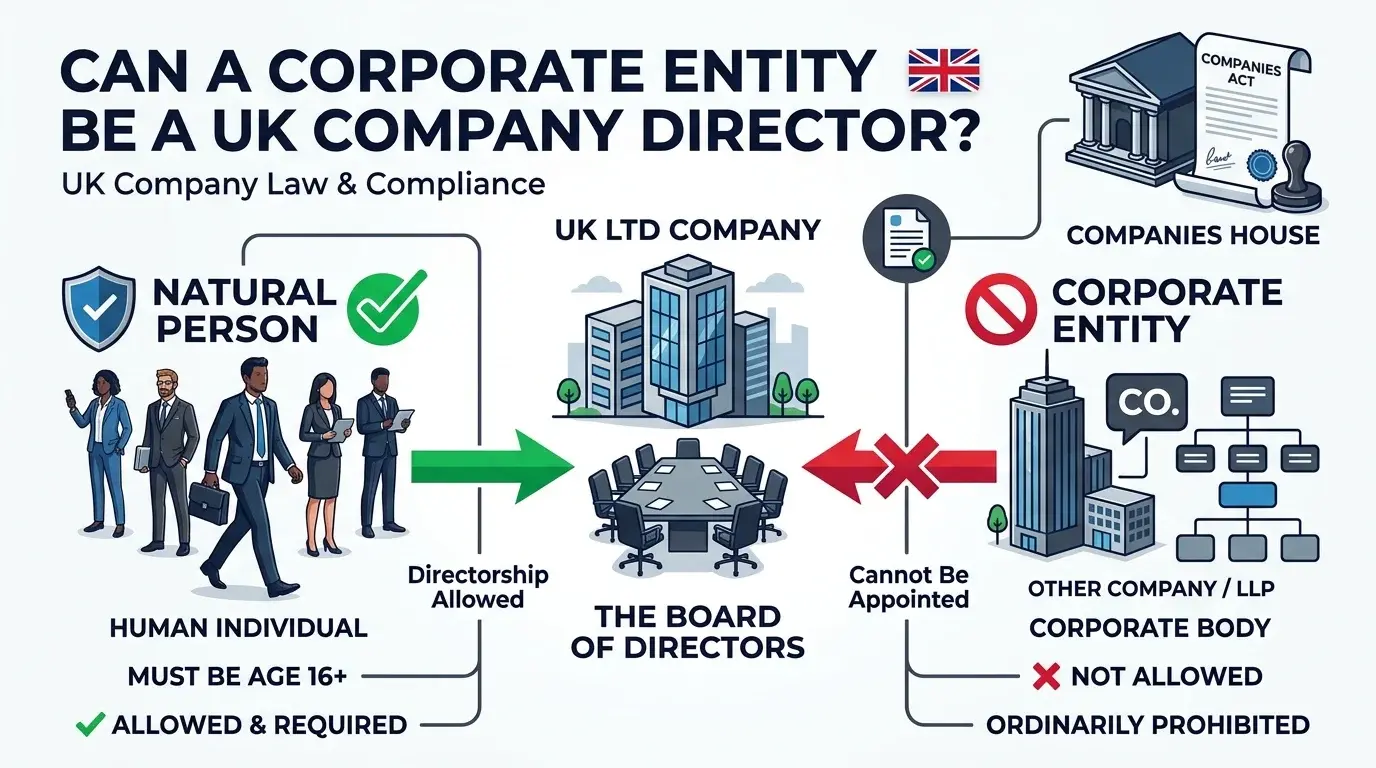
This distinction is important for business owners considering group structures, overseas entities and corporate ownership arrangements.
A corporate shareholder and a corporate director are different legal concepts. A company can own shares in another company without automatically becoming eligible to serve as its director.
For a more detailed explanation, read our guide on whether a corporate entity can be a UK company director.
Different Types of Company Directors
Not every director performs the same function. Companies may establish different board roles according to their size, structure and governance requirements.
Executive Directors
Executive directors participate in the company’s operational management and strategic decision-making.
They may oversee areas such as finance, operations, sales, technology or human resources while contributing to wider board responsibilities.
Non-Executive Directors
Non-executive directors generally provide independent oversight, challenge management decisions and contribute external experience to board discussions.
They are not usually involved in the company’s daily operational management, but they still have the legal responsibilities of company directors.
To understand how these roles differ, read our guide on the difference between an executive director and a non-executive director.
What Should Companies Consider Before Appointing a New Director?
Choosing a new director is an important governance decision. Companies should evaluate more than whether an individual meets the basic legal requirements.
Consider the following areas before proceeding:
Professional experience: Assess whether the individual has the knowledge and experience relevant to the company’s activities.
Financial understanding: Directors should understand financial statements, cash flow, liabilities and business performance.
Governance capability: Confirm that the individual understands board responsibilities and statutory obligations.
Availability: Evaluate whether the prospective director has sufficient time to fulfil the role.
Potential conflicts: Identify personal, professional or financial interests that could affect independent decision-making.
Regulatory eligibility: Confirm that no legal restrictions prevent the individual from acting as a director.
Identity verification: Ensure the required Companies House verification has been completed.
Companies should also document the appointment decision appropriately and follow their governing documents.
For further guidance, explore how to correctly draft board minutes for a new director appointment process.
Frequently Asked Questions
Who can be a director of a company in the UK?
An individual aged 16 or over can generally become a director of a UK company if they are not legally disqualified or subject to restrictions preventing the appointment. They must also complete the required Companies House identity verification.
How do you become a director of a company?
To become a company director, you must meet the legal eligibility requirements, understand the company’s governance arrangements, complete identity verification and follow the applicable appointment procedure. Your appointment must then be properly recorded with Companies House.
Can someone under 18 become a company director?
Yes. Individuals aged 16 and 17 can legally become company directors in the UK. They must meet the same general eligibility requirements and understand the responsibilities associated with the role.
Is there a maximum age for company directors in the UK?
No. UK company law does not establish a general maximum age for directors. Individuals can continue serving as directors as long as they remain eligible and capable of fulfilling their legal responsibilities.
Can a foreign national become a director of a UK company?
Yes. Foreign nationals can become directors of UK companies. There is no general nationality or UK residency requirement, but overseas directors must meet the applicable eligibility and identity verification requirements.
Can a bankrupt person become a company director?
Certain bankruptcy and insolvency restrictions prevent individuals from acting as company directors without court permission. Anyone subject to an undischarged bankruptcy or relevant restrictions should obtain legal advice before accepting a directorship.
Does every company need a director?
A UK private limited company must have at least one director, and at least one director must be a natural person. Public limited companies generally require at least two directors.
Do company directors need to verify their identity?
Yes. Companies House identity verification became a legal requirement on 18 November 2025. New directors must verify their identity and provide their Companies House personal code as part of the relevant appointment process.
Get Professional Support with Director Appointments
Becoming a company director involves meeting legal eligibility requirements, understanding statutory duties and complying with Companies House procedures. From minimum age and disqualification restrictions to identity verification and governance responsibilities, each requirement plays an important role in maintaining a properly managed UK company.
Form My Company provides professional support for businesses managing director appointments and changes to their company records. Our team helps companies navigate the relevant procedures and maintain accurate official information.
Explore our professional director appointment and resignation service to get support with updating your company’s official records and managing director changes.