

Yes, evaluate ROI by comparing total cost per session against measurable benefits like improved conversion rates, time savings, and reduced overhead; calculate net return using tracked KPIs (conversion uplift, billable hours recovered, client retention) over a defined period (e.g., 12 months).
How do you calculate the ROI of renting external professional meeting room spaces?
Calculate ROI as (Total Financial Benefits − Total Costs) ÷ Total Costs over a set period.
To compute, sum measurable benefits (revenue uplift, billable hours recovered, travel cost savings) over 12 months. Subtract rent, booking fees, tech support charges, and staff time. Divide by total costs and convert to a percentage.
Renting external meeting rooms produces direct revenue and efficiency gains. Quantify benefits by tracking client conversions, interviewer productivity, and direct costs avoided. Use a 12-month window to smooth calendar variability. Report ROI monthly and cumulatively.
What costs should you include when evaluating meeting room ROI?
Include fixed rent, hourly booking fees, technical support charges, travel reimbursements, staff time, and opportunity costs.
Fixed rent applies to subscription plans. Hourly booking fees apply to ad-hoc hires. Technical support charges include AV technicians and platform fees. Travel reimbursements count for staff and clients. Staff time equals hourly wage multiplied by hours spent organising or travelling. Opportunity cost equals revenue lost when staff manage logistics instead of billable work.
Track each cost in a spreadsheet. Use actual invoices, payroll rates, and travel receipts. Use separate rows for one-off setup fees and recurring charges to create clear monthly totals.
Read our articles, Why Renting a Meeting Room is the Best Solution for Client Interviews and Rent Our Meeting Rooms with Full Technical Support and Professional Boardroom Layouts.
What measurable benefits should you track?
Track increased conversion rate, additional billable hours, reduced travel time, greater client retention, and incremental revenue per meeting.
Measure conversion rate by comparing lead-to-client ratios from meetings held in external rooms versus other channels. Calculate recovered billable hours by logging hours staff save on travel and setup. Measure travel time reduction in minutes and convert to wage cost saved. Track client retention by repeat bookings over 6–12 months. Attribute incremental revenue directly to meetings using post-meeting conversion tracking.
Use CRM tags and meeting outcome fields to attribute revenue accurately. Run A/B comparisons where possible to isolate the meeting-room effect on conversions.
How do you attribute revenue directly to meetings held in rented rooms?
Attribute revenue using CRM meeting tags, unique booking codes, follow-up workflows, and conversion windows tied to meeting dates.
Create a CRM field for “Meeting Room Type” and tag each prospect meeting. Assign unique booking codes to each paid room session. Use a 30- to 90-day conversion window to link signed contracts to the meeting. Run reports that filter opportunities by meeting tag and booking code. Validate with finance using invoice dates.
This method isolates revenue linked to external-room interactions. It reduces attribution leakage from phone calls and email-only leads.
How can you quantify time savings and turn them into monetary value?
Measure average travel and setup minutes saved per meeting, multiply by relevant staff hourly rates, then scale by meeting frequency.
Run a time-motion study for a sample of meetings: record travel to in-house locations, room setup, and AV troubleshooting minutes. Compare to external-room sessions with on-site support. Multiply minutes saved by staff cost-per-minute. Sum across expected sessions per month to produce the monthly time-savings value.
Use conservative estimates when scaling to avoid overstating ROI. Re-run the study quarterly if travel patterns change.
What KPIs give the clearest ROI signal for training and client-facing meetings?
Use conversion rate uplift, revenue per meeting, billable hours recovered, client no-show reduction, and net promoter score (NPS) change.
Conversion rate uplift shows direct sales impact. Revenue per meeting records the value per session. Billable hours recovered measure efficiency. Client no-show reduction reflects professionalism and reliability. NPS change captures perceived meeting quality and longer-term retention.
Set baseline KPIs for 3 months before using external rooms. Compare the following 3–12 months to isolate the impact.
How does the room type and layout affect ROI for Meeting rooms?
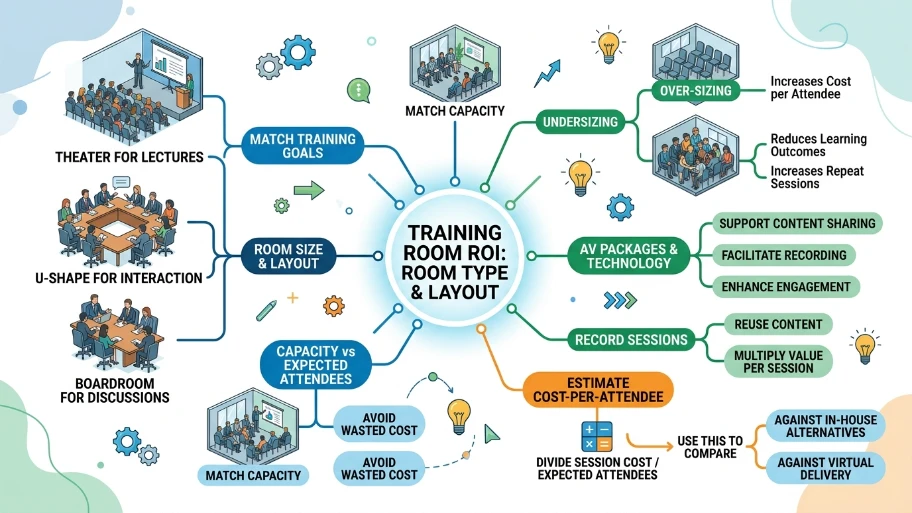
Select room size and layout to match training goals: theatre for lectures, U-shape for interaction, boardroom for discussions; match capacity to expected attendees to avoid wasted cost.
Over-sizing increases cost per attendee. Undersizing reduces learning outcomes and increases repeat sessions. Choose AV packages that support content sharing, recording, and participant engagement. Record sessions for reuse to multiply the value per session.
Estimate cost-per-attendee by dividing the session cost by the expected attendees. Use this to compare against in-house alternatives and virtual delivery.
When should you choose subscription plans over ad-hoc bookings?
Choose subscription plans when weekly sessions exceed four per month or when predictable monthly usage reduces average hourly cost by more than 20%.
Subscriptions offer lower per-hour rates and include credits or support. Ad-hoc suits irregular needs or one-off events. Calculate the break-even point by comparing the monthly subscription fee to the sum of expected ad-hoc bookings at standard rates.
Factor in cancellation flexibility and peak-hour pricing when comparing options.
How do you include technical support and equipment in the ROI model?
Add technician hourly rates, equipment rental fees, and internet upgrade charges to total costs; value benefits as reduced downtime and improved session quality.
Record tech-support invoices and incident logs showing minutes lost before and after using professional support. Convert reduced downtime to wage savings and avoided rescheduling costs. Include hardware rental for projectors, conferencing kits, and hybrid-audio systems.
Capture improved outcomes by comparing session completion rates and fewer rescheduled trainings.
What process helps you present ROI to stakeholders?
Produce a one-page ROI summary with assumptions, monthly cash flows, KPI deltas, and a 12-month projected ROI percentage.
Include clear assumptions: meeting frequency, average attendees, conversion uplift percentage, staff hourly rate, and booking fees. Show monthly cost and benefit lines, then cumulative figures. Highlight sensitivity analysis: best, base, and worst cases based on conversion uplift of +1%, +3%, +5%.
Provide a short appendix with raw data and CRM reports for auditability.
Explore our Meeting Rooms guides,
Understanding the Benefits of Flexible Training Spaces for Modern Hybrid Work Teams
10 Creative Ideas for Making Your Next Employee Training Workshop More Engaging
How can Brand Name’s Meeting rooms improve the ROI of rented meeting spaces?
From My Company provides professional Meeting rooms with configurable layouts and full technical support to reduce setup time and improve attendee experience.
Using trained on-site technicians and standardised boardroom layouts reduces downtime. Professional spaces increase perceived credibility during client interviews and training. Record sessions for reuse to create recurring value per booking.
From My Company’s Meeting Rooms include booking flexibility and AV support that convert time savings into billable hours. These features improve conversion rates and reduce repeat-session costs.
Renting professional Meeting rooms delivers measurable ROI when you track conversion uplift, recovered billable hours, travel savings, and reduced rescheduling. Use CRM tags, time studies, and clear cost lines to compute a 12-month ROI. From My Company’s Meeting Rooms, reduce setup friction and provide AV support that increases conversion and efficiency.
Frequently Asked Questions
What are Meeting rooms used for in a business setting?
Meeting Rooms are dedicated spaces designed for staff development, workshops, and structured learning sessions. From My company offers professional Training Rooms equipped with AV support and flexible layouts suitable for induction programmes, compliance training, and client education sessions.
How do I know if I need to rent Meeting rooms instead of using office space?
Renting Meeting Rooms becomes cost‑effective when internal space is limited, setup is time‑consuming, or you need specialist AV and layout support. From My company’s Meeting Rooms, reduce setup overhead and provide a neutral, professional environment ideal for larger groups and external attendees.
What features should I look for in a professional Meeting room?
Look for adjustable seating layouts, reliable Wi‑Fi, integrated AV equipment, and sound‑treated spaces to support interactive learning. From My company’s Meeting Rooms include configurable furniture, video conferencing facilities, and on‑site technical support to maintain smooth delivery.
Are Meeting rooms suitable for client workshops and onboarding sessions?
Yes, meeting rooms provide a focused, distraction‑free environment ideal for client workshops, onboarding, and group training. From My company’s Meeting Rooms are designed to support mixed‑mode delivery, including in‑person and hybrid participants, with layout and tech tuned for engagement.
How can renting Meeting rooms improve productivity and ROI for my team?
Renting Meeting Rooms reduces internal disruption, slashes room‑setup time, and improves attendance and engagement during sessions. From My company’s Meeting Rooms, help teams run structured programmes efficiently, turning training hours into measurable capability uplift and project outcomes.