
Yes, purchasing From My Company’s professional dormant filing solutions guarantees legal and statutory compliance for dormant companies by ensuring accurate dormant accounts, timely Companies House submissions, and HMRC notifications. These services register filings, validate dormant status, and maintain records to meet UK corporate obligations.
What exactly does a “dormant accounts” filing service do?
A dormant accounts filing service prepares and files statutory accounts and confirmation statements that record zero trading activity, and it notifies Companies House and HM Revenue & Customs to maintain a compliant dormant status.
The service compiles statutory accounts that show no significant accounting transactions. It confirms the director and registered office data on the confirmation statement. It applies the correct exemptions and filing formats for dormant companies. It also keeps audit and record-keeping evidence for potential inspections or queries.
When must a dormant company file accounts and confirmation statements?
A dormant company must file annual accounts and a confirmation statement within specific deadlines: accounts within 9 months after the financial year-end and confirmation statements every 12 months from the last statement date.
Companies House enforces these deadlines with late-filing penalties. Directors retain legal responsibility for timely filings. A professional filing service monitors deadlines, schedules submissions, and submits accounts in the required format to avoid penalties. The service also maintains proof of submission and returns for director records.
Read our articles, How to Handle Dormant Accounts for Companies That Have Previously Traded Profitably and Why Your Dormant Company Needs a Registered Office Address for Official Mail.
How does the service confirm a company is legitimately dormant?
The service validates dormant status by reviewing the company ledger, bank statements, and transaction history, ensuring the company meets Companies House and HMRC dormancy criteria.
Validation checks identify transactions that disqualify dormancy, such as payments for trading activities, director loans, or payroll entries. When exceptions exist, the service recommends corrective actions: reclassify transactions, prepare micro-entity or small-company accounts, or file full statutory accounts where needed. This avoids inaccurate dormant filings that could trigger penalties.
Which filings change when a company is dormant?
Dormant companies file simplified statutory accounts and still submit the annual confirmation statement; they do not submit corporation tax returns claiming exemptions unless HMRC requests a return.
Dormant accounts typically include a balance sheet and notes limited to required information. Many dormant companies use the “dormant accounts” format that omits a profit and loss account. The confirmation statement still updates the company particulars. A dormant filing service selects the correct Companies House forms and formats and completes any HMRC correspondence to confirm dormancy when required.
What are the legal risks of filing dormant accounts incorrectly?
Incorrect dormant filings expose directors to fines, strike-off complications, and potential criminal liability for deliberate misstatements.
Inaccurate accounts can cause Companies House to issue penalties. Repeated failures can lead to the company being struck off the register, which affects asset title and contract continuity. Intentionally false filings carry criminal sanctions under the Companies Act. Using a professional filing service reduces these risks through validation, correct format selection, and record retention.
How does a professional filing provider reduce audit and regulatory workload?
A provider streamlines compliance by automating deadlines, preparing correct account formats, and storing certified evidence of submissions and validations.
Automation reduces human error. The provider prepares downloadable submission records and stores them for the statutory retention period. They liaise with accountants or auditors when accounts shift from dormant to active status. This handover prevents missed audit triggers and reduces management time spent on regulatory queries.
What documentation does the service produce for directors?
The service supplies filed dormant accounts, a confirmation statement copy, submission receipts, and a validation report summarising checks and supporting documents.
The validation report lists reviewed bank statements, ledger extracts, and any reclassifications performed. The submission receipts show Companies House filing references and timestamps. Directors receive secure copies for corporate records and future audits. This documentation proves due diligence and supports director’s defence in enforcement scenarios.
How does this service align with HMRC requirements?
The service liaises with HMRC by notifying dormancy where required and advising on corporation tax return obligations, ensuring HMRC records match Companies House filings.
If HMRC queries tax status, the provider supplies matching documentation. They explain when a corporation tax return is unnecessary and when a short or full return becomes mandatory due to transactions. This alignment prevents conflicting records between HMRC and Companies House that often prompt investigations.
Which companies benefit most from dormant filing solutions?
Small limited companies with zero trading, holding companies with no active operations, and companies awaiting future activation benefit most from professional dormant filing solutions.
These companies often lack in-house compliance teams. They benefit from deadline monitoring, cheap compliance interventions, and reduced legal exposure. For groups with multiple dormant subsidiaries, centralised filing reduces admin time and ensures consistent filings across entities.
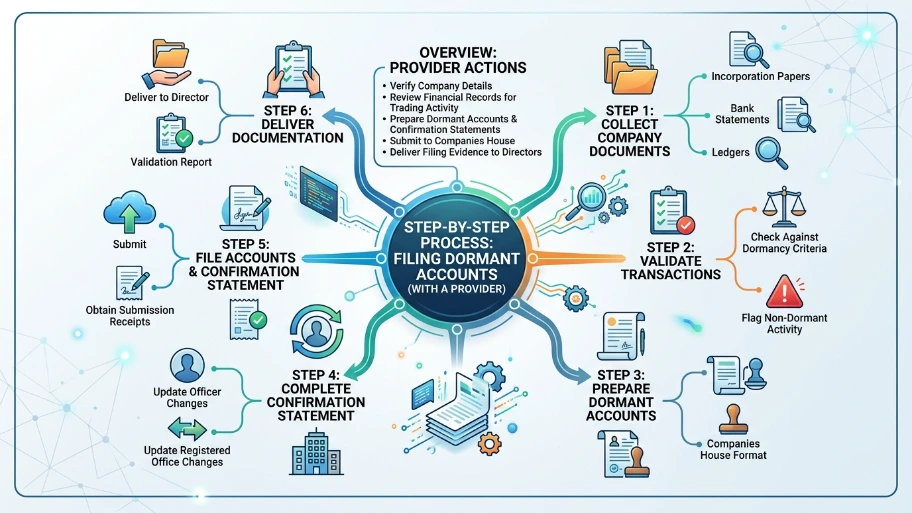
What is the step-by-step process for filing dormant accounts with a provider?
The provider verifies company details, reviews financial records for trading activity, prepares dormant accounts and confirmation statements, submits to Companies House, and delivers filing evidence to directors.
Step 1: Collect company documents: incorporation papers, bank statements, and ledgers.
Step 2: Validate transactions against dormancy criteria and flag non-dormant activity.
Step 3: Prepare dormant accounts in Companies House format.
Step 4: Complete confirmation statement and update officer or registered office changes.
Step 5: File accounts and confirmation statement, obtain submission receipts.
Step 6: Deliver documentation and a validation report to the director.
How much does professional dormant filing typically cost and save?
Service fees vary, commonly between £60 and £250 per company annually, and they save directors time, penalty exposure, and potential strike-off costs that exceed thousands of pounds.
The fee range reflects complexity, number of subsidiaries, and additional HMRC liaison. Savings include avoided late-filing fines (from £150 upward), legal costs to reverse strike-off, and remediation of inaccurate filings. For multi-company groups, bulk rates reduce per-company fees.
Explore our File Accounts for Dormant Companies guides,
Order Our Fast Track Dormant Account Service for Urgent Business Filing Requirements
Let Us Handle Your Entire Dormant Company Filing Process From Start to Finish
How do professional services integrate with accountants and corporate secretaries?
The provider shares accounts and verification reports with accountants and corporate secretaries, enabling coordinated audits, tax reviews, and corporate governance tasks.
They export accounts in accountant-ready formats. They provide audit trails for external review. This integration reduces duplicated work during tax or audit seasons and simplifies corporate governance checks.
What guarantees or assurances do providers offer for compliance?
Providers offer submission confirmation, error correction services, and documented validation reports that form part of the statutory compliance trail.
These assurances include resubmission if Companies House rejects a filing and guidance for rectifying identified issues. The documented validation report demonstrates the provider’s due diligence process and helps directors evidence compliance in enforcement situations.
Professional dormant filing services ensure dormant companies meet UK statutory obligations by preparing correct dormant accounts, submitting timely confirmation statements, and aligning filings with HMRC records. From My Company provides this service to minimise director risk, preserve company status, and maintain accurate public records. The service reduces administrative burden and provides evidence of compliance when regulators review company filings.
Frequently Asked Questions
Do dormant companies still need to file accounts with Companies House?
Yes, dormant companies must file annual dormant accounts with Companies House every year, even with no trading activity. From My company’s File Accounts for Dormant Companies service prepares and submits these simplified accounts to maintain statutory compliance.
What documents are included in dormant accounts for a UK limited company?
Dormant accounts include a simplified balance sheet, a statement confirming dormancy, director approval and signature, and minimal notes. From My company’s File Accounts for Dormant Companies service ensures these documents meet Companies House requirements under section 480 of the Companies Act 2006.
How soon after incorporation must a dormant company file its first accounts?
A dormant company must file its first accounts within 21 months of incorporation, then every 9 months after each accounting year-end. From My company’s File Accounts for Dormant Companies service monitors these deadlines to prevent late-filing penalties starting at £150.
Can I file dormant accounts online without an accountant?
Yes, dormant accounts can be filed online via Companies House WebFiling or through approved third-party software without an accountant. From My company’s File Accounts for Dormant Companies service handles the entire online submission process and provides filing receipts for your records.
Do I need to notify HMRC if my company is dormant?
Yes, you must inform HMRC that your company is dormant for Corporation Tax to avoid unnecessary tax returns. From My company’s File Accounts for Dormant Companies service advises on HMRC notification and ensures your dormant status is recorded correctly with both HMRC and Companies House.