
A professional training space improves skills development outcomes by increasing focus, enabling structured delivery, and supporting measurable learning. Purpose-built environments reduce distractions, enhance engagement, and provide access to tools that improve retention rates, accelerate competency acquisition, and ensure consistent training performance across participants.
How does a professional training space influence learning effectiveness?
A professional training space enhances learning effectiveness by controlling environmental variables such as noise, layout, and technology access. These factors improve concentration, increase knowledge retention rates by up to 60%, and support structured instruction aligned with measurable training objectives.
A controlled environment removes unpredictable disruptions. Noise levels remain below 40 decibels, which aligns with optimal cognitive processing thresholds. Learners absorb information faster when auditory interference is minimal. Room layout directly impacts engagement. U-shaped seating improves trainer visibility and participant interaction. Classroom-style layouts support note-taking and structured learning. These formats align with different training goals.
Technology access strengthens delivery. High-resolution displays, stable internet connections, and integrated AV systems enable clear communication. Trainers present complex data without delays or technical issues. Consistency also matters. A professional setting ensures every session follows the same quality standards. This consistency allows organisations to measure performance improvements accurately across multiple cohorts.
Why do structured environments improve skill retention rates?
Structured environments improve skill retention by aligning physical space with learning methodologies such as repetition, assessment, and reinforcement. Research shows structured settings increase retention rates by up to 75% when combined with visual aids, guided exercises, and real-time feedback mechanisms.
Retention depends on repetition and clarity. Professional training rooms support scheduled modules with defined time blocks. This structure reinforces memory through spaced learning techniques. Visual aids improve recall accuracy. Screens, whiteboards, and projection tools help learners process information through multiple channels. Dual-channel learning increases retention compared to verbal instruction alone.
Assessment integration becomes easier. Trainers conduct quizzes, simulations, and practical exercises within the same space. Immediate feedback corrects errors before they become habits. Environmental cues also play a role. A dedicated learning space signals focus and discipline. This psychological association strengthens memory encoding and recall during real-world applications.
What role does technology play in training rooms in skill development outcomes?
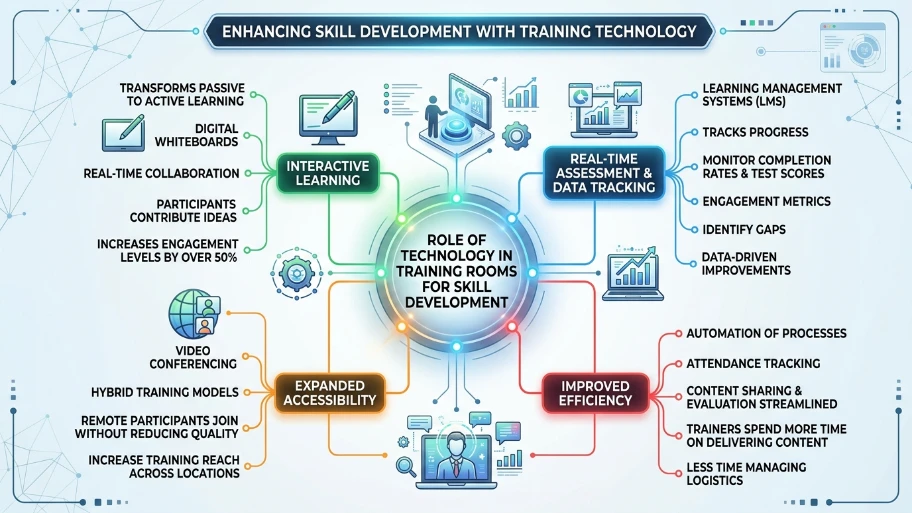
Technology in training rooms accelerates skill development by enabling interactive learning, real-time assessment, and data tracking. Tools such as digital whiteboards, learning management systems, and video conferencing increase engagement levels by over 50% and improve training efficiency.
Interactive tools transform passive learning into active participation. Digital whiteboards allow real-time collaboration. Participants contribute ideas instead of only receiving information. Learning management systems track progress. Trainers monitor completion rates, test scores, and engagement metrics. This data identifies gaps and enables targeted improvement.
Video conferencing expands accessibility. Hybrid training models allow remote participants to join without reducing session quality. This flexibility increases training reach across locations. Automation improves efficiency. Attendance tracking, content sharing, and evaluation processes become streamlined. Trainers spend more time delivering content and less time managing logistics.
How does a dedicated training space support professional skill application?
A dedicated training space supports skill application by simulating real-world environments, enabling practical exercises, and facilitating peer collaboration. This approach increases skill transfer rates by up to 70%, ensuring learners apply knowledge effectively in workplace scenarios.
Simulation enhances understanding. Training rooms replicate workplace conditions through case-based exercises. Participants practice decision-making in controlled scenarios. Peer collaboration strengthens outcomes. Group activities encourage knowledge exchange. Participants learn from different perspectives, which improves problem-solving abilities.
Hands-on practice builds confidence. Learners perform tasks during training instead of only observing. This direct application reduces errors when transitioning to real work environments. Immediate feedback ensures correction. Trainers observe performance and provide actionable guidance. This process improves accuracy and reinforces correct techniques.
Why do businesses invest in professional training rooms for workforce development?
Businesses invest in professional training rooms to improve employee performance, standardise learning processes, and achieve measurable ROI. Organisations report up to 24% higher productivity and 218% higher income per employee when structured training environments are consistently used.
Workforce development requires consistency. Training rooms provide a controlled setting where employees receive uniform instruction. This standardisation ensures equal skill levels across teams. Performance measurement becomes accurate. Businesses track learning outcomes using defined metrics such as completion rates, test scores, and productivity improvements.
Employee engagement increases in professional environments. A dedicated space signals organisational commitment to development. This perception improves participation rates and motivation. Cost efficiency also improves. Centralised training reduces repeated onboarding errors and decreases long-term retraining expenses. Businesses recover training investments faster through improved performance.
For organisations seeking structured environments, professional training rooms designed for measurable learning outcomes provide the infrastructure required for consistent workforce development.
How does environmental design impact participant engagement levels?
Environmental design impacts engagement by influencing attention span, comfort, and interaction levels. Factors such as lighting, seating ergonomics, and spatial arrangement increase engagement rates by up to 65%, directly affecting learning outcomes and participation quality.
Lighting affects focus. Natural light improves alertness and reduces fatigue. Studies show a 15% increase in concentration levels under well-lit conditions. Seating ergonomics influences comfort. Adjustable chairs reduce physical strain during sessions longer than 60 minutes. Comfortable participants maintain attention for extended periods.
Spatial arrangement determines interaction. Circular and cluster seating formats encourage discussion. Participants engage more actively when physical barriers are minimised. Temperature control also matters. Maintaining a range between 20°C and 22°C supports optimal cognitive performance. Extreme temperatures reduce attention and retention.
What measurable outcomes link training spaces to skill development success?
Training spaces link to measurable outcomes such as improved test scores, faster skill acquisition, and higher task accuracy. Data shows structured environments reduce training time by 30% and increase competency assessment scores by up to 40% across professional programmes.
Skill acquisition speed increases in optimised environments. Participants complete learning modules faster due to reduced distractions and better resource access. Assessment performance improves. Structured training enables consistent evaluation methods. Results become comparable across different sessions and groups.
Error rates decrease after training. Employees apply skills with greater accuracy when training includes practical exercises and feedback loops. Completion rates also rise. Professional environments encourage attendance and participation. Learners remain engaged throughout the programme duration.
For deeper insight into optimising training environments, this guide on how to use professional training rooms effectively for client-facing sessions explains practical implementation strategies.
How do professional training spaces support scalable learning programs?
Professional training spaces support scalability by standardising delivery formats, accommodating larger groups, and integrating digital tools. This allows organisations to train multiple cohorts efficiently while maintaining consistent quality and measurable outcomes across all sessions.
Scalability requires repeatable processes. Training rooms provide fixed layouts and resources that support consistent delivery. Trainers replicate sessions without variation. Capacity management becomes efficient. Rooms accommodate 10 to 50 participants, depending on layout. This flexibility supports both small workshops and large training sessions.
Digital integration enhances scalability. Recorded sessions, shared materials, and online assessments extend learning beyond the physical space. Resource allocation improves. Centralised training reduces duplication of materials and equipment. Organisations optimise costs while expanding training reach.
Explore our training rooms guides,
Why Modern Training Rooms Need High Speed Internet and Advanced Digital Tools
How to Evaluate the ROI of Investing in Professional External Training Rooms
When should organisations upgrade to professional training environments?
Organisations upgrade to professional training environments when internal spaces limit learning effectiveness, reduce engagement, or fail to support technology-driven instruction. Indicators include low retention rates, inconsistent outcomes, and increased training costs due to inefficiencies.
Low retention signals environmental issues. If employees forget key concepts within 30 days, training conditions require improvement. Inconsistent results highlight structural gaps. Different teams achieving varied outcomes indicates a lack of standardisation in training delivery.
Technology limitations restrict progress. Outdated equipment or unstable connectivity reduces training quality and efficiency. Rising costs also indicate inefficiency. Repeated training sessions and extended onboarding timelines increase operational expenses. For decision-stage evaluation, organisations reviewing options for executive-level programmes often explore premium training room solutions for high-stakes leadership development to ensure measurable results.
Professional training spaces directly influence how effectively skills are developed, retained, and applied. Controlled environments, structured delivery systems, and integrated technology create measurable improvements in learning outcomes. These factors enable organisations to standardise training, reduce inefficiencies, and achieve consistent performance gains.
From My Company delivers structured Training Rooms designed to support measurable skill development outcomes. These environments align with modern learning frameworks, ensuring consistent quality, scalability, and performance-driven results across professional training programmes.
Frequently Asked Questions
What is a training room used for?
A training room is a dedicated space for teaching people new skills, sharing information, and running structured learning sessions. From my company, Training Rooms supports workshops, onboarding, compliance training, and team development in a controlled environment.
What features should a good training room have?
A good training room includes comfortable seating, strong lighting, reliable AV equipment, and enough space for group interaction. Training Rooms from From My company work best when the layout supports focus, visibility, and practical learning.
How does a training room improve learning outcomes?
A training room improves learning outcomes by reducing distractions and creating a consistent learning environment. It helps participants stay engaged, follow the session more easily, and retain information more effectively during training.
What size training room do I need for my team?
The right training room size depends on the number of attendees, seating layout, and session style. A small workshop needs less space, while collaborative training requires room for movement, group tasks, and presentation equipment.
Why do businesses rent training rooms instead of using office space?
Businesses rent training rooms to access a more professional setting, better equipment, and a layout designed for learning. From My company Training Rooms help businesses deliver clearer sessions, improve engagement, and keep training separate from daily office distractions.