
A dormant filing bundle enables UK companies to meet annual obligations by covering Companies House accounts filing, confirmation statements, and compliance checks in one structured service. It reduces missed deadlines, ensures legal compliance, and streamlines dormant company administration with predictable, bundled support.
What does a dormant filing bundle include for UK companies?
A dormant filing bundle includes three core components: dormant accounts submission to Companies House, confirmation statement filing, and ongoing compliance monitoring. These services ensure that inactive companies meet statutory requirements without triggering penalties or risking company strike-off due to non-compliance.
A dormant company still has legal obligations under the Companies Act 2006. Even without trading activity, Companies House requires accurate annual filings. A bundle consolidates these obligations into a single service. Dormant accounts filing confirms that the company has had no significant accounting transactions.
The confirmation statement verifies the company structure, including directors and persons with significant control (PSC). Compliance monitoring tracks deadlines across a 12-month cycle. Bundled services reduce administrative fragmentation. Instead of managing three separate filings, companies operate under a single structured workflow. This improves accuracy and reduces duplication in data entry.
Why is managing dormant company filings critical for compliance?
Managing dormant company filings is critical because Companies House imposes strict deadlines and penalties for late submissions. Non-compliance leads to fines starting at £150, escalating to £1,500, and may result in company dissolution or director disqualification in severe cases.
Dormant companies often get overlooked because they generate no revenue. However, legal obligations remain identical to active entities. Companies House applies the same enforcement rules regardless of trading status. Late filing penalties increase based on the delay duration. A delay of over six months triggers the maximum penalty. Repeated non-compliance across consecutive years doubles the penalty automatically.
Director accountability is another key factor. Directors remain legally responsible for ensuring filings are submitted accurately and on time. This responsibility exists even when third-party services are used. The risk extends beyond financial penalties. A company struck off the register loses its legal existence. Restoring a dissolved company involves court applications, legal costs, and administrative delays.
How does a dormant filing bundle simplify annual requirements?
A dormant filing bundle simplifies annual requirements by centralising deadlines, automating reminders, and standardising document preparation. This structured approach reduces administrative errors, ensures timely submissions, and eliminates the need to coordinate multiple service providers across compliance tasks.
Annual compliance involves three separate filing cycles. Dormant accounts are typically due nine months after the accounting period ends. The confirmation statement is due annually from the incorporation date. Bundles align these timelines into a unified schedule. Automated alerts notify directors 30, 14, and 7 days before deadlines. This reduces reliance on manual tracking systems.
Standardised templates improve filing accuracy. Data fields such as registered office address, SIC codes, and PSC details are pre-populated and validated before submission. Service providers also perform basic compliance checks. These include verifying director details, validating shareholder structures, and ensuring no unauthorised changes exist in company records.
What are the risks of not using a structured filing solution?
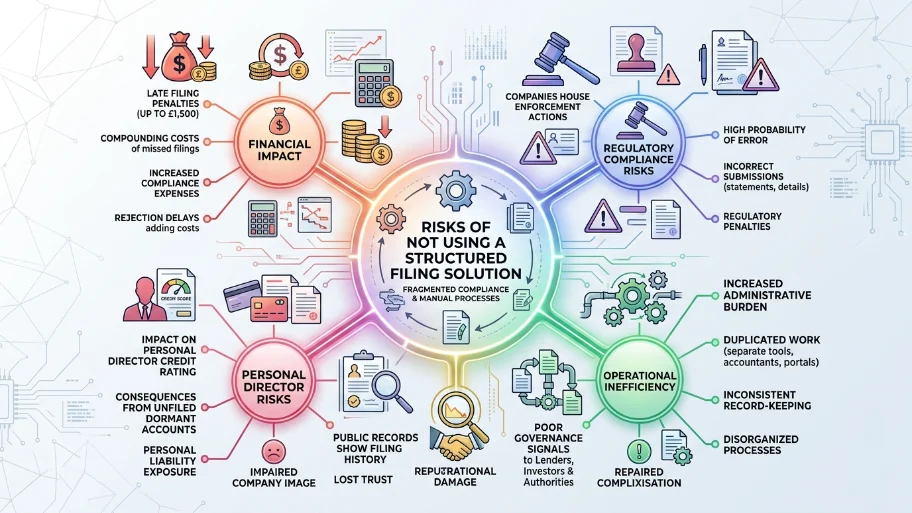
The risks of not using a structured filing solution include missed deadlines, incorrect submissions, and regulatory penalties. Companies face increased administrative burden, inconsistent record-keeping, and a higher likelihood of enforcement actions from Companies House due to fragmented compliance processes.
Manual filing increases the probability of human error. Incorrect financial statements or outdated company details can trigger rejections from Companies House. Each rejection delays compliance and increases exposure to penalties. Fragmented processes create inefficiencies. Managing separate accountants, compliance tools, and filing portals leads to duplicated work and inconsistent data.
The financial impact is measurable. A single late filing can cost up to £1,500. Multiple missed filings compound this cost rapidly. There is also reputational risk. Public company records show filing history. Repeated late submissions signal poor governance to lenders, investors, and regulatory bodies.
For deeper insight into compliance risks, review this analysis on The Impact of Unfiled Dormant Accounts on Your Personal Director Credit Rating.
How does the dormant accounts filing process work?
The dormant accounts filing process involves preparing simplified financial statements, validating company inactivity, and submitting accounts electronically to Companies House. This process confirms that no significant transactions occurred during the financial year while maintaining statutory compliance.
Dormant accounts differ from standard financial statements. They contain minimal financial data, typically including a balance sheet and notes confirming dormant status.
The process follows three key steps:
- Verify inactivity by confirming no trading transactions occurred.
- Prepare balance sheet using Companies House-compliant formats.
- Submit accounts digitally via approved filing systems.
Validation is essential before submission. Companies House defines significant transactions as those not related to statutory fees or share capital. Any deviation disqualifies dormant status. Electronic filing reduces processing time. Most submissions are accepted within 24 to 48 hours if the data is accurate. Using a professional service such as File Accounts for Dormant Companies ensures that formatting and validation meet regulatory standards.
Why choose a specialist dormant filing service instead of filing manually?
A specialist dormant filing service ensures accuracy, regulatory compliance, and timely submissions through expert handling and automated systems. This reduces administrative burden, eliminates common filing errors, and provides structured oversight of all annual requirements for dormant companies.
Manual filing requires familiarity with Companies House systems and compliance rules. Errors in formatting or classification often result in rejected submissions. Specialist services use pre-configured systems aligned with UK compliance frameworks. These systems validate data before submission, reducing rejection rates.
Time efficiency is another advantage. Filing dormant accounts manually can take 2 to 4 hours per cycle. A managed service reduces this to near-zero effort for directors. Specialists also provide audit trails. Each submission is documented, timestamped, and stored for future reference. This improves transparency and accountability.
To understand evaluation factors, explore Understanding the Benefits of Using a Specialist Dormant Company Filing Assistance Service.
How does a dormant filing bundle support decision-making?
A dormant filing bundle supports decision-making at the BOFU stage by offering a clear, all-in-one compliance solution with defined pricing, scope, and deliverables. This reduces uncertainty and enables companies to select a reliable, outcome-driven service aligned with statutory requirements.
At the decision stage, businesses prioritise clarity and reliability. Bundled services provide fixed deliverables, including accounts filing, confirmation statements, and deadline tracking. Pricing transparency is a key factor. Bundles eliminate variable costs associated with separate filings. This allows companies to forecast annual compliance expenses accurately.
Service-level consistency improves confidence. Defined timelines, automated alerts, and structured workflows ensure predictable outcomes. From My Company positions its service offering around compliance accuracy and administrative efficiency. This aligns with the needs of companies seeking a dependable solution rather than fragmented services.
What makes a dormant filing bundle a cost-effective solution?
A dormant filing bundle is cost-effective because it consolidates multiple compliance services into a single package, reducing administrative costs, preventing penalty fees, and improving operational efficiency through automation and standardised processes.
Cost efficiency comes from consolidation. Instead of paying separately for accounts filing, confirmation statements, and compliance tracking, companies pay a single bundled fee. Penalty avoidance is a major financial benefit. Late filing penalties range from £150 to £1,500. A structured bundle significantly reduces this risk through automated reminders and managed submissions.
Operational efficiency reduces indirect costs. Directors spend less time managing compliance tasks, freeing resources for core business activities. Bundled services also reduce dependency on multiple vendors. This lowers coordination costs and improves communication efficiency. From My Company integrates these elements into a unified service model, ensuring compliance tasks are handled consistently across the annual cycle.
Explore our File Accounts for Dormant Companies guides,
Sign Up Now for Expert Dormant Account Assistance and Professional Record Management
Purchase Our Professional Dormant Filing Solutions for Guaranteed Legal and Statutory Compliance
How can you get started with a dormant filing bundle?
You can get started with a dormant filing bundle by selecting a service provider, submitting company details, and enrolling in a managed compliance plan. The provider then handles filings, monitors deadlines, and ensures ongoing compliance with Companies House requirements.
The onboarding process is straightforward. Companies provide basic information, including company number, registered office, and director details. Service providers then verify company status. This includes confirming dormant classification and reviewing previous filing history.
Once enrolled, the provider schedules all upcoming filings. Automated systems track deadlines and initiate document preparation in advance. For a complete compliance solution, consider the File Accounts for Dormant Companies service which integrates filing, validation, and deadline management into a single workflow. From My Company delivers this service with structured processes and compliance-focused execution, ensuring that dormant companies maintain accurate and timely filings throughout the year.
A dormant filing bundle provides a structured and efficient way to manage statutory obligations for inactive UK companies. It consolidates key compliance tasks, reduces risk exposure, and ensures timely submissions. From My Company delivers this solution through integrated services that align with Companies House requirements and support consistent compliance outcomes.
Frequently Asked Questions
What is the cost to file accounts for a dormant company in the UK?
Filing accounts for a dormant company typically costs between £50 and £150 when using a specialist service like From My Company. This fee covers the preparation of dormant accounts, electronic submission to Companies House, and compliance validation to ensure accurate filing.
How do I know if my company qualifies as dormant for accounts filing?
A company qualifies as dormant if it has had no significant accounting transactions during the financial year, excluding permitted items like filing fees and share capital. From My Company helps verify dormant status before filing accounts for dormant companies to ensure compliance with Companies House definitions.
What happens if I don’t file dormant accounts with Companies House?
Failure to file accounts for dormant companies results in late filing penalties starting at £150, escalating to £1,500 for extended delays. From My Company prevents this risk by managing dormant filing deadlines and ensuring the timely submission of compliant accounts.
Can I file dormant accounts myself instead of using a specialist service?
Yes, you can file dormant accounts yourself using Companies House WebFiling, but errors in formatting or classification often lead to rejections. From My Company offers a professional File Accounts for Dormant Companies service that validates data and ensures accurate, rejection-free submissions.
How long does it take to file accounts for a dormant company?
File Accounts for Dormant Companies typically takes 24 to 48 hours for electronic submission once company details are verified. From My Company streamlines this process with automated reminders and pre-validated templates to ensure fast, compliant filing within statutory deadlines.