

Engaging a professional firm lets you file overdue dormant-company accounts quickly by assessing missing filings, preparing overdue accounts, submitting them to Companies House, and handling HMRC notifications to stop penalties.
What immediate steps resolve past-due dormant account filings?
Contact a specialist who will assess outstanding filing dates, compile accounts, and submit late dormant accounts to Companies House with the correct format and dates.
A specialist first reviews the company’s filing history and Companies House records. They identify the exact periods with missing accounts and confirm dormant status. They then gather required records, prepare abbreviated or micro-entity accounts where allowed, and submit the documents electronically or by post. The process reduces filing errors that trigger further delays.
How fast can professionals file overdue dormant accounts?
A professional can often prepare and submit overdue dormant accounts within 5–15 business days, depending on document availability and the number of missing periods.
Timescale varies by complexity. If a company has one missed year and directors provide bank statements and minutes within two days, firms typically finish preparation in under a week. If multiple years lack documentation or if statutory declarations are required, the timeline extends. Electronic submissions shorten Companies House processing times compared with postal filings.
What documents prove a company was dormant for past periods?
Provide bank statements showing no business transactions, director minutes confirming inactivity, and any invoices or correspondence proving zero trading.
Companies House accepts financial statements demonstrating no accounting transactions. Bank statements must show only routine entries (e.g., interest) without trading receipts. Directors’ minutes should record the decision to keep the company dormant. Accountants often request a simple confirmation letter from directors to authenticate the dormancy claim.
Read our articles, Why Accurate Record Keeping is Crucial Even for Companies with Zero Turnover and Get Professional Help with Your Dormant Company Accounts and Avoid HMRC Fines.
Can you file abbreviated accounts for dormant companies?
Yes. Dormant companies file accounts that show a balance sheet and minimal notes; small or micro-entity formats apply where thresholds fit.
Dormant accounts omit profit and loss accounts because no trading occurred. Micro-entity accounts require an abbreviated balance sheet, directors’ report (short), and specific notes. For companies qualifying as micro-entities, this format reduces preparation time and paperwork. Professionals choose the correct format to ensure compliance with Companies House rules.
Will late filing trigger penalties or enforcement?
Companies House may impose late filing penalties; professionals minimise further action by filing quickly and correcting errors with explanatory notes when necessary.
Late filing fines follow a statutory scale based on delay length. Professionals prepare accounts accurately and add explanatory statements where appropriate to reduce the risk of additional scrutiny. If Companies House issues strike-off action or prosecution threats, advisers manage responses and negotiate timelines with regulators.
How does HMRC factor into dormant account filings?
HMRC requires confirmation of dormant status for corporation tax; professionals notify HMRC and file any necessary returns to prevent penalties.
Dormant companies still must inform HMRC that they are not trading. Accountants send a formal notification and, if a tax return was required previously, file a ‘nil’ return or follow HMRC closed-company procedures. Prompt communication prevents HMRC penalty assessments and clarifies the company’s tax position.
What compliance checks do professionals perform before filing?
They verify director details, confirm registered office accuracy, reconcile bank records, and ensure statutory registers are up to date.
Professionals validate director identities against Companies House records and confirm the registered office address. They reconcile bank statements with internal records and ensure the register of members and PSC register reflect current facts. These checks reduce rejection risk and ensure filings match Companies House expectations.
How much does professional help typically cost?
Fees range from £75 to £400 per missed year, depending on complexity, with bundled pricing for multiple years and expedited services at higher rates.
Simple overdue dormant accounts with available documentation sit at the lower end. Multiple missed years, required statutory declarations, or resolution of director disputes raise fees. Ask firms for a fixed-fee quote that lists deliverables, submission method, and estimated timeline.
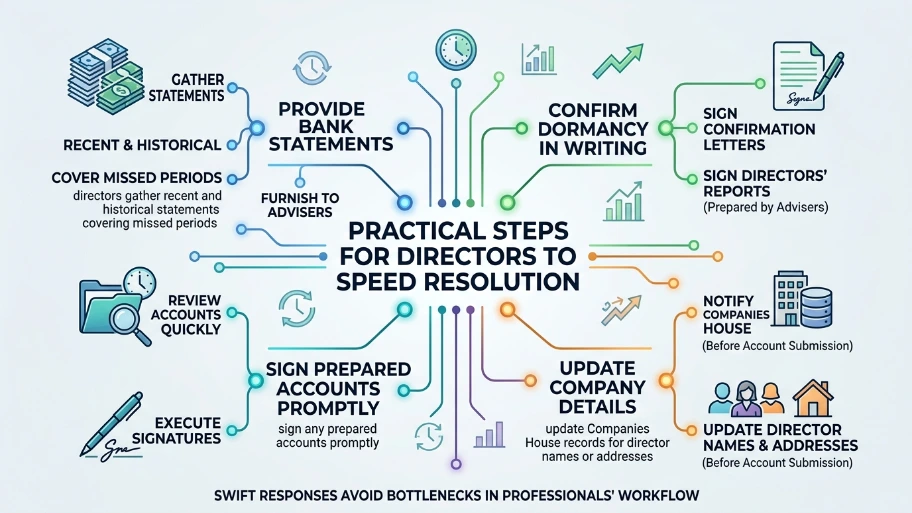
What are the practical steps for directors to speed resolution?
Provide bank statements, confirm dormancy in writing, update the director and address details, and sign any prepared accounts promptly.
Directors should gather recent and historical bank statements covering the missed periods. They must sign confirmation letters and directors’ reports prepared by the adviser. Update Companies House records for director names or addresses before account submission. Swift responses avoid bottlenecks in the professional’s workflow.
How do professionals handle multiple missed filing years?
They audit each missed year, prepare accounts for each period using consistent accounting dates, and submit filings sequentially or bundled where Companies House allows.
When gaps exist across several years, advisers reconstruct financial positions for each statutory period. They maintain consistent accounting reference dates and prepare separate accounts for each year. Where permitted, they submit filings together to present a clear compliance remediation trail.
What risks remain after professionals file dormant accounts?
The main risks are existing late-filing penalties and potential historical compliance issues that require correction or disclosure.
Filing resolves the current non-submission but does not erase accrued penalties. Directors might face fee assessments for past delays. If filings reveal previously unreported transactions or director conflicts, further remediation may be necessary. Professionals flag such risks early and propose corrective actions.
When is it necessary to change accounting reference dates?
Change the accounting reference date only if it simplifies reconstruction of accounts or aligns future reporting; professionals advise and file the change with Companies House.
Altering the accounting reference date shifts the statutory year-end. Professionals recommend it when it reduces the number of missing periods or aligns reporting with a parent company. They submit a Companies House form to record the new date and prepare prorated accounts if required.
How does using a specialist affect a director’s duties and liabilities?
Professionals prepare and file documents, but directors retain statutory responsibilities and personal liability for deliberate non-compliance.
Advisers act on directors’ instructions and certify documents where allowed. Directors must approve accounts and confirm information. A professional cannot absolve directors of legal duties. Timely engagement reduces exposure to enforcement but does not change statutory obligations.
Explore our File Accounts for Dormant Companies guides,
Understanding the Benefits of Using a Specialist Dormant Company Filing Assistance Service
Why Professional Filing Services Give You Peace of Mind Regarding Legal Deadlines
How does Brand Name’s service streamline this process?
File Accounts for Dormant Companies provides a structured review, preparation, and filing workflow that handles overdue submissions and HMRC notifications efficiently.
From My Company’s audit filing history, compile missing accounts, and submit the required documents to Companies House. The service also handles director confirmations and HMRC notifications. This approach shortens resolution time and centralises communication with regulators.
Professional help speeds resolution of past-due dormant account filings by accurately reconstructing records, preparing the correct accounts format, and submitting documents to Companies House and HMRC. Directors must supply bank records and approvals. From My Company delivers a compliant, outcome-driven process to restore filing status and limit further penalties.
Frequently Asked Questions
How long does it take From My Company to file accounts for dormant companies?
From My Company typically prepares and submits dormant-company accounts within 5–15 business days after receiving the required documents. Timelines depend on the number of missed periods and the completeness of bank statements and director confirmations.
What documents does From My Company need to file accounts for dormant companies?
Provide bank statements showing no trading, signed director confirmation of dormancy, and any company minutes relating to inactivity. From My Company uses these records to prepare micro-entity or dormant accounts compliant with Companies House rules.
Will filing dormant accounts with From My Company stop Companies House penalties?
Filing overdue dormant accounts removes the cause of further late-filing penalties but does not automatically cancel existing fines. From My Company files, accurate accounts and submits explanatory notes to Companies House to minimise additional enforcement risk.
Can From My Company notify HMRC that a company is dormant?
Yes. From My Company can notify HMRC that the company is dormant and file any required ‘nil’ corporation tax returns. This clarifies the company’s tax status and reduces the chance of HMRC penalty assessments.
How much does it cost to use From My Company to file accounts for dormant companies?
Fees vary by complexity; expect a range of approximately £75–£400 per missed year, with bundled pricing for multiple periods and expedited options. From My Company provides a fixed-fee quote after reviewing the company’s filing history.