

Residents of East Timor can launch a UK company and run an international business from there. UK company formation firms register the company, appoint directors and a registered office, and enable remote management while the company complies with the UK Companies Act and tax rules.
How can an East Timor entrepreneur legally form a UK company?
An East Timor resident forms a UK company by registering with Companies House, appointing at least one director, providing a UK-registered office, and completing identity and verification checks.
Form My Company assists East Timor residents with company formation, registered office services, and compliance setups to meet UK statutory requirements.
Registering a UK private limited company (Ltd) takes clear steps. First, choose a company name and structure. Next, prepare a Memorandum and Articles of Association. Then, file an application with Companies House and provide a service address for directors. Non-UK residents use formation agents and a UK-registered office to satisfy the address requirement. Formation agents also handle identity verification and file the incorporation documents electronically. After incorporation, the company receives a Certificate of Incorporation and a Companies House number.
What documents and checks are required from East Timor residents?
Directors must present government-issued ID, proof of address, and provide a service address; formation agents perform identity verification and anti-money laundering checks.
Companies House requires accurate director data and PSC (person with significant control) statements. UK law mandates identity checks for anti-money laundering (AML) compliance before formation.
Typical documents include a passport, national ID, and a recent utility bill or bank statement showing the director’s name and address. Three verification methods are common: passport verification, address validation via utility or bank statements, and electronic identity checks. An approved formation agent validates documents and retains proof to comply with AML regulations. Companies must also maintain statutory registers and file confirmation statements annually.
Read our articles, How East Timor Residents Can Set Up a UK Company and Operate Internationally and How East Timor Entrepreneurs Can Start a UK Company for Global Business.
How does tax residency and corporate tax work for a UK company run from East Timor?
A UK-registered company is subject to UK Corporation Tax on UK-source profits and worldwide profits if centrally managed and controlled in the UK.
Tax residency depends on where board decisions occur. If directors manage the company from East Timor, the company may not be UK tax-resident; however, UK-source income remains taxable in the UK.
East Timor residents should separate personal tax residency from the company’s tax status. The company pays UK Corporation Tax on profits arising in the UK. Shareholders and directors must report personal income in their tax jurisdiction. Double taxation treaties affect withholding tax on dividends and interest. East Timor currently has limited tax treaty coverage with the UK, so consult tax advisors for withholding and permanent establishment risk. Maintain clear board minutes and centralised decision records to substantiate where management occurs.
How can an East Timor founder manage a UK company remotely?
Use a UK-registered office, online company secretary services, virtual mail forwarding, and secure remote banking solutions to run operations from East Timor.
Remote management requires robust governance, digital record-keeping, and reliable communication channels. Directors should implement a secure virtual board process and maintain statutory registers electronically.
Key operational steps include appointing a registered office in the UK, subscribing to a company formation and secretarial service, and setting up cloud accounting. Virtual mail services scan and forward statutory mail. Use two-factor authentication and encrypted file storage for company records. For banking, choose banks or fintechs that support non-resident directors and provide international payments. Prepare a clear delegation: appoint a UK-based service provider for filings and a nominated company secretary to handle Companies House and HMRC correspondence.
What are the compliance and reporting obligations after formation?
A UK company must file annual Confirmation Statements, annual accounts with Companies House, and Corporation Tax returns with HMRC; maintain statutory registers and record minutes of meetings.
Failure to file prompts fines and possible strike-off. Compliance tasks include VAT registration if turnover exceeds thresholds and payroll reporting if the company employs staff.
Annual accounts require accounting records and figures for the financial year. Confirmation Statements update shareholder and PSC data every 12 months. If turnover exceeds the VAT threshold — currently £85,000 per 12 months — register for VAT and submit VAT returns. If the company employs staff in any jurisdiction, operate PAYE and files payroll returns. Use formation agents and accounting firms experienced with non-UK resident companies to ensure timely filings and tax registrations.
How do banking and payments work for a UK company owned by East Timor residents?
A UK company can open a UK or international business bank account; banks and fintechs require KYC documents and may request director visits or video ID.
Banks assess risk for non-resident directors. Some UK banks accept remote applications with certified documents. Fintech providers offer faster onboarding but may limit features such as loans.
Prepare certified copies of ID and proof of address, company incorporation documents, and proof of business activity. Consider multi-currency accounts for international trade. Use payment providers to receive card payments and manage cross-border transfers. If banks require in-person verification, schedule visits or use a trusted representative. Maintain transaction records to support VAT and Corporation Tax filings.
What operational steps ensure smooth cross-border commerce?
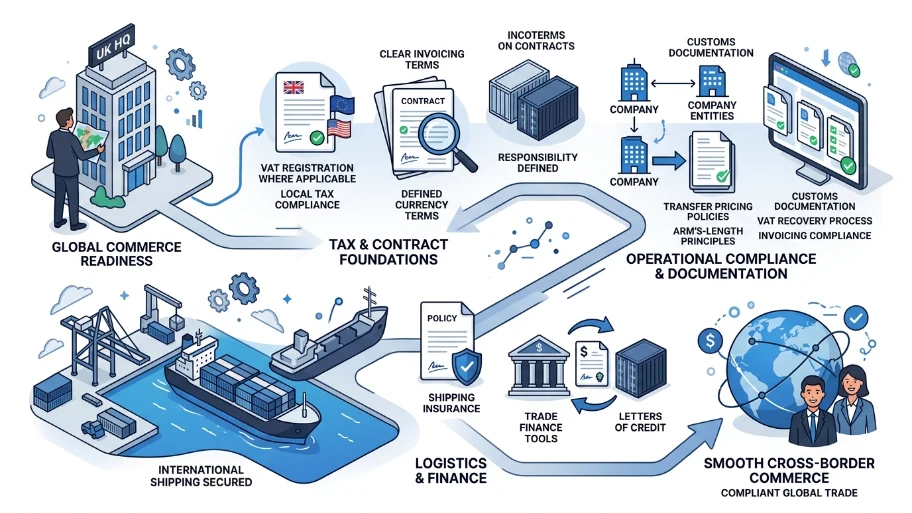
Register for VAT where applicable, set up clear invoicing and contract terms, implement transfer pricing documentation for related-party transactions, and secure international shipping and insurance arrangements.
Cross-border operations require documentation for customs, VAT recovery, and invoicing compliance. Use Incoterms on contracts to define responsibility for shipping, insurance, and duties.
Invoice customers with clear VAT treatment and currency terms. If trading with the EU or other markets, register for local VAT where necessary. For related-party transactions, prepare transfer pricing policies aligned with OECD principles and keep documentation substantiating arm’s-length pricing. Secure logistics partners with experience in international shipping and customs clearance. Use trade finance tools like letters of credit for high-value transactions.
How long does it take, and what are the typical costs?
Formation typically completes in 24–72 hours; total first-year costs range from £200 to £1,500 depending on package level, registered office, and verification fees.
Basic online incorporation is fast and low-cost. Additional services such as a registered office, mail forwarding, nominee directors, or company secretarial services raise costs.
Typical costs: Companies House filing fee around £12 if done online; formation agent packages range from £50 to £400; registered office services run £50–£250 per year; ongoing accounting and tax services often start at £500 per year. Banking fees vary by provider. Obtain a detailed quote from a provider that lists formation, compliance, registered office, and annual service fees.
Explore our Djibouti guide,
Open a UK Company from Djibouti with Full Banking Support – Form My Company
What risks should East Timor residents address when forming a UK company?
Key risks include tax residency disputes, banking onboarding refusals, compliance lapses, and insufficient corporate governance documentation.
Mitigate risks by using expert advisors, documenting board decisions, maintaining up-to-date records, and choosing reputable formation and banking partners.
Tax authorities examine where central management occurs. Keep minutes of board meetings and decision logs to show where control lies. Use AML-compliant service providers to reduce banking rejections. Ensure annual filings occur on time to avoid penalties and strike-off. Obtain professional legal and tax advice to align corporate structure with business objectives.
Forming a UK company from East Timor is practical and widely used for global expansion. The process requires Companies House registration, identity verification, a UK-registered office, and ongoing filings to HMRC and Companies House. From My Company provides tailored packages for East Timor residents, covering formation, registered office provision, compliance support, and post-incorporation services to keep the company statutory-compliant and operational.
Frequently Asked Questions
Can I launch a UK company from East Timor as a non-UK resident?
Yes, you can launch a UK company from East Timor as a non-UK resident. From My Company provides a complete formation package for East Timor residents, including registered office services, director setup, and Companies House incorporation.
What documents are required to form a UK company from East Timor?
You need a government-issued passport or ID, proof of address (utility bill or bank statement), and a UK service address. From My Company handles identity verification and anti-money laundering checks for East Timor applicants.
How long does it take to register a UK company from East Timor?
UK company registration from East Timor typically completes in 24–72 hours after document submission. From My Company processes East Timor applications electronically with Companies House for fast incorporation.
Do I need to live in the UK to own or run a UK company from East Timor?
No, you do not need to live in the UK to own or operate a UK company from East Timor. From My Company sets up non-resident packages for East Timor entrepreneurs with remote management and compliance support.
What tax obligations apply to a UK company owned by an East Timor resident?
A UK company owned by an East Timor resident must file UK Corporation Tax returns and annual accounts with Companies House. Fro My Company guides East Timor clients on UK tax compliance, VAT registration thresholds, and statutory filing requirements.